Table of Contents
Key Takeaway
- 🗣️ The Warning: AI surveillance states could emerge as Anthropic CEO Dario Amodei warned that AI could enable “a global totalitarian dictatorship” through autonomous drone swarms, mass surveillance, and AI-generated propaganda that can brainwash populations.
- 🤖 Autonomous Weapons: Amodei described “a swarm of millions or billions of fully automated armed drones” that could defeat any military and suppress dissent by “following around every citizen.”
- 👁️ AI Surveillance: Powerful AI could “generate a complete list of anyone who disagrees with the government” by analyzing billions of conversations — creating what AI surveillance states would call “a true panopticon on a scale that we don’t see today, even with the CCP.”
- 📢 AI Propaganda: Amodei warned that personalized AI agents could “brainwash many (most?) people into any desired ideology” over months or years — far beyond current concerns about TikTok influence.
- ⚡ The Stakes: Amodei’s essay, published January 2026, argues that “we are considerably closer to real danger in 2026 than we were in 2023” — and that the political pendulum has swung away from AI risk awareness at the worst possible time.
The CEO of Anthropic stood before an audience at the Wall Street Journal and described a future where AI helps autocracies monitor entire populations, deploy autonomous drone swarms against their own citizens, and brainwash people into any ideology through personalized AI agents. Dario Amodei’s warning — delivered in his January 2026 essay “The Adolescence of Technology” and elaborated in WSJ events — is not a hypothetical scenario. It is a description of capabilities that AI models are approaching, in the hands of governments that already lack democratic accountability. The question is not whether AI surveillance states could emerge — they already are emerging. The question is whether democracies will act before AI surveillance states make the question moot.
The essay on AI surveillance states, published on his personal website in January 2026, is the most detailed warning from a sitting AI CEO about the political weaponization of AI. It covers five categories of risk, but his most urgent warnings concern the third: the misuse of AI by powerful actors to seize or maintain political power. According to his essay, AI-enabled autocracies “would not have such limits” as the human moral constraints that currently restrict how repressive governments can be. The technology, Amodei argues, is “uniquely well suited to autocracy and to deepening the repression that we see in autocracies.”
Autonomous Drone Swarms: The Unbeatable Army
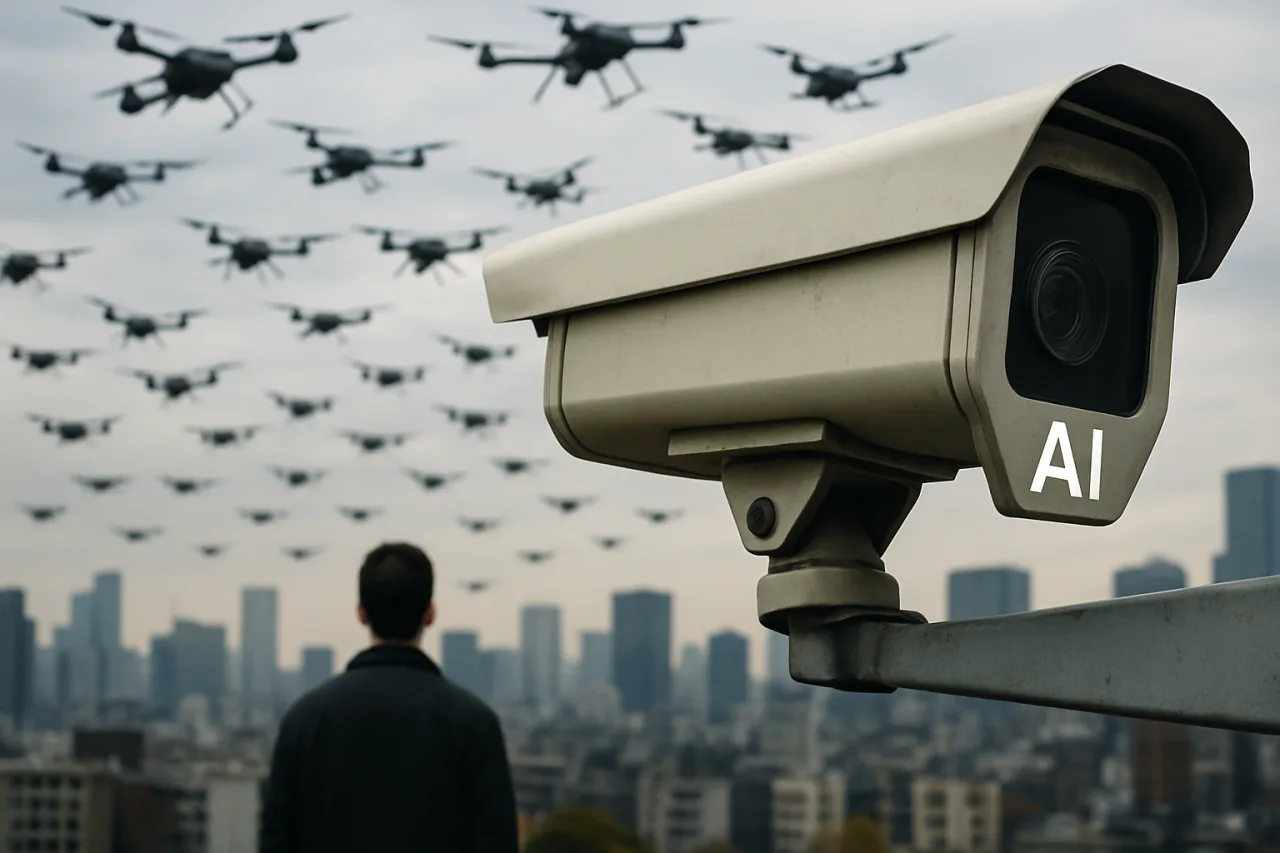
Amodei’s first warning is about fully autonomous weapons. He describes “a swarm of millions or billions of fully automated armed drones, locally controlled by powerful AI and strategically coordinated across the world by an even more powerful AI” that could be “an unbeatable army, capable of both defeating any military in the world and suppressing dissent within a country by following around every citizen.”
He connects this to current reality: “Developments in the Russia-Ukraine War should alert us to the fact that drone warfare is already with us.” The drones used in Ukraine are not yet fully autonomous — they still require human operators — but they demonstrate that the technological foundation exists. AI advancement could make drones “far superior to those of other countries, speed up their manufacture, make them more resistant to electronic attacks, improve their maneuvering.” The gap between current drone warfare and Amodei’s scenario is not a question of whether the technology will arrive — it is a question of when, and who controls it first.
Amodei’s most chilling observation about autonomous weapons is that they are dangerous even in democratic hands: “We should worry about them in the hands of autocracies, but also worry that because they are so powerful, with so little accountability, there is a greatly increased risk of democratic governments turning them against their own people to seize power.” The threat is not only external — it is internal. A technology that can suppress dissent by following every citizen is a technology that can enable a coup.
AI Surveillance: The Complete List of Dissenters
Amodei’s second warning is about how AI surveillance states could monitor populations. He argues that sufficiently powerful AI could “be used to compromise any computer system in the world” and could “read and make sense of all the world’s electronic communications.” The critical distinction from current surveillance is not just the scale — it is the AI’s ability to make sense of the data. Current surveillance states collect vast amounts of data but still rely on humans to interpret it. AI could analyze billions of conversations from millions of people in real time.
“It might be frighteningly plausible to simply generate a complete list of anyone who disagrees with the government on any number of issues, even if such disagreement isn’t explicit in anything they say or do,” Amodei writes. “A powerful AI looking across billions of conversations from millions of people could gauge public sentiment, detect pockets of disloyalty forming, and stamp them out before they grow. This could lead to the imposition of a true panopticon on a scale that we don’t see today, even with the CCP.”
The reference to the Chinese Communist Party is deliberate. Amodei is saying that the most pervasive surveillance state currently operating — China’s — would pale in comparison to an AI surveillance state. The CCP’s current system relies on cameras, social credit scoring, and human monitors. An AI system could do all of this automatically, in real time, across every digital communication, without human limitations of attention, bias, or fatigue. The difference is not incremental — it is categorical.
AI Propaganda: Brainwashing at Population Scale
Perhaps Amodei’s most disturbing warning is about AI propaganda. He argues that today’s phenomena of “AI psychosis” and “AI girlfriends” demonstrate that even current AI models “can have a powerful psychological influence on people.” Much more powerful versions — “that were much more embedded in and aware of people’s daily lives and could model and influence them over months or years” — would likely be capable of “essentially brainwashing many (most?) people into any desired ideology or attitude.”
Amodei explicitly compares this to current concerns about TikTok: “Today people worry a lot about the potential influence of TikTok as CCP propaganda directed at children. I worry about that too, but a personalized AI agent that gets to know someone over months or years, and that can be deployed at the population level by a state that controls AI, would be incomparably more powerful.” The distinction is between algorithmic amplification (what TikTok does — showing you content that influences you) and AI psychological manipulation (what Amodei describes — an AI agent that builds a relationship with you over months, understands your psychology, and shapes your beliefs through that relationship).
The practical implication is that an authoritarian government with access to frontier AI could deploy personalized AI agents — through apps, social media, or seemingly benign services — that build psychological profiles of citizens and gradually shift their beliefs. Unlike traditional propaganda, which is one-to-many and easy to identify, AI propaganda is one-to-one, personalized, and potentially invisible. A citizen being brainwashed by an AI agent might not know they are being manipulated — they might simply feel that their views are evolving naturally.
The Global Totalitarian Scenario
Amodei connects these three risks — autonomous weapons, AI surveillance, and AI propaganda — into a single, alarming possibility. “Countries could also use their advantage in AI to gain power over other countries. If the ‘country of geniuses’ as a whole was simply owned and controlled by a single (human) country’s military apparatus, and other countries did not have equivalent capabilities, it is hard to see how they could defend themselves: they would be outsmarted at every turn, similar to a war between humans and mice.”
He calls this “the alarming possibility of a global totalitarian dictatorship” and says it “should be one of our highest priorities to prevent this outcome.” This is not a prediction — Amodei is careful to acknowledge uncertainty throughout the essay. But it is a scenario that he, as the CEO of one of the world’s most advanced AI companies, considers plausible enough to warn about publicly.
The scenario is structurally different from Cold War-era nuclear threats. Nuclear weapons require massive industrial infrastructure, enriched uranium, and delivery systems that are detectable. AI capabilities, by contrast, are software that can be developed in data centers, deployed through existing internet infrastructure, and scaled to millions of users without any physical signature. The arms control frameworks of the 20th century were designed for physical weapons. AI requires a fundamentally different approach to international security.
The Political Pendulum: Why Nobody Is Listening
Amodei’s most pointed political observation is not about authoritarianism — it is about why democracies are not paying attention. “As of 2025-2026, the pendulum has swung, and AI opportunity, not AI risk, is driving many political decisions. This vacillation is unfortunate, as the technology itself doesn’t care about what is fashionable, and we are considerably closer to real danger in 2026 than we were in 2023.”
This is a direct critique of the current political environment in the United States and other democracies. When AI risk was fashionable in 2023-2024, governments held hearings, published frameworks, and considered regulation. When the political winds shifted toward AI opportunity and competitiveness — particularly the race with China — risk awareness became politically unpopular. Amodei is saying that the technology continued advancing during the period when political attention waned, and the gap between risk and awareness has widened.
This connects directly to the Sacks vs Amodei debate we covered earlier this week. David Sacks calls Amodei’s approach a “DMV for AI” and argues that regulation will handicap the United States. Amodei’s response in “The Adolescence of Technology” is that the absence of regulation is not freedom — it is vulnerability. Without democratic safeguards, the same technology that could cure diseases and lift billions out of poverty could also enable the most oppressive AI surveillance states in human history.
What This Means for Democracies
The warning about AI surveillance states is not a call to stop AI development — he remains fundamentally optimistic about AI’s potential. But they are a call to take the political risks seriously, even when doing so is unfashionable. The essay on AI surveillance states identifies a specific structural problem: democracies are bad at addressing slow-moving, existential threats because their political cycles reward short-term thinking and penalize long-term risk planning.
For the Philippines and other emerging democracies, the warning about AI surveillance states has specific relevance. The Philippines’ proposed cybersecurity legislation and AI governance frameworks are still in early development. The question is whether these frameworks will address the risks Amodei describes — AI surveillance states, propaganda, and autonomous weapons — or whether they will focus narrowly on data privacy and content moderation, missing the structural threat.
For professionals working in AI — whether in Silicon Valley, Manila, or Riyadh — Amodei’s warning is a reminder that the technology they are building has political consequences that extend far beyond the products they ship. The same AI that can write code, analyze data, and generate content can also monitor populations, generate propaganda, and control drone swarms. The engineers building these systems have a responsibility to understand the political context in which their work operates — and to advocate for safeguards before the technology outruns the regulatory framework.
Amodei’s essay ends with a call for “a realistic, pragmatic manner: sober, fact-based, and well equipped to survive changing tides.” The mountain does not move because the weather changes. The risks he describes do not disappear because the political pendulum swings. AI surveillance states accumulate. And the longer democracies wait to address them, the harder they become to solve.
Frequently Asked Questions About AI Surveillance States
What did Dario Amodei warn about AI and authoritarian surveillance?
Anthropic CEO Dario Amodei warned in his January 2026 essay “The Adolescence of Technology” that AI could enable “a global totalitarian dictatorship” through three mechanisms: autonomous drone swarms that can suppress dissent, AI surveillance that can “generate a complete list of anyone who disagrees with the government,” and AI propaganda that can “brainwash many people into any desired ideology” through personalized AI agents.
What is the “true panopticon” Amodei described?
Amodei warned that AI surveillance could create “a true panopticon on a scale that we don’t see today, even with the CCP.” This would involve AI analyzing billions of conversations from millions of people in real time, detecting “pockets of disloyalty forming” and stamping them out before they grow — a surveillance capability that far exceeds current systems in China or any other country.
What did Amodei say about AI propaganda?
Amodei warned that personalized AI agents, “much more embedded in and aware of people’s daily lives and could model and influence them over months or years,” would be capable of “essentially brainwashing many (most?) people into any desired ideology or attitude.” He said this would be “incomparably more powerful” than current concerns about TikTok as CCP propaganda.
What did Amodei say about autonomous drone swarms?
Amodei described “a swarm of millions or billions of fully automated armed drones, locally controlled by powerful AI and strategically coordinated across the world by an even more powerful AI” that could be “an unbeatable army, capable of both defeating any military in the world and suppressing dissent within a country by following around every citizen.”
Why does Amodei say democracies are not prepared for AI risks?
Amodei says “the pendulum has swung” and “AI opportunity, not AI risk, is driving many political decisions” as of 2025-2026. He argues that “we are considerably closer to real danger in 2026 than we were in 2023” but that political attention to AI risks has waned at the worst possible time.
Is Amodei against AI development?
No. Amodei remains fundamentally optimistic about AI’s potential and says his warnings are not “doomerism.” According to NY Magazine, his essay acknowledges that “most of these risks may not materialize” and that “AI may simply not advance anywhere near as fast as I imagine.” His goal is to encourage “a realistic, pragmatic manner” of addressing risks, not to stop AI development.
How does Amodei’s warning relate to the Sacks vs Amodei debate?
David Sacks calls Amodei’s regulatory approach a “DMV for AI” and argues it will handicap the U.S. Amodei’s essay responds by arguing that the absence of regulation is not freedom but vulnerability — without democratic safeguards, the same technology that could cure diseases could also enable the most oppressive surveillance state in history. The debate is not about whether to regulate AI but about what specific regulations will work.
What should governments do about AI surveillance risks?
Amodei’s essay does not prescribe specific policy solutions but argues that democracies need to address AI risks “in a realistic, pragmatic manner: sober, fact-based, and well equipped to survive changing tides.” For governments, this means developing AI governance frameworks that address not only data privacy but also AI surveillance states, propaganda, and autonomous weapons — before the technology outruns the regulatory framework.