Table of Contents
Key Takeaway
- 🛒 TikTok Shop AI is now the market’s spine: TikTok Shop grew 93% across Southeast Asia in H1 2026 while Shopee grew 24%, and it now takes an estimated 39% of combined GMV across the three big platforms (Cube Asia estimates, August 2026).
- 💰 The free platform tools come first: Seller Center now runs an agentic Seller Assistant, an AI Homepage that turns daily store tasks into one-command workflows, and auto-clipping that cuts highlights out of your live streams. These ship with the shop, not behind a $99 subscription.
- ⚙️ Automate in this order: listings → ad creative with Symphony and Smart+ → livestream clipping → customer support. Each layer has a free platform option before any paid vendor tool.
- 📉 The real risk is fees, not AI cost: Vietnam jumped to a 12.50% commission (15.50% for Mall) plus a 6% transaction fee in May 2026, pushing all-in take rates near 18.5% to 21.5%. Model the fee stack before you scale spend.
- ✅ Tonight-action: open Seller Center, paste the listing prompt in this guide, and let the Seller Assistant draft your first product page while you check your market’s fee schedule.
TikTok Shop AI stopped being a buzzword in Southeast Asia in 2026 and became the default way stores operate on the platform. TikTok Shop grew from $4.4 billion in GMV in 2022 to $45.6 billion in 2025 across the region (as of year-end 2025), which is 71% of TikTok Shop’s global GMV, and every major Southeast Asian market doubled year-over-year in 2025. If you sell on Shopee, Lazada, or TikTok Shop, the question is no longer whether to use AI in your workflow. The question is which tools are free, which ones cost money, and what the platform itself takes from every sale.
This guide lays out the whole stack for a working seller: what TikTok Shop AI does inside Seller Center, the ads tools under the Symphony and Smart+ names, where AI carries support and livestreams, and the per-country fee tables that decide whether your margins survive. The numbers here come from platform fee notices, the Momentum Works regional report, and tracker estimates dated in 2026, and every placement is marked with its as-of date because fee schedules in this region changed repeatedly in the first half of 2026.
Why TikTok Shop AI Matters in Southeast Asia Now
The scale argument first. Platform e-commerce across Southeast Asia reached US$157.6 billion in GMV for full-year 2025, up 22.8% year-over-year, and live and content commerce now accounts for 32% of that platform GMV, per the Momentum Works Ecommerce in Southeast Asia 2026 report (published April 2026). Shopee held a 53% share of platform GMV in 2025, but the growth leader is TikTok Shop.
Cube Asia’s H1 2026 estimates put TikTok Shop growth at 93% across the region against 24% for Shopee, and estimate TikTok Shop now commands 39% of combined GMV across Shopee, Lazada, and TikTok Shop (as of H1 2026). Per-country 2025 GMV from the regional tracker already showed the base: Indonesia $13.1 billion (+111%), Thailand $10 to 12 billion (+101%), Vietnam $7 to 8 billion (+150%), Malaysia above $5 billion (+132%), and the Philippines at $4 to 5 billion (+99%).
The competitive response confirms the shift. Sea and OpenAI expanded their partnership so Shopee now sits inside ChatGPT for users in Indonesia, Malaysia, the Philippines, Singapore, Thailand, Taiwan, Vietnam, and Brazil, and Sea plans to extend ChatGPT for Business to eligible Shopee sellers for listings, marketing, and customer service work. When both of the region’s dominant platforms are wiring AI into the merchant workflow, the seller who ignores TikTok Shop AI competes against stores that run the same hours with a fraction of the staff. Our breakdown of what AI for small business actually costs and saves covers the same cost logic for storefronts beyond marketplaces.
One more reason the moment matters: average order value on TikTok Shop sits around $4.50 to $6.00 against $13 to $15 on Shopee, so profitability on TikTok Shop leans on volume and cheap-to-produce content rather than on one high-ticket sale. AI that cuts the cost of producing each listing, video, and clip is not a convenience. It is the margin.
What TikTok Shop AI Does Inside Seller Center
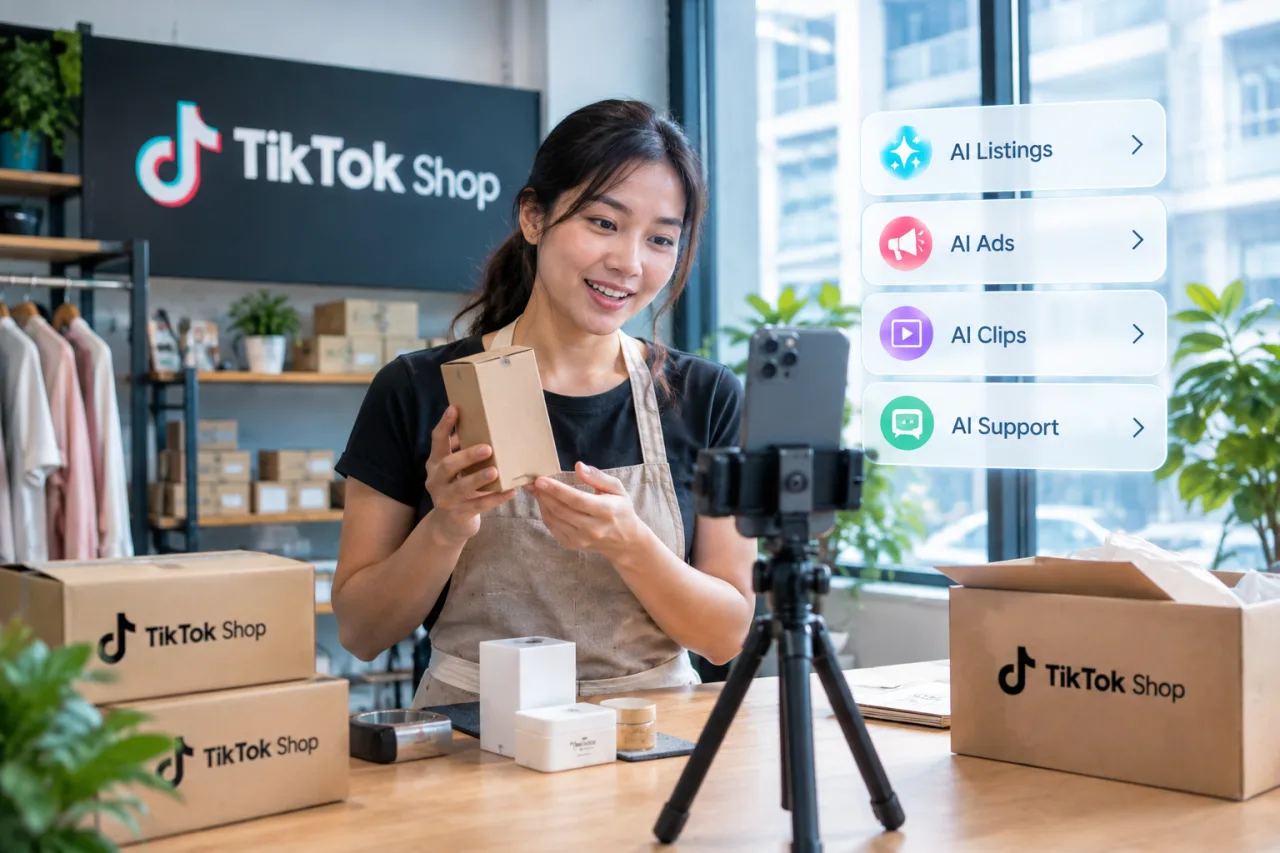
TikTok has quietly rebuilt its seller dashboard around AI over the past year, and the full TikTok Shop AI set now works as one system.
Seller Assistant is now agentic. TikTok’s own Seller Academy describes the upgrade plainly: the Seller Assistant answers questions, reasons through store issues, suggests next steps, and can take actions with your permission across Seller Center. You ask in plain language, it drafts or executes, and you confirm the actions that touch live store data. TikTok documents that it is available to all TikTok Shop sellers, not a premium tier.
The AI Homepage turns chores into one-command workflows. TikTok’s AI Homepage handbook describes a screen that surfaces your daily store priorities, answers data questions in chat, diagnoses live-stream and product issues, and recommends actions. Think of it as a morning briefing that replaces an hour of dashboard hopping.
Diagnostics run on ACE data. Since November 2025, Seller Center has added ACE-powered recommendations across Growth Center and Shop Analytics, scoring your store against Assortment, Content, and Empowerment dimensions and telling you where to fix first.
February 2026 added the automation layer. TikTok’s seller tool rollout that month expanded Seller Assistant access, automated product sample approvals, and introduced auto-clipping that edits and publishes highlights from your live streams without an editor on your payroll.
TikTok also publishes an official 1,000-prompt Seller Center AI query bank, organized by task, which tells you two things at once: the assistant is meant for daily work, and the platform expects sellers to build fluency in prompting it. The AI is embedded in Seller Center itself, so TikTok Shop AI in 2026 is not something you install. It is something you switch on.
The Free Stack First: Automate Your Listings Tonight
The fastest win is listings, and it requires nothing you have to pay for. Here is the copy-paste block for the Seller Assistant or any capable chat model working alongside it:
Seller Center prompt (replace the bracketed fields with your details):
Write a complete TikTok Shop listing for [product name] in [market, e.g., Malaysia].
Include: a title with the exact keywords [keyword 1] and [keyword 2],
a 3-line opening that names the buyer's problem, 5 benefit bullets with specifics,
material and size specs in a table, 3 buyer objections with one-line answers,
[local currency] price framing, and a 120-character hook for the shop video.
Keep claims factual. No invented certifications, no medical promises.
A worked example, using the same input an Indonesian skincare seller would type: product “vitamin C brightening serum,” market Indonesia, keywords “serum vitamin C” and “wajah sehat.” The output you should demand looks like this: a title that places both keywords inside the first 60 characters, five benefit bullets that each name a concrete outcome (for example “7% ethyl ascorbic acid at pH 6.5” rather than “great for glow”), a spec table with volume and expiry, and a 120-character video hook in Bahasa Indonesia. If the draft invents a dermal clinic endorsement or a “dermatologist proven” tag you never earned, delete it. Platform moderation treats unproven claims as seller responsibility, and that rule bites harder than any tool saves.
For the visual half, CapCut (TikTok’s own editor) generates captions, templates, and product-video cuts inside the ecosystem, which keeps your creative native to the feed instead of re-edited from another platform’s aspect ratios. The combination of Seller Assistant drafts plus CapCut cuts is the cheapest credible TikTok Shop AI workflow that exists today, and it keeps TikTok Shop AI creative native to the feed: total outside spend, zero.
TikTok Shop AI for Ads: Symphony, Smart+, and Buy Direct
The ads layer is where TikTok has pushed automation hardest, and the tools now cover the whole campaign life.
Symphony Assistant builds campaigns conversationally: you describe the goal and audience, it drafts scripts, briefs, and ready-to-run video concepts. Symphony Agent, unveiled on June 22, 2026 at the Cannes Lions festival, extends that into an agentic layer that plans and edits creative across the existing Symphony tools. Smart+ for Search automates keyword selection and creative deployment for search ads, announced at TikTok Advertising Week 2026 in New York alongside Buy Direct, a one-click checkout that completes purchases from the For You feed itself, and a conversational Shopping Assistant for the app.
For sellers, the practical read on TikTok Shop AI ads is this: creative generation is effectively automated, campaign assembly compresses from days to hours, and the checkout path now bypasses the product page entirely, which raises the stakes on your video hook because the feed itself becomes the storefront. Where you still matter most is the offer truth: the assistant can assemble the ad, but it cannot know your real delivery times, stock positions, or return terms, and those are exactly the fields the Shopping Assistant will relay to buyers. Check availability and features per market in your Ads Manager, since several of these roll out market by market. If your product also sells on Shopee, note the buyer side is changing too; our piece on how AI shopping agents complete a checkout without a human shows where that path leads.
Support and Livestreams: Where AI Carries the Load
Customer support is the second place the free layer earns its keep. The expanded Seller Assistant handles order status questions, return policy lookups, and campaign data queries in chat, which absorbs most of the repetitive questions that used to eat a night shift. What it should not handle alone is anything that touches money or disputes: refund approvals, chargeback arguments, and review escalations still need a human decision on record, both for buyer trust and because platform audits ask for them.
Livestreams are the other heavy lift. Auto-clipping, added in the February 2026 rollout, turns a two-hour live session into highlight clips it can publish directly, which means every session compounds into a library of promotable shorts. Vendors are pushing further: separate companies now sell AI avatar hosts that run 24/7 streams, and one vendor’s own analysis claims live commerce can run without a human host. Treat those vendor numbers as marketing until you see their return rates, because a stream that sells while you sleep is worthless if it sells products your warehouse cannot ship. TikTok’s own tooling, in contrast, stays inside the rules of the platform your live session already lives on.
One risk lane deserves its own paragraph: fake deals, impersonation accounts, and payment scams ride the same feeds you sell in. Protect your buyers and your account by knowing the plays in our TikTok scam defense guide, because a verified shop that vouches for its checkout path is worth more than any automation gain.
The Real Costs: Platform Fees Sit Above the AI Stack
AI reduces your cost to produce. The platform’s fee stack reduces your margin regardless. In 2026 those two forces collided more than once, and the fee schedules in this section moved during the first half of the year. Every figure below carries its as-of date; verify the current number in your own Seller Center before you build a margin model, because several markets adjusted fees between January and July 2026.
The cleanest example is Vietnam, because it comes with a primary source. From May 9, 2026, TikTok Shop Vietnam’s fee notice set the default commission at 12.50% for Marketplace sellers and 15.50% for Mall sellers, with a 6% transaction fee on top, which puts the all-in take near 18.5% and 21.5% respectively. A seller who modeled Vietnam on pre-May numbers understated the cost of sale badly in the fastest-growing market in the region.
| Market (as of H1 2026) | Commission | Other stack items | All-in takeaway |
|---|---|---|---|
| Vietnam (from May 9, 2026) | 12.50% Marketplace / 15.50% Mall | +6% transaction fee | ~18.5% to 21.5% all-in |
| Indonesia | ~1.5% to 8% by category | +2% transaction, Mall +2% service, +11% VAT | VAT, not commission, is the swing line |
| Malaysia / Thailand (non-Mall) | ~4% to 6% | +3.21% transaction, +2% payment | ~9.2% to 11.2% all-in; verify Thai figures in-market |
| Singapore | ~6% to 10% | category-based bands | highest headline band, simplest stack |
| Philippines | ~2.24% official (incl. VAT) | effective costs commonly 5% to 9.1% | lowest headline commission in the region |
Sources and caveats: Vietnam figures come from TikTok Seller Vietnam’s own May 2026 fee notice and are the firmest numbers in this table. The Indonesia, Malaysia, Thailand, and Singapore stacks trace to the all-in take-rate analysis by market from August 2026, whose core warning is worth quoting in spirit: the commission line is the smallest number, and two markets quoting similar commission can sit six points apart once transaction fees, payment fees, and VAT stack up. The Philippines ranges come from a 2026 commission calculation guide and are the softest numbers here, so verify them in your own seller panel before quoting them in a business plan.
Put the fee stack next to TikTok Shop AI savings and the priority order writes itself. An AI vendor subscription that saves five editing hours a month costs $15 to $120. A two-point fee misread on Vietnamese sales costs vastly more. Automate listings and clips first, audit your fee stack second, and only then spend on paid AI tools.
Where TikTok Shop AI Gets It Wrong and What It Costs You
Every automation in this guide shares one failure mode: confident output you did not verify. Three specific traps recur with sellers adopting TikTok Shop AI for the first time.
Invented product claims. Listing generators love phrases like “clinically tested” or “dermatologist approved.” If your actual documentation does not support the claim, the listing generator just manufactured liability, and marketplace moderation treats the seller as responsible regardless of which model wrote the copy. The platform-side rule is simple: AI can speed up editing and localization, but the seller remains responsible for the accuracy of every claim. Where AI-written content lands in ownership questions, our explainer on who owns AI content under law and platform rules covers the current position.
Localization without local proof. Translation models will happily put Bahasa or Thai copy on a listing, but the errors that cost conversions are the unlocalized ones: prices referenced in the wrong currency, shipping terms that do not exist in that market, size charts in imperial units. Have a native speaker or a local hire pass through the first ten listings, then trust the pattern.
Data answers without receipts. The Seller Assistant can diagnose why views dropped, but a store that accepts its first explanation without opening the matching analytics tab can lock itself onto a wrong theory. The assistant tells you where to look; the numbers live in Shop Analytics, and the ACE diagnostics exist precisely to cross-check them.
None of these risks argue against the stack. They argue for the habit that makes it safe: one human pass over every AI draft before it goes live, every time.
Recommendations: A Working Order for Your First Month
Use the free TikTok Shop AI stack if you are a solo seller or small team. Turn on Seller Assistant, run your listings through the prompt in this guide, let auto-clipping carry your live stream highlights, and keep your total tool spend at zero while you learn what the platform’s own tools can and cannot do.
Add Symphony or Smart+ when your bottleneck is ad creative volume rather than sell-through. The agentic layers compress campaign assembly dramatically, and their cost is your ad budget, not a subscription.
Add paid vendor tools only after two things are true: your fee stack is modeled with the table above against your actual currency and category, and you have a specific workflow the platform cannot do, such as cross-platform research dashboards or creator outreach. The vendor market (research trackers like FastMoss and Kalodata, clip tools like OpusClip at roughly $15 per month) is real, but each subscription must earn its place against a fee line that bites harder.
Hold human decisions on refunds, disputes, product claims, and anything in your listing that a regulator would care about. AI drafts, you sign.
The regional picture only reinforces the plan. The e-Conomy SEA 2026 report’s Philippines findings put the region’s digital economy on a path toward $1 trillion by 2035 with AI already reshaping every sector, and sellers who build disciplined AI workflows now are compounding an advantage the latecomers will pay for in fees and lost volume.
FAQ
Is TikTok Shop AI free to use?
The core tools are free because they live inside Seller Center: the Seller Assistant chatbot, the AI Homepage workflows, ACE diagnostics, and auto-clipping ship with the standard seller account. Paid AI enters only when you buy vendor tools for research or editing, or when you spend on ads powered by Smart+ and Symphony.
How much commission does TikTok Shop take in Southeast Asia in 2026?
It varies by country and seller type, and several schedules changed in 2026. As of H1 2026: Vietnam runs 12.50% commission plus a 6% transaction fee from May 9, 2026 (15.50% for Mall), Indonesia adds an 11% VAT alongside a 1.5% to 8% commission band, Malaysia and Thailand non-Mall sellers pay roughly 4% to 6% commission plus 3.21% transaction and 2% payment fees, and the Philippines headline commission sits around 2.24% including VAT. Verify your own category in Seller Center because these are the figures sellers reported, not contract terms.
Can AI write my whole TikTok Shop listing?
It can draft one, and the free Seller Assistant makes that easy, but a whole listing written and shipped by AI is where sellers get burned. Invented certifications, overstated results, and unlocalized specs are the three regular defects. Use the prompt structure in this guide, then run a human pass on claims, currency, and sizing before publishing.
What is the best AI tool for TikTok Shop sellers?
Start with the platform-native ones because they cost nothing: Seller Assistant for listings and diagnostics, the AI Homepage for daily priorities, auto-clipping for live streams, and CapCut for video editing. If you then need market research, cross-platform dashboards, or creator outreach, that is the point to trial vendor tools, with trackers like FastMoss or clip tools like OpusClip, and only against a modeled fee stack.
Do AI avatars actually work for live selling?
The vendor side sells it hard, and 24/7 avatar streams are real products. But the independent evidence is thin: return rates, compliance risk, and buyer trust data mostly come from the vendors themselves. Until independent numbers exist, treat avatar livestreams as an experiment with a small budget, not infrastructure. The platform’s own auto-clipping gives you most of the content leverage without the compliance questions.
Does TikTok Shop AI work in my country?
The Seller Assistant and Seller Center AI features are documented as available to all TikTok Shop sellers, with market-level nuances on the newer agentic actions and ad tools. Ads features like Smart+ for Search and Buy Direct roll out market by market. Check your region’s Seller Center and Ads Manager for the current feature set, since availability changed repeatedly through 2026.
Financial Disclaimer
This article is for general information about seller tools and fees and is not financial advice. Fee schedules, commission rates, and platform policies change frequently; verify all figures in your own Seller Center and consult a qualified professional before making business or investment decisions. The author holds no positions in the companies mentioned.
- syntopia.ai/tiktok-shop-live-commerce-without-human-host
- anniechantalk.com/blog/tiktok-shop-fees-southeast-asia — the all-in take-rate analysis by market
- duoke.com/en/blog/article/394-How-is-TikTok-Shop-Commission-Fee-Calcu… — a 2026 commission calculation guide
External sources linked in this article, in order of first mention. Spotted an error or a broken link? Tell us.
Cite this pagePublished Nov 12, 2026
Agron, E. (2026, November 12). TikTok Shop AI: How Southeast Asian Sellers Automate Listings, Ads, and Support. WorldNgayon. https://worldngayon.com/tiktok-shop-ai-seller-automation/
Agron, Edmon. “TikTok Shop AI: How Southeast Asian Sellers Automate Listings, Ads, and Support.” WorldNgayon, 12 Nov. 2026, worldngayon.com/tiktok-shop-ai-seller-automation/.
Agron, Edmon. “TikTok Shop AI: How Southeast Asian Sellers Automate Listings, Ads, and Support.” WorldNgayon, November 12, 2026. https://worldngayon.com/tiktok-shop-ai-seller-automation/.
Agron, E. (2026) ‘TikTok Shop AI: How Southeast Asian Sellers Automate Listings, Ads, and Support’, WorldNgayon, 12 November. Available at: https://worldngayon.com/tiktok-shop-ai-seller-automation/.
E. Agron, “TikTok Shop AI: How Southeast Asian Sellers Automate Listings, Ads, and Support,” WorldNgayon, Nov. 12, 2026. [Online]. Available: https://worldngayon.com/tiktok-shop-ai-seller-automation/
@online{agron2026tiktokshop,
  author       = {Agron, Edmon},
  title        = {{TikTok Shop AI: How Southeast Asian Sellers Automate Listings, Ads, and Support}},
  year         = {2026},
  date         = {2026-11-12},
  organization = {WorldNgayon},
  url          = {https://worldngayon.com/tiktok-shop-ai-seller-automation/},
  urldate      = {}
}TY - ELEC AU - Agron, Edmon TI - TikTok Shop AI: How Southeast Asian Sellers Automate Listings, Ads, and Support T2 - WorldNgayon PY - 2026 DA - 2026/11/12/ UR - https://worldngayon.com/tiktok-shop-ai-seller-automation/ Y2 - ER -
Cite the version you read; the page may be updated. Zotero and Mendeley can also import this page directly.