Key Takeaway
- Samsung Electronics Singapore and New York-based Reality Defender signed a memorandum of understanding (MoU) to develop a fake voice and deepfake check that would run directly on Galaxy devices for enterprises in Singapore — an agreement to collaborate, not a shipped product.
- The proposal: an ensemble of AI models scores a live call’s audio, a video, or an image on the device in real time, next to Samsung’s Knox security platform — and, per Reality Defender, nothing is enrolled and nothing is stored.
- The stakes: a 2024 survey by Regula cited by Samsung found 56% of businesses in Singapore had faced audio deepfake fraud, and Singapore figures carried by IT之家 (ITHome) put 2025 government-official impersonation losses at least S$242.9 million — 26.6% of that year’s scam losses.
- It does not exist today: no launch date, no confirmed device list beyond Samsung’s own footnote pointing at Galaxy S26 Series-and-beyond and Galaxy flagship tablets.
- The habit that still wins: if a relative or an authority figure calls with an urgent money request, hang up and call back on the number you already have.
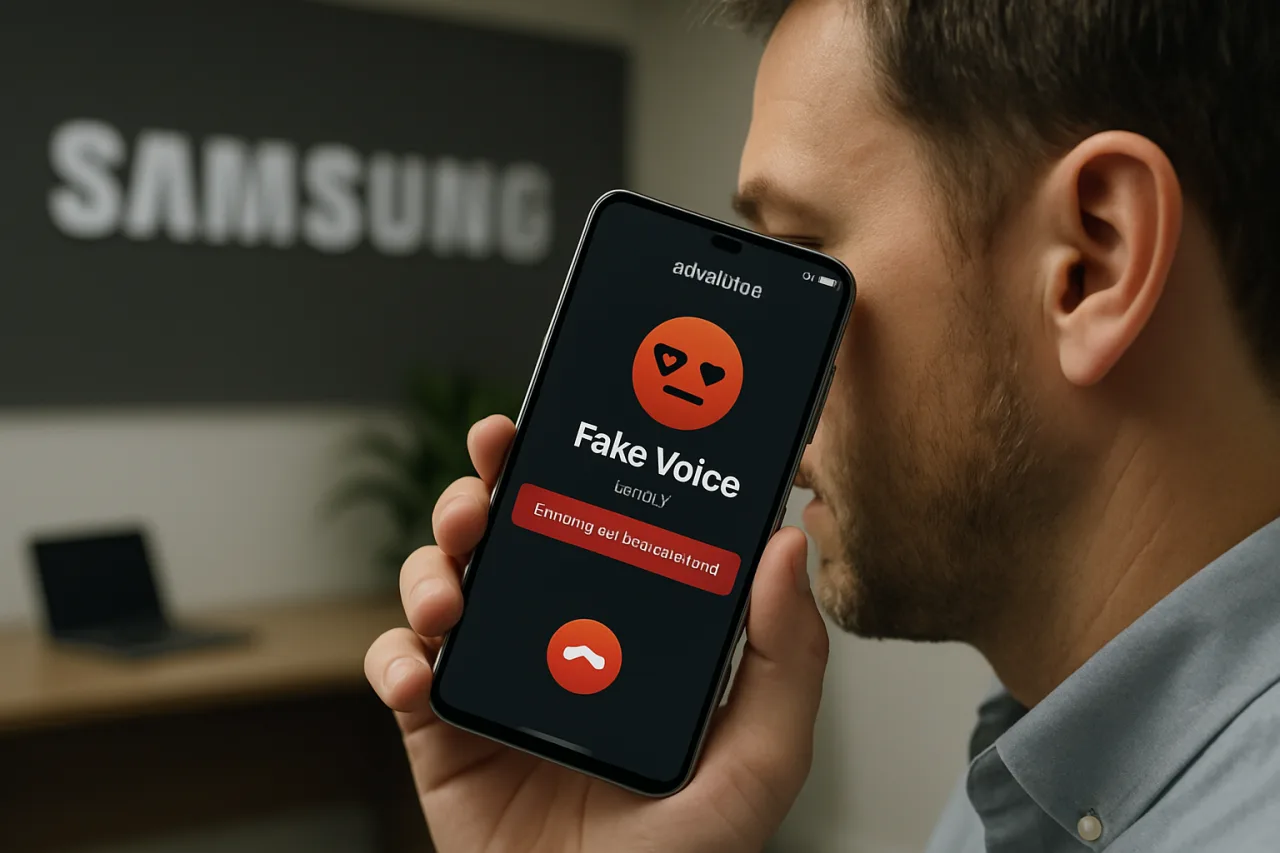
The call sounds exactly like your child, your boss, or your bank officer, and it wants money in the next ten minutes. That fake voice is the precise threat two companies have now agreed to fight at the device level. Samsung Electronics Singapore and New York-based detection firm Reality Defender signed a memorandum of understanding to build fake voice and deepfake detection that would run directly on Galaxy devices for enterprises in Singapore, scoring the caller while the analysis stays on the phone. What was actually announced, what the check cannot do yet, and the habit that still beats it — in plain words, below.
Table of Contents
What Samsung and Reality Defender Actually Announced
Samsung published the announcement on October 14 on its own Samsung Newsroom Singapore page, and Newsflash Asia’s coverage frames it within GovWare 2026, Singapore’s annual cybersecurity event. The substance is a memorandum of understanding between Samsung Electronics Singapore and Reality Defender. Together they plan to develop and deploy an on-device deepfake detection solution for enterprises in Singapore — technology intended to identify AI-generated voice, video, and images on Galaxy devices, per the release.
The plan pairs Reality Defender’s detection capabilities with Samsung Knox, the security platform that protects Galaxy data from the chipset level up. “Through our partnership with Reality Defender, we aim to develop practical on-device deepfake detection solutions that can flag potential threats before data needs to be processed in the cloud,” said Timothy Tan, Director and Head of Integrated Business at Samsung. Samsung’s announcement states the same privacy logic: when the analysis happens on the secured Galaxy device, less sensitive data needs to travel to cloud services.
Reality Defender’s framing is blunter. “Our mission is to protect high-trust systems from AI-generated threats by verifying what is real in real time. For many organisations, the first place a deepfake lands is an employee’s phone. Our partnership with Samsung aims to bring Reality Defender’s detection directly onto Samsung Galaxy devices, working alongside Knox so teams can spot AI-generated impersonation before they act on it. And our detection is stateless by design: nothing enrolled, nothing stored,” said Ben Colman, Co-Founder and CEO of Reality Defender (a company that sells enterprise deepfake detection).
Guardrails matter here. An MoU is an agreement to collaborate, not a binding product commitment — SammyGuru’s consumer-side read of the announcement, and ours: Samsung has not revealed arrival timing or supported models. The only device signal anywhere in the announcement is Samsung’s own footnote, which points at Galaxy S26 Series and beyond, and Galaxy flagship tablets. That is a footnote about scope, not a launch list. In other words: the concept is signed; no fake voice product ships until Samsung itself says so.

How a Fake Voice Check Works on the Phone
In plain words, the proposal is a second opinion on the call itself. Reality Defender’s detection runs an ensemble — a team of AI models — that scores a piece of content and asks one question: was this voice, video, or image made by a machine? The verdict arrives in real time, and timing is the whole point, because a scam call is decided in seconds, not in a forensic lab the next morning.
Two scenarios anchor the partnership. The first is audio impersonation on live calls: a fake voice pretending to be a trusted boss, a bank officer, or family while the line is still open. The second is the identity-check lane: businesses running know-your-customer (KYC) and onboarding checks get shown a machine-made face or voice instead of a real customer’s. Both are cases the two companies named in the announcement, and both are exactly where a wrong decision costs money.
The check is proposed to run next to Knox. Knox Vault is a hardware-isolated environment that keeps sensitive information separate from the main operating system, and Knox Enhanced Encrypted Protection (KEEP) gives each app its own encrypted storage that other apps cannot open. The privacy logic follows from the design Tan described: if the fake voice verdict is computed on the secured device, sensitive audio and identity data never need to leave the phone for a cloud service to review it.
Colman’s “stateless” line closes the loop: nothing enrolled, nothing stored. The tool scores a call without keeping a copy of it, so how a fake voice gets checked matters as much as who gets checked — the score is a confidence read on the moment, not an archive of the conversation.
Why Checking a Fake Voice at the Phone Matters
Detection at the moment of decision beats after-the-fact forensics. By the time a fraud report is written, the transfer has already cleared; a warning inside the first seconds of a live call is the only intervention that lands before the money moves. That is the durable argument inside Colman’s line: the first place a deepfake lands is an employee’s phone, so the check has to live on the phone.
This is not an abstract enterprise worry. The voice-clone “family in distress” call and the boss-impersonation urgent transfer are exactly the audio-impersonation case the partnership names — both industrialized inside the AI scam economy our coverage has tracked for months. The institutional counterattack is building in parallel: ASEAN’s plan to trace scam proceeds, block mule accounts, and share evidence across borders attacks the network layer, while a device-level check attacks the device layer — the ASEAN trace-and-block strategy is one half of the same defense.
For Filipinos in the OFW corridor, the pattern is the familiar one: a fake voice that sounds like a loved one in distress, asking for money on the spot. The defense has not changed with the technology — hang up and call back on the number you know, the verify-the-authority habit our Scamcheck.ph guide walks step by step. Detection tools, when they arrive, assist that habit; the callback still rules.
What the Fake Voice Feature Cannot Do
Honesty first, because this whole piece is a proposal review. What exists today is an MoU. There is no launch date — Samsung has not revealed arrival timing or supported models, per the consumer coverage above. There is no confirmed device list beyond Samsung’s own footnote pointing at Galaxy S26 Series-and-beyond plus Galaxy flagship tablets in an enterprise context. Any claim that the fake voice check is live on your phone today outruns the primary source.
Second: the verdict is probabilistic. An ensemble scores confidence — probably synthetic, probably human — and a confidence read is not proof. Thresholds get set and tuned, which means false alarms and misses both happen. A “probably real” verdict on a call that asks you to move money is not a clearance; it is one more signal that the callback exists to sort out.
Third: detection assists, it never replaces the verify-the-authority habit. The tool is a screen; the callback is the decision. A detector that leans “probably real” on the wrong threshold would still fail you, and a “probably fake” one protects you only if you act on it — the habit is what converts either verdict into safety.
Fourth: the adversary iterates. Voice clones improve as detectors improve, because each side trains against the other — any accuracy claim is a snapshot, not a destination. Regulators are adding a parallel layer: the AI Act’s Article 50 transparency duties for machine-generated content push disclosure, and provenance labels such as Content Credentials are designed to carry a “this is synthetic” marker from creation onward. Markers, labels, device checks — none of them alone closes a family-chat loop; the callback does.
The Numbers Behind the Push
The threat numbers that lead the announcement are Singapore’s own. In a 2024 survey by Regula, an identity-verification firm, cited in Samsung’s announcement, 56% of businesses in Singapore had faced incidents of audio deepfake fraud, while 52% reported experiences with video deepfakes — the fake voice problem inside the boardroom, not only the family group chat.
| Indicator | Number | Year basis | Source |
|---|---|---|---|
| Businesses in Singapore that faced audio deepfake fraud | 56% | 2024 survey | Regula survey cited by Samsung |
| Businesses in Singapore that reported video deepfakes | 52% | 2024 survey | Regula survey cited by Samsung |
| Singapore losses to government-official impersonation scams | at least S$242.9 million | 2025 | Singapore figures carried by IT之家 (ITHome) |
| Share of Singapore’s 2025 scam losses by amount | 26.6% | 2025 | Same attribution: figures carried by IT之家 (ITHome) |
One attribution note, because scam statistics collide easily: the fake voice survey numbers and the loss totals measure different things, and both deserve exact sourcing. the S$242.9 million figure — full-year 2025, government-official impersonation only — is IT之家’s citation of Singapore figures, and we keep it in its own sentence rather than merging it with other totals. Our own Singapore scam statistics hub tracks a separately sourced cut: first-half 2026, 16,821 reported scam cases and S$410.6 million lost, per the Singapore Police Force’s half-year figures. Different windows, different cuts, different sources — each number stands attributed where readers can check it.
What to Watch Next
Each watch item below is a decision trigger, not a wish.
- Productization timing. Samsung Singapore has revealed none. Treat any launch-date claim you see as unverified until a dated post appears on Samsung’s own newsroom.
- The device list. Which Galaxy models and flagship tablets actually ship with the check. Confirm per device before assuming any phone is protected; the footnote is a scope statement, not a promise.
- Other markets. The MoU is Singapore-enterprise-first. Watch whether other Samsung regional units sign similar agreements with Reality Defender — that would signal a rollout pattern.
- The accuracy race. Fresh Regula-style survey waves as detectors and clones both improve — the 2024 numbers are a baseline, not a ceiling.
- The demo trail. At GovWare, Digital Daily (DDAILY) reported Samsung Singapore solution architect Hendra Wiratno demonstrating a live-call check that returned a real-or-deepfake verdict in roughly 3–5 seconds on the device, per Digital Daily’s GovWare report — a stage demo of the proposal, not evidence of a shipped product.
Frequently Asked Questions
Does Samsung’s fake voice detection exist today?
No. What exists is an MoU between Samsung Electronics Singapore and Reality Defender, announced October 14, with no launch date. Until Samsung publishes productization on its own newsroom, the correct description is “agreed to develop,” not “released.”
Which phones will get fake voice detection?
No confirmed list is public. Samsung’s footnote points at the Galaxy S26 Series and beyond plus Galaxy flagship tablets for the enterprise concept, and the arrival timing and full device list remain unannounced in the coverage.
Can a fake voice detector be wrong?
Yes, in both directions. Detection ensembles score probabilities rather than facts, thresholds shift, and the adversary adapts as defenses improve. Treat a verdict as one signal among many — the callback on a known number stays the proof step.
What should I do when a fake voice claims to be family or an official?
Hang up and call the person back on a number you already have, then verify the story through a second channel. Never act on a single call that creates urgency; our Scamcheck.ph walkthrough covers the checklist.
Is the feature coming to consumers outside Singapore?
Not announced. The MoU targets enterprise users in Singapore first, and other markets have no signed agreements or dates. Consumer availability — where a fake voice check would land first — is a watch item, not a plan.
How can I check whether media is real in the meantime?
Slow the moment down. Call back on the number you know, cross-check through a second channel, and look for provenance labels such as Content Credentials where platforms support them. Verification habits beat any single tool today.
How to Cite This Article
Cite as: WorldNgayon, “Your Phone Will Soon Spot the Fake Voice Before You Do,” October 17, 2026, worldngayon.com.