Table of Contents
Key Takeaway
- 🧠 Filipino-led breakthrough: An Ateneo de Manila University team led by researcher Patricia Angela R. Abu developed an AI heart monitoring model that predicts cardiac index with 97.78% accuracy using only non-invasive skin sensors.
- 🌡️ The heart disease reality: Ischemic heart disease accounts for 18.7% of all Philippine deaths (PSA 2022 data), and 20% of heart attacks now strike adults under 40 — the crisis is getting younger.
- 📍 Why this matters here: Advanced cardiac assessment requires equipment concentrated in major city hospitals. The AI heart monitoring model processes basic physiological data from adhesive sensor stickers — practical for clinics without specialized analyzers.
- 🔬 Published research: The study appeared in the April 2026 issue of MDPI Bioengineering journal, titled “Robust Non-Invasive Cardiac Index Prediction via Feature Integration and Data-Augmented Neural Networks.”
- ⚡ What professionals should do: Filipino engineers, data scientists, and healthcare IT professionals should engage with university AI research programs — this is where the next wave of Philippine-built medical AI is emerging.
The most important artificial intelligence story in the Philippines this month did not come from a multinational tech company or a government policy launch. It came from a university laboratory — and it might change how Filipinos monitor their hearts.
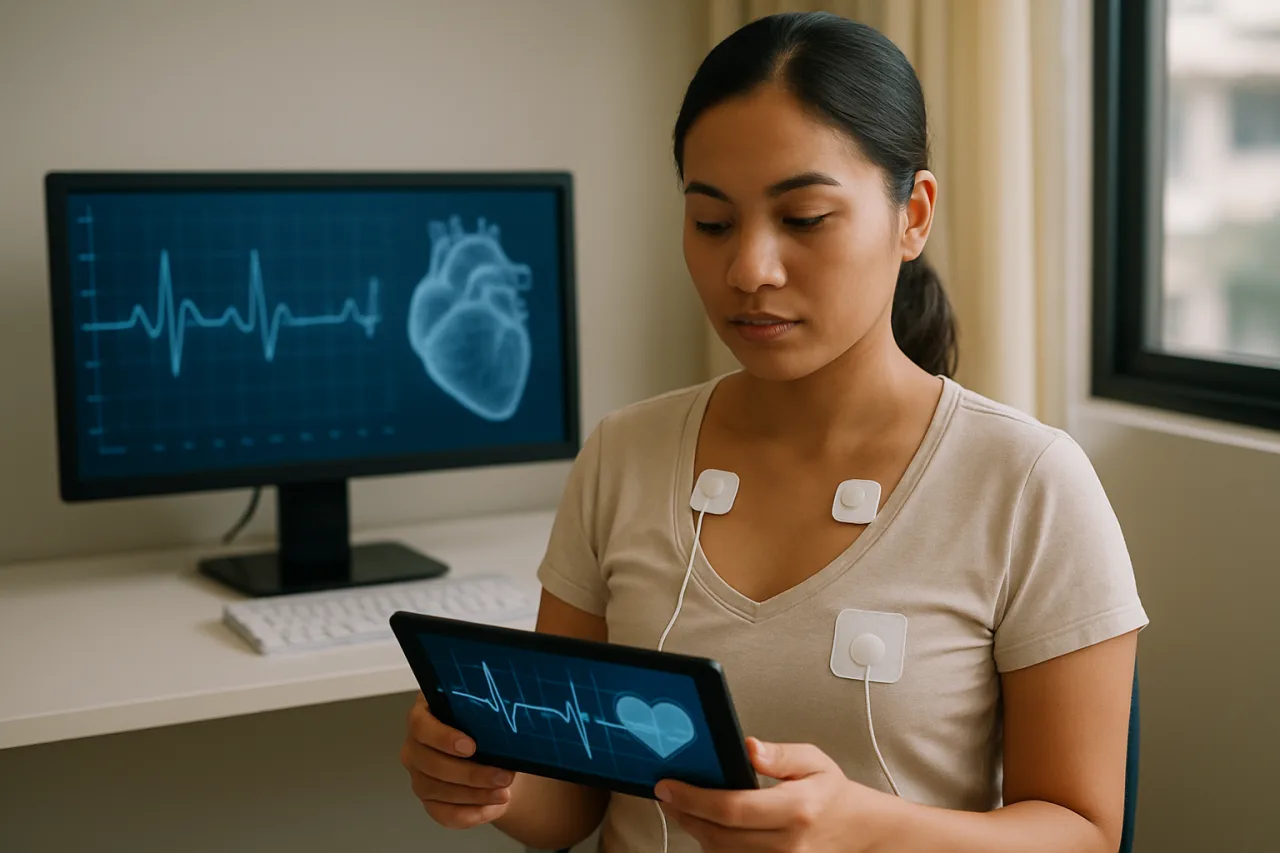
An international research team led by Patricia Angela R. Abu of Ateneo de Manila University’s Department of Information Systems and Computer Science has built an AI heart monitoring system that predicts cardiac index with 97.78% classification accuracy. The model reads physiological indicators — heart rate, stroke volume index, and cardiac output — collected through adhesive sensor stickers placed on a patient’s skin. No catheter. No specialized hemodynamic analyzer. No controlled clinical environment required. The research, published in the April 2026 issue of Bioengineering, an MDPI journal, represents something that deserves more attention than it has received: a credible, peer-reviewed, Filipino-led AI model targeting one of the country’s deadliest health problems with a practical solution designed for resource-limited settings.
Here is the question that matters: why does a Philippine university building an AI heart monitoring model matter more for Filipino professionals than another billion-dollar data center announcement? The answer sits at the intersection of three trends — a worsening cardiovascular crisis among younger Filipinos, a healthcare infrastructure gap that concentrates diagnostic tools in major cities, and a maturing Philippine AI research ecosystem that is starting to produce solutions designed specifically for local constraints rather than imported from abroad.
Why AI Heart Monitoring Is Happening Now
The timing of this research is not accidental. Cardiovascular disease is becoming increasingly common in young people aged 20 to 29, according to the World Health Organization, driven by rising metabolic conditions — obesity, hypertension, hyperlipidemia, and diabetes — among younger populations worldwide. The Philippines sits squarely in this trend. According to the Philippine Statistics Authority, ischemic heart disease accounted for 18.7% of all recorded deaths in the country in 2022, ranking as the single leading cause of death nationwide. The PSA’s 2025 provisional data, released February 2026, confirms that heart disease continues to outpace cancers and stroke as the nation’s top killer.
What makes this crisis particularly Philippine is the convergence of lifestyle and access factors. Studies referenced by the World Heart Federation show that cardiovascular disease causes approximately 25.6% of all deaths in the Philippines. Hypertension affects roughly one-third of Filipino adults. Dyslipidemia — abnormal cholesterol and triglyceride levels — appears in more than half of adults in some local studies. Roughly one in five Filipino adults uses tobacco. The Department of Science and Technology survey cited by Xinhua in its July 30, 2026 report found that about 13% of Filipino adults have elevated blood pressure. And critically, 20% of heart attacks now occur among adults under 40, according to research published through the National Institutes of Health.
These numbers explain why a group of scientists chose to build an AI heart monitoring model rather than another chatbot. The problem is urgent, specific, and structurally tied to the Philippine healthcare landscape. Advanced cardiac assessment — the kind that measures cardiac index, evaluates heart pumping efficiency, and guides treatment decisions — requires specialized hemodynamic analyzers, trained healthcare professionals, and controlled clinical environments. These resources are concentrated in major hospitals in Metro Manila, Cebu, and Davao. A patient in a provincial clinic, a rural health unit, or a community hospital typically cannot access this level of diagnostic detail. The AI heart monitoring model addresses this gap directly: it processes basic physiological data from non-invasive sensors and produces a cardiac index prediction with near-clinical accuracy.
What the Numbers Reveal — and What They Miss
The 97.78% classification accuracy figure is the headline number, and it is legitimately impressive. But understanding what it means requires unpacking the methodology. The research team — comprising 13 scientists from institutions including Ateneo de Manila University and international collaborators — collected physiological measurements using three instruments: the InBody 720 body composition analyzer, the TERUMO ES-P2000 blood pressure monitor, and the PhysioFlow blood flow analyzer. Adhesive sensor stickers placed on a patient’s back collected the physiological measurements. The AI model then processed heart rate, stroke volume index, and cardiac output data to predict cardiac index, a measure clinicians use to evaluate how effectively the heart pumps blood and to guide treatment decisions.
The model’s architecture, described in the paper titled “Robust Non-Invasive Cardiac Index Prediction via Feature Integration and Data-Augmented Neural Networks,” uses feature integration and data-augmented neural networks — a technical approach that combines multiple physiological signals and augments training data to improve robustness. The classification accuracy of 97.78% means the model correctly categorized cardiac index levels with that precision across the test dataset.
But here is what the headline number does not capture. The researchers explicitly noted that the model must be validated on more diverse populations before clinical deployment. The current dataset, while promising, represents a specific demographic. The team also plans to explore whether the model can retain its performance using fewer physiological measurements — a critical optimization for real-world deployment in clinics that may not have access to all three sensor types. This is honest science: a strong result with clear limitations and a defined path forward. It is not a product. It is a proof of concept with genuine clinical potential.
For Filipino professionals working in healthcare IT, biomedical engineering, or data science, this distinction matters. The gap between a 97.78% accuracy in a research setting and a deployable clinical tool is significant — it involves regulatory approval, integration with electronic health records, validation across Philippine population subgroups, and clinician training. But the research proves the approach works. The engineering path from here to deployment is now defined.
The Second-Order Effect on Filipino Professionals
The implications of this research extend well beyond cardiology. The Ateneo AI heart monitoring model represents a broader pattern that Filipino professionals should recognize: Philippine universities are no longer just teaching AI — they are building AI solutions designed for Philippine constraints. This shifts the career and investment landscape in three ways.
First, for Filipino engineers and data scientists, the message is that meaningful AI work is happening inside the country, not just at foreign companies with Philippine offices. Ateneo’s Department of Information Systems and Computer Science, alongside programs at UP Diliman and DLSU, is producing peer-reviewed AI research published in international journals. The Philippine AI landscape includes university research as a core pillar, and professionals who engage with these programs — through collaboration, hiring, or investment — gain access to talent and innovation that multinational competitors cannot replicate locally.
Second, for healthcare professionals and IT leaders, the AI heart monitoring model signals that the next wave of medical AI in the Philippines will not come from importing Western diagnostic tools. It will come from models trained on Philippine data, designed for Philippine infrastructure constraints, and built by researchers who understand that a provincial clinic in Davao del Norte does not have the same resources as a Manila tertiary hospital. This is the AI regulation Philippines conversation made concrete: the country needs frameworks that enable domestic AI innovation in healthcare, not just rules that govern imported AI systems.
Third, for investors and entrepreneurs, the research highlights an opportunity that most market analyses miss. The Philippine healthcare AI market is not saturated with solutions designed for local constraints. A startup that licenses this kind of university research, validates it across Philippine populations, and builds a deployment platform for provincial clinics would address a genuine, measurable gap. The Alibaba Cloud survey found that 91% of Philippine firms are bullish on AI, with driving innovation as the top objective — but most of that investment flows to customer service, marketing, and content creation. Healthcare AI designed for resource-limited settings remains an underinvested frontier.
What the Research Tells Us About Philippine AI Maturity
Step back from the specific model and look at what this research reveals about where Philippine AI stands in 2026. The Ateneo team’s work is not an isolated achievement. It connects to a pattern of Philippine university-led AI research that includes Ateneo’s earlier AI dental assistant with 98.2% accuracy (developed in March 2025), AI and robotics projects for uncovering ancient Philippine history, and low-cost liquid lens development. Each project shares a common thread: applying AI to problems that are specifically Philippine in their constraints and stakes.
This matters because the global AI conversation is dominated by frontier model announcements — bigger parameters, higher benchmarks, more compute. But the AI that changes lives in the Philippines is more likely to look like the Ateneo heart monitoring model: focused, practical, trained on relevant data, and designed for deployment in environments that lack the resources of a Silicon Valley research lab. The AI skills that Filipino professionals should develop are not just about using foreign tools — they include the ability to build, validate, and deploy AI models for local problems.
The research also connects to the broader Philippine digital infrastructure buildout. As the country invests in data centers, cloud infrastructure, and AI computing resources through initiatives like the DICT AI Innovation Centers and partnerships with Google Cloud, the question is not whether the Philippines will have compute capacity. The question is whether that capacity will be used to build solutions like the Ateneo heart monitoring model — or whether it will primarily serve foreign AI workloads. The answer depends on whether Filipino professionals, researchers, and institutions can translate infrastructure into innovation.
The Healthcare Access Problem This Model Addresses
To understand why the AI heart monitoring model matters specifically in the Philippine context, consider the healthcare infrastructure reality. Conventional cardiac assessment that measures cardiac index requires specialized hemodynamic analyzers — equipment that costs hundreds of thousands of pesos and requires trained technicians to operate. These machines sit in the cardiac care units of tertiary hospitals, predominantly in urban centers. A patient in a provincial health unit, a community clinic, or a rural hospital who needs detailed cardiac evaluation is typically referred to a city hospital — a process that involves travel, waiting time, and costs that many Filipino families cannot absorb.
The Ateneo model’s approach — using adhesive sensor stickers and basic physiological measurements processed by an AI algorithm — could theoretically bring cardiac index assessment to settings that lack specialized equipment. The sensors used in the study (InBody 720, TERUMO ES-P2000, PhysioFlow) are significantly less expensive and less complex than full hemodynamic analyzers. If the model can be refined to work with even fewer inputs, as the researchers plan to explore, the deployment cost could drop further.
This is not a theoretical concern. Cardiovascular disease is the leading cause of death in the Philippines, and the risk factors — hypertension, diabetes, high cholesterol, obesity — are appearing earlier in Filipino adults. The WHO reports that cardiovascular disease is increasingly common in adults aged 20 to 29. A tool that enables earlier, more accessible cardiac assessment could shift the detection window from emergency rooms to routine checkups — and that shift could save lives across a population where 13% of adults already have elevated blood pressure, according to DOST survey data.
For Filipino healthcare IT professionals, this is the practical action item: monitor the validation progress of this and similar models. When Philippine university AI research reaches clinical validation, the deployment opportunity — integrating AI-assisted cardiac assessment into electronic health record systems, telemedicine platforms, and provincial health networks — will require exactly the kind of technical talent that Filipino IT professionals can provide. The healthcare cybersecurity conversation has already established that Philippine healthcare IT is modernizing. AI-assisted diagnostics is the next layer.
What Comes Next
The Ateneo research team has outlined clear next steps: validate the model on more diverse populations, and explore whether performance holds with fewer physiological measurements. Both are necessary before clinical deployment. But the trajectory is promising, and it points to a broader trend that Filipino professionals across sectors should watch.
Philippine university AI research is moving from theoretical to applied. The Ateneo heart monitoring model follows the same institution’s AI dental assistant, and other Philippine universities are pursuing similar applied AI tracks. As the digital job market evolves and AI becomes embedded in more professional workflows, the boundary between academic AI research and commercial AI application will narrow. Professionals who build relationships with university research programs now — through advisory roles, collaboration, hiring, or investment — will be positioned to commercialize the next wave of Philippine-built AI.
For policymakers, the research underscores a point that the AI safety conversation often misses: the most important AI regulation question for the Philippines is not just how to govern foreign AI models. It is how to create a regulatory pathway that enables domestic AI innovation in healthcare — a domain where the Philippines has both urgent need and emerging technical capability. A regulatory framework that makes it feasible to validate and deploy university-built AI models in clinical settings, with appropriate safety oversight, would accelerate exactly the kind of innovation the Ateneo team represents.
The deeper story here is not about one model or one university. It is about a Philippine AI ecosystem that is starting to produce solutions designed for Philippine problems — not imported approximations of them. The Ateneo AI heart monitoring model is early evidence that this ecosystem is maturing. For every Filipino professional watching where AI is going in this country, the signal is clear: the most meaningful AI work is happening closer to home than you might think, and the opportunity to participate in it is real.
Frequently Asked Questions About AI Heart Monitoring
What is the Ateneo AI heart monitoring model?
The AI heart monitoring model is a machine learning system developed by an international research team led by Patricia Angela R. Abu of Ateneo de Manila University’s Department of Information Systems and Computer Science. It predicts cardiac index — a measure of how effectively the heart pumps blood — using physiological data collected from non-invasive adhesive sensor stickers placed on a patient’s skin. The model achieved 97.78% classification accuracy and was published in the April 2026 issue of MDPI’s Bioengineering journal.
How accurate is the AI heart monitoring model?
The model achieved a classification accuracy of 97.78% in predicting cardiac index levels. It processes three physiological indicators: heart rate, stroke volume index, and cardiac output. The researchers used feature integration and data-augmented neural networks to achieve this accuracy. However, the team noted that the model requires validation on more diverse populations before clinical deployment.
Is the AI heart monitoring model available for clinical use?
No. The model is currently a research proof of concept published in a peer-reviewed journal. It has not yet undergone clinical validation on diverse populations, regulatory approval, or integration with healthcare systems. The research team plans to test the model on more diverse populations and explore whether it can maintain performance with fewer physiological measurements before pursuing clinical deployment.
Why does AI heart monitoring matter for the Philippines?
Cardiovascular disease is the leading cause of death in the Philippines, accounting for 18.7% of all deaths in 2022 according to the Philippine Statistics Authority. Advanced cardiac assessment requires specialized equipment concentrated in major city hospitals. The AI heart monitoring model processes basic physiological data from non-invasive sensors, potentially making cardiac assessment more accessible in clinics and healthcare facilities that lack specialized hemodynamic analyzers.
What sensors does the AI heart monitoring model use?
The study used three instruments: the InBody 720 body composition analyzer, the TERUMO ES-P2000 blood pressure monitor, and the PhysioFlow blood flow analyzer. Adhesive sensor stickers placed on the patient’s back collected physiological measurements. The researchers are exploring whether the model can maintain accuracy with fewer sensor inputs, which would reduce deployment costs.
How does this compare to traditional cardiac assessment?
Traditional cardiac index measurement requires specialized hemodynamic analyzers, controlled clinical environments, and trained healthcare professionals — resources typically available only in major hospitals. The AI heart monitoring model processes data from less expensive, non-invasive sensors and produces a prediction with 97.78% accuracy, potentially enabling cardiac assessment in settings without specialized equipment.
Can Filipino professionals get involved in this research?
Yes. Philippine universities including Ateneo de Manila University, UP Diliman, and DLSU conduct AI research programs that welcome collaboration from industry professionals. Engineers, data scientists, and healthcare IT professionals can engage through advisory roles, research partnerships, hiring pipelines, or investment in commercialization. The Ateneo research communications office can be contacted at media.research@ateneo.edu for inquiries.
What are the limitations of the AI heart monitoring model?
The model has been validated on a specific dataset and requires testing on more diverse populations to confirm generalizability. It currently uses three sensor types, and reducing the number of required inputs is a research goal. Clinical deployment would require regulatory approval, integration with healthcare systems, and clinician training. The 97.78% accuracy figure represents research-setting performance, not guaranteed real-world clinical accuracy.
This article is based on published research and news reports. The AI heart monitoring model described is a research proof of concept and is not available for clinical use. Consult a qualified healthcare professional for cardiac assessment and treatment.