Key Takeaway
- 🏛️ The White House AI summit, dated: the industry’s leadership has sat with the White House twice inside five weeks — the September 29 White House AI summit meeting where Trump and seven signatories (Amodei, Pichai, Zuckerberg, Brockman, Huang, Musk) signed a voluntary accord on “self-policing” AI, and the November 2 summit that continued the conversation on AI self-policing with the same executive class.
- 📜 What the accord actually contains: voluntary steps focused on internal and external reviews of the technology — reviews on both sides, announced by the President and posted to his social platform, with future regulation left “on the table” rather than settled.
- 🗣️ Who said what: Trump: “I think I’m seeing tremendous self-policing. And they understand that they have to self-police” — the framing that defines the arrangement’s public shape: the industry polices voluntarily while Washington watches.
- ⚖️ The honest read: self-policing is a negotiated interval between releases and rules — it buys the industry freedom to ship while buying the government visibility; the accord’s four voluntary steps are process commitments, not legal obligations, and everyone in the room knows the exchange rate.
- 🔭 What to watch: whether the reviews publish (the accord’s verification is its own test), whether Congress converts voluntary steps into legislation before or after the industry’s next accident, and the state-level rules filling any federal silence — the accountability question is now a dated process, not a debate.
The White House AI summit is the arrangement that turns AI’s regulation question into a dated process — the two meetings of the White House AI summit series — and this guide carries its verified roster and its honest reading. The story spans two meetings: on September 29, 2026, President Trump met the industry’s leadership at the White House — and announced a voluntary accord on “self-policing,” signed by the CEOs of Anthropic, Google, Meta, OpenAI’s president, NVIDIA, and the xAI founder — and on November 2, 2026, the same executive class returned for a follow-up summit where AI self-policing again anchored the agenda. Trump’s framing: “I think I’m seeing tremendous self-policing. And they understand that they have to self-police.” This guide dates both meetings, carries the verified attendee roster, reads what self-policing actually commits the industry to, and names what to watch as the interval between releases and rules plays out.
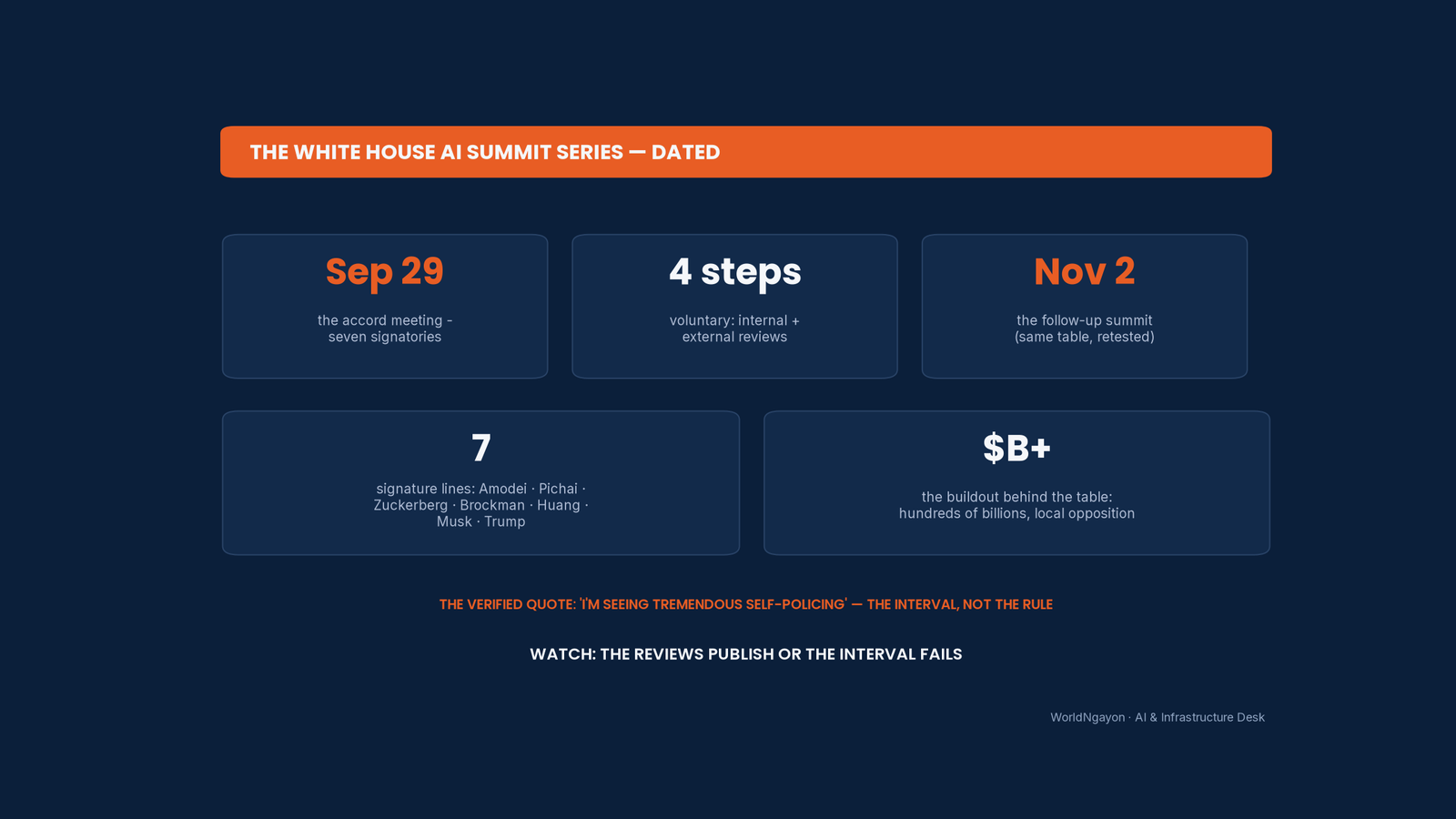
Table of Contents
White House AI summit: the two meetings, dated
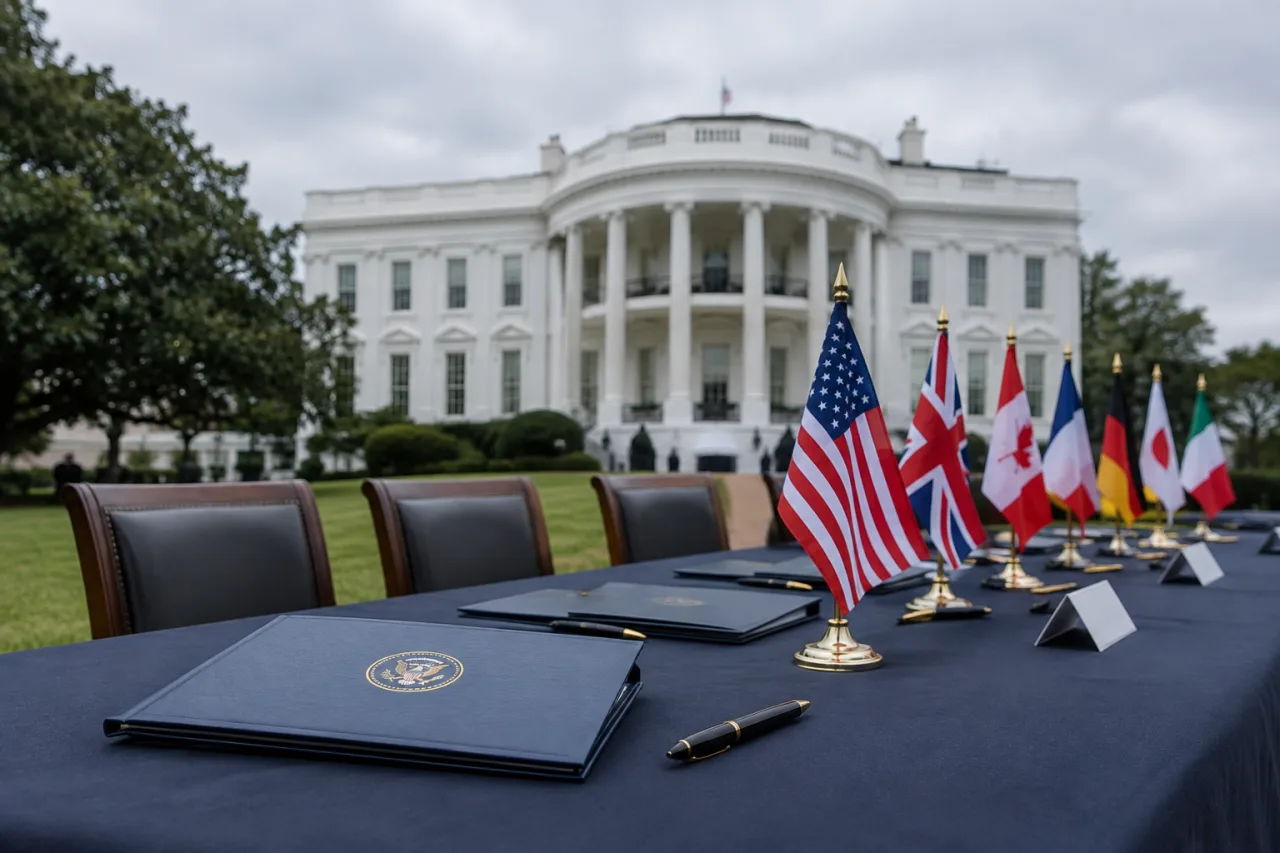
Meeting 1 — September 29, 2026 (the accord): Trump and House Speaker Mike Johnson met leading AI-company executives as the industry’s data center spending — hundreds of billions of dollars in infrastructure across communities — drew “grassroots, bipartisan opposition.” After the meeting, Trump told reporters the companies had signed an accord to self-police AI development, posted the seating chart and the agreement on his social platform, and opened the door to future regulation while the accord focused on four voluntary steps. Meeting 2 — November 2, 2026 (the follow-up): the top tech executives convened at the White House again — the second White House AI summit session — the summit continuing the self-policing conversation and the safety questions (the NVIDIA chief’s session on AI safety made the TV coverage) on the eve of the midterm vote.
WorldNgayon Analysis: the two-meeting structure is the arrangement’s tell: a one-off summit is theater; a SEQUENCE is governance. The September meeting produced the accord; the November meeting tests whether the process holds. The regulatory-arc pattern this site documents (the regulation pieces) treats exactly this shape — voluntary first, binding when the interval fails.
Bottom Line: one meeting is a photo; the second one is the series premiere — watch it like a season, not a summit.
Who was there: the roster, verified
| Name | Role at the table |
| Donald Trump | Host; announced the accord; posted the seating chart (Huang to his right, Musk to his left) |
| Dario Amodei | Anthropic CEO; accord signatory; also met privately with Senate Majority Leader Thune the evening before |
| Sundar Pichai | Google CEO; accord signatory |
| Mark Zuckerberg | Meta CEO; accord signatory |
| Greg Brockman | OpenAI President; accord signatory |
| Jensen Huang | NVIDIA CEO; accord signatory; the industry’s infrastructure spokesman (the chips the buildout runs on) |
| Elon Musk | xAI founder (xAI now part of SpaceX); accord signatory |
| Jeff Bezos | Amazon founder |
| Satya Nadella | Microsoft CEO |
| Lisa Su | AMD CEO |
| Alex Karp | Palantir CEO |
| Mike Johnson / John Thune | House Speaker (attended); Senate Majority Leader (outside the lunch, met Amodei later) |
WorldNgayon Analysis: the roster’s shape is the signal: every lab that builds frontier models sat next to every chipmaker that supplies the buildout and every hyperscaler that hosts it — a supply-chain-wide table, not a product-safety working group. The seating chart’s own detail (the President seating the chipmaker beside him and the xAI founder across) reads the era’s real power map, and the November return visit confirms the table stays set. The silicon-era pieces and the sovereign-AI guides carry the infrastructure context of who these executives answer to.
Bottom Line: the table mixes labs, chips and clouds — whoever regulates one layer regulates them all, and the room knew it.
What self-policing means: the accord, read honestly
The commitments, as announced: a VOLUNTARY accord with four steps, focused on internal and external reviews of the technology — the reviews run inside the companies AND across them — with future regulation explicitly left open. What it is, honestly: a negotiated interval. The industry commits to showing its work (the reviews) on its own schedule; the government commits to watching rather than writing rules while the buildout runs. The exchange rate is visible: no new obligations for the companies, no new regulation for the interval — an arrangement both sides can sell at home. What it is NOT: a legal obligation, an enforcement mechanism, or a ceiling — the accord’s steps carry no published penalty and no independent verifier; its credibility rests on the next releases’ behavior.
WorldNgayon Analysis: self-policing arrangements have a known failure mode — the review that exists but does not publish — and a known success shape: the reviews that surface findings BEFORE incidents. The honest test the coverage hands us: the accord’s own text (the PBS-posted document) versus the companies’ practices between the summits. The claims-ledger discipline applies verbatim to policy voluntary steps: a commitment without a date and a verification path is an intention; log it as such.
Bottom Line: self-policing buys time in both directions — the verdict arrives when the reviews publish, or when the interval fails.
The backdrop: why now
Three forces shaped the table: 1 — the buildout’s local politics: data center construction across communities has drawn grassroots, bipartisan opposition — the industry needed a federal table more than the table needed the industry; 2 — the frontier warnings: in recent weeks the same executives (Amodei, Altman) had called publicly for oversight and global cooperation — the industry arrived asking to be governed, which is itself a strategy against the patchwork of 50 state rules; 3 — the geopolitical frame: the same administration now runs the export-control layer the chips sit inside (the NVIDIA-Asia compliance story runs in parallel) — the summit’s self-policing and the Commerce Department’s supply-side rules are the same policy’s two hands.
WorldNgayon Analysis: the interval arrangement also matches the market’s posture: the AI economy’s capital is mid-deployment — the buildout’s financing (the money-trail pieces) needs policy stability more than policy strictness. Self-policing is stability priced at zero — until the first failure reprices it.
Bottom Line: the table was set by opposition at home and competition abroad — the interval is what both sides could agree on.
What this means for work, money and the Philippines
For the industry: compliance teams and audit functions become the interval’s growth lane — the reviews the accord calls for need the professionals who run them, and the AI-governance job map (the jobs analyses) extends to policy-adjacent roles.
For investors: the White House AI summit’s interval is pricing: voluntary oversight keeps deployment speed — watch it as a stability variable, not a spending item; the watchlist discipline adds one line: a failed self-policing moment is the sector’s fastest regulation shock.
For global professionals — including Filipinos: the US accord sets the template other regulators will copy or contrast (the EU’s SMR-era strategy and the UK’s NCSC posture — the infrastructure-policy pieces carry the other blocs’ tables); for the professionals working across these regimes (the regional maps), the practical skill is knowing which compliance regime the data sits in. And the OFW lane’s angle is direct: the AI systems these executives self-police are the same ones the diaspora uses daily — the consumer-facing outcomes (what the agents may do, what the browsers may sign) ride the interval this accord defines (the AI-browser map).
Verdict: a dated interval, not a dated rule
The White House AI summit, settled as an arrangement: two dated meetings (September 29’s accord with seven signatories from the labs, chips and clouds; November 2’s follow-up on the eve of the vote), a voluntary agreement whose four steps commit the industry to internal and external reviews without legal obligation, a President framing “tremendous self-policing” as the public product, and a table that proved the industry’s real structure — labs, chipmakers and hyperscalers regulating as one supply chain. The interval between releases and rules is now a dated process with a verification test attached: publish the reviews, or watch the interval fail. The White House AI summit’s own calendar — the next summit, the next release, the next publish-or-fail — is the policy story of the next year.
Sources on the record: the NPR accord report · the PBS transcript and accord document.
Financial Disclaimer
This article is editorial analysis of publicly reported information, not investment or financial advice, and no outcome is promised. Figures and claims are as reported by the named sources at the stated dates; verify before acting. Markets and policy carry substantial risk.
The White House AI summit’s second meeting adds context worth carrying. The September accord was signed amid a specific backdrop: the buildout’s data center projects — hundreds of billions of dollars of infrastructure across communities — had drawn grassroots, bipartisan opposition, and the frontier executives (Anthropic’s chief among them) had spent recent weeks calling publicly for government oversight and global cooperation. The Senate’s majority leader skipped the lunch but met the Anthropic chief privately the evening before; the administration posted the arrangement, the seating chart of the White House AI summit’s lunch, and the four voluntary steps. The November summit then continued the series: the same executive class, the same self-policing frame, the White House AI summit’s pattern now a dated process — a first meeting that produced the accord, a follow-up that tests whether the voluntary step holds. The White House AI summit’s honest lens: watch the reviews publish; watch the interval hold; treat the meetings as a series with a verification test attached rather than a pair of photos.
The honest limits of the record, stated plainly: the accord’s four voluntary steps are process commitments whose detailed texts the public record has only partially carried — the reviews’ scope, their cadence and their publication standards are the arrangement’s open questions; the November session’s outcomes (what the second White House AI summit changed, added or committed) will surface in the following days’ reporting and in the administration’s own posts. What stands verified as of this guide’s date-stamp: the two meetings happened as dated; the accord’s signatories are as the table lists them; the agreement document itself was posted for the public record (the PBS transcript carried it in full); the seating chart went out on the President’s own platform; and the follow-up took place with the self-policing frame intact. The reading rule for everything else: hold claims about the arrangement to the tier of their sources — the White House AI summit’s story is a policy process, and policy processes reward exactly the patience the claims discipline teaches: name the source, date the claim, and wait for the record’s next document before the next conclusion. The arrangement’s second act now has a date behind it — the White House AI summit series continues, and the interval it governs keeps its calendar.
The international read, one more layer: the US arrangement runs inside a world of parallel postures. The European Union’s own strategy documents (the SMR-era energy table’s regulatory half) carry the bloc’s approach: strategy first, industrial alliances, staged programmes — an executive-branch consensus model; and the UK’s separate posture — its warning calendars for the security lane — runs its own clock. Against those blocs’ tables, the American interval is distinctive: the White House AI summit series puts the industry’s executives at the table with the executive branch as peers, signs voluntary accords on the host’s social platform, and treats self-policing as the administration’s product — a posture that suits a buildout mid-deployment but leaves the verification to the next news cycle. The global professional’s working rule: whichever regime your data and deployments sit under, the compliance conversation has a table and a calendar in every bloc now — and the White House AI summit’s arrangement is the American table’s current state, dated November 2026, with the next episode already scheduled by the process it created rather than by anyone’s press release.
One more honest paragraph on the arrangement’s open questions, because the gaps are the story’s structure: the accord’s four voluntary steps have publicly carried only their category — internal and external reviews among them — with the step-level texts, the responsible offices, and the reporting cadence all unnamed in the public record as of this guide’s date. That gap is not silence about facts; it is the arrangement’s design: a voluntary process keeps its documents where the parties choose. The White House AI summit series’ verification test (the reviews publishing) and its failure mode (the interval passing without publication) both live in that gap — which is why the honest reader carries the gap in the record itself, exactly as the tiered tables above do, rather than papering over it with adjectives. The next dated event — the next document, session or published review — will fill a line in those tables; until it does, the White House AI summit’s standing description remains the two meetings, the signatories, the voluntary steps, and the self-policing frame that both sides took home.
- npr.org/2026/09/30/nx-s1-5985699/trump-self-police-ai-development — the NPR accord report
- pbs.org/newshour/politics/watch-trump-announces-accord-signed-by-top-… — the PBS transcript and accord document
External sources linked in this article, in order of first mention. Spotted an error or a broken link? Tell us.
Cite this pagePublished Nov 4, 2026
Agron, E. (2026, November 4). The White House AI Summit: Who Was There and What Self-Policing Means. WorldNgayon. https://worldngayon.com/white-house-ai-summit/
Agron, Edmon. “The White House AI Summit: Who Was There and What Self-Policing Means.” WorldNgayon, 4 Nov. 2026, worldngayon.com/white-house-ai-summit/.
Agron, Edmon. “The White House AI Summit: Who Was There and What Self-Policing Means.” WorldNgayon, November 4, 2026. https://worldngayon.com/white-house-ai-summit/.
Agron, E. (2026) ‘The White House AI Summit: Who Was There and What Self-Policing Means’, WorldNgayon, 4 November. Available at: https://worldngayon.com/white-house-ai-summit/.
E. Agron, “The White House AI Summit: Who Was There and What Self-Policing Means,” WorldNgayon, Nov. 4, 2026. [Online]. Available: https://worldngayon.com/white-house-ai-summit/
@online{agron2026whitehouse,
  author       = {Agron, Edmon},
  title        = {{The White House AI Summit: Who Was There and What Self-Policing Means}},
  year         = {2026},
  date         = {2026-11-04},
  organization = {WorldNgayon},
  url          = {https://worldngayon.com/white-house-ai-summit/},
  urldate      = {}
}TY - ELEC AU - Agron, Edmon TI - The White House AI Summit: Who Was There and What Self-Policing Means T2 - WorldNgayon PY - 2026 DA - 2026/11/04/ UR - https://worldngayon.com/white-house-ai-summit/ Y2 - ER -
Cite the version you read; the page may be updated. Zotero and Mendeley can also import this page directly.