Is USDT Traceable? How Tether's Blacklist Freezes Stablecoins — and What It Means After Binance
Key Takeaway
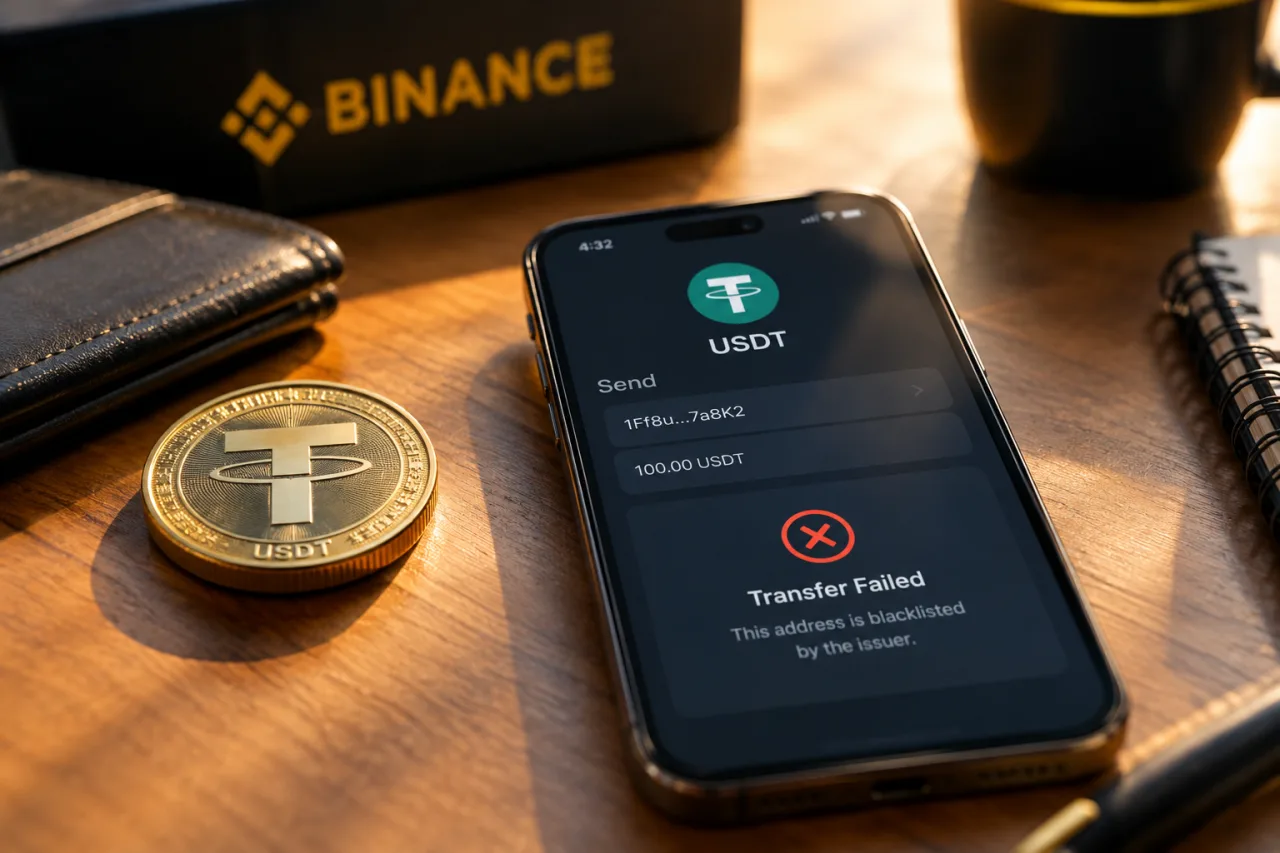
🧊 Yes — USDT is traceable, and blacklisting freezes it at the contract level: when Tether blacklists an address, the tokens stay on the ledger but every transfer attempt is rejected — switching wallets, RPCs, or VPNs changes nothing, because the contract checks the address, not the software.
📊 Traceability is the whole point of the post-hack freeze wave: the Binance heist aftermath froze ~$3 billion through issuer blacklists and partner coordination — the traceable token was the traceable asset, which is exactly why the attacker converted what they could before freezes landed.
🔍 Self-classification takes one check: contract-level freeze (Tether’s blacklist — rare and rarely reversed) versus exchange-level hold (the platform’s own compliance gate — resolved through the platform). The address checker settles which one you’re in before you gather documents.
📉 The reversal odds are documented and thin: of the thousands of addresses blacklisted in 2025 across Ethereum and Tron, only about 3.6 percent were ever removed, with a median 18 days when it happened — reversal is the exception that fits provable errors, not inconvenience.
🛡️ For ordinary holders, the practical takeaway is hygiene: traceability exposes who you transact with, so clean sources and screened counterparties keep your address off the lists — the same exposure logic our stablecoin and custody guides teach.
Table of Contents
Is USDT traceable is the question the Binance heist made urgent for every stablecoin holder — because the aftermath demonstrated the answer at $3 billion scale in one afternoon: yes, traceable, black listable, and freezable at the token-contract level in ways most holders never considered. The heist’s stolen USDT became immobilized the moment issuers blacklisted attacker addresses — balance visible, movement impossible — while the attacker raced to convert what they could into non-freezable assets. This guide explains the machinery in plain language: how Tether’s blacklist works inside the token contract, what traceability actually means on-chain, the four reasons a USDT balance can appear frozen, the one check that classifies your situation, the documented reversal odds, and what steady-state hygiene looks like for ordinary wallets that simply never want to appear adjacent to a sanctioned address.
How Tether’s Blacklist Actually Works: the Contract-Level Freeze
Is USDT traceable to the issuer? The issuer controls USDT at contract level — an issuer blacklist built into the token contract itself. When Tether adds an address to the USDT contract’s blacklist, tokens at that address can no longer be transferred anywhere — the balance stays visible on-chain, but sends, swaps, and withdrawals all reject at the contract boundary. The decisive property: the check runs against the ADDRESS, not the software. Import the same keys into a different wallet app, switch RPC endpoints, route through a VPN — the freeze follows the address regardless of which interface touches it. This is the distinction that separates blockchain-level freezing from old-finance freezing: no court bailiff visits a wallet file; the token’s own code enforces the issuer’s list, everywhere, instantly, at zero marginal cost per address. Circle’s USDC carries the same pattern, which is why the heist response could immobilize billions across both issuers within hours of the compromise.
Is USDT Traceable On-Chain: Pseudonymity With a Fully Public Ledger
Traceability sits between the memes. Every USDT transfer is public on the ledger — addresses, amounts, timing, counterparties in perpetuity — but addresses are pseudonymous, not named. The traceable layer comes from correlation: exchange KYC endpoints, known-address labeling (hack tags, sanctions lists, mixer deposits), and pattern analysis across chains. The same correlation machinery that lets investigators trace stolen funds across hops is what feeds the blacklists — the TRM Labs and Chainalysis attributions in the Binance case depended on exactly this public-ledger transparency. For the ordinary holder the meaning is practical, not paranoid: your USDT history is inspectable, the issuers can and do act on addresses that touch flagged activity, and “traceable” is not a threat to lawful users — it is the property that made the recovery wave possible at all. Privacy-coin users chasing the opposite trade into a different asset class our coins coverage documents.
Why Is My USDT Frozen? the Four Reasons and the One Check
A USDT balance that won’t move has four possible parents, and the classification determines everything that follows. One: the true contract-level freeze — Tether’s blacklist, the rarest for retail, and the hardest to reverse. Two: an exchange-level compliance hold — the platform’s own KYC/AML gate on YOUR account, reversible through the platform’s appeal lanes. Three: a pending network or custody feature you misread — smart-contract vesting, locked staking, a token that simply isn’t USDT. Four: a UI or node problem — balance shown, network lagging, RPC wrong. The self-serve check comes first: run the address through a blacklist checker (issuers and independent trackers publish lookups) and compare against what your platform shows — contract-frozen flags a blacklist entry, everything else points back to the account or the app. Only after classification does the document-gathering start, because the contract freeze and the exchange hold answer to completely different appeal lanes.
The Reversal Odds: Honest Numbers From the 2025 Record
The freeze list is close to one-way, and the record quantifies it: across thousands of addresses blacklisted in 2025 on Ethereum and Tron, roughly 3.6 percent were ever removed, with a median removal time around 18 days when removal happened. The removals cluster where the original flag was provably wrong — fraud-victim wallets whose stolen coins flowed INTO the blacklist transit, identity-verification errors, or law-enforcement clearance after seizure proceedings. What the numbers say to everyone else: an address on the blacklist stays there, which is why the freeze weapon works as deterrence — the attacker’s stolen USDT becomes a liability that can’t run. For legitimate users the lesson is upstream: the address hygiene that keeps you OFF lists (clean funding sources, screened counterparties, prompt responses when a platform asks questions) is worth infinitely more than any untangling after the fact.
The Post-Binance Reality: USDT Traceability as Recovery Infrastructure
The heist aftermath made usdt traceable mechanics mainstream news: issuers froze attacker addresses within hours, tracking firms published laundering patterns in real time, and the frozen tranche became the recovery story — the same public-ledger transparency that let TRM and Chainalysis attribute the theft enabled the freezes that contained it. The system’s design intent shows in one sentence: stablecoins trade decentralization’s censorship-resistance for issuer controllability, on purpose, because the payment use case demands it — the same licensed-stablecoin logic our Hong Kong licensing coverage tracks. Holders choosing USDT for savings or remittances are choosing that trade — and the portfolio implications stay the same as ever: the cold-storage ladder keeps long-term savings in assets whose keys no issuer can reach, while stablecoin balances do payment work inside the controllable system. Our Binance postmortem and proof-of-reserves guide carry the custody-side and trust-side halves of that trade.
The Freeze Timeline: What Happens in the First Hours
The freeze mechanics run on a clock, and the Binance heist supplied the reference timeline. Hour zero: stolen tokens land at attacker addresses and the laundering automation begins cycling them. Early hours: tracing firms publish patterns, issuers receive law-enforcement requests, and the blacklist transactions go on-chain — the contract-level entries that turn attacker balances inert. The exchange echo follows: every compliant platform screens deposits against the published lists, so even unfrozen tokens arriving at a KYC exchange get held pending review. The lesson embedded in that sequence: the freeze window is short by design, and the distance between a theft and immunity is measured in issuer responsiveness and automation speed, not in anyone’s paperwork speed. For the ordinary holder the timeline matters in one practical respect — if your wallet ever gets wrongly entangled (a theft transit passed through it), the same clock runs in reverse: report immediately with the evidence pack, because adjacency flags age badly and early context beats late explanations.
Frequently Asked Questions
Is USDT Traceable by Police?
Yes — USDT traceability starts with the public ledger: every transfer is on-chain, and investigators correlate exchanges’ KYC records, labeled addresses, and cross-chain patterns to attribute activity to real identities. The Binance heist demonstrated the full pipeline: same-day attribution by two tracking firms, issuer freezes, and law-enforcement coordination. For ordinary lawful holders, traceability rarely touches them directly — it is what makes stolen funds freezable and recoverable. The uncomfortable corollary: the same transparency that froze the attacker’s take can flag YOUR wallet if it transacts with exposed addresses, which is why the hygiene habits — clean sources, verified counterparties, prompt KYC responsiveness — belong in every stablecoin routine, and the usdt traceable record from 2025 shows issuers acting on adjacency faster than holders expect.
Can Stolen USDT Be Frozen and Returned?
Freezing — yes, and it worked at scale because usdt traceable funds carry issuer controls in the post-Binance response, with roughly $3 billion immobilized through issuer blacklists and partner coordination. Return is the slower lane — seizure, legal process, and platform good-faith vary case by case; the freeze is the standard first mile, and the recovery guide covers the lanes in full.
How Do I Check If a USDT Address Is Blacklisted?
Issuers and independent trackers publish blacklist lookups — enter the address and read the contract-level status directly, then compare with what your wallet or exchange shows. The check separates the true contract freeze (Tether’s list — the address itself is restricted on-chain) from exchange-level holds (your account’s compliance gate — resolved through the platform’s appeal process), which is exactly the self-classification step every frozen-balance situation needs before documents get gathered.
Can a Blacklisted USDT Address Be Unblacklisted?
Rarely, and slowly when it happens: roughly 3.6 percent of 2025-blacklisted addresses were ever removed, with a median 18-day removal window — and the removals cluster around provable errors, fraud-victim transit, or post-seizure legal clearance. The practical stance: prevention through address hygiene (clean sources, screened counterparties) beats any untangling afterward. The usdt traceable design also answers the questions people bring to it in the wrong order — anonymity is not the product, stability is; tracing is not surveillance theater, it is the enforcement layer that keeps issuers able to cooperate with law enforcement and keep reserves auditable, per the proof-of-reserves discipline.
Does Using USDT in a Self-Custody Wallet Protect Me From Freezes?
No — the blacklist is contract-level, so the restriction follows the address into every wallet app, on every RPC, from any jurisdiction. Self-custody changes who holds the keys, not what the token’s code does. The asset choice is the control: savings that must be immune to issuer action live in assets without issuer backdoors behind cold-storage keys, while payment-flow USDT accepts the controllability by design.
Can I Use USDT for Remittances Safely Given All This?
Yes, with the hygiene rules as the price of admission: receive from known counterparties only, avoid cash-in-person trades with strangers (the funding source that most often poisons a wallet’s history), verify addresses before every send, and keep the remittance flow on a dedicated account separated from savings — the single-counterparty logic every wallet guide in our series repeats. The freeze machinery touches this lane rarely and specifically: it targets addresses tied to theft and sanctions lists, which is exactly why the clean-source discipline matters — the remittance wallet that never touches exposure never meets the blacklist.
Financial Disclaimer
This article provides general educational information and does not constitute financial or investment advice. Contract mechanics, blacklist policies, and regulatory treatment change over time and by jurisdiction; verify against Tether, Circle, and official regulator pages before acting. The author and publisher disclaim any liability for actions taken based on this information.
External sources linked in this article, in order of first mention. Spotted an error or a broken link? Tell us.
Cite this pagePublished Nov 1, 2026
APA 7
Agron, E. (2026, November 1). Is USDT Traceable? How Tether’s Blacklist Freezes Stablecoins — and What It Means After Binance. WorldNgayon. https://worldngayon.com/usdt-traceable/
MLA 9
Agron, Edmon. “Is USDT Traceable? How Tether’s Blacklist Freezes Stablecoins — and What It Means After Binance.” WorldNgayon, 1 Nov. 2026, worldngayon.com/usdt-traceable/.
Chicago
Agron, Edmon. “Is USDT Traceable? How Tether’s Blacklist Freezes Stablecoins — and What It Means After Binance.” WorldNgayon, November 1, 2026. https://worldngayon.com/usdt-traceable/.
Harvard
Agron, E. (2026) ‘Is USDT Traceable? How Tether’s Blacklist Freezes Stablecoins — and What It Means After Binance’, WorldNgayon, 1 November. Available at: https://worldngayon.com/usdt-traceable/.
IEEE
E. Agron, “Is USDT Traceable? How Tether’s Blacklist Freezes Stablecoins — and What It Means After Binance,” WorldNgayon, Nov. 1, 2026. [Online]. Available: https://worldngayon.com/usdt-traceable/
BibTeX
@online{agron2026usdttraceable,
  author       = {Agron, Edmon},
  title        = {{Is USDT Traceable? How Tether’s Blacklist Freezes Stablecoins — and What It Means After Binance}},
  year         = {2026},
  date         = {2026-11-01},
  organization = {WorldNgayon},
  url          = {https://worldngayon.com/usdt-traceable/},
  urldate      = {}
}
RIS
TY  - ELEC
AU  - Agron, Edmon
TI  - Is USDT Traceable? How Tether’s Blacklist Freezes Stablecoins — and What It Means After Binance
T2  - WorldNgayon
PY  - 2026
DA  - 2026/11/01/
UR  - https://worldngayon.com/usdt-traceable/
Y2  -
ER  -
Cite the version you read; the page may be updated. Zotero and Mendeley can also import this page directly.