
Table of Contents
Key Takeaway
- 🪪 Umid card abroad: the umid card abroad question now has a modern answer, because SSS has launched the MySSS Card, its new EMV functional ID that replaces the old UMID card entirely.
- 📱 The new path is online: the MySSS Card application runs through the My.SSS portal with National ID eVerify facial verification, then an account at your chosen SSS partner bank, so no branch biometrics visit is required on the new route.
- 🧾 The old rules still stand: an umid card abroad scenario on the legacy route still requires branch biometrics with at least one posted contribution, first-time issuance is free, and a replacement carries a ₱200 fee at the branch.
- 🏦 One enrollment, two jobs: the partner bank account auto-links to SSS for benefits, loans and proceeds, which ends the separate DAEM disbursement enrollment that members used to complete.
- 🇵🇭 Keep the papers ready anyway: eligibility requires a permanent SS number, My.SSS registration, updated contact details, and PSA or National ID registration, which are the checks every OFW should clear before starting.
The SSS ID has quietly become the most upgrade-anxious document in the Filipino wallet. The plastic you knew for a decade, the UMID card, is being replaced by a new EMV-chipped, bank-linked functional ID called the MySSS Card, and the application model flipped with it: the old card required branch biometrics in person, while the new one verifies your face through the National ID eVerify system and hands the plastic to a partner bank. For Filipinos working overseas, the practical question changed shape: instead of how to fly home for a biometrics chair, the question is how the umid card abroad path runs on the new online route, what still requires the old process, and which documents decide eligibility. This guide answers all three, with the verified two-step application, the fee schedule, the eligibility checklist SSS publishes, and the honest limits about where the new card counts as an official ID.
Umid Card Abroad: the Two Card Generations, Named
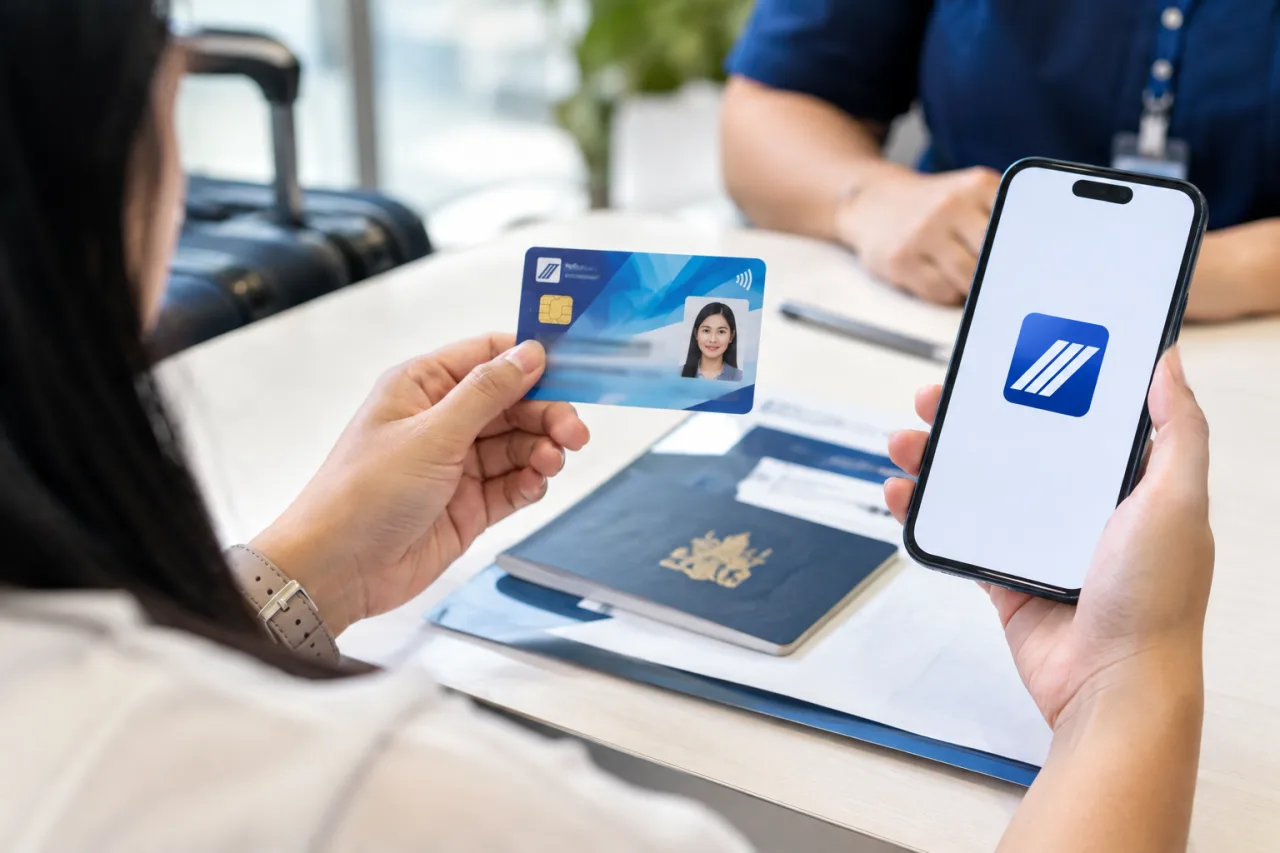
Start with the vocabulary, because confusion between the two lanes wastes weeks. The UMID card is the Unified Multi-Purpose ID that unified data from SSS, GSIS, PhilHealth and Pag-IBIG behind one cardholder identity; SSS issued its own UMID variants for members working in the private sector, and for years it asked every applicant to appear at a branch for biometrics capture, which SSS staffed exclusively through its own branches. The MySSS Card, by contrast, is the newer official functional ID SSS now issues through partner banks, carrying an EMV chip, opening straight into an associated bank account, and replacing the old UMID card where members choose to adopt it. Both cards still matter: SSS states that all previously issued SSS cards remain valid, so an umid card abroad still works wherever it did, while new applications and replacements now route to the MySSS Card lane, where the process lives online.
The New Route: the Two-Step MySSS Card Application
The online route runs in two steps, documented on SSS’s own MySSS Card page. Step one happens inside the My.SSS member portal on your phone or laptop. Log in, choose the MySSS Card option under the Services menu, confirm that your personal details are current and correct, and consent to identity verification through the National ID eVerify system, which uses your National ID photo for comparison. After the facial scan, you choose your preferred SSS partner bank, agree to the data sharing terms between SSS and that bank, and a confirmation message follows, with an email and an inbox notification in the portal. Step two happens at the bank, depending on the partner you picked: some banks let you open the account in their online app, others ask for a branch visit. After the bank’s own verification and any applicable bank fees, the account exists, the card follows, and SSS links the account automatically to your SSS records for receiving benefits, loans and proceeds under the Disbursement Account Enrollment Module, without a separate DAEM enrollment step.
For the umid card abroad reader, the meaning of this design is in the facial scan. The eVerify comparison runs on your device against your National ID photo, which means the identity session does not depend on standing in a Manila branch. Members abroad who hold a registered National ID can complete the SSS step from overseas, and where the chosen partner bank supports fully remote onboarding in its app, the entire chain closes without a flight. The honest caveat sits in step two: remote bank onboarding rules are each bank’s own policy, some banks still anchor on Philippine-present devices or addresses, so the partner bank you choose is the one variable in the umid card abroad journey you actually control. Choose the bank whose onboarding you can complete from your worksite, not the one with the best billboard.
Eligibility, Checked Before You Start
SSS publishes the eligibility list, and clearing it before the facial scan saves the most common rejections. You must hold an SS number tagged as permanent, the standing requirement that separates workers from one-time registrants. You must be registered on the My.SSS portal, which is also where the application itself runs. Your local address, mobile number and email must be up to date in SSS records, which for OFWs means updating the records first, because a stale mobile number cuts off the confirmation path. And you must be registered with PSA or the National ID system, because the eVerify comparison runs against the National ID record; if your name or date of birth disagrees between SSS and the National ID registry, SSS directs you to update the information with the correct agency first, before the card application can proceed. Members, prior registrants, pensioners, individual claimants and representative payees can all apply under these rules, which covers most of the OFW family’s SSS relationships in one lane.
The Legacy Route: When the Old UMID Process Still Applies
The old lane persists wherever the new card has not taken over an existing umid card abroad situation, and its rules are documented in SSS’s published UMID application guidelines. Applications were accepted at branches by appointment through the My.SSS portal appointment system, with the application form downloadable and a primary valid ID, or two secondary IDs, presented at the counter. On that legacy lane, an umid card abroad applicant needed qualification too: at least one posted contribution, and the fee schedule ran short: first-time issuance was free of charge, while a lost, damaged or data-update replacement carried a ₱200 replacement fee paid at the branch. The biometrics capture happened only in branches, a rule SSS enforced to keep a fixer-free process, and production delays were announced openly, with applicants notified when cards became available for pickup. One useful survivor of that system answers a niche question: for members applying for work in Taiwan, SSS issues a certification in lieu of the UMID card to support visa applications, a paper substitute that stays useful for workers headed into jurisdictions whose forms still expect the older card.
What the Card Actually Gets You
The point of either card is the transactions behind it. For the OFW member, SSS links the MySSS Card’s bank account directly to benefit flows, which is the point of the whole umid card abroad exercise: sickness and maternity reimbursements, unemployment benefits, salary loan proceeds and pension releases land in the account without a separate disbursement enrollment, and the card’s EMV chip and payment function mean the same plastic works at physical and online stores. SSS is explicit about one boundary: the SSS valid-ID list and card guidance say the SSS valid-ID list and card guidance say the MySSS Card serves as a valid ID for SSS transactions, while other government agencies and private institutions are not mandated to accept it, since the National ID under PhilSys now serves as the primary official identification for Filipinos. Practical households read that as a wallet plan, not a single-card dream: the PhilSys National ID carries the broad acceptance duty, the SSS card carries the benefits pipeline, and the passport, which our replacement guide covers for emergencies, carries the border. Build the wallet around all three rather than arguing with a bank teller about a card SSS never promised would be universal.
The Paper Trail From Abroad: Contributions, Claims and Records
The ID sits at the end of a paper chain, and OFW families that keep the chain tidy never need an emergency appointment for the card. Contributions must post, and the payment routes now run online for voluntary and OFW members as our contribution payment guide documents, since a posted contribution is exactly what qualifies the member in the eligibility list. For retiring members, the retirement claim filing guide and the digital bank comparison for where money actually sits close the loop, since benefits land in the account the card opens. Claims and benefits run through the same portal our claim guides cover: the retirement filing walkthrough, the unemployment benefit process, and the broader SSS claims guide for members abroad list what each channel expects. Keep the data hygiene habit the eligibility list demands: a change of mobile number or email is a two-minute portal edit today and a lost confirmation tomorrow, and for a family depending on remittances tied to SSS benefits, that edit is the cheapest insurance in the whole system.
The Fees and Where Each Peso Shows Up
The fee picture splits cleanly once the two generations are separated. On the legacy UMID lane, first-time issuance was free of charge, and the only fee the guidelines name is the ₱200 replacement amount paid at the branch when a card is lost, damaged or needs a data correction. On the MySSS Card lane, SSS does not charge for the issuance step itself; the costs live at the partner bank, where the account you open may carry an initial deposit, a card fee, or maintenance rules that vary by bank, and the onboarding flow discloses each one before you commit. Members abroad should price the choice the same way they priced remittance rails: the account that receives SSS benefits is a long-term fixture, so the bank’s fee table, not its launch poster, decides the real cost of the umid card abroad setup.
Common Failures and the Fixes That Work
Three failure patterns dominate this lane, and each has a cheap fix. The first is the stale record: an OFW applicant whose SSS mobile number or email predates two contract renewals never sees the confirmation the portal sends, which freezes a technically complete application at step one; the fix is a two-minute contact-update edit in My.SSS before anything else. The second is the record mismatch: a name difference between the SSS file and the National ID registry, most often after marriage documents were processed in one registry and not the other, and SSS’s own guidance sends the member to update with the correct agency first, so budget one PSA correction cycle before the facial scan. The third is the device check: the eVerify facial scan runs against your registered National ID photo on the device you use, so a cracked camera or a heavily filtered selfie environment turns a one-minute verification into a retry loop; steady lighting and the device the National ID app already runs on are the working answers.
Frequently Asked Questions
Is the UMID card still valid for OFWs?
Yes. SSS states that all previously issued SSS cards, including UMID cards, remain valid. New applications and replacements, however, now route to the MySSS Card and its partner bank process.
Can I apply for my SSS card without flying home?
On the MySSS Card route, yes, in principle: the SSS step runs through the My.SSS portal with National ID eVerify facial verification, and some partner banks complete onboarding in their online apps. The variable is the bank’s own remote onboarding policy, so choose a partner bank you can actually finish from your worksite.
What are the requirements for the MySSS Card?
A permanent SS number, My.SSS registration, current address and contact details in SSS records, and PSA or National ID registration, with name and date of birth matching across the SSS and National ID records. Members, prior registrants, pensioners, individual claimants and representative payees are eligible.
How much does the card cost?
The legacy UMID issuance was free for first-time applicants, with a ₱200 replacement fee at the branch for lost, damaged or update cases. The MySSS Card’s costs are the account-related bank fees your chosen partner bank charges, which the bank’s onboarding flow discloses.
What if my name or birthday differs between SSS and my National ID?
The eVerify comparison needs matching records, and SSS directs members to update the information with the correct agency first. Clear the mismatch before the application, because the facial scan step is where every umid card abroad filing actually succeeds or stalls.
Is the MySSS Card accepted as a valid ID everywhere?
No. SSS states the card is a valid ID for SSS transactions, while other agencies and private institutions decide by their own policies; the PhilSys National ID holds the broad official-ID role.
What about visa applications that still ask for the UMID?
SSS has long issued a certification in lieu of the UMID card for members applying for work in Taiwan, a standing paper substitute documented in its guidelines; ask the SSS office handling your case for the certification route where a jurisdiction’s forms still expect the older card.
Editor’s note, November 2026: card names, fees and eligibility lines in this guide follow the SSS pages named above; the umid card abroad process can change with each SSS issuance, so verify on the official pages before applying.
Financial Disclaimer
This article explains SSS identification and benefit processes and is general information, not financial, legal, or professional advice. SSS rules, card programs, fees, and eligibility requirements change; verify current details on official SSS pages or with the organization before acting. WorldNgayon.com is not liable for decisions made based on this content.
- Official sss.gov.ph/mysss-card
- Official sss.gov.ph/news-and-updates/sss-reminds-members-of-guidelines-in-fili… — in SSS’s published UMID application guidelines
- Official sss.gov.ph/list-of-valid-ids — SSS valid-ID list
External sources linked in this article, in order of first mention. Spotted an error or a broken link? Tell us.
Cite this pagePublished Nov 18, 2026
Agron, E. (2026, November 18). UMID Card From Abroad: How OFWs Get Their SSS ID Without Flying Home. WorldNgayon. https://worldngayon.com/umid-card-abroad/
Agron, Edmon. “UMID Card From Abroad: How OFWs Get Their SSS ID Without Flying Home.” WorldNgayon, 18 Nov. 2026, worldngayon.com/umid-card-abroad/.
Agron, Edmon. “UMID Card From Abroad: How OFWs Get Their SSS ID Without Flying Home.” WorldNgayon, November 18, 2026. https://worldngayon.com/umid-card-abroad/.
Agron, E. (2026) ‘UMID Card From Abroad: How OFWs Get Their SSS ID Without Flying Home’, WorldNgayon, 18 November. Available at: https://worldngayon.com/umid-card-abroad/.
E. Agron, “UMID Card From Abroad: How OFWs Get Their SSS ID Without Flying Home,” WorldNgayon, Nov. 18, 2026. [Online]. Available: https://worldngayon.com/umid-card-abroad/
@online{agron2026umidcard,
  author       = {Agron, Edmon},
  title        = {{UMID Card From Abroad: How OFWs Get Their SSS ID Without Flying Home}},
  year         = {2026},
  date         = {2026-11-18},
  organization = {WorldNgayon},
  url          = {https://worldngayon.com/umid-card-abroad/},
  urldate      = {}
}TY - ELEC AU - Agron, Edmon TI - UMID Card From Abroad: How OFWs Get Their SSS ID Without Flying Home T2 - WorldNgayon PY - 2026 DA - 2026/11/18/ UR - https://worldngayon.com/umid-card-abroad/ Y2 - ER -
Cite the version you read; the page may be updated. Zotero and Mendeley can also import this page directly.