Table of Contents
Key Takeaway
- 📊 The Philippines digital economy reaches $42 billion in gross merchandise value in 2026: a 15% rise on $36 billion in 2025, and the e-Conomy SEA 2026 report projects $157 billion by 2035.
- 💳 Payments posted the fastest growth in Southeast Asia: Philippine digital payments rose 23% to $194 billion in gross transaction value, led by the national digital ID, InstaPay for Business and the BancNet and Philippine Clearing House Corporation merger.
- 🤖 42 million Filipinos already use standalone generative AI: 53% of the working population, but only one in four uses it daily, which is the gap Bain partner Bennett Aquino says the next chapter must close.
- 🛍️ E-commerce stays the anchor: $28 billion in gross merchandise value in 2026, while online media accelerates to 26% growth, the fastest of any segment.
- 💡 What you can do: treat AI as a workflow, not a novelty, because ads arrive on AI platforms next and 7 in 10 Filipinos already say they will rely on AI recommendations when buying.
The Philippines digital economy is projected to reach $42 billion in gross merchandise value this year, the e-Conomy SEA 2026 report said in its November 3 release for the country, and that number sits on a path e-Conomy SEA 2026 extends to $157 billion by 2035. The annual Google, Temasek and Bain & Company research program, now in its 11th edition and titled “Building the Intelligent Economy,” reads the country through three engines: commerce in every segment, a payments system growing faster than Southeast Asia as a whole, and an AI audience that adopted faster than almost anyone.
This decode walks through the Philippine numbers by segment, explains why payments lead the region, sizes the AI adoption wave, and names what each reader group can do with the data.
e-Conomy SEA 2026: the Philippines Numbers That Matter
The headline projection is $42 billion in gross merchandise value for 2026, up 15% from $36 billion in 2025, per the report. The measured value of goods and services transacted online, so the figure tracks activity flowing through e-commerce, media subscriptions, travel bookings and delivery platforms rather than the wider digital contribution to GDP. On the report’s long-horizon chart, the study projects the country’s digital economy could expand to as much as $157 billion by 2035, almost four times this year’s level, on the report’s own assumptions.
The global edition of the e-Conomy SEA 2026 report by Bain & Company was released October 21 with the full report PDF from Google, and the Philippine-country figures followed in the November 3 media cycle led by Newsbytes.PH. Region-wide, the study frames Southeast Asia as on track for $1 trillion in gross merchandise value on 17% annual growth, with AI as the variable that decides which economies take the larger share of that path.
Philippines e-Commerce, Media, Travel and Food: Where the Growth Sits
E-commerce remains the largest segment of the Philippine digital economy, with gross merchandise value expected to reach $28 billion in 2026, a 15% rise on the prior year. That is roughly two thirds of the country’s total digital economy figure, which makes seller-level decisions about assortment, advertising and AI-assisted discovery the practical lever for most of that growth.
Online media is projected to grow 26% to $6 billion, accelerating from 23% growth in 2025, the fastest rate of any segment, as streaming and content subscriptions keep deepening. Online travel expands 14% to $3 billion, up from 9% a year earlier. The combined mobility and food delivery segment grows a more modest 2% to $4 billion, with e-Conomy SEA 2026 extending it to $7 billion by 2030 and $11 billion by 2035.
Read together, the segments describe a market where the biggest bucket grows steadily, the content bucket accelerates, and the delivery bucket consolidates. For businesses, each segment rewards a different preparation: catalog quality for e-commerce, subscription retention for media, and channel partnerships for travel.
Philippines Digital Payments: Fastest Growth in Southeast Asia
The stand-out statistic in e-Conomy SEA 2026 belongs to payments: gross transaction value in the Philippines rises 23% year-on-year to $194 billion, the report found, the fastest in Southeast Asia. e-Conomy SEA 2026 credits three structural drivers: wider adoption of the national digital ID system, the introduction of InstaPay for Business, and the merger of BancNet and the Philippine Clearing House Corporation, which aims to improve payment interoperability across the banking system.
The financial-services layer underneath keeps building. Digital lending outstanding balances are projected at $7 billion in 2026, up 17%, and the report extends the lending market to $31 billion by 2035. Digital insurance grows 16% to $110 million in annual premium equivalent and gross written premiums, putting the Philippines alongside Vietnam as the region’s fastest-growing digital insurance markets.
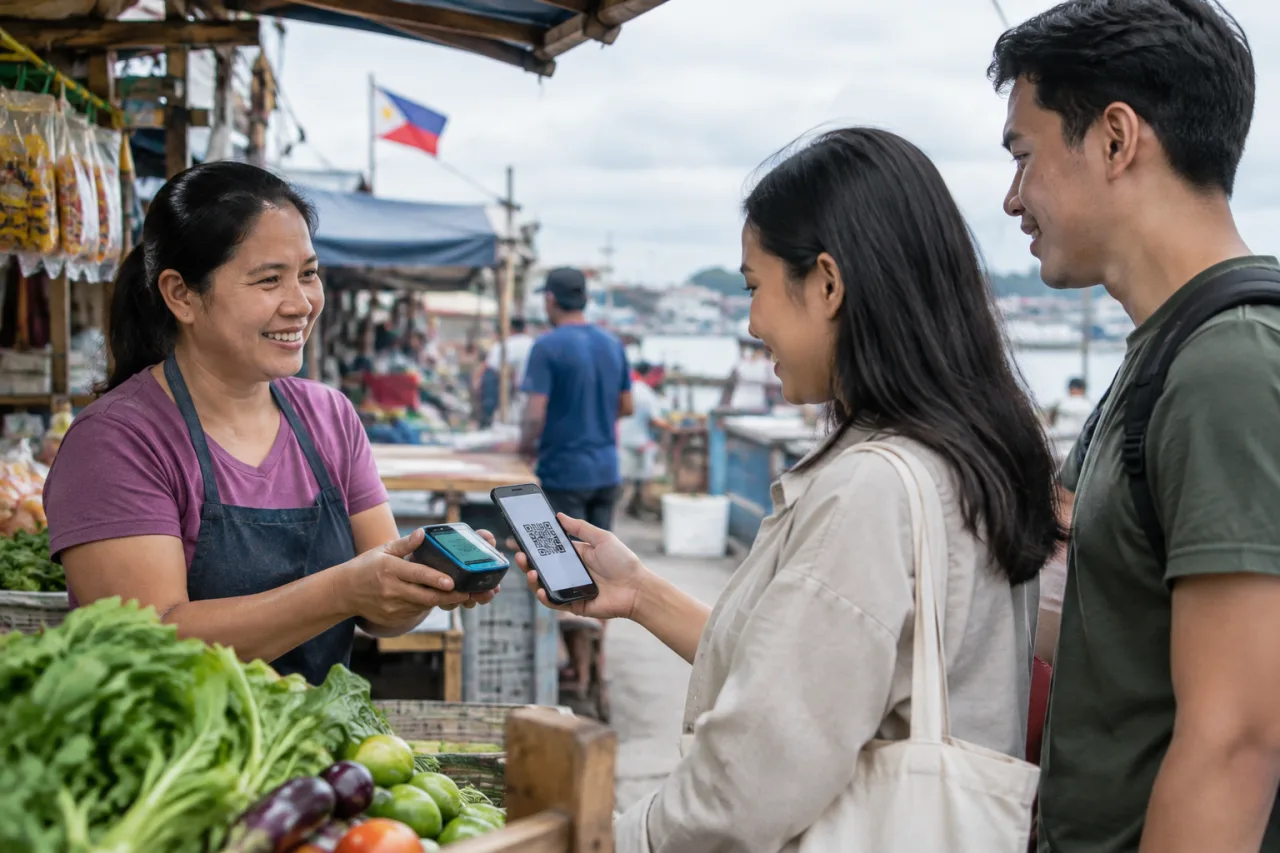
For readers of our payments coverage, the interoperability theme will be familiar: the same rails that made cross-border QR payments work are the rails the report says will carry the next $194 billion of transaction growth. A faster clearing layer changes checkout behavior at the small-merchant edge before it changes anything at the bank tower.
AI Reached 42 Million Filipinos, and That Is Only the Half of It
An estimated 42 million Filipinos now use standalone generative AI platforms, the report found, equivalent to 53% of the country’s working population, and about 65 million monthly users once AI features inside other applications are counted. Usage intensity is the catch: only one in four AI users interacts with the technology daily, and the average sits at 1.87 AI sessions per week per user, measured by the study’s own token metric of around 13 million consumer tokens each.
The shape of that usage matters for what comes next. Consumer applications account for about 80% of AI usage in the country, with study, work, health, online shopping and entertainment the five leading uses. Around 33% of consumer journeys in the Philippines now begin with AI, and prompts submitted to Google’s Gemini platform for customer-support content run nearly three times the Southeast Asian average. English dominates at 79% of conversations, with local-language prompts at 21%.
Bennett Aquino, partner at Bain & Company, put the adoption curve in one line: “Filipinos are embracing AI quickly, with 53% of the working population already using GenAI. But we are still early in the journey, and there is significant headroom for growth. The next chapter is about depth, turning what is occasional use today into everyday workflows that will truly benefit Filipino individuals and businesses.”
The regional frame sharpens the point. Across the six major Southeast Asian markets, 243 million people, 58% of the working population, adopted generative AI in under three years, while only 1-2% of the population pays for it, against 3% of US households. e-Conomy SEA 2026 expects ads to arrive on standalone AI platforms soon, which turns the paying-user gap into a monetization question for platforms, creators and advertisers alike. Trust is rising alongside use: half of Filipino AI users say they trust the technology more than a year ago, and seven in ten say they are willing to rely on AI-generated insights when making purchasing decisions.
Two Rulers: $42B gross merchandise value Versus the $40B GDP Measure
Readers will meet two different Philippine numbers this year, and both are correct because they measure different things. Our July piece on the Philippine digital economy carried the GDP-share measure: around $40 billion, or 8.5% of GDP, with 11.3 million digital workers, a labor-and-value lens on how deeply the digital economy penetrates the national economy. The e-Conomy SEA 2026 lens measures transactions: $42 billion of gross merchandise value flowing through commercial platforms. One ruler reads the economy as income share, the other reads it as activity volume, and neither subtracts from the other.
The practical way to hold both: cite GDP-share when the question is how much of the nation’s economic base the digital sector commands, and cite gross merchandise value when the question is how much buying and selling moves online this year. The two series also update on different clocks, with government statistical releases landing on the national accounts cycle and e-Conomy SEA 2026 updating annually each autumn, so a reader who wants the freshest transaction number waits for the autumn report, while GDP contributions arrive with the official accounts.
What e-Conomy SEA 2026 Means for Workers and Sellers
For professionals: the adoption numbers reward depth over breadth. With one in four users active daily, the professionals who move AI into everyday workflows pull ahead of the median, and the labor-market context sharpens the stakes, since our reporting on which jobs AI actually cut shows the skills premium landing on users, not bystanders.
For sellers: a $28 billion e-commerce bucket growing 15% means demand is not the constraint; visibility is. With 33% of consumer journeys starting in AI and 69% of consumers in the region’s six major markets using AI to compare product options, the product data that AI agents read is becoming storefront-facing infrastructure. The report also notes AI features delivered uplifts as large as 75% in order volume for players using them, which prices the investment for small sellers.
For creators and advertisers: the paying-user gap, 1-2% of the population against 3% of US households, plus the report’s expectation that ads arrive on standalone AI platforms soon, marks a new monetization surface before it exists everywhere. Preparing ad formats and measurement for AI surfaces earlier than the crowd is the same arbitrage early social-ads adopters captured.
For finance watchers: a payments layer compounding at 23% changes small-business cash cycles, lending risk models and remittance timing. Our OECD Digital Economy Outlook parse covers how other fast-growing digital economies absorb the same pressure, which is the comparison the report invites.
How e-Conomy SEA 2026 Expects the AI Decade to Be Funded
Digital economy deals landed at $8 billion in the past year, matching three-year run rates, and AI-focused companies captured 80% of private capital deployment in the last six months, up from 30% in the second half of 2024. The e-Conomy SEA 2026 reading is blunt about what that shift means: venture attention has consolidated around AI builds.
Balance-sheet money runs alongside venture. Digital infrastructure drew $20 billion in investment across the last twelve months, led by the $11 billion acquisition of ST Telemedia Global Data Centres, and data-center capacity is expanding faster than 52% a year while vacancies in third-party-operated facilities stay low. Public markets added a third channel, with IPO proceeds rebounding past $8.5 billion, led by Singapore and Malaysia across digital infrastructure, digital applications and healthcare. For a country planning its own AI decade, that funding map is the report’s second headline after the transaction charts.
What to Watch Next
Three dated items follow the report. The 2027 edition will show whether the $157 billion projection bends or holds, and whether the payments growth rate repeats beyond one strong year. The BancNet and Philippine Clearing House Corporation merger timeline is worth tracking, because interoperability is what the report named as the driver of the payments surge. Watch also for the first AI-platform ad rollouts reaching Philippine users, which converts the paying-user gap into a revenue line and a new advertising market.
FAQ
What is the size of the Philippine digital economy in 2026?
The e-Conomy SEA 2026 report projects $42 billion in gross merchandise value for 2026, a 15% increase from $36 billion in 2025, with a projection of up to $157 billion by 2035.
Which segment of the Philippine digital economy is largest?
E-commerce, at $28 billion of gross merchandise value in 2026, about two thirds of the digital economy total. Online media is the fastest-growing segment at 26%, and travel grows 14%. Mobility and food delivery grow 2%.
Why did Philippine digital payments grow the fastest in Southeast Asia?
The report credits wider adoption of the national digital ID, the launch of InstaPay for Business, and the BancNet and Philippine Clearing House Corporation merger, which improves payment interoperability. Gross transaction value rose 23% to $194 billion.
How many Filipinos use AI?
About 42 million Filipinos use standalone generative AI platforms, 53% of the working population, rising to about 65 million monthly users when AI features inside other apps are included. Only one in four uses AI daily.
Who publishes e-Conomy SEA 2026?
Google, Temasek and Bain & Company publish the annual report, in its 11th edition. Bain is the lead research partner, and the 2026 edition is titled “Building the Intelligent Economy.”
How is the $42 billion figure different from the $40 billion digital economy figure?
The $42 billion is gross merchandise value, the transaction value flowing through online platforms. The $40 billion, cited in our July report on the Philippine digital economy, is the digital economy’s share of GDP, an income measure around 8.5% of GDP with 11.3 million digital workers. Both are accurate; they measure different things.
What should Filipino sellers do after this report?
Prepare product data for AI-assisted discovery, since a third of consumer journeys already start with AI and seven in ten users are willing to rely on AI recommendations. The report prices AI-driven tooling at up to 75% order-volume uplift for adopters.
Financial Disclaimer
This article is for general information only and does not constitute investment, financial or business advice. Figures reflect the Google-Temasek-Bain e-Conomy SEA 2026 report and cited releases as of November 9, 2026. Projections are the publisher’s estimates and not commitments. Consult a licensed adviser before making investment decisions.
- bain.com/insights/e-conomy-sea-2026 — e-Conomy SEA 2026 report by Bain & Company
- services.google.com/fh/files/misc/e_conomy_sea_2026_report.pdf — report PDF from Google
- newsbytes.ph/2026/11/03/ph-digital-economy-to-hit-42b-in-2026-google-…
External sources linked in this article, in order of first mention. Spotted an error or a broken link? Tell us.
Cite this pagePublished Nov 9, 2026
Agron, E. (2026, November 9). e-Conomy SEA 2026: How the Philippines Hit $42B and Why Payments Lead Southeast Asia. WorldNgayon. https://worldngayon.com/e-conomy-sea-2026/
Agron, Edmon. “e-Conomy SEA 2026: How the Philippines Hit $42B and Why Payments Lead Southeast Asia.” WorldNgayon, 9 Nov. 2026, worldngayon.com/e-conomy-sea-2026/.
Agron, Edmon. “e-Conomy SEA 2026: How the Philippines Hit $42B and Why Payments Lead Southeast Asia.” WorldNgayon, November 9, 2026. https://worldngayon.com/e-conomy-sea-2026/.
Agron, E. (2026) ‘e-Conomy SEA 2026: How the Philippines Hit $42B and Why Payments Lead Southeast Asia’, WorldNgayon, 9 November. Available at: https://worldngayon.com/e-conomy-sea-2026/.
E. Agron, “e-Conomy SEA 2026: How the Philippines Hit $42B and Why Payments Lead Southeast Asia,” WorldNgayon, Nov. 9, 2026. [Online]. Available: https://worldngayon.com/e-conomy-sea-2026/
@online{agron2026economy,
  author       = {Agron, Edmon},
  title        = {{e-Conomy SEA 2026: How the Philippines Hit \$42B and Why Payments Lead Southeast Asia}},
  year         = {2026},
  date         = {2026-11-09},
  organization = {WorldNgayon},
  url          = {https://worldngayon.com/e-conomy-sea-2026/},
  urldate      = {}
}TY - ELEC AU - Agron, Edmon TI - e-Conomy SEA 2026: How the Philippines Hit $42B and Why Payments Lead Southeast Asia T2 - WorldNgayon PY - 2026 DA - 2026/11/09/ UR - https://worldngayon.com/e-conomy-sea-2026/ Y2 - ER -
Cite the version you read; the page may be updated. Zotero and Mendeley can also import this page directly.