Table of Contents
Key Takeaway
- 🇻🇳 Vietnam semiconductors are entering the AI supply chain through the smart door: not leading-edge fabs, but the testing and packaging layers where AI-era chips need the most capacity, announced into a legal environment that now has the region’s first binding AI law (Law 134/2025/QH15, effective March 1, 2026).
- 🏗️ The anchor buildouts are dated and confirmed: FPT announced its Advanced Semiconductor Testing and Packaging Plant in Hanoi on January 28, 2026, and Reuters reported in May 2026 that Samsung plans roughly $1.5 billion for a semiconductor testing facility in Thai Nguyen.
- ⚡ Compute is scaling beside the chips: Vietnam has crossed $7 billion in announced AI data-center investment, with a Samsung C&T and CMC $1.3 billion hyperscale hub, Viettel’s 140 MW Tan Phu Trung facility, and Nvidia-powered AI factories serving 18,000-plus clients (FPT).
- 🤝 Nvidia committed: Viettel partnered with Nvidia to build a sovereign AI ecosystem, announced in Vietnam News on October 31, 2026, extending a relationship the Nvidia CEO has described as making Vietnam the chipmaker’s second home.
- ✅ Tonight-action: frame Vietnam’s opportunity as packaging-plus-power-plus-policy, and read the constraint list before treating any hub headline as a buildout already funded.
Vietnam semiconductors spent two decades as the background assembly layer inside other countries’ supply chains, and 2026 is the year that changed. In 2026 the country is bidding for a bigger seat, and AI demand is the reason the seat opened. AI-era silicon needs advanced packaging and high-volume testing at quantities the industry has never shipped, the exact layers Vietnam already knows how to run, and the announcements landed fast enough in 2026 to sketch a whole hub: a national AI law in force since March, an FPT packaging-and-testing plant announced in January, a Samsung testing commitment reported in May, a $7-billion data-center wave, and an Nvidia partnership carrying a sovereign-AI label.
This guide lays out the buildout as it stands, separates the confirmed from the announced, and names the constraints that decide whether the hub title sticks. The companion coverage of Vietnam’s legal framework lives in our Vietnam AI 2026 piece on the region’s first binding AI law; this piece stays on the silicon, power, and policy stack.
Vietnam Semiconductors Meet AI Demand: the Opening
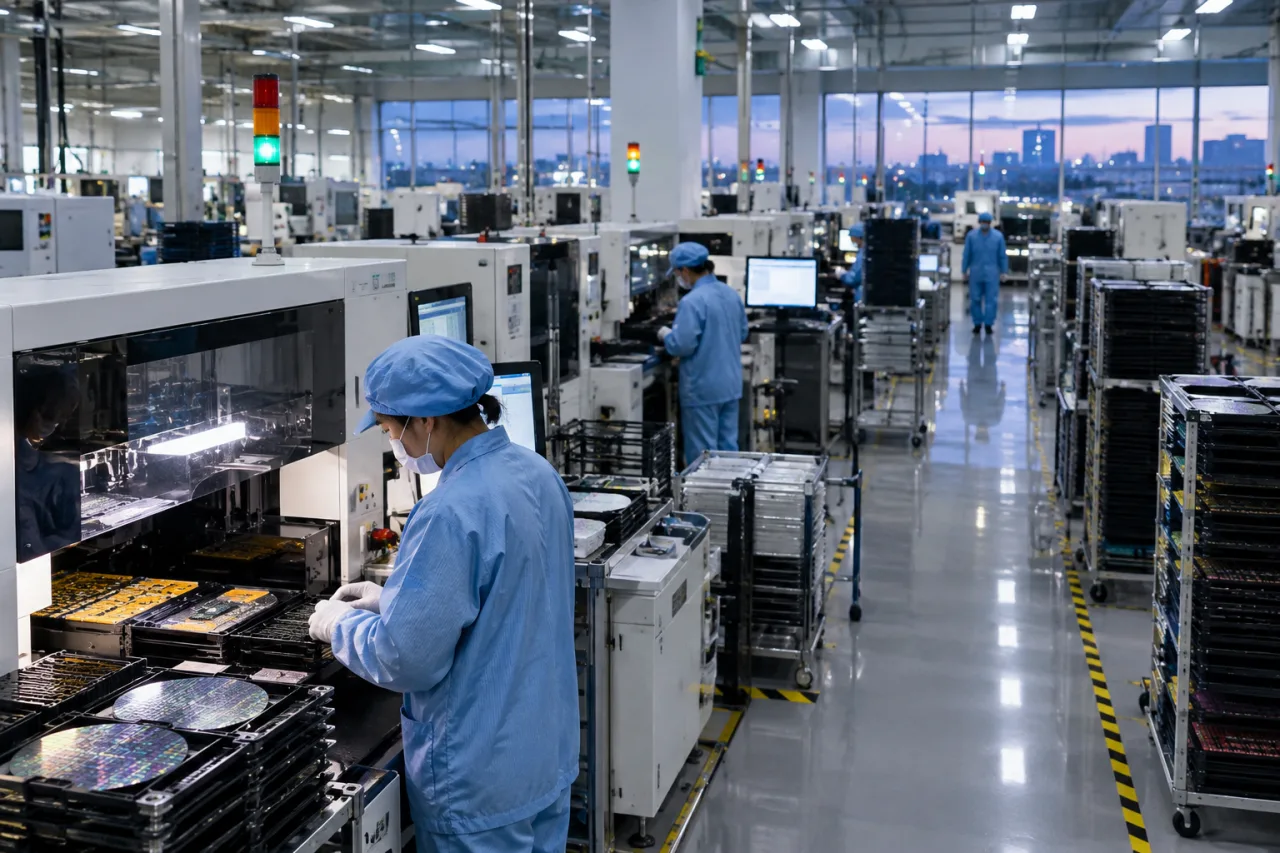
The industry logic first. AI and high-performance computing make chips larger and more complex, which pushes work into advanced packaging and testing, the steps that assemble chiplets into working products and prove they survive real loads. That makes packaging and testing the fastest-growing part of the value chain, and it is capital-lighter than a fab: a packaging or testing facility costs hundreds of millions, not the tens of billions a leading-edge wafer plant needs. Vietnam’s play is to own that middle of the chain the way its electronics sector already owns assembly: at volume, on time, at competitive cost, inside a supply chain that is actively re-shaping around AI demand.
The base is real. Vietnam semiconductors already sit inside global products through Intel’s largest packaging and test site in Ho Chi Minh City and Samsung’s enormous phone-production complex, which makes Samsung one of the country’s largest foreign investors. The AI-era move builds on physical presence, an installed workforce, and government policy that treats compute and now AI data centers as core national infrastructure.
Vietnam Semiconductors Buildout: FPT, Samsung, and the Race
Two announcements anchor the year, and both are specific:
- FPT’s plant (announced January 28, 2026, Hanoi). Vietnam’s largest tech company officially established the FPT Advanced Semiconductor Testing and Packaging Plant, expanding Vietnam’s role in the global semiconductor supply chain, per the announcement carried by VietnamPlus on January 28, 2026. FPT is not a newcomer: the company booked $2.66 billion in 2025 revenue and runs Nvidia-powered AI factories in Vietnam and Japan serving more than 18,000 clients, so the packaging plant extends an existing silicon services business rather than starting one.
- Samsung’s testing push (reported May 2026). Reuters reporting carried in May 2026 says Samsung Electronics plans roughly $1.5 billion (about 39 trillion Vietnamese dong) for a semiconductor testing facility in Thai Nguyen, one of Vietnam’s existing electronics heartlands, a move driven by rising AI chip demand, per the 2026 market tracker that documents the report.
Between and behind those two, the foreign investors already inside Vietnam semiconductors poured additional billions into new projects through 2026, per the October 21, 2026 investor tracking in Vietnam Investment Review. The pattern across all three is the same: packaging, testing, and assembly first, the layers Vietnam can staff today, with fabrication remaining the long game nobody is promising yet.
Compute and the Data-Center Layer: the $7 Billion Wave
Chips need somewhere to run, and Vietnam’s announced AI data-center investment has crossed $7 billion alongside the semiconductor buildout, per the hub tracker documenting the wave from G42, FPT, Samsung, Viettel, and Nvidia, projects including the Samsung C&T and CMC $1.3 billion hyperscale hub and Viettel’s 140 MW Tan Phu Trung facility. Ho Chi Minh City leads the concentration, with national policy designating AI data centers as core infrastructure and encouraging public-private partnership structures for entry, per the Vietnam AI data-center analysis.
The sovereign compute lane matters as much as the commercial one. Viettel, the state telecom giant, partnered with Nvidia to build a sovereign AI ecosystem, announced in Vietnam News on October 31, 2026, which pairs national AI infrastructure with the world’s dominant AI chipmaker, the relationship the Nvidia CEO has publicly described as making Vietnam his company’s second home. The practical signal: Vietnam is wiring its government, military-linked enterprises, and its largest private tech group into one compute stack, and doing it with the supplier that defines the AI hardware market. Regional context on why compute siting matters this much sits in our Southeast Asia AI infrastructure race analysis and the buildout economics in the AI capex explainer.
The Policy Stack: an AI Law Under the Chips
Vietnam is building the legal floor at the same speed. The Law on Artificial Intelligence No. 134/2025/QH15, passed by the National Assembly on December 10, 2025, took effect on March 1, 2026, making Vietnam the first Southeast Asian country with a comprehensive, binding national AI framework alongside its Vietnam semiconductors push, and follow-on implementation arrived with Circular 05/2026, per the analysis by Kim & Chang’s AI law briefing. For chip and data-center investors, the significance is predictability: the market’s rules of engagement for AI development and deployment are written law, not waiting drafts, a contrast with Indonesia’s and Malaysia’s pending instruments tracked in the regional funding and regulation map.
That legal certainty is itself an industrial asset. Packaging and testing plants run decade-long planning horizons; a market where AI governance is settled law prices one risk lower for Vietnam semiconductors than for its neighbours, and Vietnam’s government has leaned into that message by treating AI data centers as national infrastructure eligible for PPP structures.
What Vietnam Semiconductors Mean for the Regional Supply Chain
Zoom out and the announcements read as risk logic, not just growth logic. AI demand concentrated the world’s packaging and testing capacity in Taiwan, Malaysia, and a handful of sites, and every large buyer of AI hardware now prices the concentration risk of that geography. Vietnam semiconductors arriving at scale give the region’s buyers a second Southeast Asian packaging and testing option inside the same time zone, port system, and trade framework as their assembly lines, which is the practical version of diversification: not a new continent, just a new lane beside the existing one.
A worked scenario shows the mechanics. An AI server maker assembling systems for Southeast Asian customers currently ships chips to a Malaysian facility for packaging and testing, then to Vietnam for final assembly. With FPT’s plant ramping and Samsung’s testing facility building, the same maker can quote Vietnam for the silicon services step, cut inter-country freight and one customs cycle, and hold the whole flow inside Vietnamese industrial parks that already handle its mechanical assembly. Each week of lead time removed is a competitive product change, not a compliance footnote, and that is the demand signal behind both 2026 announcements.
The workforce reading follows the same line. Vietnam’s engineering pipeline, from university programs to the installed base running electronics plants, suits packaging and testing work, which hires process discipline more than frontier research pedigree. A country does not need Nobel-level device physics to run advanced packaging at world quality; it needs thousands of process engineers who hit yield targets for a decade, which is the workforce profile Vietnam’s electronics sector already produces and the reason the packaging-first sequence is credible rather than aspirational.
The Structural Constraints: What Could Slow the Hub
Four constraints decide whether the Vietnam semiconductors push becomes a functioning hub:
- The fab gap. Vietnam has no leading-edge wafer fabrication, and none is announced. The country’s seat is packaging, testing, and assembly, which grows with AI demand but never captures the highest-value slice of the chain.
- Talent depth. Packaging and test engineering talent exists, but AI-grade advanced packaging needs deep process specialists, and every regional hub is hiring from the same global pool. Vietnam’s universities scale programs, yet the pipeline lags the announcements.
- Power. Data centers at the announced scale need gigawatt-adjacent planning, grid upgrades, and credible renewable supply, and power timelines, not customer demand, increasingly gate when facilities go live.
- Competition. Malaysia’s Johor corridor and Singapore’s ecosystem are pursuing the same regional AI-compute dollars, and the region’s capital allocation patterns, documented in our funding coverage, still concentrate investment flows through Singapore.
None of these kills the thesis. They size it: Vietnam semiconductors in 2026 are a fast-growing packaging, testing, and compute hub with a first-mover legal framework, not yet a full-chain chip power, and the straightforward distinction between those two claims is exactly what separates useful coverage from hype.
One more planning lens before the FAQ: timing. Packaging and testing facilities move from announcement to qualified production in roughly the time a data center takes to build, which means the 2026 announcements land as operating capacity across 2027-2028, exactly when the region’s AI data-center wave needs its supply. That synchronization, chips services ramping as compute comes online, is what turns separate country bets into a functioning regional chain, and it is the schedule a watcher should hold both parts of the Vietnam story against.
The verdict line, written plainly: Vietnam semiconductors in 2026 look like a hub in the making, not a hub finished. The building blocks are real and dated, the legal floor exists, the compute wave is financed, and the constraints are ordinary industrial ones that money and years address. Watch the three signals that mark the transition from making to made: FPT’s plant reporting qualified production lines, Samsung’s testing facility announcing its ramp date, and the first hyperscale data center taking live AI workloads. When those three land, the hub claim stops being a forecast and becomes a line in the regional supply chain map.
FAQ
What did FPT announce about semiconductor packaging in Vietnam?
On January 28, 2026 in Hanoi, FPT Corporation officially announced the establishment of the FPT Advanced Semiconductor Testing and Packaging Plant, expanding Vietnam’s role in the global semiconductor supply chain. FPT is Vietnam’s largest tech company, with $2.66 billion in 2025 revenue and Nvidia-powered AI factories serving over 18,000 clients, so the plant extends an existing technology services base into chip packaging and testing.
How much is Samsung investing in Vietnam’s semiconductor push?
Reuters reporting carried in May 2026 says Samsung Electronics plans to invest approximately $1.5 billion, about 39 trillion Vietnamese dong, in a semiconductor testing facility in Thai Nguyen, driven by rising AI chip demand. Samsung is already one of Vietnam’s largest foreign investors through its electronics manufacturing complex.
When did Vietnam’s AI law take effect?
The Law on Artificial Intelligence No. 134/2025/QH15 was passed by the National Assembly on December 10, 2025 and took effect on March 1, 2026, with implementation circulars following. Vietnam is the first Southeast Asian country with a comprehensive, binding national AI framework.
How big is Vietnam’s AI data-center buildout?
Announced AI data-center investment has crossed $7 billion, per regional trackers, spanning deals from G42, FPT, Samsung, Viettel, and Nvidia, with a Samsung C&T and CMC $1.3 billion hyperscale hub and Viettel’s 140 MW Tan Phu Trung facility among the largest named projects. The government designates AI data centers as core national infrastructure and encourages PPP investment.
What is Nvidia’s role in Vietnam’s AI plans?
Viettel partnered with Nvidia to build a sovereign AI ecosystem, announced in Vietnam News on October 31, 2026, adding to Nvidia’s research and data-center agreements in the country and to the Nvidia-powered AI factories FPT already operates. The Nvidia CEO has publicly described Vietnam as his company’s second home, positioning the country as a strategic node in Nvidia’s regional footprint.
Can Vietnam become a full semiconductor hub with fabs?
Not on the current announcements. Vietnam’s 2026 buildout concentrates on packaging, testing, assembly, and compute, which is where its workforce, cost position, and policy support align. Leading-edge fabrication requires different capital scales, ecosystems, and timelines, and no Vietnamese fab project of that class has been announced, so the plain read for 2027 is a deepening packaging-and-compute hub rather than a fab power.
- en.vietnamplus.vn/fpt-announces-semiconductor-testing-packaging-plant… — VietnamPlus on January 28, 2026
- pionix.com.vn/vietnam-semiconductor-market-2026 — 2026 market tracker
- vir.com.vn/foreign-investors-pour-billions-into-vietnams-semiconducto… — Vietnam Investment Review
- blog.datacore.vn/en/vietnam-ai-data-center-2026 — Vietnam AI data-center analysis
- kimchang.com/en/insights/detail.kc?sch_section=4&idx=34937 — Kim & Chang’s AI law briefing
External sources linked in this article, in order of first mention. Spotted an error or a broken link? Tell us.
Cite this pagePublished Nov 12, 2026
Agron, E. (2026, November 12). Vietnam Semiconductors: How AI Demand Is Building the Next Chip Hub. WorldNgayon. https://worldngayon.com/vietnam-semiconductors-ai-chip-hub/
Agron, Edmon. “Vietnam Semiconductors: How AI Demand Is Building the Next Chip Hub.” WorldNgayon, 12 Nov. 2026, worldngayon.com/vietnam-semiconductors-ai-chip-hub/.
Agron, Edmon. “Vietnam Semiconductors: How AI Demand Is Building the Next Chip Hub.” WorldNgayon, November 12, 2026. https://worldngayon.com/vietnam-semiconductors-ai-chip-hub/.
Agron, E. (2026) ‘Vietnam Semiconductors: How AI Demand Is Building the Next Chip Hub’, WorldNgayon, 12 November. Available at: https://worldngayon.com/vietnam-semiconductors-ai-chip-hub/.
E. Agron, “Vietnam Semiconductors: How AI Demand Is Building the Next Chip Hub,” WorldNgayon, Nov. 12, 2026. [Online]. Available: https://worldngayon.com/vietnam-semiconductors-ai-chip-hub/
@online{agron2026vietnamsemiconductors,
  author       = {Agron, Edmon},
  title        = {{Vietnam Semiconductors: How AI Demand Is Building the Next Chip Hub}},
  year         = {2026},
  date         = {2026-11-12},
  organization = {WorldNgayon},
  url          = {https://worldngayon.com/vietnam-semiconductors-ai-chip-hub/},
  urldate      = {}
}TY - ELEC AU - Agron, Edmon TI - Vietnam Semiconductors: How AI Demand Is Building the Next Chip Hub T2 - WorldNgayon PY - 2026 DA - 2026/11/12/ UR - https://worldngayon.com/vietnam-semiconductors-ai-chip-hub/ Y2 - ER -
Cite the version you read; the page may be updated. Zotero and Mendeley can also import this page directly.