Table of Contents
Key Takeaway
- 🔑 The Case: The fake OEC interception at Clark Airport stopped a 45-year-old Filipina bound for Dubai on July 24, 2026, after the Bureau of Immigration’s system detected her falsified Overseas Employment Certificate in real time.
- ⚡ The System: The BI’s immigration system is now directly linked to the Department of Migrant Workers database, enabling instant verification of every OEC presented at any Philippine airport.
- 📊 The Scale: From 2020 to 2026, the DMW reported 146,871 illegal recruitment posts removed from Facebook and 57,557 from TikTok — and approximately 1,700 aspiring OFWs rescued from a single illegal recruitment scheme.
- 🎯 The Warning: BI Commissioner Joel Anthony Viado stated that the old ways of faking OECs will no longer work because verification is now fully digital and online.
- 📜 What You Must Do: Before you fly, verify your recruiter through DMW’s official channels, never accept documents handed to you by fixers, and confirm your OEC through the DMW online portal.
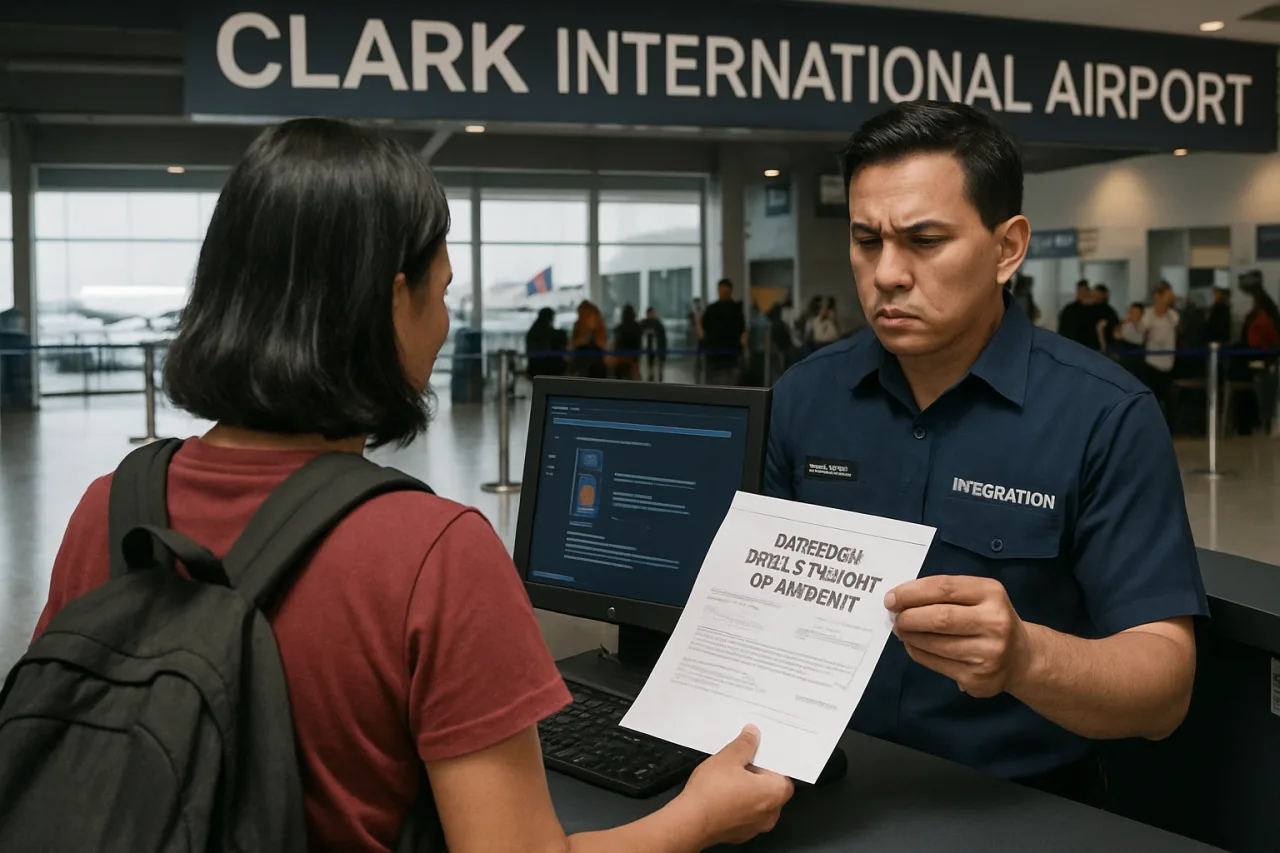
The fake OEC interception at Clark Airport is not an isolated incident. A 45-year-old Filipina walked into Clark International Airport on July 24, 2026, carrying what she believed was a legitimate Overseas Employment Certificate. She was wrong. Her recruiter had handed her a falsified document, and she did not know it. Within minutes, the Bureau of Immigration’s system — now directly connected to the Department of Migrant Workers database — flagged the alteration. She never boarded her flight to Dubai. The fake OEC interception at Clark Airport is not just one woman’s story. It is a signal that the infrastructure protecting Filipino workers at the departure gate has fundamentally changed, and every aspiring OFW needs to understand what that means before they fly.
This is not a warning about one incident. It is a look at the system that made the interception possible, the scale of the illegal recruitment industry it is fighting, and the specific steps every departing worker must take to avoid becoming the next person pulled aside at the airport. The technology has evolved. The threats have not gone away. The gap between what workers know and what the system now detects is where the danger lives.
How the Interception Actually Worked
The details, confirmed by the Bureau of Immigration’s official statement and reported by both the Daily Tribune and Gulf News, are straightforward but revealing. The passenger was scheduled to depart for Dubai on a connecting flight. During a routine immigration inspection, she presented her OEC — the document that certifies a worker’s employment has been properly registered with the DMW and serves as their exit clearance from the Philippines.
The document looked normal. But when immigration officers cross-checked it against the DMW database — now directly linked to the BI’s integrated system — the verification revealed that the certificate had been altered. The system did not require a phone call, a manual lookup, or a secondary inspection. It flagged the discrepancy instantly, the way a credit card transaction is declined when the numbers do not match.
BI Commissioner Joel Anthony Viado explained the significance: “The Bureau’s system is now directly connected to the Department of Migrant Workers’ database, allowing our officers to instantly verify the authenticity of every Overseas Employment Certificate. The old ways of faking OECs will not work anymore because everything is now online.” This is the infrastructure shift that makes the fake OEC interception at Clark Airport a turning point rather than a one-off catch. Every OEC presented at every Philippine airport is now checked against a live database in real time.
The Woman Behind the Document
During questioning, the passenger revealed that she had been recruited to work as a nanny for an Egyptian employer. She told authorities she had not known the OEC was fake — her recruiter had handed it to her without explanation. This detail matters because it shifts the focus from the worker to the recruitment pipeline that produced the fraudulent document. The passenger was not a forger. She was a passenger, carrying a piece of paper someone else had tampered with, heading to a job she may have genuinely believed was legitimate.
After the fake OEC interception, the passenger was turned over to the Inter-Agency Council Against Trafficking (IACAT), which provides support services to victims and pursues charges against those responsible for illegal deployment. This means the system did not just stop her at the gate — it routed her into a support framework designed to go after the people who created the fake document in the first place. The global anti-scam alliance framework that connects Philippine agencies with international anti-trafficking networks is part of the same infrastructure that caught her document.
The Scale of Illegal Recruitment in 2026
The fake OEC interception at Clark Airport is a single data point in a much larger landscape. The Department of Migrant Workers has documented the scale of the illegal recruitment industry with specific numbers. From 2020 to 2026, the DMW reported that 146,871 illegal recruitment-related posts were taken down from Facebook, and 57,557 were removed from TikTok. These are not estimates — they are documented platform removals, each representing a post that potentially targeted an aspiring overseas worker.
In a separate case, approximately 1,700 aspiring OFWs were rescued from an alleged large-scale illegal recruitment scheme offering jobs in Poland, Lithuania, and the Czech Republic. The DMW has warned about a surge in fake overseas job offers and online scams, noting that illegal postings frequently misuse the names, addresses, and logos of legitimate, DMW-licensed recruitment agencies. This means the fake OEC found at Clark Airport was not an isolated forgery — it was the output of an industry that operates across social media platforms, recruitment networks, and document forgery rings.
The Tribune also reported a related case the same week: two OFWs were intercepted at Clark — one a potential human trafficking victim and another with a fake OEC. The fact that multiple fake OEC interceptions occurred at the same airport within the same period suggests the problem is systemic, not incidental. The BI also reported rescuing 14 suspected human trafficking victims at Manila and Clark airports in a separate operation. The fake OEC interception at Clark Airport is one visible outcome of a much wider enforcement net.
Why the OEC Matters — and Why Faking It Is Dangerous
The Overseas Employment Certificate is not a formality. It is the document that certifies a worker’s employment has been properly registered with the DMW, serves as their exit clearance from the Philippines, and exempts them from travel tax and airport terminal fees. Without a valid OEC, a worker departing for overseas employment is undocumented — which means they lose the protections that come with official DMW registration, including access to the Migrant Workers Office network, legal assistance through the Assistance to Nationals program, and repatriation support if their situation abroad deteriorates.
The digital OFW Pass is gradually replacing the printed OEC, with 24 airlines now accepting the digital version. But the transition creates its own vulnerability: workers who do not understand the new system may be more susceptible to recruiters who offer to “handle” the paperwork for them. The fake OEC interception at Clark Airport shows exactly what happens when that trust is misplaced. The recruiter handed the worker a document. The worker assumed it was legitimate. The system proved it was not.
The Digital Verification Shift — and What It Means for Every Worker
Before the BI-DMW database integration, verifying an OEC required manual checks that could take time and relied on the vigilance of individual immigration officers. Forged documents could pass if they looked convincing enough. The system was only as strong as the person inspecting the paper. The integration changes that equation entirely. Every OEC is now checked against a live database. Every alteration is flagged. Every discrepancy triggers an interception.
This is the same digital transformation that has reshaped OFW travel declaration systems and border management worldwide. The Philippines is not unique in deploying digital verification at its borders — but the specific integration between the immigration system and the migrant workers database is notable because it targets the exact document that illegal recruiters most frequently forge. The fake OEC interception at Clark Airport is proof that the system works. The question is whether workers know it works.
Here is the critical gap: the technology has outpaced public awareness. Most aspiring OFWs do not know that their OEC will be checked against a live database in real time. Many still believe that if a recruiter hands them a document that looks official, it is official. The fake OEC interception at Clark Airport demonstrates that this assumption is now fatal — not to the worker’s safety, because the system caught her, but to their travel plans, their employment opportunity, and potentially to the recruiter’s liberty.
What Every OFW Must Check Before Flying
The fake OEC interception at Clark Airport provides a clear checklist for any Filipino worker preparing to depart for overseas employment:
1. Verify your recruiter through DMW. The DMW maintains a public database of licensed recruitment agencies. Before accepting any job offer, confirm that your recruiter is on that list. The DMW has repeatedly warned that illegal postings misuse the names and logos of legitimate agencies — so do not rely on a Facebook post or a WhatsApp message as proof of legitimacy.
2. Process your OEC through official channels only. The DMW’s online services portal at onlineservices.dmw.gov.ph allows workers to secure their OEC or OFW Pass digitally. Do not accept a printed OEC from a recruiter, a fixer, or anyone who claims to “have connections.” The fake OEC interception at Clark Airport happened because the passenger accepted a document from her recruiter without verifying it independently.
3. Check your OEC status online before you fly. If your OEC is legitimate, it will appear in the DMW database. If it does not appear, or if the details do not match what you were given, do not go to the airport. The system that caught the 45-year-old Filipina at Clark will catch you too — but you will not have a flight to board.
4. Report suspicious recruiters to IACAT or DMW. The Inter-Agency Council Against Trafficking handles cases of illegal recruitment and document forgery. The economic pressures that push Filipinos abroad create a market that illegal recruiters exploit. Reporting them protects not just yourself but the next worker who would have been given the same fake document.
The Bigger Picture: Digital Borders and Worker Protection
The fake OEC interception at Clark Airport sits at the intersection of three trends that will define OFW protection in the coming years. First, the digitization of deployment documents — the OEC is becoming the OFW Pass, printed papers are becoming digital records, and verification is moving from manual inspection to database cross-checking. Second, the integration of agency databases — the BI and DMW are now linked, but the vision extends to connecting with overseas Philippine embassies, Migrant Workers Offices, and international anti-trafficking networks. Third, the enforcement of recruitment standards — the takedown of 146,871 illegal recruitment posts from Facebook and 57,557 from TikTok represents a sustained, multi-year effort to dismantle the digital infrastructure of illegal recruitment.
The risk that remains is not technological. It is informational. The system works. The question is whether the workers who need it most know it exists. The 45-year-old Filipina at Clark Airport did not know her OEC was fake until the system told her. If she had known how to verify it herself, she would have discovered the fraud before she packed her bags. The fake OEC interception at Clark Airport is a success story for enforcement — but it is also a reminder that the best protection is a worker who knows what to check before they fly.
Frequently Asked Questions About Fake OEC Interception
What is a fake OEC interception?
A fake OEC interception occurs when Philippine immigration officers detect a falsified Overseas Employment Certificate at an airport departure point. The fake OEC interception at Clark Airport on July 24, 2026, involved a 45-year-old Filipina whose altered OEC was flagged by the BI’s system linked to the DMW database.
How does the BI-DMW database integration work?
The Bureau of Immigration’s system is directly connected to the Department of Migrant Workers database, allowing immigration officers to instantly verify the authenticity of every OEC presented at any Philippine airport. The fake OEC interception at Clark Airport demonstrated that the system detects alterations in real time without manual checks.
What happens to a worker caught with a fake OEC?
The worker is prevented from boarding their flight and is turned over to the Inter-Agency Council Against Trafficking (IACAT), which provides support services and pursues charges against those responsible for the illegal deployment. In the Clark Airport case, the passenger was referred to IACAT for assistance.
How can I verify my OEC is legitimate before flying?
You can verify your OEC through the DMW’s online services portal at onlineservices.dmw.gov.ph. If your OEC does not appear in the database, or if the details do not match, do not proceed to the airport. The fake OEC interception system will flag any discrepancy.
How common is illegal recruitment in the Philippines?
The DMW reported that from 2020 to 2026, 146,871 illegal recruitment posts were removed from Facebook and 57,557 from TikTok. In a single case, approximately 1,700 aspiring OFWs were rescued from an illegal recruitment scheme offering jobs in Poland, Lithuania, and the Czech Republic.
Is the printed OEC being replaced?
Yes. The digital OFW Pass is gradually replacing the printed OEC, with 24 airlines now accepting the digital version. However, the transition does not eliminate the risk of fraud — workers must still verify their documents through the DMW portal before departure.
What should I do if my recruiter gives me an OEC?
Do not accept any OEC directly from a recruiter without independently verifying it through the DMW online portal. The fake OEC interception at Clark Airport occurred precisely because a worker accepted a document from her recruiter without knowing it had been altered. Always process your OEC through official DMW channels.
OFW Advisory: This article is based on publicly reported statements from the Bureau of Immigration, the Department of Migrant Workers, and news reports from the Daily Tribune and Gulf News. It does not constitute legal advice. Workers seeking overseas employment should consult the DMW’s official website and licensed recruitment agencies for current requirements and verification procedures.