Table of Contents
Key Takeaway
- 🛒 A cybersecurity label is now the fastest tell on a smart device’s safety, and learning to read one takes about five minutes, and Singapore’s CSA runs the region’s first scheme, with more than 250 labelled products listed, from Wi-Fi routers to IP cameras.
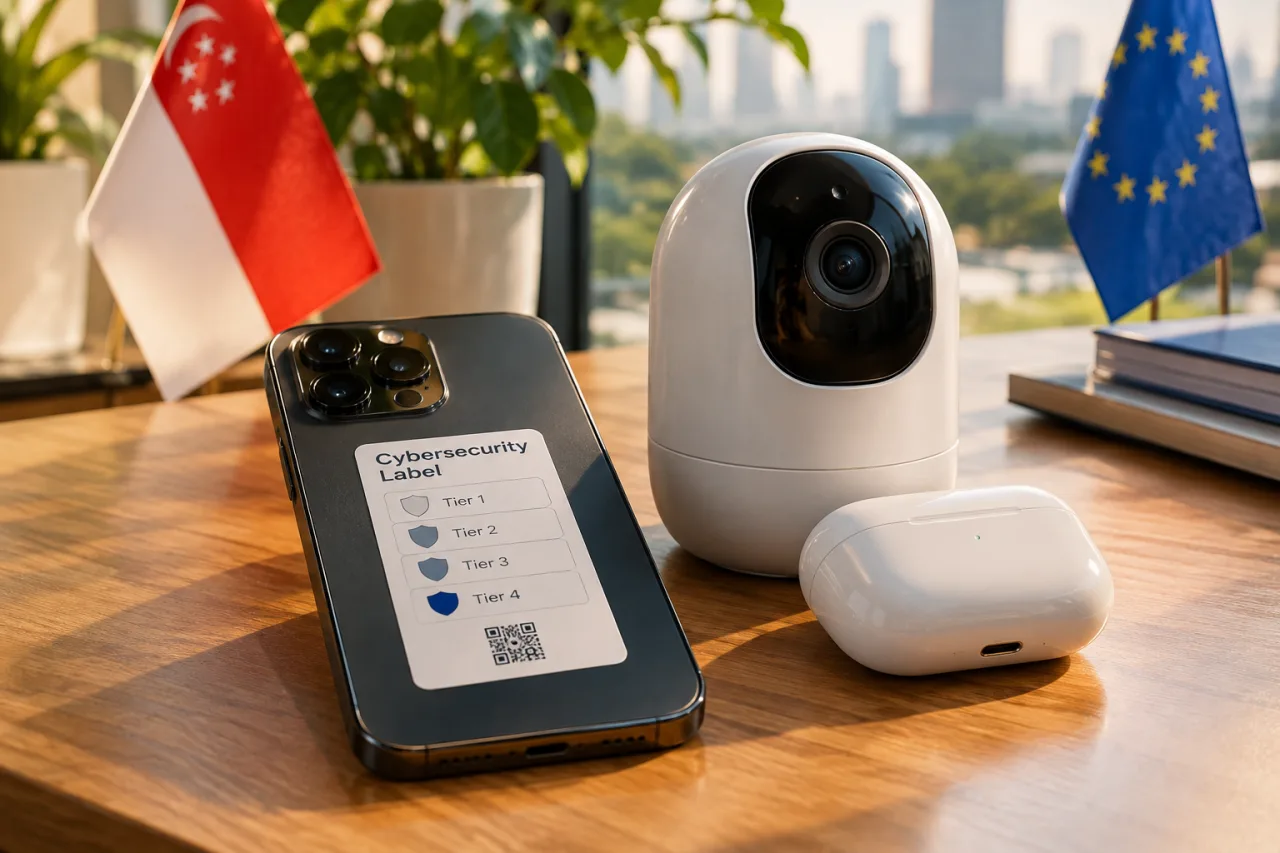
- 🏷️ Singapore’s Cybersecurity Labelling Scheme (CLS) grades consumer IoT into four levels: a longer label means the maker shipped more verified security, so shoppers can compare devices by tier before checkout.
- 🌏 The label landscape is going regional and mandatory: Australia’s smart-device security standard is in force, China launched a voluntary label on July 1, 2026, and Japan’s JC-STAR scheme now mutually recognizes with Singapore’s labels.
- 🇪🇺 The EU’s Cyber Resilience Act started enforcing vulnerability and incident reporting on September 11, 2026, which pushes labelled, patch-supported devices into global supply chains, including SEA’s.
- ✅ Tonight-action: before your next router, camera, or TV purchase, search the model on the label registry, prefer tier 3-4, and confirm the maker prints an end-of-support date.
Two smart devices with the same features can carry completely different security inside, and price tags no longer reveal which is which. That information gap is what the cybersecurity label solves: a public grading scheme that tells shoppers how much verified security a device ships with, enforced by national programs rather than marketing claims. Singapore built the region’s first, Australia’s mandatory standard has been law since March 2025, China’s label arrived in July 2026, and the EU’s Cyber Resilience Act began enforcing its reporting phase in September 2026. This guide explains what each label means, how to read the tiers, and the five-minute check that turns any gadget aisle into a defensible purchase, written for households and small offices buying routers, cameras, doorbells, TVs, and the rest of the connected home.
What a Cybersecurity Label Actually Tells You
A label is a checked claim, not a badge of good faith. Under Singapore’s Cybersecurity Labelling Scheme for consumer IoT, the Cyber Security Agency of Singapore (CSA) grades devices across four levels, from baseline hygiene (unique default passwords, timely update promises) through to the top tier that requires independent lab testing of the build, per the official Cyber Security Agency of Singapore program pages and certification partners like UL Solutions. The design intent shows in the label’s structure: as the level rises, so do the proofs behind it, from maker self-declaration at the bottom toward third-party evaluation at the top. Shoppers reading the label therefore learn three things at once: whether the device resists basic takeovers, whether the maker commits to security updates, and whether anyone other than the maker ever verified those claims.
The scheme exists because default passwords and abandoned firmware did the damage: home cameras, routers, and DVRs remain the classic entry points for botnets and the credential-harvesting waves our infostealer check guide documents from the inside.
How to Read the Four Levels Before You Buy
The tiers translate into a shopping decision:
- Level 1: maker self-attests baseline controls, including the end of default passwords and a vulnerability-update commitment. Acceptable for low-risk devices that hold no camera footage and touch no accounts.
- Level 2: adds documented vulnerability management; suitable for the always-on devices that sit on your home network for years.
- Level 3: independent testing of core security requirements; the sensible tier for anything with a camera or microphone in a bedroom or office.
- Level 4: structured lab assessment of the full build; the tier to prefer for routers and hubs, the devices every other device trusts.
The registry itself answers the rest: the CSA lists labelled models publicly (today more than 250 products across routers, smart home hubs, lighting, appliances, and IP cameras, per the scheme’s OECD policy record), so the check is a model search, not a shelf inspection.
Labels pair naturally with the lockdown routines our device guides teach: our smart TV lockdown walkthrough and the Ring camera hardening piece both assume you already picked hardware that will still receive updates next year, which is exactly what the label verifies.
The Label Landscape Around the Region
Singapore’s scheme is the regional reference, not the only one:
- Australia: mandatory minimum security standards for connectable smart devices took effect in 2025, covering default passwords, update commitments, and vulnerability disclosure; the Connected Technology Alliance’s scheme summary tracks the rule set.
- China: a voluntary cybersecurity label for internet-connected products launched July 1, 2026, aimed squarely at the world’s largest device supply base, meaning labelled competition now arrives from both directions.
- Japan: a mutual-recognition arrangement lets devices certified under Japan’s JC-STAR scheme carry Singapore’s label, expanding the labelled shelf without duplicating testing.
- The EU’s force multiplier: the Cyber Resilience Act entered into force in December 2024, and from September 11, 2026 manufacturers must run vulnerability handling and incident reporting, per the compliance trackers at OneKey and Hunton. The act’s full requirements phase in through the end of 2027, but the reporting obligation already reshapes what global makers consider shippable, per the OneKey CRA timeline.
The trajectory reads the same everywhere: security moves from brochure claims to checked, dated, revocable commitments, and the labels are how that information reaches the checkout aisle, and the cybersecurity label tier is the number to compare first.
The Five-Minute Shopping Check
Run this sequence before any connected-device purchase:
- Minute 1: search the registry. Look up the exact model in the label registry; absence is not disqualification, but presence with a tier verdict is verified information.
- Minute 2: find the support window. The maker’s product page should print an end-of-support date or an update-commitment period. No date, no purchase.
- Minute 3: check the password story. Confirm the device ships without a universal default password, or with a forced first-setup password change.
- Minute 4: check the disclosure record. One search on the maker plus “vulnerability” shows whether advisories exist and whether past issues got patched in public.
- Minute 5: plan placement. No label and no update promise means the device stays off the main network, away from bedrooms, ideally on a guest VLAN, a compromise our smart-device hardening guides document step by step.
The check converts label absence from anxiety into policy: labelled tiers 3-4 buy trust, labelled tier 1-2 buys baseline, and the unlabelled remainder buys suspicion plus network isolation.
What This Means for Regional Shoppers and Small Offices
For Southeast Asian households and small businesses, the practical shift is supply-side: the labels that now cover Singapore, Japan, and Chinese-made devices increasingly appear on regional shelves, and EU reporting duties push the same security posture through global supply lines regardless of where a device sells. Buying labelled does two things at once: it protects your own network, and it prices security into the market so unlabelled competition has to improve. Small offices should apply a stricter rule than homes: label or VLAN, because the router and camera estate in a small business sits inside the same exposure zone as the payment terminal, an overlap our small-business security checklist treats as one continuous surface.
The regional trajectory is set: more schemes, more mutual recognition, and heavier obligations on makers. A buyer who learns one label system now, Singapore’s four levels, is learning the vocabulary every other scheme is converging toward.
The Maker’s Side: Why Cybersecurity Labels Are Becoming a Competitive Tool
The label matters as much to the seller as to the shopper, and that is why the scheme spreads. A cybersecurity label converts a manufacturer’s security work into shelf-visible differentiation: two routers at the same price point stop competing purely on Wi-Fi speed once one carries a tier-3 grade the other cannot claim. Procurement feels the same pressure earlier than consumers do; tenders from regional banks, telcos, and enterprises increasingly ask for labelled or standard-compliant devices in their purchasing terms, which means a maker without a label loses deals that never reach a shelf. The reporting duties under the EU regime sharpen the arithmetic further, because global makers now run vulnerability-handling processes for one market and discover the same processes serve every market. The result visible in the region’s showrooms: label participation moved from compliance cost to market access, and the tier a device carries has become part of the product’s identity, a sentence in the marketing copy that shoppers can actually verify.
For resellers and small distributors, the label simplifies the hard conversation. stock lists can be filtered by label tier, warranty desks gain a clean security baseline, and post-sale support inherits a device whose update promises have a printed shelf life. The household gains safety; the trade chain gains verifiability; the region gains the vocabulary, four levels, registry, mutual recognition, that will outlast whichever scheme ships first.
One more lens before the FAQ: what the label does not do. It does not audit a maker’s business model, subscription strategy, or data harvesting, and a tier-4 camera still sends footage to a cloud whose policies you should read. The label answers the device question; the account question (where your footage lives, who sees it, what happens when it expires) remains yours. Read both: label for the hardware, privacy notice for the platform, and the five-minute check for the seller you are trusting with the warranty. Households that run this two-question habit, security tier plus account destination, end every argument about a gadget’s safety before the receipt prints, and they hold the strongest position a smart-device owner can have: a labeled, dated, patch-supported product on a network segment that matches its trust level. The cybersecurity label made that position purchasable, which is the quiet revolution this whole scheme represents.
A Worked Example: Two Cameras on One Shelf
Make the label concrete with the decision most households actually face. Two IP cameras, same resolution, similar price. Camera A carries no label; its product page lists nothing about update windows, and its setup guide buries the password policy on page nine. Camera B carries a Singapore tier-3 grade: independent testing of its build, a printed update commitment through a dated horizon, and the maker’s vulnerability advisories one search away. In the old market the decision was aesthetic. In the labeled market it is arithmetic: A demands the guest-VLAN treatment, an isolated power supply, and a yearly firmware reassessment you will never actually schedule, while B earns the bedroom with a five-minute verification. Multiply that arithmetic across the eleven connected devices an average home runs and the label becomes the single highest-leverage check a household makes all year.
Then run the same logic through the supply chain of a small cafe: the router, the four security cameras, the smart TVs, the payment tablet’s dock, the smart doorbell. The labeled-versus-unlabeled split sorts the estate into a trust tier and an isolation tier in one afternoon, and the ordering list for the next purchase cycle writes itself, which is exactly what a cybersecurity label is supposed to compress: weeks of vendor research into a printed tier a shopper reads in seconds.
FAQ
What is a cybersecurity label on a smart device?
A public grading that states how much verified security a connected device ships with. Singapore’s Cybersecurity Labelling Scheme grades consumer IoT in four levels, from maker self-attested baseline controls up to independently lab-tested builds, and publishes the labelled models in a searchable registry.
How many levels does Singapore’s CLS have?
Four. Level 1 covers maker-declared basics such as no universal default passwords and an update commitment, levels 2 and 3 add documented vulnerability management and independent testing, and level 4 subjects the full build to structured lab assessment.
Does a label mean the device cannot be hacked?
No. A label certifies the shipped security posture and the maker’s update commitments at grading time. It removes the worst outcomes, default passwords, silent firmware, and abandoned support, but no connected device is unhackable, which is why the placement and network-segmentation advice still applies.
Is a device without a label unsafe?
Not automatically, but unverified. Absence means the security claim stays a marketing statement: the maker may be excellent, yet the shopper has no checked evidence. The five-minute check covers this case by demanding a printed support window, a password story, and a public disclosure record before the device earns network trust.
Do labels apply outside Singapore?
Schemes now run or are launching across the region: Australia’s mandatory smart-device standard has been in force since 2025, China launched a voluntary label on July 1, 2026, Japan’s JC-STAR certificates mutually recognize with Singapore’s labels, and the EU’s Cyber Resilience Act began enforcing vulnerability and incident reporting on September 11, 2026 with its main obligations through 2027.
The label story compresses to a habit: registry search, tier read, support window, password story, disclosure scan. Five minutes that outlast the cheapest gadget in the cart.
Which devices deserve the highest label tier?
The devices every other device trusts: routers, smart home hubs, and network-attached cameras. Those sit at the center of the home network and of the threat statistics, so prioritizing labelled tier 3-4 devices there delivers the largest safety gain per dollar spent.
The label habit also ages well: schemes evolve, tiers tighten, and mutual recognition spreads, so the registry check you learn today keeps working as the region’s label landscape expands around it.
- Official csa.gov.sg/our-programmes/certification-and-labelling-schemes/cyberse… — official Cyber Security Agency of Singapore program pages
- depp.oecd.org/policies/SGP1715 — OECD policy record
- connectedtechnologyalliance.com.au/labellingscheme — Connected Technology Alliance’s scheme summary
- onekey.com/press-release/cyber-resilience-act-phase-1--reporting-requ… — OneKey CRA timeline
External sources linked in this article, in order of first mention. Spotted an error or a broken link? Tell us.
Cite this pagePublished Nov 12, 2026
Agron, E. (2026, November 12). Shopping for Safer Smart Devices: How Singapore’s Cybersecurity Label Leads the Region. WorldNgayon. https://worldngayon.com/cybersecurity-label-smart-devices/
Agron, Edmon. “Shopping for Safer Smart Devices: How Singapore’s Cybersecurity Label Leads the Region.” WorldNgayon, 12 Nov. 2026, worldngayon.com/cybersecurity-label-smart-devices/.
Agron, Edmon. “Shopping for Safer Smart Devices: How Singapore’s Cybersecurity Label Leads the Region.” WorldNgayon, November 12, 2026. https://worldngayon.com/cybersecurity-label-smart-devices/.
Agron, E. (2026) ‘Shopping for Safer Smart Devices: How Singapore’s Cybersecurity Label Leads the Region’, WorldNgayon, 12 November. Available at: https://worldngayon.com/cybersecurity-label-smart-devices/.
E. Agron, “Shopping for Safer Smart Devices: How Singapore’s Cybersecurity Label Leads the Region,” WorldNgayon, Nov. 12, 2026. [Online]. Available: https://worldngayon.com/cybersecurity-label-smart-devices/
@online{agron2026cybersecuritylabel,
  author       = {Agron, Edmon},
  title        = {{Shopping for Safer Smart Devices: How Singapore’s Cybersecurity Label Leads the Region}},
  year         = {2026},
  date         = {2026-11-12},
  organization = {WorldNgayon},
  url          = {https://worldngayon.com/cybersecurity-label-smart-devices/},
  urldate      = {}
}TY - ELEC AU - Agron, Edmon TI - Shopping for Safer Smart Devices: How Singapore’s Cybersecurity Label Leads the Region T2 - WorldNgayon PY - 2026 DA - 2026/11/12/ UR - https://worldngayon.com/cybersecurity-label-smart-devices/ Y2 - ER -
Cite the version you read; the page may be updated. Zotero and Mendeley can also import this page directly.