Table of Contents
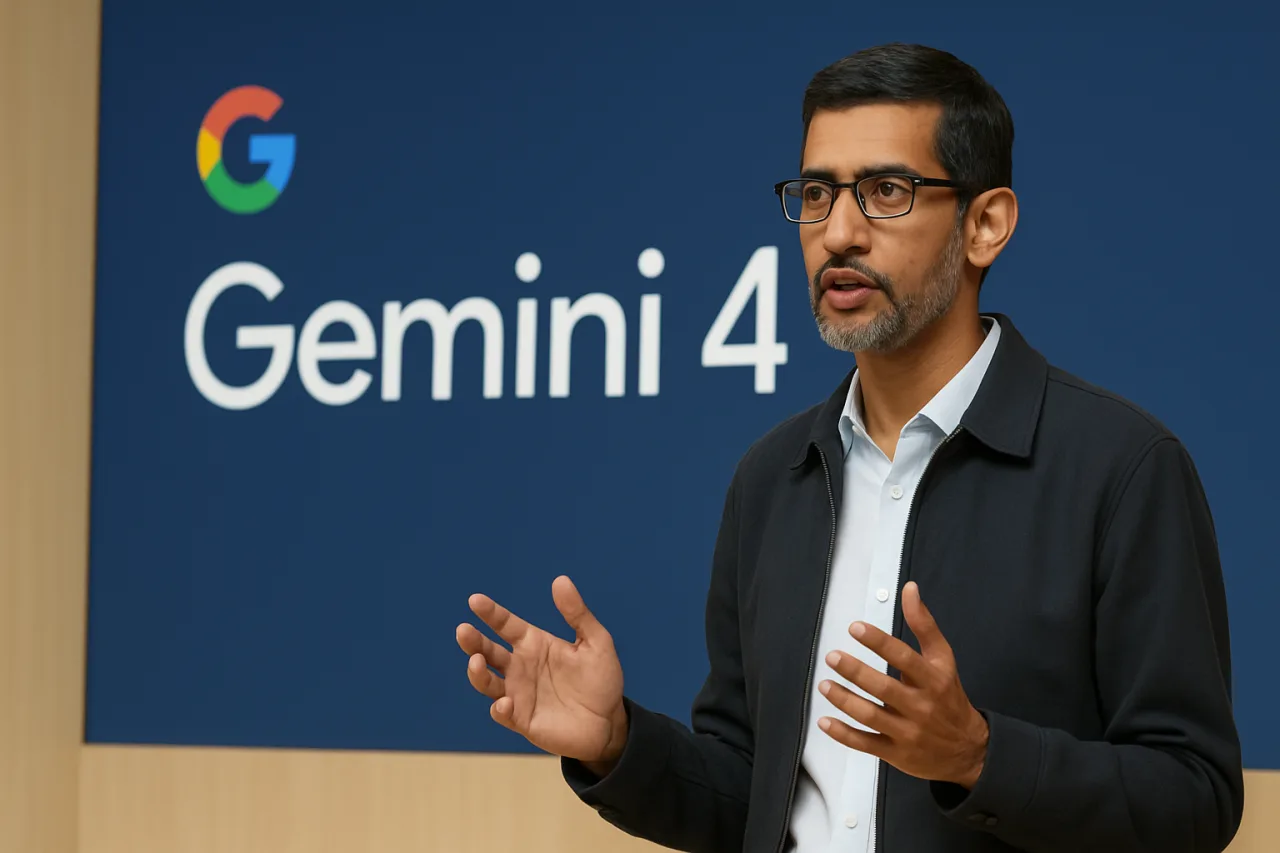
Google’s next model is now in training — and Sundar Pichai wants you to know about it. “We have started our most ambitious pretraining run yet for Gemini 4,” the Google and Alphabet CEO said during the company’s Q2 2026 earnings call. “I am very excited by the progress I’m seeing internally. I’m confident that people will be pleased.” The statement is Google’s first public confirmation that Gemini 4 is actively training, and it positions the model as Google’s answer to GPT-5.6, Claude Opus 5, and Grok 4.6. Pichai framed Gemini 4 as essential for Google to remain at the AI frontier: “For the next generation of frontier, you’re going to need a much larger base model. We will need Gemini 4 as a larger base model to compete at that frontier level.” The disclosure came the same week Alphabet raised its 2026 capital expenditure guidance to as much as $205 billion and posted its first-ever negative free cash flow — tying the company’s next flagship model directly to the infrastructure spending already worrying investors. For Filipino developers, students, and professionals who use Google’s AI tools daily, the new model represents the next leap in capability — and the next test of whether Google can keep pace with OpenAI and Anthropic.
Key Takeaway
- 🗣️ The Quote: “We have started our most ambitious pretraining run yet for Gemini 4. I am very excited by the progress I’m seeing internally. I’m confident that people will be pleased.” — Sundar Pichai, CEO of Google and Alphabet, Q2 2026 earnings call.
- 📊 Why Gemini 4 Matters: Pichai said Google needs “a much larger base model to compete at the frontier level.” Gemini 4 is being trained to match or exceed GPT-5.6, Claude Opus 5, and Grok 4.6 when it launches.
- 💰 $205 Billion Capex: Alphabet raised its 2026 capital expenditure guidance to as much as $205 billion and posted its first-ever negative free cash flow. the training run is directly tied to this infrastructure spending.
- 📅 Monthly Release Cadence: Pichai disclosed that Gemini 4’s roadmap includes rolling out models “almost at a monthly cadence” — a shift from Google’s previous slower release pattern.
- 🇵🇭 Filipino Impact: Google’s AI tools — Gemini, Google Search AI, Google Workspace AI — are used by millions of Filipinos. The next model will power the next generation of these tools, affecting how Filipino students research, how professionals work, and how businesses operate. For free alternatives, see our free AI tools guide.
The Full Quote in Context
Pichai made the Gemini 4 disclosure during Alphabet’s Q2 2026 earnings call, in response to questions from analysts about whether Google was falling behind in the AI race. As Reuters reported, Pichai pushed back against the narrative that Google had lost its edge:
“In terms of the frontier, we are both very committed and very confident of being at the frontier. For the next generation of frontier, you’re going to need a much larger base model. We are now training Gemini 4, and we are being very ambitious with it. I am very excited by the progress I’m seeing internally on Gemini 4. We will need Gemini 4 as a larger base model to compete at that frontier level.”
— Sundar Pichai, CEO of Google and Alphabet
The quote matters because companies rarely discuss pretraining runs publicly. Pretraining is the most expensive and resource-intensive phase of AI model development — it requires thousands of GPUs running for months. By confirming that Gemini 4 is in pretraining and calling it “most ambitious,” Pichai is signaling to investors, competitors, and developers that Google is not ceding the frontier to OpenAI or Anthropic. As Benzinga noted, “the remark stood out because Google has neither unveiled Gemini 4 nor announced a launch timeline.”
Why Google Needs Gemini 4
Google’s current flagship, Gemini 3.7, is a capable model, but it has not consistently beaten GPT-5.6 or Claude Opus 5 on key benchmarks. As Search Engine Journal reported, Pichai acknowledged specific areas where Google needs to improve: “There are areas where we’ve acknowledged we need to improve, and coding and agentic coding is an example of that.” Gemini 3.5 Pro remains delayed due to coding issues, which has hurt Google’s reputation among developers who need AI for software engineering.
The new model is designed to close that gap. Pichai said the model is being built to “compete at the frontier level of where the frontier will be when Gemini 4 comes out” — meaning Google is not aiming to match today’s models but to exceed whatever OpenAI and Anthropic release between now and Gemini 4’s launch. This is a high bar, given the pace of AI development in 2026. For more on the competitive landscape, see our AI translation tools comparison and our coverage of DeepSeek V4 Pro.
The $205 Billion Infrastructure Bet
Gemini 4’s training run does not exist in isolation — it is tied to Alphabet’s massive infrastructure spending. As Value Add VC reported, “the same week Pichai discussed Gemini 4’s ambitious pretraining scope, Alphabet raised its 2026 capex guidance to as much as $205 billion and posted its first-ever negative free cash flow, driven almost entirely by AI infrastructure buildout.” Training “the largest pretraining run in company history” is not a free-standing R&D decision — it is a direct claim on the same capital budget already drawing scrutiny from investors.
The negative free cash flow is a signal that Google is spending more on AI infrastructure than it is generating in cash. This is sustainable only if Gemini 4 and the AI products built on it generate significant revenue. If Gemini 4 succeeds, Google’s investment in AI infrastructure pays off. If it fails, the company has spent billions with nothing to show for it. This is the same infrastructure investment pattern we documented in our Jensen Huang LPS analysis — the AI race is now a competition over who can spend the most on compute, power, and data centers.
What Gemini 4 Means for Filipino Users
Google’s AI tools are among the most widely used in the Philippines. Google Search, Gmail, Google Docs, and Google Workspace are embedded in the daily workflow of millions of Filipino professionals, students, and businesses. The next model will power the next generation of AI features across these tools — from AI-assisted search results to AI-powered document drafting to AI-driven email management.
For Filipino professionals, three practical implications follow:
1. Google’s AI tools will get more capable. The model is being trained to compete at the frontier, which means the free and paid AI features in Google Workspace will improve. For Filipino students who rely on free AI tools, the launch will expand what they can do without paying. See our guide to free AI tools for Filipino students for current options.
2. The cost of frontier AI may decrease. If the new model matches or exceeds GPT-5.6, competition between Google and OpenAI will drive down API pricing — benefiting Filipino developers and startups who pay per token. For more on cost optimization, see our DeepSeek V4 Pro guide and our AI tools pricing comparison.
3. Google’s investment in AI infrastructure affects the Philippine data center market. Google is one of the largest data center operators in Southeast Asia, with facilities in Singapore and planned expansion in the region. If the training requires more infrastructure, Google may expand its data center footprint — creating opportunities for Filipino engineers and IT professionals. See our guide to AI skills for Filipino professionals for how to position for these opportunities.
The Competitive Stakes: Google vs OpenAI vs Anthropic
The Gemini 4 disclosure comes at a critical moment in the AI race. OpenAI’s GPT-5.6 remains the benchmark for general-purpose AI models. Anthropic’s Claude Opus 5 leads in coding and long-context reasoning. SpaceXAI’s Grok 4.6, built in partnership with Cursor, targets the enterprise coding market. Google’s current Gemini 3.7 is competitive but not consistently dominant. Pichai’s acknowledgment that Google needs to improve in “coding and agentic coding” is an admission that the company has fallen behind in the developer tools category — the fastest-growing segment of the AI market.
The stakes are not just about model benchmarks. Google’s core business — search advertising — is being disrupted by AI. When users ask ChatGPT or Perplexity instead of searching Google, Google loses ad revenue. Gemini 4 is not just a model release; it is a defense of Google’s entire business model. If the new model can power AI-assisted search that keeps users on Google’s platform, the investment pays for itself. If users continue migrating to ChatGPT and Perplexity, Google’s advertising revenue — and its ability to fund AI infrastructure — erodes. For more on how AI is reshaping search, see our AI prompts guide and our Google Sheets Canvas guide.
For Filipino professionals, the Google vs OpenAI vs Anthropic competition means one thing: better AI tools at lower prices. Each company is spending billions to win, and the beneficiary is the user. Free tiers are expanding, API prices are falling, and capabilities are improving. The competition also means that building skills on one platform is risky — the competitive landscape may shift. The best strategy is to learn AI fundamentals that transfer across all platforms. See our guide to AI skills for Filipino professionals for a platform-independent approach.
Frequently Asked Questions
What did Sundar Pichai say about Gemini 4?
Sundar Pichai said during Alphabet’s Q2 2026 earnings call: “We have started our most ambitious pretraining run yet for Gemini 4. I am very excited by the progress I’m seeing internally. I’m confident that people will be pleased.” He said Google needs Gemini 4 as “a larger base model to compete at the frontier level.”
When will Gemini 4 be released?
Google has not announced a specific launch date for Gemini 4. Pichai said the model’s roadmap includes rolling out models “almost at a monthly cadence” once it launches. The current flagship is Gemini 3.7, with Gemini 3.5 Pro still delayed due to coding issues.
Why does Gemini 4 matter?
The model is Google’s next-generation flagship AI model, designed to compete with GPT-5.6, Claude Opus 5, and Grok 4.6. Pichai acknowledged that Google needs to improve in coding and agentic coding — areas where competitors have an edge. Gemini 4 is being trained to close that gap.
How much is Google spending on Gemini 4?
Alphabet raised its 2026 capital expenditure guidance to as much as $205 billion and posted its first-ever negative free cash flow. Gemini 4’s training run is the largest in Google’s history and is directly tied to this infrastructure spending.
Will Gemini 4 be free to use?
Google has not announced the new model’s pricing. Based on the current model, Gemini 3.7 Flash is available in a free tier with usage limits. Gemini 4 will likely follow a similar pattern — free tier with limits, paid tier for unlimited access. See our guide to free AI tools for Filipino students for current free options.
How will Gemini 4 affect Filipino professionals?
The next model will power the next generation of AI features in Google Search, Gmail, Google Docs, and Google Workspace — tools used by millions of Filipinos daily. More capable AI features in free tools benefit students and professionals. Competition with OpenAI may also drive down API pricing for Filipino developers. For more on AI skills, see our AI skills guide.