Table of Contents
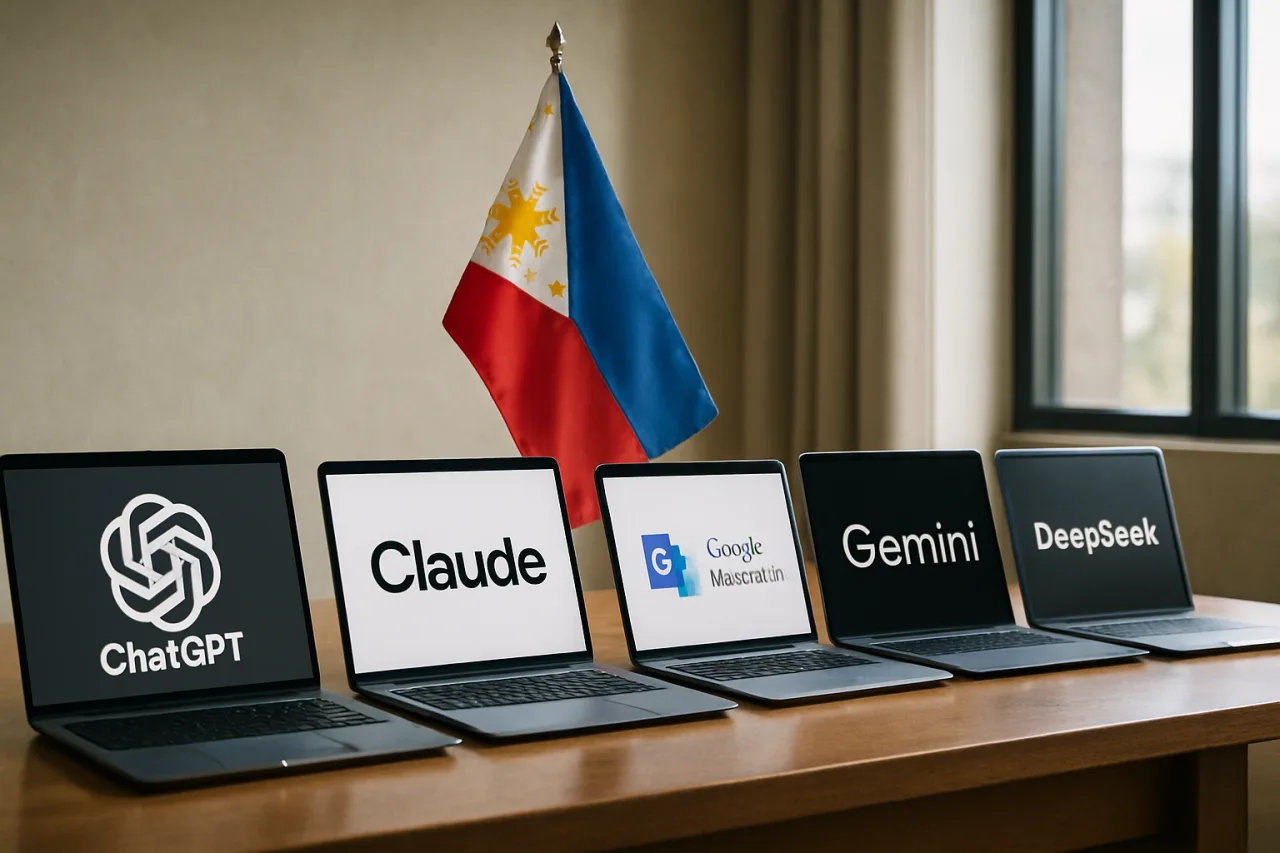
AI translation has improved so dramatically in 2026 that the best tools now handle Filipino and Tagalog with near-human quality — but not all AI translation tools perform equally. A PCMag comparison found that GPT models produce the most grammatically accurate Tagalog translations, while Google Translate leads in language coverage with 249 languages. Claude wins for tone and nuance preservation. Gemini excels at Asian language pairs and long-document translation with its 1-million-token context window. DeepSeek matches Claude’s quality at a fraction of the cost. For Filipino professionals, OFWs, and students who need to translate between Filipino, English, Arabic, and other languages, the choice of AI translation tool matters more than you might think. Here is a head-to-head comparison of the 5 best AI translation tools for Filipino users in 2026, with specific recommendations for different use cases.
Key Takeaway
- 🥇 Best Overall for Filipino: ChatGPT (GPT-5.6) produces the most grammatically accurate Tagalog translations, according to PCMag’s head-to-head test. Best for documents, emails, and professional communication.
- 🥈 Best for Tone and Nuance: Claude (Opus 5) handles register changes — formal, informal, business, casual — more reliably than any other AI. Best for creative writing, marketing copy, and cultural context.
- 🥉 Best Free Option: Google Translate covers 249 languages including Filipino, is free forever, and handles real-time speech. Best for quick translations and travel.
- 📄 Best for Long Documents: Gemini’s 1-million-token context window translates entire books without losing consistency. Best for research papers, contracts, and multi-page documents.
- 💰 Best Budget Option: DeepSeek V4 matches Claude’s translation quality at $0.43/$0.87 per million tokens — hundreds of times cheaper than premium models.
How We Evaluated These 5 AI Translation Tools
The comparison is based on three sources: PCMag’s 2026 head-to-head test of ChatGPT versus Google Translate across multiple languages including Tagalog, Intento’s State of Translation Automation report covering 46 systems across 11 language pairs, and OpenMark’s benchmark of 25 AI models on translation accuracy. The evaluation criteria are: grammatical accuracy, tone preservation, context awareness, Filipino/Tagalog specific performance, cost, and ease of access from the Philippines.
Intento’s report found that large language models represented 89% of top-performing translation systems in 2025, up from 55% the year before. This means the AI chatbots you already use — ChatGPT, Gemini, Claude — are now better at translation than most dedicated translation software. The question is no longer whether to use AI for translation, but which AI gives you the best results for your specific language pair and use case.
1. ChatGPT (GPT-5.6): Best Overall for Filipino
ChatGPT’s GPT-5.6 model produces the most grammatically accurate Tagalog translations among all AI tools tested. PCMag’s evaluation, which compared ChatGPT, Google Translate, Microsoft Copilot, and Google Gemini across multiple languages, found that GPT models led in Tagalog translation quality. “Most of the grammar was correct, and the main thought of each sentence was properly translated,” the reviewer noted, with only minor issues like using “gusot” for both “tangles” and “disheveled.”
Strengths: Context-aware translation that understands idioms and cultural references. Handles formal and informal Filipino registers. Strong English-to-Tagalog and Tagalog-to-English translation. Can explain its translation choices if you ask.
Weaknesses: Slight default toward American English register. Can be too literal with figurative Filipino expressions. Free tier has usage limits.
Cost: Free tier available. ChatGPT Plus at $20/month for unlimited access.
Best for: Professional documents, business emails, academic papers, and any translation where grammatical accuracy is the priority. For more on using ChatGPT in the Philippines, see our complete ChatGPT Philippines guide.
2. Claude (Opus 5): Best for Tone and Cultural Nuance
Claude consistently produces the most natural-sounding translations and handles register changes — formal to informal, business to casual — more reliably than any other AI. According to MultipleChat’s 2026 comparison, Claude scored 9.3/10 for translation quality, beating ChatGPT (9.2) and Gemini (9.1). For Filipino users, this means Claude is the best choice when the tone of the translation matters as much as the accuracy — for example, translating a marketing message that needs to sound natural in Filipino, or translating a personal letter that needs to preserve the writer’s voice.
Strengths: Most natural-sounding output. Best at preserving the source author’s voice. Handles ambiguous phrasing better than competitors. Strong with creative and literary translation.
Weaknesses: Translation scores on benchmarks (58% on OpenMark) are lower than ChatGPT despite better subjective quality. No free tier with the latest model.
Cost: Claude Free available. Claude Pro at $20/month.
Best for: Marketing copy, creative writing, personal letters, and any translation where tone and cultural nuance matter. For OFWs writing to family in Filipino, Claude preserves emotional context better than ChatGPT.
3. Google Translate: Best Free Option and Language Coverage
Google Translate covers 249 languages — more than any other AI translation tool. It is free forever, handles real-time speech translation, and is available as a mobile app that works offline. For Filipino users, Google Translate is the fastest, most accessible option for quick translations. PCMag’s test found that Google Translate ranked second in Tagalog, behind only GPT models, and first in German. The gap between Google Translate and ChatGPT for Tagalog has narrowed significantly since 2025.
Strengths: 249 languages including Filipino, Cebuano, and Ilocano. Free forever. Real-time speech translation. Offline mode on mobile. Camera translation for signs and documents. Available as an app on every platform.
Weaknesses: Can be too literal with idioms. Loses tone and cultural context. Does not handle long documents well. Tagalog translation quality, while improved, still trails ChatGPT.
Cost: Free. API at $20 per million characters for developers.
Best for: Quick translations, travel, reading foreign websites, and real-time conversation. For OFWs communicating with non-English speakers in their host country, Google Translate’s speech mode is the fastest option. For more on AI tools for OFWs, see our guide to best AI tools for Filipino OFWs.
4. Gemini: Best for Long Documents and Asian Languages
Google Gemini’s 1-million-token context window means it can translate an entire book, a full research paper, or a complete legal contract in a single request without losing consistency. Gemini also excels at Asian language pairs, according to Verbi’s 2026 comparison, benefiting from Google’s extensive language data across Southeast Asian languages including Filipino, Indonesian, Malay, and Vietnamese. Gemini’s tight integration with Google Workspace — Docs, Gmail, Drive — means you can translate documents without leaving your workflow.
Strengths: 1M token context for long documents. Multimodal — translates text inside images, PDFs, and audio. Google Workspace integration. Strong Asian language performance. Free tier with Gemini 3.7 Flash.
Weaknesses: Occasionally too literal. Inconsistent for specialized domains like legal or medical translation, according to Polilingua’s evaluation. Can be verbose in output.
Cost: Free tier available. Google AI Pro at $19.99/month.
Best for: Long documents (research papers, contracts, books), Google Workspace users, and Asian language pairs. For students translating academic papers, Gemini’s context window is the key advantage. See our guide to free AI tools for Filipino students.
5. DeepSeek V4: Best Budget Option for Quality Translation
DeepSeek V4 matches Claude’s translation quality at a fraction of the cost. OpenMark’s benchmark of 25 AI models found that DeepSeek Chat scored 58% on translation accuracy — the same as Claude Sonnet and Grok-4 — at $0.000114 per run, which is 599x cheaper than Grok-4. For Filipino users who need quality translation on a budget, DeepSeek is the most cost-effective option. Its 1-million-token context window matches Gemini for long-document translation.
Strengths: Frontier-class quality at budget pricing. 1M token context. MIT open-source license. Free web interface available. Strong on coding and technical translation.
Weaknesses: Slower per task than competitors. Chinese-developed model — some organizations may restrict use. Filipino/Tagalog specific performance has not been independently benchmarked.
Cost: Free web interface at chat.deepseek.com. API at $0.43/$0.87 per million tokens.
Best for: High-volume translation work where cost matters. For Filipino freelancers offering translation services, DeepSeek’s API pricing makes professional-quality translation profitable at rates that would lose money on ChatGPT. For a detailed guide, see our DeepSeek V4 Pro practical guide.
Which AI Translation Tool Should Filipino Professionals Use?
The answer depends on what you are translating:
| Use Case | Best Tool | Why |
|---|---|---|
| Business emails and documents | ChatGPT (GPT-5.6) | Highest grammatical accuracy for Tagalog |
| Marketing copy and creative writing | Claude (Opus 5) | Best tone preservation and cultural nuance |
| Quick translations and travel | Google Translate | Free, fastest, 249 languages, speech mode |
| Long documents and research papers | Gemini | 1M token context, Google Workspace integration |
| High-volume professional translation | DeepSeek V4 | Frontier quality at fraction of the cost |
| OFW communication with family | Google Translate + ChatGPT | Google for speed, ChatGPT for accuracy |
For most Filipino professionals, the practical approach is to use two AI translation tools: Google Translate for quick, everyday translations and ChatGPT for important documents and professional communication. Both are available for free from the Philippines. If you need to translate long documents regularly, add Gemini for its context window. If you are a freelance translator, DeepSeek’s API pricing makes quality AI translation profitable at competitive rates. For more on building an AI-powered freelance career, see our guide to AI prompts for Filipino professionals and our AI tools pricing comparison. According to MachineTranslation.com’s 2026 analysis, large language models now represent 89% of top-performing translation systems — the AI translation gap between free and paid tools has never been narrower.
The Bottom Line: Free AI Translation Is Now Professional Quality
The most important takeaway from this comparison is that the gap between free and paid AI translation has nearly disappeared. Google Translate is free and covers 249 languages. ChatGPT’s free tier produces the most grammatically accurate Tagalog. Gemini’s free tier handles 1-million-token documents. DeepSeek’s free web interface matches Claude’s quality. The only tool that requires payment for its best quality is Claude Pro — and even Claude Free produces better translations than most dedicated translation software did two years ago.
For Filipino professionals, this means translation is no longer a barrier. Whether you are an OFW translating an employment contract from Arabic to English, a student translating a research paper from Japanese to Filipino, or a freelancer offering translation services to international clients, the AI translation tools available today — most of them free — are capable enough for professional use. The skill that matters now is not which language you can translate, but which tool you choose and how well you prompt it. For a comprehensive guide to writing better AI prompts, see our AI prompts for Filipino professionals guide.
Frequently Asked Questions
Which AI translates Filipino best?
ChatGPT (GPT-5.6) produces the most grammatically accurate Tagalog translations, according to PCMag’s 2026 comparison. Claude produces the most natural-sounding translations with the best tone preservation. Google Translate is the fastest and most accessible free option. For more on AI tools available to Filipinos, see our guide to AI skills for OFWs.
Is Google Translate good for Filipino?
Google Translate covers Filipino and Tagalog with reasonable accuracy and is free forever. PCMag’s 2026 test found it ranked second in Tagalog translation, behind only GPT models. It is the best option for quick translations, travel, and real-time conversation. For professional documents, ChatGPT or Claude produce better results.
Can AI translate Tagalog to English accurately?
Yes. Modern AI models like ChatGPT, Claude, and Gemini handle Tagalog-to-English translation with high accuracy. ChatGPT leads in grammatical accuracy, Claude in tone preservation, and Gemini in long-document consistency. DeepSeek V4 offers comparable quality at a lower cost for high-volume work.
What is the best free AI translation tool for Filipinos?
Google Translate is the best free option for quick translations and covers 249 languages including Filipino. ChatGPT’s free tier offers better grammatical accuracy for Tagalog but has usage limits. Gemini’s free tier is best for long documents. DeepSeek’s free web interface offers frontier-class quality at no cost.
Can AI translation replace human translators for Filipino?
AI translation has improved dramatically, but human translators remain essential for legal documents, certified translations, and content where cultural context and creative judgment matter. AI is best used as a first draft that a human translator refines. For more on how AI is affecting Filipino freelancers, see our analysis of AI’s impact on Filipino freelancers.
How much does AI translation cost?
Google Translate is free. ChatGPT and Claude offer free tiers with limits; paid plans cost $20/month. DeepSeek V4’s API costs $0.43 per million input tokens and $0.87 per million output tokens — the most cost-effective option for high-volume translation. Gemini’s free tier includes the 1M context window.