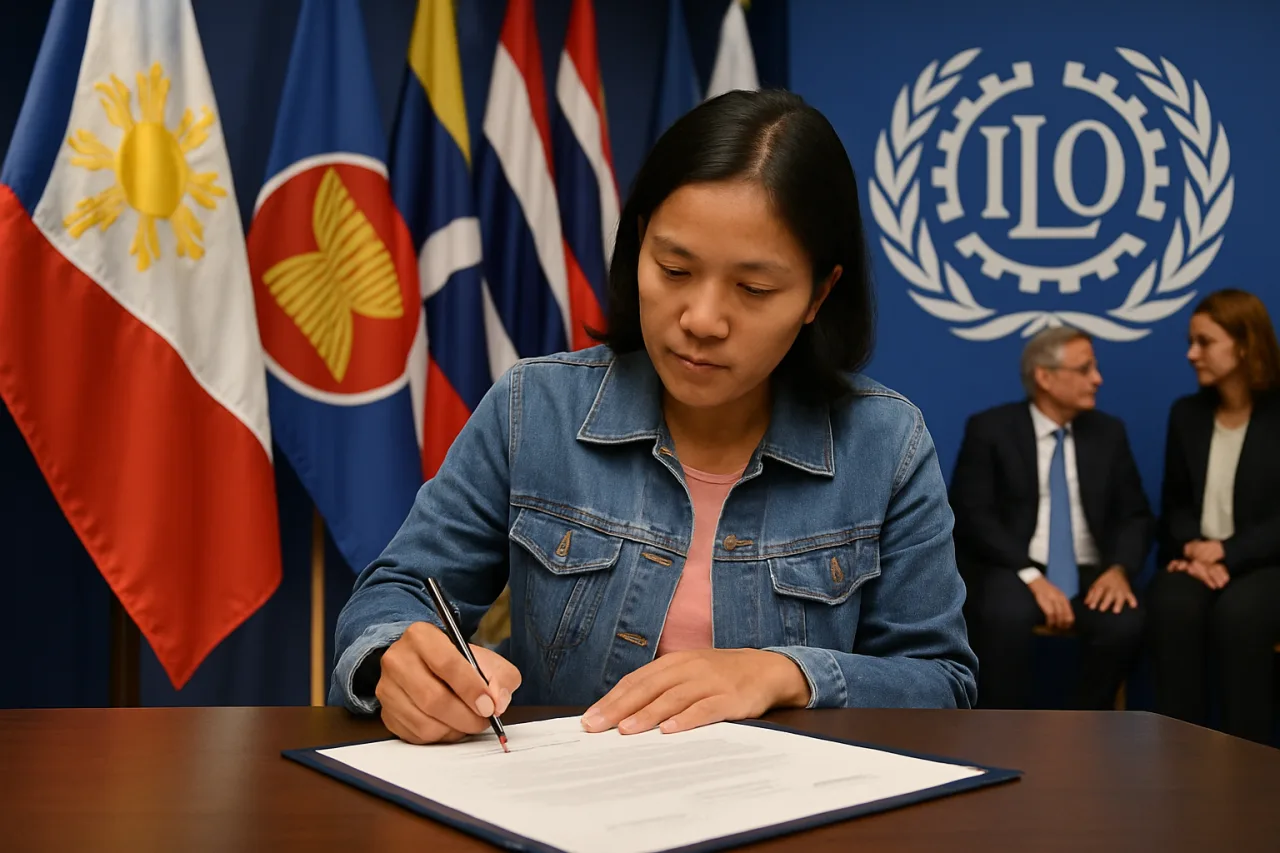
OFW protection just had its biggest diplomatic week of 2026 — and most Filipinos never saw it happen. In Bangkok, Labor Secretary Francis Tolentino sat down with International Labour Organization Director-General Gilbert Houngbo on August 26 and put three Philippine priorities on the ILO’s table: ratification of Convention No. 193 on decent work in the platform economy, the country’s bid to preside over the 115th International Labour Conference in 2027, and the ASEAN labor agenda the Philippines authored during its 2026 chairmanship. Two days later, the Department of Labor and Employment announced that ASEAN Labour Ministers had endorsed four Philippine-led labor documents spanning green jobs, skills training and recognition, labor inspection, and fair recruitment, while the Department of Migrant Workers reported separately that OFWs stand to gain from stronger labor protections, fair recruitment systems, skills recognition, and expanded social protection under the new ILO framework. For the roughly 2.2 million Filipinos counted in the Philippine Statistics Authority’s latest Survey on Overseas Filipinos — and the more than one million land-based OFWs the Middle East crisis exposed last spring — these meetings will eventually reach something concrete: the recruitment agency, the jobsite, and the payroll.
Table of Contents
Key Takeaway
- 🌏 The ASEAN wins: At the 29th ASEAN Labour Ministers Meeting in Bangkok (August 2026), ASEAN endorsed four Philippine-led labor documents during the country’s 2026 chairship — covering green jobs, skills training and recognition, labor inspection including the fishing sector, and fair recruitment guidelines.
- 🇺🇳 The ILO track: Labor Secretary Tolentino met ILO Director-General Gilbert Houngbo on August 26 to push Convention No. 193 on platform work, seek support for the Philippines’ 115th ILC presidency in 2027, and align ILO cooperation with the ASEAN agenda.
- 🛡️ What OFW protection gains: The DMW says OFWs will benefit from stronger labor protection, fair recruitment systems, skills recognition, and expanded social protection — the four pillars that govern how Overseas Filipino Workers get hired, paid, and covered when things go wrong.
- ⚖️ The honest caveat: ASEAN instruments are consensus documents, not binding laws. Convention 193 still needs ratification and Senate concurrence before it binds Philippine employers. The gap between declaration and enforcement is where OFW protection is won or lost.
- ✅ What workers can do now: Verify your agency’s DMW license, register on official channels like the OFW Pass, report illegal third-country recruitment schemes, and start building the internationally recognized skills that the new frameworks are designed to certify.
OFW Protection Takes Center Stage at ASEAN 2026
The Philippines holds the 2026 ASEAN chairship, and labor is one of the areas where Manila chose to spend that political capital. During the 29th ASEAN Labour Ministers Meeting and related meetings in Bangkok from August 24 to 27, the Philippine delegation pushed a slate of labor instruments it authored — and came home with the region’s endorsement. According to DOLE, the ASEAN Labour Ministers backed four key documents developed during the Philippine chairship, a diplomatic return that labor attaches and migration advocates had been watching closely.
Why does regional endorsement matter for a country that sends workers worldwide? Because most OFW problems — illegal recruitment, contract substitution, excessive placement fees, abandoned workers — are cross-border by design. A Filipino worker in the Gulf or Southeast Asia is hired through chains that cross at least two jurisdictions, and no single country’s labor inspectorate can police the whole chain. ASEAN-level frameworks on recruitment and inspection are the architecture of OFW protection for closing those gaps, which is precisely why the Department of Migrant Workers framed the new ILO-aligned standards as a win for every stage of the migration process, from the first job offer to the final repatriation flight.
The ILO’s international labor standards system already recognizes migrant workers’ rights on paper — the 1990 UN Migrant Workers Convention and the ILO’s own migration instruments have existed for decades. What changed this month is that the Philippines moved from signing onto those standards to actively chairing the committees and conferences that turn them into regional practice. For a nation that built its economy on labor export, chairing the rulebook is leverage; it is the difference between accepting global standards and writing them.
The Bangkok Meetings: What Was Actually Endorsed for OFW Protection
The week in Bangkok was denser than a single meeting. Senior labor officials from ASEAN and ASEAN Plus Three met on August 24-25, the 29th ASEAN Labour Ministers Meeting convened mid-week, and the 14th ASEAN Plus Three Labour Ministers Meeting — with China, Japan, and South Korea at the table — closed the session on August 27. By August 28, DOLE’s readout was public: four Philippine-led documents had secured ASEAN Labour Ministers’ endorsement, covering the areas Manila had lobbied for all year.
| Endorsed Area (per DOLE) | What It Covers | Relevance to Filipinos |
|---|---|---|
| Green jobs | Regional declaration on promoting green jobs for equity and inclusive growth | Positions Filipino workers for the transition industries — renewables, sustainable construction, climate-resilient agriculture — where ASEAN demand is rising |
| Skills training and recognition | Regional cooperation on skills frameworks and mutual recognition | Makes Filipino certifications more portable across ASEAN employers, a direct payoff for TVES and TESDA-aligned upskilling |
| Labor inspection | Strengthened inspection cooperation, including in the fishing sector | The fishing sector is one of the highest-risk placements for Filipino seafarers and fishers; inspection standards target its worst abuses |
| Fair recruitment | Regional guidelines for fair and sustainable recruitment | Targets placement fees, contract substitution, and illegal brokers — the entry point of most OFW exploitation cases |
DOLE’s official announcement notes that discussions covered initiatives on green jobs, skills training, and labor inspection, along with proposed regional guidelines — the plumbing of a regional labor market that, for the ten million Filipinos living and working overseas, is more consequential than most headlines suggest. The same week, BusinessWorld reported that the Philippines also sought Thailand’s support for initiatives on labor market resilience and occupational safety, signaling that the chairship agenda is broader than the four documents that crossed the finish line.
The ILO Bilateral: OFW Protection, Convention 193, and the 115th ILC Presidency
The quieter meeting may matter more. On August 26, on the sidelines of the Bangkok meetings, Secretary Tolentino met ILO Director-General Gilbert Houngbo directly, and the agenda was OFW protection policy in three parts. First, the Philippines signaled it plans to ratify ILO Convention No. 193, the new global standard on decent work in the platform economy — the rules that will govern the digital labor platforms where hundreds of thousands of Filipino freelancers, riders, and online professionals now earn their living. Second, Manila sought ILO backing for its bid to assume the presidency of the 115th International Labour Conference in 2027, one of the most visible leadership posts in global labor governance. Third, the two officials aligned ILO cooperation with the ASEAN labor agenda during the Philippine chairship.
Convention 193 deserves particular attention in any serious OFW protection strategy. The ILO designed it to address the exact questions platform work raises — employment status, working conditions, and access to social protection for people whose employer is an app. For the Philippines, one of the world’s largest suppliers of online freelance labor, ratification would push platform companies operating in the country toward recognizing basic entitlements for the workers their business models depend on. BusinessWorld’s report on the ratification plan frames it as the next frontier of PH labor diplomacy: the same protection logic that applied to land-based OFWs, extended to the growing class of Filipinos whose workplace is an app.
The 115th ILC presidency is the second prize. Presiding over the ILC does not give the Philippines enforcement power, but it gives the country the gavel, the agenda influence, and the visibility to place migrant labor at the center of the global labor conversation at a moment when repatriations from the Middle East crisis — more than 29,000 OFWs repatriated during the regional crisis, by the Philippine Embassy in Riyadh’s count — are still fresh. A presidency year spent on migrant worker standards would be a fitting capstone to the ASEAN year that preceded it.
What OFW Protection Changes Mean On The Ground
Strip away the diplomatic language and four practical OFW protection effects are coming for Filipino workers, on different timelines.
Recruitment gets harder to abuse. Fair recruitment guidelines at the ASEAN level give OFW protection regulators like the DMW a regional benchmark to force agencies toward transparent contracts and legitimate fee structures. The DMW has already been alerting the public to illegal third-country recruitment schemes — the July advisory warning OFWs about recruitment fraud routed through third countries is the enforcement face of the same policy direction. Workers verifying an agency’s license before signing can expect those verification tools to keep improving; the OWWA benefits system is the domestic anchor of that protection stack.
Skills start traveling. Skills recognition frameworks mean a certification earned in Manila should carry weight with an employer in Bangkok, Singapore, or the Gulf — and the government’s digital job-matching infrastructure is being built for exactly that. Our guide to DICT’s eTrabaho system explains how AI-assisted matching and skills profiles are meant to formalize what has long been an informal advantage.
Platform workers enter the tent. Convention 193 ratification would, over time, extend social protection and clearer employment status to the gig economy. For Filipino freelancers and app-based workers whose income is real but whose coverage is not, that is the single most consequential OFW protection item in the whole package. Our analysis of AI-era hiring and skills screening shows why certified, verifiable skills are becoming the currency of both remote and platform work.
Social protection: OFW protection goes portable. The DMW’s language — “expanded social protection” — points toward the portability of SSS, PhilHealth, and OWWA coverage across borders and job types, the longest-promised and least-delivered promise in the OFW system. Portability is where OFW protection stops being paperwork and starts being money. Regional frameworks make cross-border portability administratively easier; domestic legislation must still carry it.
The Catch: OFW Protection Declarations Versus Enforcement
Here is the sober reading on OFW protection, because OFWs have seen commendations before. ASEAN instruments operate by consensus and endorsement — they are political commitments, not enforceable law. A regional declaration on fair recruitment changes nothing by itself for a worker facing contract substitution in a Gulf placement office tomorrow morning. The mechanism that converts endorsement into protection is long: national implementation, bilateral labor agreements, agency licensing enforcement, and inspection budgets — most of which are decided in Manila, not Bangkok.
The same applies to the ILO track. Ratifying Convention 193 requires the constitutional process — Senate concurrence — plus implementing legislation, and even then its reach depends on how Philippine rules classify platform workers. The 115th ILC presidency, meanwhile, is influence, not authority. What this week actually purchased is positioning: the Philippines authored the documents, the region endorsed them, and the ILO’s leadership has agreed to keep the conversation moving. The distance from that position to a recruitment agency losing its license for overcharging a first-time OFW is measured in years of enforcement.
Workers should read this moment the way labor economists do: as the infrastructure of future rights being laid, visible only to those tracking it while it is still cheap to ignore.
What OFWs Should Do Now
While the diplomats move at conference speed, OFW protection also moves at practical speed — five actions, all available today:
- Verify before you sign. Check any agency against DMW licensing records before paying anything — illegal recruitment most often starts with an unlicensed or suspended recruiter.
- Use official digital ID. Register for the DMW’s OFW Pass and keep your e-Registration current; these are the documents that activation and repatriation systems run on.
- Report schemes, not just scams. Third-country recruitment schemes flagged by the DMW in July are the current exploit vector; reporting through official channels feeds the enforcement data the new frameworks depend on.
- Bank the skills recognition. Get existing certifications documented and aligned with TESDA and ASEAN-recognized frameworks while the recognition infrastructure is being built.
- Track two dates. The Philippines’ Convention 193 ratification path through the Senate, and the 115th ILC in 2027 — the two moments when this month’s diplomacy either becomes binding or stays on paper.
The era of treating OFW protection diplomacy as background noise is ending. The countries that write the standards are the countries whose workers carry the credentials — and this week, the Philippines made sure its workers will be in that conversation.
Frequently Asked Questions About OFW Protection 2026
What is the new ILO Convention No. 193?
ILO Convention No. 193 is the global standard on decent work in the platform economy, adopted to address the employment status, working conditions, and social protection gaps of digital platform workers. The Philippines announced in August 2026 that it plans to ratify the convention, a process that also requires Senate concurrence before it binds locally.
What did the Philippines win at the 29th ASEAN Labour Ministers Meeting?
ASEAN Labour Ministers endorsed four key documents developed during the Philippines’ 2026 ASEAN chairship, per DOLE: a green jobs declaration, skills training and recognition cooperation, strengthened labor inspection including the fishing sector, and regional guidelines for fair and sustainable recruitment. The meetings were held in Bangkok from August 24 to 27, 2026.
Why does the 115th ILC presidency matter for OFWs?
The International Labour Conference presidency gives the Philippines agenda-setting influence and visibility in the world’s principal labor rights forum for 2027. A Philippine-held gavel increases the likelihood that migrant worker protection, fair recruitment, and social protection portability stay at the top of the global labor agenda.
Will the new OFW protection frameworks reduce placement fees?
Fair recruitment guidelines target excessive fees, contract substitution, and unlicensed brokers — the root causes of most fee-related exploitation. Regional guidelines give regulators like the DMW a standards baseline to enforce against agencies, but actual fee relief for individual workers depends on national enforcement, not the ASEAN endorsement itself.
How many Filipinos work overseas?
The Philippine Statistics Authority’s latest Survey on Overseas Filipinos estimated around 2.2 million OFWs, with Saudi Arabia the largest single destination and more than one million land-based OFWs in the Middle East. Remittances from these workers remain a pillar of the Philippine economy.
How do I report illegal recruitment as an OFW?
Report unlicensed agencies, third-country recruitment schemes, and contract violations directly to the DMW through its official channels and field offices, or through the Philippine embassy or consulate in your host country. The DMW issued a public advisory in July 2026 specifically warning about illegal third-country recruitment schemes targeting OFWs.
📩 Get the Free OFW Money Starter Kit
25 practical money moves, plus WorldNgayon’s weekly OFW money tips and scam alerts.
No spam. Unsubscribe anytime. Download directly →