Key Takeaway
- 🛡️ A single NordVPN review conclusion for busy readers: one subscription protects up to ten devices at once — phone, laptop, and the whole family’s gadgets under one bill.
- 💰 Pricing starts at $3.49/month on the 27-month Basic plan (about ₱200 a month at current rates), with every plan carrying a 30-day money-back guarantee — the whole subscription is effectively risk-free to test.
- 🧰 The Complete and Prime bundles stack a VPN with next-gen antivirus, scam-call filtering, and identity monitoring — the “all-in-one” pitch has real substance behind it, with one disclaimer worth reading (below).
- ✈️ For OFW households the practical wins are specific: protected logins on hotel and airport WiFi, scam-call and phishing defense for family back home, and one dashboard for ten devices across two countries.
- ⚖️ Honest limits stated up front: renewal prices jump after the intro term, the month-to-month plan is expensive, and rivals like Proton and Surfshark win on specific dimensions — all named plainly below.
Table of Contents
A Filipino family’s security budget usually gets spent piecemeal: a legacy antivirus for the laptop, a free VPN app nobody trusts, a password notebook by the monitor. The pitch behind NordVPN is consolidation — one subscription covering up to ten devices at once, with the security layers most families buy separately bundled into the higher tiers. This NordVPN review walks through what that actually means for an OFW family: the real prices in dollars and pesos, what each plan includes, where it beats the alternatives, and where it honestly doesn’t.
NordVPN Review: the Plans and What They Cost
Nord’s current lineup runs four tiers — Basic, Complete, Prime, and an Ultra tier — across 27-month, 12-month, and 1-month terms. The pricing page’s own numbers, checked at the time of writing:
- Basic (27 months): $3.49/month — $94.23 for the first 27 months, renews at $139.08/year. The VPN core plus the ad and tracker blocker.
- Complete (27 months): $4.49/month — $121.23 for 27 months, renews at $219.48/year. Adds next-gen antivirus protection, the NordPass password manager, and 1TB of encrypted NordLocker cloud storage.
- Prime (27 months): $7.49/month — $202.23 for 27 months, renews at $296.28/year. Adds identity-theft monitoring, bank transaction monitoring, and call and message protection.
- Month-to-month: $14.99 (Basic) to $29.99 (Prime) — the flexibility tax; fine for a two-week trip, poor value long-term.
Converted at recent peso rates, the Complete plan’s $4.49 monthly effective rate lands near ₱260 — roughly the cost of two large fast-food meals for the household’s entire security stack. The pricing lever worth knowing: intro rates don’t survive renewal. The 27-month Complete plan renews at $219.48/year — still reasonable, but a jump from the intro rate that families should diary. The 30-day money-back guarantee covers the whole term, so the first month is effectively a free test.
The All-in-One Pitch, Examined
The app bundles matter more than the brand names. On the Complete plan, a family gets: the encrypted tunnel for every device’s traffic; next-gen antivirus — behavior-based malware detection that watches what programs do rather than matching old virus signatures; the NordPass password manager for the household’s shared logins; and NordLocker’s 1TB encrypted cloud for documents like scanned passports and land titles. The Prime plan layers on identity monitoring (email, phone, credit card, and national ID numbers), bank transaction monitoring, and protection against scam calls and messages.
That feature set maps directly to the scam wave this site has documented in remittance scams and Viber impostor messages.
One required disclosure, quoted in full: “All-in-one” refers to the VPN, scam protection, phishing protection, tracker and ad blocking, and other features available within the NordVPN app, depending on your device and the plan you choose. Translation: not every device gets every feature — the family’s old Android tablet won’t carry the same protections as a current phone. Check the device list before assuming the bundle covers the household’s oldest hardware.
Setup: Ten Devices, One Evening
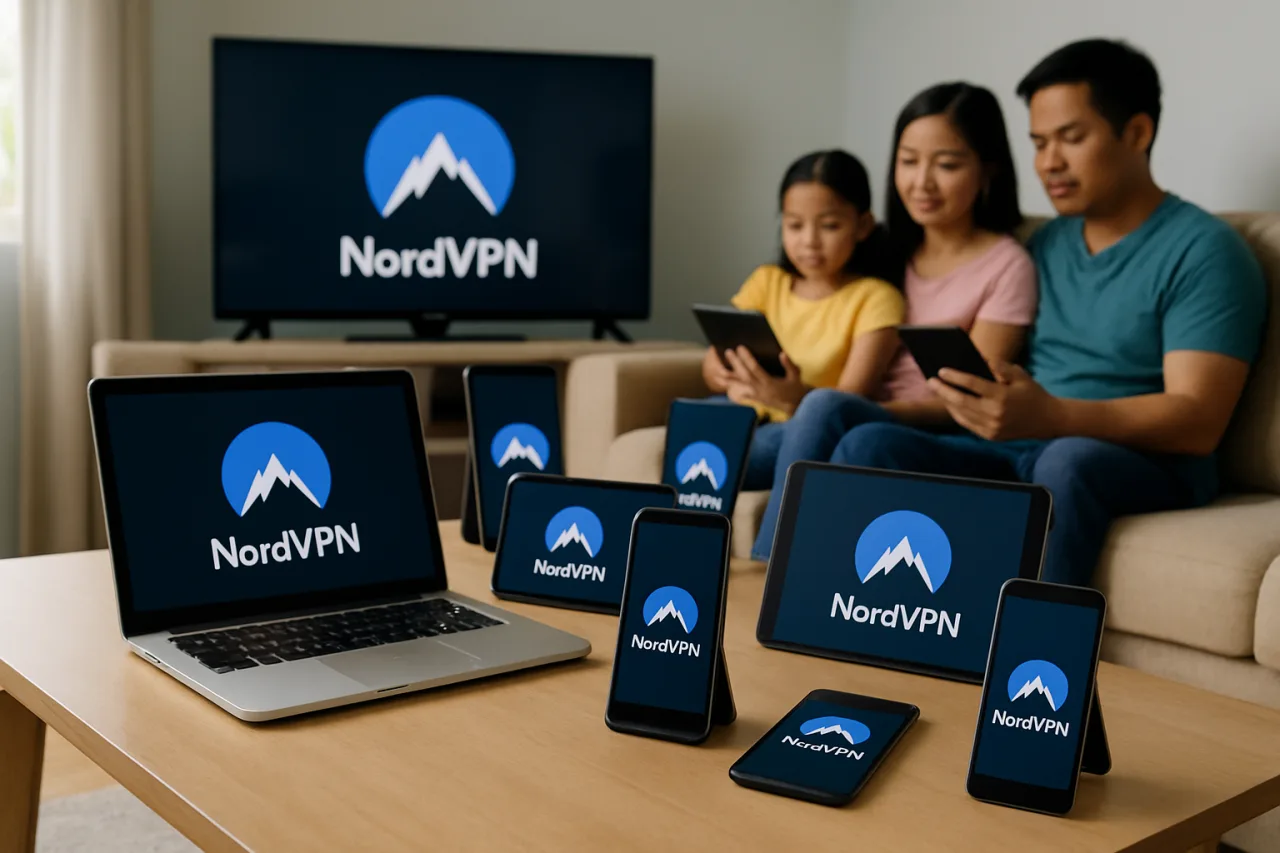
The practical reason this NordVPN review favors the family framing: installation is boringly easy, which is a compliment. One account signs in on ten devices simultaneously — Windows, macOS, Linux, Android, iOS, and the major TV platforms. A realistic household deployment:
- Phones and laptops (the OFW’s work phone, the spouse’s phone, the kids’ tablets): install the app, enable auto-connect on untrusted WiFi — the setting that matters most for anyone logging into bank apps from airports, malls, or PUVs.
- The home router: Nord’s router config covers the devices that can’t install apps — the smart TV, the console, the household’s oldest gadgets — through the network itself, the same pattern as the router hardening guide.
- The OFW side: auto-connect on public WiFi in the host country, plus the travel security kit habits — the VPN handles the encryption layer, not the scam-detection layer.
Where Nord Wins — and Where It Doesn’t
The fair-comparison section, because this site names rivals honestly. Where Nord leads: the bundle depth (VPN + next-gen antivirus + password manager + storage on one subscription) undercuts paying for four separate services; the ten-device allowance beats ExpressVPN’s eight and covers most family sizes; the 5,900+ server count and audited no-logs policy are citable Nord claims — the auditors’ reports are public; and Dark Web Monitor’s breach alerts integrate with the breach-response workflow this site already recommends.
Where rivals win: Proton’s free tier is genuinely usable and its Swiss jurisdiction reads better to privacy purists; Surfshark’s unlimited simultaneous devices undercut Nord’s ten-device cap for very large households; ExpressVPN’s router firmware is friendlier for non-technical router setups. None of those competitors bundles identity monitoring with scam-call protection at Nord’s Prime tier price — that’s the dimension where Nord’s bundle is distinct.
The OFW Family Case, Concretely
Consider the arithmetic that matters to a household splitting between Riyadh and Batangas. A barebones stack — standalone VPN (~$8/month), password manager (~$3/month), next-gen antivirus (~$4/month), cloud storage (~$5/month) — runs roughly $16/month across four subscriptions, four bills, four renewal dates. Nord’s Complete at $4.49/month (27-month intro) replaces all four line items at roughly a quarter of the spend, under one login and one renewal diary entry. The savings case alone justifies the switch for most families.
The fewer-accounts-to-secure case arguably matters more: every unused subscription is an account waiting to be breached.
The Verdict
The NordVPN review conclusion, stated plainly: for a Filipino household — especially one split across two countries — the Complete plan at $4.49/month over 27 months is the sweet spot, and the 30-day money-back guarantee makes trying it a zero-risk exercise. Buy month-to-month only for a short trip; budget for the renewal rate. If identity monitoring matters to your household (it should, given the Philippine data leak climate), price the Prime upgrade against a separate identity service. That is the whole pitch, checked against the pricing page — no mystery, no unboxing theater.
Frequently Asked Questions (FAQ)
- Q: Is NordVPN worth it for a family that mostly stays home?
- Yes — the router install covers the whole household’s smart TVs and consoles, and the bundle replaces three or four separate subscriptions. The travel angle is a bonus, not the only use.
- Q: Which plan should a family start with?
- Complete at $4.49/month (27-month term) — the next-gen antivirus and NordPass additions are where the bundle economics actually work. Prime suits households worried about identity theft specifically.
- Q: How does the 30-day money-back guarantee work?
- Cancel within 30 days of purchase and Nord refunds the full term — the standard test-first pattern. The refund processes through the same account dashboard.
- Q: Does NordVPN slow the internet down?
- Any VPN adds overhead; Nord’s WireGuard-based connections are among the faster measured in independent tests — the vendor’s own speed claims are citable at AV-TEST’s published figures, attributed as vendor claims.
- Q: How many devices can use one NordVPN subscription?
- Ten simultaneous device connections on one account — enough for a typical family’s phones, laptops, and a router config covering the rest of the household.
Disclosure: WorldNgayon may earn a commission if you purchase through links in this article. Full details on our disclaimer page.