Table of Contents
Viber scam defense has become a survival skill for Filipino families: the messaging app that 80 percent of Philippine smartphone users open every day has become the country’s most efficient fraud delivery system, with the government’s own cybercrime agency flagging it as an active scam channel in documented reporting on Viber scam patterns. The patterns are documented and brutal in their simplicity — the boss who texts from a “new number” asking for an urgent GCash favor, the “Viber support agent” who needs the six-digit code that just arrived by SMS, the paluwagan group that dissolves along with the organizer’s account, the marketplace seller who only “ships” after a deposit. What makes Viber scams different from email phishing is trust architecture: Viber is where tita’s voice notes live, where the parents’ group organizes fiestas — the platform itself carries borrowed trust that scammers exploit. This guide dissects the four documented Viber scam patterns, gives the verification moves that break each one, and sets up the technical backstop that catches what attention misses — because in 2026, the scam messages arrive in perfect Taglish, with your name attached, and good instincts alone are no longer a complete defense.
📌 The four documented Viber scam patterns: authority-figure impersonation (fake bosses/officials on “new numbers”), paluwagan and investment-group fraud in community chats, marketplace/GCash-linked payment scams, and account takeover via SMS-code theft.
🚨 The one code that must never be shared: your Viber activation code IS the key to your account — no legitimate Viber employee, friend, or boss will ever ask for it.
🛡️ The 6 moves that break every pattern: callback verification, the money-request word, code silence, the two-minute rule, marketplace payment discipline, and an AI-powered security backstop on the phone itself.
🇵🇭 Why this matters: CICC has publicly flagged Viber as a fraud channel; risky URLs circulating on Viber and similar apps jumped nearly 38% in one quarter per Whoscall’s quarterly reporting.
A scam works because it arrives wearing a face you trust. That is the entire mechanism — and it is why Viber, the app Filipinos use for the most trusted conversations in their lives (family, work groups, parent-teacher chats, community associations), has become the preferred hunting ground for the country’s fraud industry. The scammer does not need to hack Viber; he needs you to extend to a Viber message the same trust you extend to Viber itself. The four documented patterns each weaponize a different flavor of trust: authority (your boss, a government official), community (the paluwagan group everyone’s tita joined), commerce (the marketplace seller with a ready payment flow), and identity (your own account, taken over with a code you handed over). None of them is technically sophisticated. All of them work, thousands of times a week, because each arrives inside the app where you have never once been scammed before. The defense has two layers, and this guide builds both: the human reflexes that catch the obvious attacks, and the technical backstop that catches the ones built to beat human reflexes — because the same AI that writes perfect Taglish scam scripts for remittance fraud is now available to every fraudster with a payment method.
The Four Viber Scam Patterns, Decoded for Filipino Families
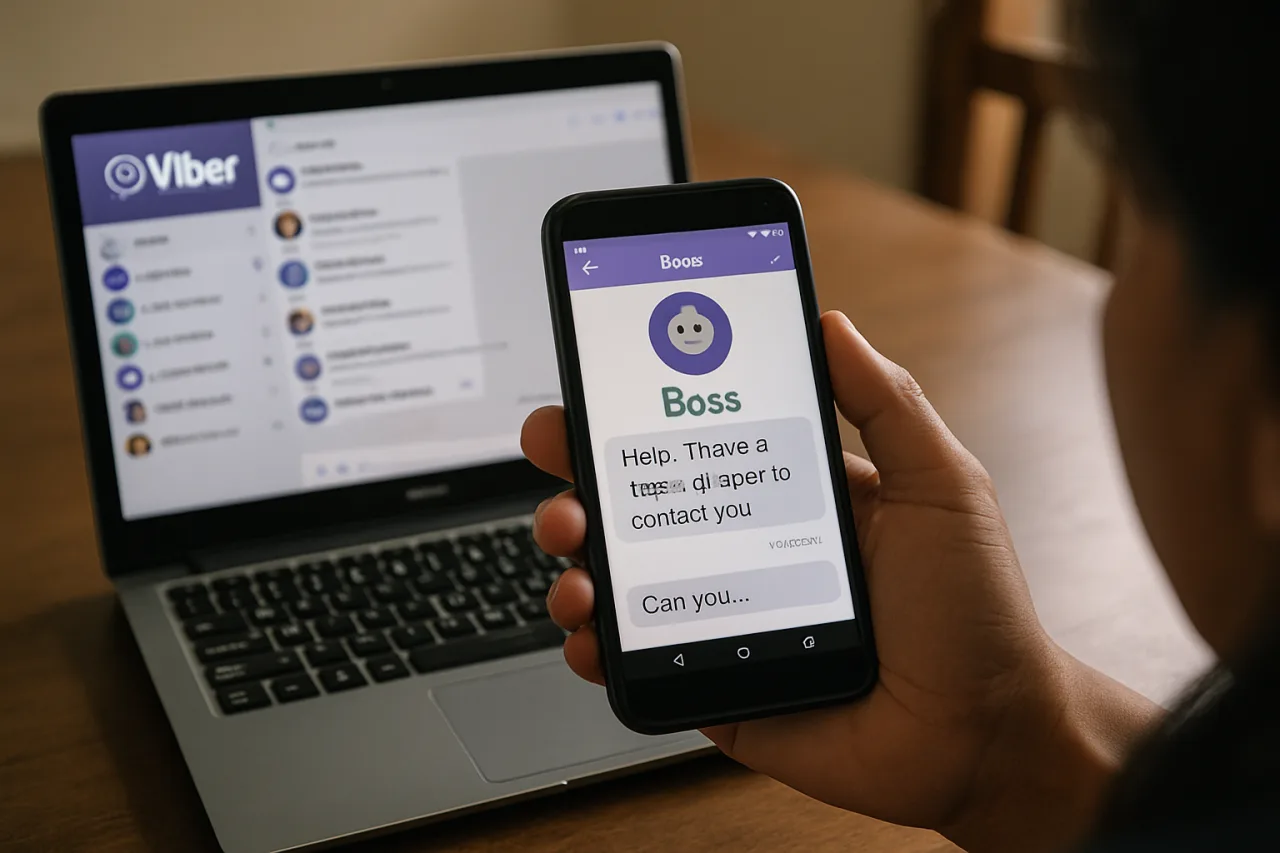
Viber scam patterns documented by security researchers and the CICC number four recurring structures, and learning to recognize the shape is worth more than any single warning. Pattern one: authority impersonation. A message arrives from your company president, a barangay official, or a school administrator — from a “new number because my phone broke.” The request is urgent and financial: gift cards, GCash transfers, supplier payments. The tell is almost always the same: real bosses verify through channels you already have; impostors push you to decide inside the chat. Pattern two: paluwagan and investment circles. The classic Filipino community finance mechanism, hijacked: a Viber group forms around a “guaranteed weekly return” organizer who posts screenshots, testimonials, and early payouts — which are, in the documented cases, simply later victims’ money. The tell: returns that outperform banks by an order of magnitude, recruitment pressure, and an organizer who goes quiet the week the payout comes due. Pattern three: marketplace payment scams. The seller insists on an off-platform payment link or a “GCash verification fee,” or the buyer sends a fake payment confirmation screenshot. The tell: any payment flow that requires leaving the platform’s own protections, plus pressure to “confirm now.” Pattern four: account takeover via code theft. The scammer initiates Viber activation on a new device with your number; Viber SMSes you the real code; the “Viber support agent” or “friend who needs a favor” asks you to read it out. The tell: nobody legitimate will ever need that code — it is the key to your account, your groups, and every contact who trusts you. Each pattern recycles the same core trick: collapse verification time. Every defense below restores it.
The 6 Moves That Break Every Viber Scam
Reflexes beat vigilance, so the defense is a checklist small enough to actually run. Move one: the callback rule. Any message involving money gets verified through a second channel you already trust — call the boss’s known number, message the tita’s real account, walk to the office. Impostors cannot survive a callback because the callback hits the real person. Move two: the family code-word. Agree today, in one group chat, that any money request between family members must include a pre-agreed word — a childhood nickname, a street name, anything an outsider cannot guess. It costs nothing and breaks authority and takeover scams instantly. Move three: code silence. The Viber activation code, bank OTPs, GCash codes — never read to anyone, ever, whatever the reason given. Legitimate services never ask. Move four: the two-minute rule. Pressure is the scammer’s main tool; impose a standing two-minute wait before any transfer of money or codes — real urgency survives two minutes, engineered urgency does not. Move five: marketplace discipline. Pay only inside the platform’s own flow, never through links the other party sends, never via “verification fees.” Move six: the technical backstop. Human reflexes catch human-speed attacks; AI-crafted attacks — perfect Taglish, personalized details, cloned voices — need a machine on your side too. This is where a next-generation antivirus with scam protection earns its place: NordVPN’s all-in-one security app includes scam-message detection and phishing protection at the link level, filtering the malicious URLs that arrive via Viber, SMS, and email before the tap happens — it is the backstop for the message that arrives while you are tired, distracted, or three seconds from trusting it. (“All-in-one” refers to the VPN, scam protection, phishing protection, tracker and ad blocking, and other features available within the NordVPN app, depending on your device and the plan you choose.) Six moves, one system: verify identity through a second channel, slow the moment down, keep the keys, and let software watch the links.
Affiliate disclosure: WorldNgayon may earn a small commission when you use our links, at no extra cost to you. Full details on our disclaimer page.
Viber Scam Account Takeover: The Six-Digit Code Is the Whole Kingdom
The Viber scam takeover pattern deserves its own section because its consequences outlast every peso lost. When a scammer obtains your Viber activation code, they do not steal your account — they clone it: your groups, your contacts, your history on their device, while your own phone gets quietly logged out or left running in parallel. From there the damage compounds automatically: messages to your family asking for help, requests to your work groups, new scams run under your name to your own network — the people least suspicious of a message from you. Recovery is possible but slow: re-register the number to reclaim the account, warn every group manually, and accept that whatever the impersonator extracted in the gap hours is gone. Prevention is one behavior, and it must be family-wide because the attack exploits the people around you: the activation code is never shared, with anyone, for any reason. Viber’s real support never asks for it; no boss, friend, or relative legitimately needs it. Teach the one line to every family member with a phone — it is the entire Viber scam defense — and pair it with two-factor authentication on the email that anchors your Viber account — our password manager setup guide walks that step, because the email is the skeleton key behind every account-recovery flow.
What the Government Is Doing About the Viber Scam Wave — and What It Cannot Do for You
The state has noticed the Viber scam wave. The CICC under DICT has publicly flagged Viber as an active fraud channel and partnered with monitoring services to track scam patterns; the NTC’s SIM Registration Act implementation has trimmed the crudest SMS attacks, as our Philippine threat-landscape analysis documented; Scam Watch Pilipinas runs takedown coordination with the platforms. This is real progress, and it is also — structurally — not enough, for the same reason this publication keeps repeating: enforcement moves at the speed of institutions, while AI-assisted scam operations iterate at the speed of software. The Whoscall data showing a nearly 38% quarterly jump in risky URLs on messaging apps is the leading edge of that gap. The practical division of labor is therefore fixed: the government pursues the syndicates, the platforms harden their channels, and the last line of defense — the two minutes between the scam message and your GCash PIN — belongs to you and the reflexes your family practices. Families that run the six moves as household policy stop being easy targets; the industrial scammer, like any efficient predator, moves on to the households that hesitate longer. That is the entire strategic picture: you cannot fix the syndicates, but you can absolutely fix being the low-hanging fruit.
Frequently Asked Questions About Viber Scams
What are the most common Viber scams in the Philippines?
Four patterns dominate: authority-figure impersonation (fake bosses or officials messaging from “new numbers” with urgent money requests), paluwagan and investment-group fraud in community chats, marketplace scams using off-platform payment links and fake GCash confirmations, and account takeover via SMS activation-code theft. All four exploit trust carried by the Viber platform itself.
How do Viber account takeovers work?
The scammer initiates Viber activation on their device using your phone number, which makes Viber send the real activation code to your phone by SMS. A scammer posing as Viber support — or a friend needing a favor — then asks you to read or forward that code. With it, they take over your account and gain access to every group and contact you trust. The defense is absolute: never share the code, with anyone, for any reason.
How can I verify if a Viber message is really from my boss or official?
Verify through a second channel: call the number you already have for that person, or confirm face-to-face. Impostors rely on urgency inside the chat and cannot survive a callback to a known number. Add a family or office code-word for any money-related request — its absence is itself the warning.
What should I do if I already shared my Viber code?
Act in this order: reclaim your account by re-registering your number on your device, log out all sessions in Viber settings, warn your groups that your account was compromised and that requests from “you” are fraudulent, report to the CICC’s scam channels, and check whether any linked email accounts need their own password changes. Speed matters most in the first hour.
Does antivirus software really help against chat scams?
The modern version helps where human attention fails: a next-generation antivirus with scam and phishing protection inspects the links behind messages across apps — Viber, SMS, email — and blocks known malicious domains before they load. It is the backstop, not the substitute: the six reflexes above remain the first and strongest layer, because no filter catches a scam that never contains a link.
What is the government doing about Viber scams?
The CICC under DICT has publicly flagged Viber as an active fraud channel and works with monitoring services to track patterns; the SIM Registration Act has enabled faster traceability; and Scam Watch Pilipinas coordinates takedowns and public warnings. But enforcement lags the scam industry’s iteration speed — which is why personal verification habits and device-level protection remain the layer that actually protects your money.
Financial Disclaimer
This article is published for general information and consumer-protection guidance. It is not investment, legal, or purchasing advice. Scam patterns reflect documented reporting and government advisories as of September 2026; verify current guidance with official CICC, NPC, and platform sources before decisions.