Table of Contents
Key Takeaway
- 🔑 The scale: A dark web identity theft service called Nexus is selling the license scan records of more than 153 million Americans and Canadians — alongside 10 million ID cards, 3 million travel documents, and 579,000 medical cards.
- 🕵️ The suspected source: Identity verification provider IDScan.net, whose clients reportedly include Hertz, Target, FedEx, and Caesars Entertainment; the FBI’s New Orleans field office has opened an official investigation into the apparent breach.
- ⚠️ Why this beats a password leak: Each license scan bundle can include front, back, infrared, and ultraviolet images with timestamps — data you cannot reset, tied to your face, birth date, and address.
- 🛡️ Your move: Seven practical steps below — from questioning why a service needs your ID image at all, to watching for the follow-up fraud that historically follows leaks like this.
License scan technology was sold to us as convenience: a quick swipe at the car rental counter, a flash at the hotel front desk, an upload to prove your age before entering a bar or opening a trading account. That convenience now has a market price. A dark web identity theft service is selling the license scan records of more than 153 million people, complete with infrared and ultraviolet images, date stamps, and — in several documented cases — the exact moment each document was handed across a counter. For Filipino professionals whose work, travel, and banking lives span borders, the license scan breach is not a foreign curiosity. It is a preview of what happens when every ID check quietly becomes a permanent record that somebody else owns.
The facts below come from the KrebsOnSecurity investigation that broke the story, Malwarebytes’ analysis of the leak, and the FBI’s confirmed inquiry — all reported within the first days of September 2026. The story is still moving, but the pattern it exposes is already settled: the infrastructure built to verify your identity has become the single richest target for stealing it.
Why the IDScan.net License Scan Breach Changes Identity Trust
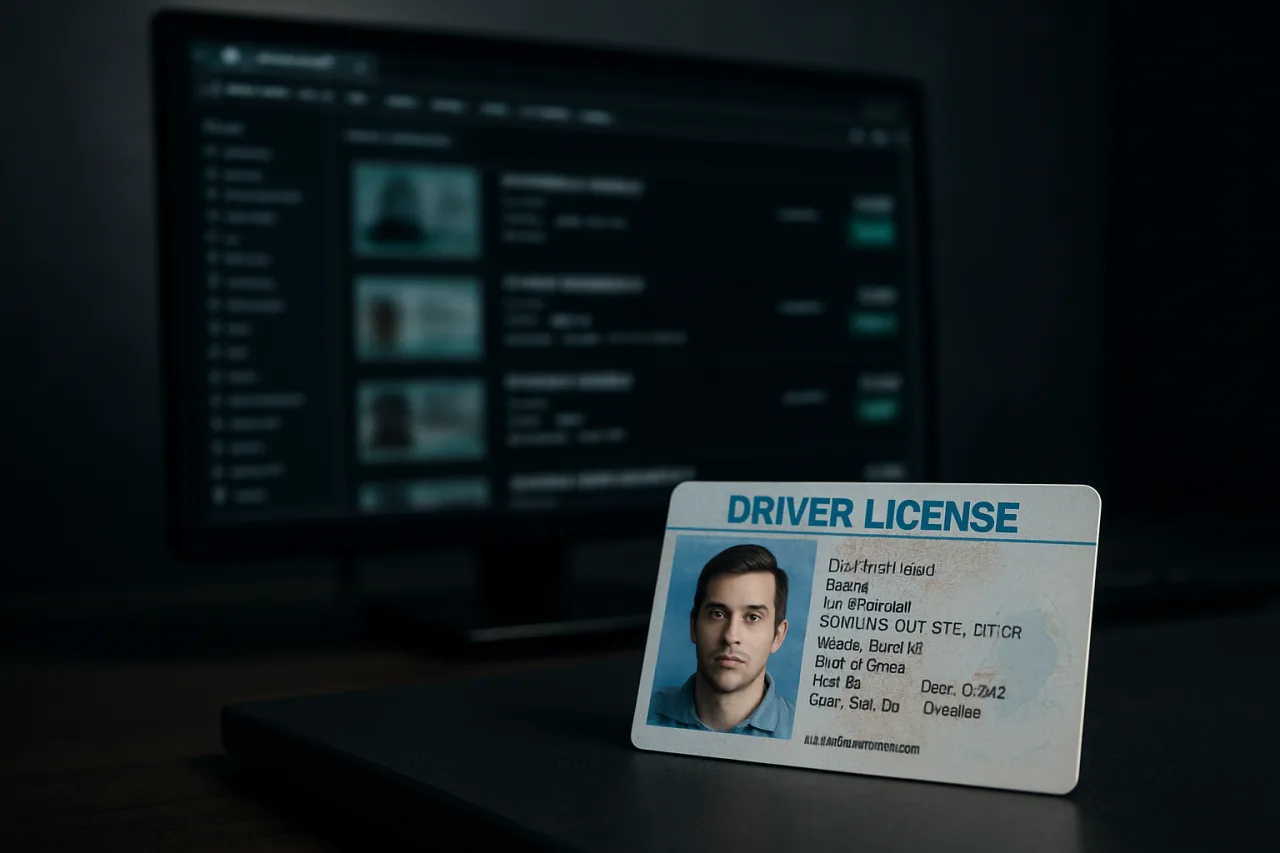
On August 31, 2026, security journalist Brian Krebs was tipped to a new seller on the Russian cybercrime forum Exploit. The seller was advertising a service, later named Nexus, offering digital scans of identity documents belonging to more than 170 million people in North America. A blank search inside Nexus returned roughly 11.5 million pages of results at about 15 records per page — a math that lines up with the seller’s headline inventory: more than 153 million driver’s licenses from the United States and Canada, over 10 million identification cards, more than 3 million travel documents and international IDs, and at least 579,000 medical cards, including marijuana dispensary cards. Searching only Canadian licenses returned about 1.1 million records, with the largest concentration — 473,673 — from Ontario. The overwhelming bulk of the trove is American.
Krebs did what no aggregator could: he searched for himself. His own Virginia driver’s license was there, offered as a free sample in the seller’s opening sales thread. So were the licenses of several high-profile figures — records visible on Nexus include one belonging to U.S. Defense Secretary Pete Hegseth, and Krebs reported finding the license of the FBI’s own assistant director, which is precisely what appears to have prompted the bureau’s attention. The seller claimed the data was flowing from “an active breach” at “a major identity verification company” whose customers include multiple Fortune 500 firms, and boasted in its introduction: “We have been continuously exfiltrating new data for over a year into our private database.” The numbers backed the boast — license records on Nexus grew by nearly 400,000 in a single 24-hour window, suggesting fresh harvests were still being uploaded as the FBI opened its case.
By the afternoon of September 1, Krebs reported, he was on a conference call with half a dozen FBI agents, including senior leaders from the bureau’s cyber division. The New Orleans field office had opened an official investigation into an apparent breach involving idscan.net, a Louisiana-based identity verification provider that says it performs more than 21 million verifications every month across more than 20,000 locations worldwide. The company acknowledged it was investigating but has not issued a substantive public statement. If the suspected source holds, this would rank among the largest identity document exposures ever recorded — and the first at this scale to involve the specialized scanners most victims never knew were logging them.
How Your License Scan Ends Up on the Dark Web
The most disturbing detail in the Nexus dataset is not the count. It is the metadata. Records sold on the service include not just a basic image of the license but paired infrared and ultraviolet captures of the front and back — six image files in the fullest records — each stamped with a date and time. Those timestamps became the forensic thread. Krebs asked more than a dozen friends and family to search the service for their own licenses. Nine were found, and every one of them confirmed traveling on or near the timestamped date. One had not flown at all but had been renting a car from Hertz for months around his record’s date. Two federal employees had shown passports at airport security — and handed their state licenses to a Hertz representative at their destination.
Then the correlation tightened. Krebs’s mother’s license appeared in Nexus with timestamps seconds apart from his own, matching the moment both handed their licenses to the same Hertz representative. Security researcher Zach Edwards, whose license appeared with a timestamp from his trip to DEFCON in Las Vegas, had not rented a car — but he had handed his ID at a marijuana dispensary called Planet13, a chain that announced an exclusive identity verification partnership with IDScan.net back in 2022. IDScan says it serves more than 1,000 dispensaries across 19 U.S. states, and its own published trust page name-drops Hertz, Target, FedEx, Motorola Solutions, the financial services firm Jack Henry, and Caesars Entertainment as clients. Its documentation confirms the technology scans IDs with both infrared and ultraviolet light — the exact image types circulating on Nexus.
Every ID scan at a counter is not a moment. It is a record — and records are assets that get bought, sold, and resold long after the transaction is forgotten.
That is the structural lesson of this breach. The Filipino professional who hands a passport or license to a hotel clerk in Dubai, a car rental agent in Toronto, a gym in Singapore, or a telecom store in Manila assumes the interaction ends when the paperwork is returned. It does not. Somewhere behind that counter sits a verification vendor, its cloud storage, its contractors, and its retention policy — an ecosystem the customer never chose and cannot audit. As Malwarebytes put it in its analysis, identity verification “is not a harmless box-ticking exercise,” and the collections people never connect to one another are, together, an ever-expanding reservoir of exactly the data that makes fraud convincing. The 284-million-record McKesson extortion crisis showed the same machinery operating on healthcare data; this time the commodity is your face itself.
The Second-Order Effect: What a Stolen License Scan Unlocks
A password resets in two minutes. A license scan never does. That asymmetry is what separates this breach from the routine leak-and-rotate cycle of corporate cybersecurity. Your face, your date of birth, your home address, your license number, your signature — these are identity anchors that no bank can reissue and no software update can patch. Once high-resolution images of them sit in a criminal marketplace, every future system that trusts those anchors inherits the breach. Larry Baldwin, principal intelligence researcher at the cybersecurity firm Cybera, keeps a front-and-back scan of his own license on Nexus, timestamped to a Hertz rental. His warning cuts past the alarmism to the mechanics: state-issued licenses are commonly used as proof of identity when opening new lines of credit, meaning the Nexus inventory is functionally a catalogue for account-opening fraud.
Baldwin’s second point is the one almost no coverage mentions. A searchable database of faces endangers people whose safety depends on not being found — domestic violence survivors who moved to escape an abuser, or witnesses whose identities the government itself reassigned through witness protection. Modern AI-based image matching tools make changing your appearance nearly useless as a defense. “Just when it seems like we’re making some headway in improving authentication controls through drivers license verification systems, this happens and the very thing those improvements are dependent on are compromised,” Baldwin told KrebsOnSecurity. The controls we built to prove who we are have handed attackers a mirror to claim to be us.
For readers in the Philippines and across the OFW diaspora, the downstream risks arrive through channels already proven hostile. Stolen identity bundles supercharge precisely the scams that dominated 2026: the vishing wave that impersonated IT departments on Teams becomes far more convincing when the caller can read back your address and birth date; the 16,619 phishing attacks that hit Philippine inboxes in six months convert better when the email knows which bank you actually use; and mobile malware like the ToxicPanda Android banking threat pairs perfectly with a victim whose real documents can be submitted to pass remote verification. Identity data is not the end of the fraud — it is the raw material that makes every other scam land.
What Filipino Professionals Should Do About the License Scan Breach
There is no notification list for a leak of this shape, and no company has announced which individuals are affected. That uncertainty is exactly why the response has to be proactive rather than reactive. The steps below are adapted from Malwarebytes’ consumer guidance and the FBI-adjacent recovery playbook at IdentityTheft.gov, ordered by how quickly they reduce real risk.
- Audit where your ID image already lives. Car rentals, hotels, gyms, dispensaries, telecoms, banks, and age-verification services are the documented collection points. You cannot un-submit them, but knowing the list tells you which institutions to watch.
- Question the next upload request. Before uploading a license or passport anywhere, ask two things: why is the image needed, and what happens to it afterward. If the service cannot answer, treat the upload as optional and refuse where the law allows.
- Prefer privacy-preserving checks. Where an alternative exists — a privacy-preserving age check, an in-person glance, a digital wallet credential — take it over a full document upload. The difference between a verified attribute and a stored image is the difference between a checked fact and a leakable file.
- Never email identity documents. Email is unencrypted at rest on multiple servers and is the single easiest way for an ID copy to escape into the wild. If a process requires it, verify the recipient independently and use an encrypted channel.
- Harden the credit channel. A license scan is credit-application fuel. Where you hold accounts, enable transaction locks and alerts; if you hold U.S. or Canadian credit files, a credit freeze is free and reversible. Filipino professionals abroad should apply the same discipline to their banks in the Philippines and their host country.
- Treat follow-up phishing as certain, not possible. Historically, leaks convert into targeted scams within weeks. If your data is in circulation, expect calls and emails that know too much. The correct response to unexpected requests — even ones citing your real details — is to hang up and contact the institution through its official app. Our guide to the first 72 hours after a data breach walks through the full sequence, and the same escalation logic applies here.
- Watch your accounts the way you watch your wallet. New logins, password resets you did not request, small test charges, and verification texts you never triggered are the early smoke of identity fraud. Catching them in week one is the difference between an annoyance and a year of paperwork.
None of this is paranoia arithmetic. The suspected source company processes 21 million verifications a month. Even at IDScan’s scale, the assumption to plan around is that any ID image you have surrendered to a counter scanner in the past few years may already exist in somebody’s database — the only question is which database, and how well it is defended.
The Age Verification Trade-Off Nobody Priced
There is a policy wound inside this breach that extends far beyond one Louisiana company. The single fastest-growing reason to upload a government ID in 2026 is age verification — for social platforms, for gaming, for adult content, for marketplaces. Regulators worldwide, including those weighing requirements for services used by millions of Filipinos, keep converging on the same mechanism: prove you are an adult by giving a private company a copy of your government ID. The Roblox PhilSys age verification debate in the Philippines is the local edition of the same design question — and Nexus is now the strongest argument yet for what the answer should be. Zach Edwards, the security researcher whose license surfaced in the leak, told KrebsOnSecurity that the episode should “strengthen the resolve for people who are fighting back against online ID schemes” that push sensitive documents into third-party vendors “we don’t have nearly the oversight” to keep safe.
The trade-off deserves plain language. A verification vendor collects identity documents for a transaction that lasts seconds, then holds them for years. When the vendor is breached, the harm lands on people who never contracted with the vendor, never read its policy, and never had a choice. That asymmetry — all convenience to the platform, all risk to the individual — is the actual product design of the identity verification industry, and the 153-million-record price tag just went public. Governments writing age-verification and digital ID rules, including the frameworks being drafted for Philippine platforms and the PhilSys ecosystem, now hold a case study of what under-secured aggregation costs. The question every regulator, platform, and Filipino professional should carry out of this story is the one Malwarebytes framed exactly right: why does this service need a copy of my identity document — and what happens to it afterward?
Frequently Asked Questions About the License Scan Breach
What exactly happened in the license scan breach?
A dark web identity theft service called Nexus began selling digital scans of more than 153 million U.S. and Canadian driver’s licenses, plus 10 million ID cards, 3 million travel documents, and 579,000 medical cards. Investigative reporting traced the likely source to IDScan.net, an identity verification provider, and the FBI’s New Orleans field office has opened an official investigation into the apparent breach. Records on Nexus grew by roughly 400,000 in one day, indicating active exfiltration.
How would I know if my license scan is in the Nexus database?
There is no public lookup, and neither IDScan.net nor investigators have named affected individuals. If you handed a physical license to a scanner — at a car rental counter, hotel, dispensary, or similar venue — in the United States or Canada, treat the possibility as real and follow the protective steps in this article rather than waiting for a notification that may never come.
Has IDScan.net confirmed the license scan breach?
No. The company acknowledged it was investigating but has not issued a substantive public statement. Its website states it performs more than 21 million verifications monthly across 20,000 locations and lists Hertz, Target, FedEx, Motorola Solutions, Jack Henry, and Caesars Entertainment among its clients. The FBI’s involvement, confirmed by KrebsOnSecurity, is the strongest official signal so far.
Can a stolen license scan really be used against me?
Yes — and it is more dangerous than a password leak. A full scan bundle includes infrared and ultraviolet images that defeat casual forgery checks, plus your birth date, address, and license number. Criminals use these to open credit lines, pass weak remote verification, build convincing phishing and vishing scripts, and assemble complete victim profiles by combining records from separate breaches.
Should I stop showing my ID at car rentals and hotels?
Often you cannot refuse — regulated services and rental agreements legally require identification. What you can control is the excess: ask whether an image is stored and for how long, prefer providers that verify without retaining scans, avoid unnecessary uploads to sites you never intended to use, and never email a copy of your ID when a verified secure channel exists.
What should OFWs and Filipino professionals abroad do first?
Start with the financial channel, because that is where license data converts to losses fastest. Enable the strongest transaction notifications your Philippine and host-country banks offer, consider credit freezes for any U.S. or Canadian credit files, and harden your defenses against the follow-up scams — the phishing, vishing, and banking-trojan waves — that historically follow leaks of this size. If money or accounts are already affected, move to the 72-hour response sequence rather than improvising.
Financial Disclaimer: This article is for informational and educational purposes only and does not constitute professional cybersecurity, legal, or financial advice. Readers who suspect their identity documents have been exposed should consult qualified security professionals, their banks, and official government resources before taking action.