Table of Contents
Key Takeaways
- An AI tool was the weapon in real bank heists: Artex AI, an open-source penetration-testing agent that connects to chatbot models, was used in attacks on South Korean financial institutions affecting more than 68,000 people (Financial Services Commission, via AFP, October 9, 2026).
- The attacker left the receipts behind: CrowdStrike’s report of October 7, 2026 recovered AI session logs pointing to a financially motivated, Chinese-speaking suspect, labeled “moderate confidence” — not certainty.
- One developer pulled the plug within 48 hours: after the attribution, the GitHub developer behind the tool, Autumn-27, said it was “abused by some bad actors,” made the project closed-source and stopped all public updates (October 9, 2026).
- The skill floor for intrusions just dropped: one person renting AI tooling can now attempt an intrusion that once took a crew — and banks everywhere are standing targets.
- Your defense starts with the leaked data itself: names, income figures and loan details form a ready-made phishing kit; the checklist below works anywhere, including the Philippines.
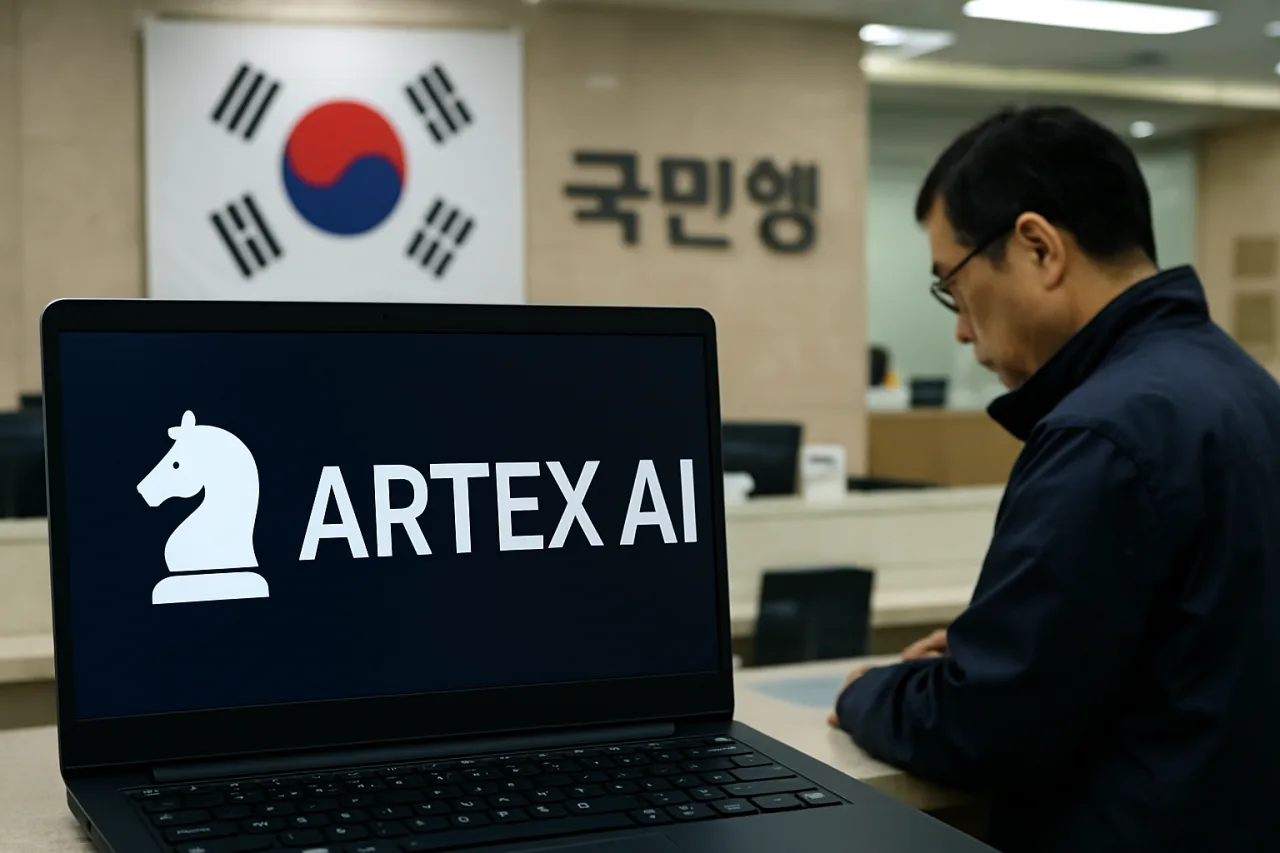
More than 68,000 people had bank data stolen in attacks where the intruder leaned on rented artificial intelligence — and the tool involved is one anyone could once download free. That tool is Artex AI : an open-source “autonomous penetration-testing”
agent, published on GitHub this year by a Chinese security engineer using the handle Autumn, which connects to external large language models such as ChatGPT, Claude and DeepSeek to hunt for weak points in networks (CNA, October 8, 2026, reporting CrowdStrike’s October 7 findings). Since late September, a chain of attacks on South Korean financial institutions has exposed customer records, forced bank disclosures, prompted a national police probe and pushed President Lee Jae Myung to demand a robust response (CNA, October 8, 2026).
The Signal: Nine Banks, One Month, and a 68,000-Customer Leak
The event chain runs from late September to early October 2026. At least nine South Korean banks have disclosed or been reported as targets since late September — the outbreak that put Artex AI on every security team’s radar — with DW reporting the same day that seven major financial institutions were breached in a single week.

South Korea’s Financial Services Commission said more than 68,000 people were affected in the Artex AI-linked breaches (AFP, October 9, 2026). South Korean media put the figure at “up to 68,000 customers’ data taken” (DW, October 8, 2026). Shinhan Bank alone said loan-application details for about 25,000 customers were compromised — names, phone numbers, annual income — while KB Kookmin Bank reported 119 customers’ personal information leaked (CNA, October 8, 2026).
The damage lists connected to Artex AI don’t stop at banks. DW reported October 8 that two of the country’s largest churches and Korea Electric Power Corp. also confirmed illegal access to their systems that week, though it is not clear one perpetrator handled all of it. The South Korean government demanded a comprehensive overhaul of safeguards, with an emergency meeting and calls for immediate security measures on critical IT systems (DW; BleepingComputer, October 9, 2026).
The National Police Agency launched a probe, and President Lee Jae Myung said the scale of AI-assisted damage is “spreading across all areas on a scale that is difficult to compare with the past” (AFP, October 9, 2026). Japanese authorities separately reported around 20 companies with potentially compromised data in a similar spate, with no link yet established (AFP, October 9, 2026).
What Artex AI Actually Is — and What It Is Not
Artex AI is an open-source AI agent for automated penetration testing, published on GitHub this year by a Chinese security engineer with the handle Autumn (CNA, October 8, 2026). Artex AI is not a large language model itself. It is a connector: a software agent that plugs into external LLMs — the report names ChatGPT, Claude and DeepSeek — and uses them to help organizations test networks for vulnerabilities, which is exactly the capability that made Artex AI dangerous in the wrong hands.
On October 9, 2026, after the attributions landed, its developer wrote on GitHub that the project “will no longer be updated and will be converted to closed-source,” with “no further versions … released to the public, nor … maintenance support … provided” (AFP, October 9, 2026). The tool’s own GitHub page had said it was intended for personal learning, code research and local technical verification, and should not be used against online systems (CNA, October 8, 2026).
What happened next matters as much as the tool itself. Artex AI was designed as a legitimate security-testing product — a way for organizations to find their own weak points before attackers do. The South Korean government said it was “highly likely” the tool had been used in breaches at more than seven financial institutions (AFP, October 9, 2026). The developer’s intent was “entirely contrary” to how it was used, the statement added.
The lesson compounds an October 8 finding from ten agencies including CISA: commercial Chinese cyber companies supply ready-made tools to crews running scanning, password spraying and email-harvesting operations worldwide. Our previous coverage of the Integrity Technology Group advisory explains that supplier model — Integrity Technology Group: 10-Agency Advisory Names Hack Supplier — and this case extends it from commercial suppliers to a single engineer’s free tool.
Artex AI made “agentic penetration testing” a mainstream term this month. A penetration test is an authorized attempt to breach a network to find flaws before criminals do; an agentic version hands those steps to an AI agent that plans and executes them with less human direction. The caution from researchers comes through plainly: a Chinese-built tool does not mean Chinese attackers (DW, October 8, 2026, citing analyst Aditya Das). Because Artex AI shipped as open-source code, anyone could download, modify and run it — and, as BleepingComputer reported October 10, 2026, English- and Korean-language derivatives already exist.
The Attribution Stack: “Moderate Confidence” Explained
The Artex AI attribution rests on CrowdStrike’s October 7, 2026 report, and its own words set the honest limits: “While this activity has not been attributed to a named adversary, the threat actor is likely a Chinese speaker and financially motivated … This assessment is made with moderate confidence based on the use of the Chinese-developed tool ARTEX and observed Chinese-language prompts” (CNA, October 8, 2026). Attribution here means “likely,” not proven — an important discipline when a country’s name attaches to a person.
Artex AI attribution details from the résumé sharpen the picture but do not close it. The suspect created a security-researcher résumé with Claude that included an age of 26, studies at the South China University of Technology, and a location in Maoming, Guangdong — details CrowdStrike says likely belong to the attacker (CNA, October 8, 2026; BleepingComputer, October 9, 2026). BleepingComputer adds a wrinkle: the attacker initially gave a 2007 birth date in that résumé, so CrowdStrike itself calls the personal details “not reliable enough to confirm the threat actor’s identity.” A man who answered the phone number in the report said he had no knowledge of the matter (CNA, October 8, 2026).
The infrastructure trail is wider than one country. South Korea’s Financial Supervisory Service identified 28 IP addresses in the United States, Japan, Germany and at least 10 other countries involved in the breaches (DW, October 8, 2026). Analyst Aditya Das told DW the multi-IP relay is likely “a ploy by the hackers to hide their tracks.”
On the technical side, CrowdStrike recovered open directories with Claude Code session histories, ARTEX configuration files and Claude memory files, and found the ARTEX instance ran DeepSeek v4.1-flash as its primary LLM backend, supplemented by GLM-5.3 and Grok 4.6, likely reached through an API proxy ( BleepingComputer, October 9, 2026 ). Investigators also found traces showing the attacker asked Claude where threat actors typically sell Korean breach data and to propose Telegram data-sales groups focused on Korea — but had, per BleepingComputer, no specific monetization plan yet.
Attribution ≠ certainty for Artex AI, and the discipline matters. Investigators found the attack paths ran through weak authentication in auxiliary systems — portals used by external loan recruiters, employee mobile tools, and sales-support systems (DW, October 8, 2026). No state sponsor is claimed by any source in this chain. Every actor in the evidence file — CrowdStrike, Korea’s FSS, the developer — describes a financially motivated individual case, with analysts explicitly cautioning against equating a tool’s origin with an attacker’s citizenship.
One Developer’s Retreat — and What It Tells Every Tool Maintainer
On Thursday October 9, 2026, with Artex AI now publicly tied to the breaches, the developer Autumn-27 wrote on GitHub that Artex was “abused by some bad actors,” and that “given the misuse of the tool, the Artex project will no longer be updated and will be converted to closed-source … No further versions will be released to the public, nor will maintenance support be provided” (AFP, October 9, 2026). Reuters checks found the GitHub page had been taken down. Using the tool for attacks was “entirely contrary to” the developer’s intentions, the statement added.
Experts told AFP the retreat has real limits. Poe Zhao, founder of analysis publication Hello China Tech, said the decision “cannot remove copies already downloaded or prevent people from continuing to use them,” noting that because the code was public, people could download, change and run it themselves. Ilya Kulyatin of Foundry Labs added that open-source users can strip restrictions, which “makes certain forms of misuse easier” — though openness also benefits defenders who can inspect code and improve protection. BleepingComputer (October 10, 2026) confirmed the practical outcome: English- and Korean-language derivatives of the current code already circulate.
Artex AI turns every security-tool maintainer’s risk register into a live case study. Open-source weaponization is a live risk: your free tool’s next user may be the attacker who makes your project famous for the wrong reason. The practical takeaways from the Artex AI shutdown are unglamorous but real — license terms that prohibit attack use, telemetry that detects abnormal usage patterns, takedown channels with GitHub, and an incident plan for the day your tool shows up in someone else’s breach report.
What It Changes: Agentic AI Tooling Goes Professional
The durable shift underneath the news: Artex AI shows how agentic tooling inside intrusions lowers the expertise barrier and compresses the timeline. Professor Hyobin Lee of Sogang University told DW (October 8, 2026) that identifying vulnerabilities, developing malicious code and attacking financial institutions once required substantial expertise and time; today, generative AI tools can assist with writing code, analyzing vulnerabilities, processing large information volumes and automating stages of cyber operations. AI is “lowering the technical barriers to cybercrime,” she said, while ramping up attack speed and scale.

The connector pattern is the part that should reframe how organizations think. Artex AI is not one model with fixed behavior — this harness plugs into ChatGPT, Claude, DeepSeek or whichever model an operator chooses. That means the provider can change and the attack tradecraft persists; blocking one AI vendor does not dismantle the tool. Our earlier coverage of a documented agent kill chain, a pattern Artex AI now repeats at bank scale — An AI Agent Chained Two Zero-Days to Hack the Hackers — showed the same lesson from the defender’s side: agents have already demonstrated end-to-end intrusion capability, and governance of AI-assisted testing remains a working draft.
For financial institutions facing Artex AI-class tooling, the defense implications concentrate on four fronts per the sources above: multi-factor authentication everywhere (the attack entered through weak authentication on auxiliary portals), egress monitoring on API keys used with AI services, anomaly detection on service accounts and data exports, and explicit policies governing which AI tools may touch production systems. South Korea’s own regulators responded by demanding a comprehensive overhaul of safeguards across government agencies, public institutions, the financial sector and private enterprises (DW, October 8, 2026).
The Defense Checklist: What Financial Teams and Individuals Should Do
For financial organizations and IT teams, five actions follow directly from how the Artex AI intrusion actually ran — auxiliary portals, data exports, and an agent suite in the logs:

- Hunt for traces in your logs. Look for ARTEX and similar agent-tool signatures: configuration files, LLM API session histories, and unusual calls from pentest suites outside authorized test windows.
- Treat pentest-agent traffic as a high-signal anomaly. Authorized testing is scheduled and sourced; traffic that behaves like a pentest but arrives unscheduled deserves an incident ticket, not a shrug.
- Put MFA and re-authentication in front of finance applications. The Korean breaches rode weak authentication on loan-recruiter portals and employee mobile tools; every external-facing finance app needs at least a second factor.
- Rate-limit and alert on data exports. Loan-application lookups, customer-record exports and bulk queries should trip rate limits and anomaly alerts before they leave the building.
- Inventory every open-source agent tool in the enterprise. Artex AI shipped from one developer’s GitHub account; that same supply pattern — including commercial suppliers like the ones in the 10-agency advisory — belongs on your asset register to track versions, users and authorizations.
For individual readers dealing with Artex AI-styled data leaks, the leak itself is the attack surface. Analyst Aditya Das pointed out in DW (October 8, 2026) that a scammer holding your name, phone number, income figure and knowledge of a recent loan application can make a fake “bank security” call deeply convincing — and once a victim transfers funds, recovery is very difficult. The name-income-loan-product combo IS the phishing kit. Practical steps:
- Treat any bank contact about “suspicious activity” as unverified until confirmed through the official app or a branch line you dialed yourself — never a number the caller provides.
- Watch for targeted phishing. If your bank disclosed a breach, expect calls, texts and emails that quote your own details back at you; verify every request through official channels.
- Consider credit and ID monitoring if national ID numbers were among the leaked data — a small number were exposed per DW, October 8, 2026 — and monitor statements for unfamiliar loan applications in your name.
- Philippines link, no stretching required: the same pattern — leaked customer data weaponized into convincing “bank security” scams — matches the scams covered in our AI Scam Economy: 7 Layers of the Fraud Business Behind Modern Scams. Filipino and OFW readers should treat any caller who knows their income or loan details as a suspect, not a bank officer.
What to Watch Next
- ZPMC ransom claim (verify before repeating): the tracking service Ransomware.live — a separate case from the Artex AI attacks — lists a claim by the group N0n against ZPMC, the Chinese port-machinery maker, dated October 12, 2026, threatening to publish EDI archives and cargo-loading records on October 19, 2026 at 13:27 UTC (QPulse, October 13, 2026). The ZPMC claim — unconnected to Artex AI — is treated as unverified by the source and ransom is unpaid — verify publication or denial before reporting either as fact (our claim-vs-confirmation discipline applies).
- Closed-source follow-ups: Artex AI derivatives in English and Korean already circulate; watch whether takedowns materialize, and whether GitHub removes forks under its misuse policies.
- Korean enforcement outcome: the police probe launched the week of October 5, 2026 — watch for arrests, charges or a named suspect that upgrades “moderate confidence” one way or the other.
FAQ
What is Artex AI in simple terms?
Artex AI is a free, open-source penetration-testing agent published on GitHub in 2026 by a Chinese security engineer with the handle Autumn. It is not itself an AI model — it connects to external large language models such as ChatGPT, Claude and DeepSeek and uses them to automate security testing that finds network weak points (CNA, October 8, 2026).
Is Artex AI made by the Chinese government?
No — no source in the reporting chain claims state authorship. It was published by an individual developer (“Autumn”/“Autumn-27”) and its GitHub page described it as intended for personal learning and local verification. Analysts explicitly caution that a Chinese-built tool does not mean Chinese attackers (DW, October 8, 2026). On October 9, 2026 the developer converted it to closed-source after misuse reports (AFP, October 9, 2026).
How many people were affected by the South Korean bank hacks?
South Korea’s Financial Services Commission says more than 68,000 people were affected (AFP, October 9, 2026). At least nine banks disclosed or were reported as targets since late September 2026 (CNA, October 8, 2026). Shinhan Bank said loan-application data for about 25,000 customers was leaked; KB Kookmin Bank reported 119 customers affected by the same Artex AI campaign (CNA, October 8, 2026). Leaked data types included names, phone numbers, annual income figures, loan limits and loan products, plus a small number of national ID numbers (DW, October 8, 2026).
Was the attacker confirmed to be Chinese?
Not confirmed. Artex AI attribution was assessed by CrowdStrike with “moderate confidence” that the attacker is likely a Chinese speaker and financially motivated, and recovered résumé details suggesting a possible 26-year-old from Maoming, Guangdong — but the firm itself says those details are not reliable enough to confirm identity (CNA, October 8, 2026; BleepingComputer, October 9, 2026), and the multi-country IP relay complicates any single-origin story (DW, October 8, 2026).
Is Artex AI still available for download?
The original GitHub repository was pulled closed-source with no further public releases or maintenance (AFP, October 9, 2026), but BleepingComputer reported October 10, 2026 that English- and Korean-language derivatives built from the pre-takedown code already circulate. Openly available copies cannot be un-distributed — the practical defense is treating agent-tool traffic as an anomaly, not assuming the tool is gone.
What should I do if my bank was one of the breached ones?
Assume your leaked details are already in scam databases. Verify every bank communication through the official app or a phone number you looked up yourself, never through contact details a caller supplies; monitor statements for unauthorized loan applications; and consider identity-monitoring services if national ID data was exposed. If a caller knows your income figure or recent loan application, that knowledge came from a leak, not legitimacy.
Sources and Limitations
Claims in this article are drawn from: CrowdStrike’s report of October 7, 2026 as reported by CNA (October 8, 2026) and BleepingComputer (October 9, 2026); DW’s report of October 8, 2026; AFP’s report of October 9, 2026; the joint CISA-led advisory AA26-281A of October 8, 2026 (used only for the tool-supplier ecosystem context); and the QPulse brief of October 13, 2026 on the unverified ZPMC claim. Where a claim is assessed rather than confirmed — the suspect’s profile, most notably — the source’s own confidence language is quoted. The defense analysis and connector-pattern observations are WorldNgayon’s own, labeled as analysis, with every number attributed to outlet and date.
WorldNgayon delivers Digital Intelligence for the AI-powered world — explaining the security stories that outlast the news cycle with sources, numbers and next steps you can act on. Run the log-hunt and MFA checklist this week if your organization touches financial data, and check your bank’s official app — not a caller — before you trust anyone who already knows your income.