Table of Contents
Key Takeaway
- 📱 GStocks PH passed two million users — the GCash stock-trading platform is now the biggest contributor to PSE online trades, per the Philippine Star (Sep 23).
- 💰 ₱1,000 is the practical floor. Board lots start small, the fee is 0.25% flat with no ₱20 minimum commission, and funding rides on your GCash wallet.
- 🧮 The math is the difference. The same ₱5,000 order costs ₱12.50 in commission on GStocks versus what the old ₱20 minimum made impossible for small tickets — but VAT and PSE/SCCp charges still stack on top.
- 🚂 The IPO subscription rail runs through the same app. The GCash IPO (pricing Oct 1, offer Oct 6–12) can be ordered from GStocks PH — one wallet, one verification, one place.
- ⚖️ Registered is not invested. This guide closes the gap: what to buy first, what to skip, and the rules that keep a first order from becoming a first loss.
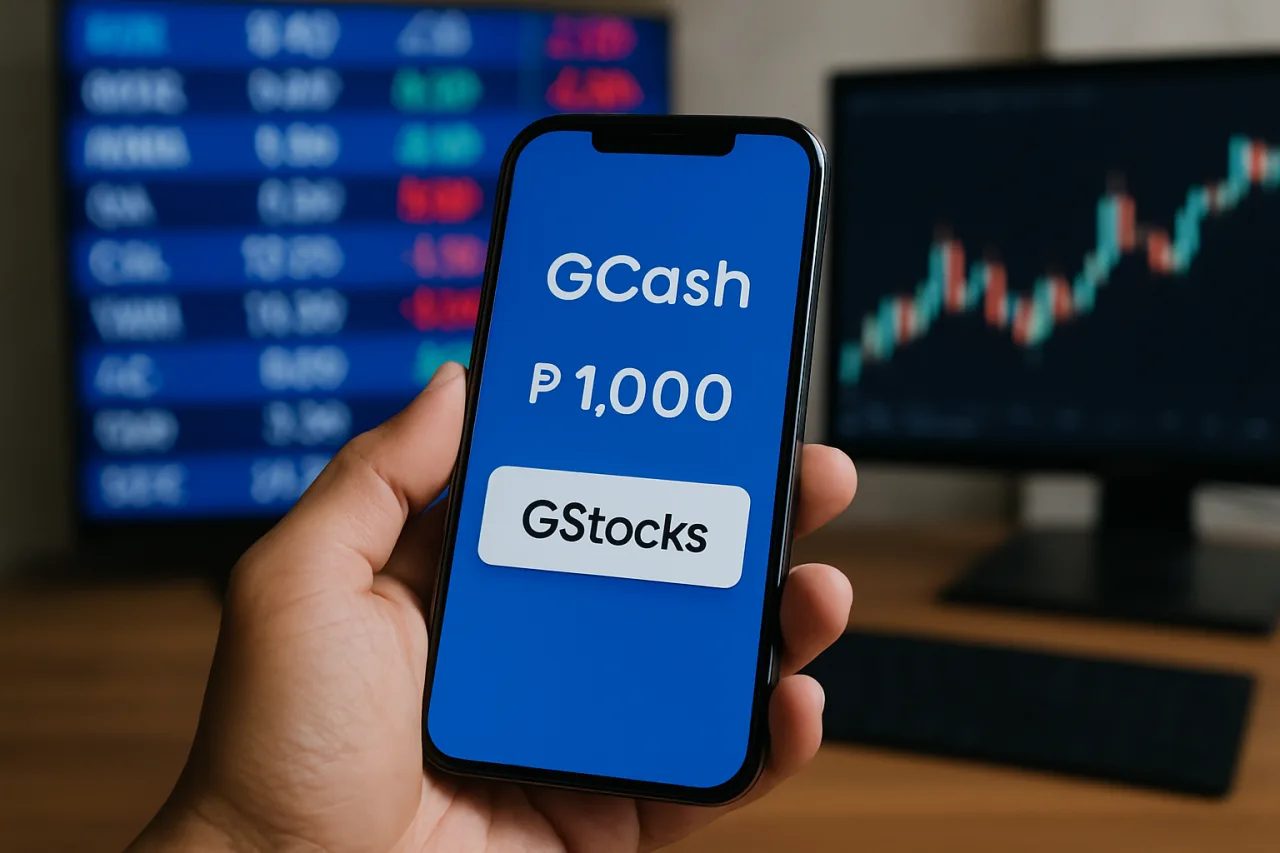
Two million Filipinos have opened the door. Most have not walked through it. GCash’s stock-trading platform GStocks PH crossed two million registered users this month — making the e-wallet the single largest contributor to online trades on the Philippine Stock Exchange — yet the difference between having an account and placing a first, disciplined order is exactly where beginners stumble: board lots they didn’t compute, fees stacked on small tickets, IPO money treated like a lottery ticket. This guide is the walkthrough. If you are holding a fully verified GCash account and a ₱1,000 you can afford to leave invested for three years, everything below applies to you — starting today, before the biggest IPO the country has ever priced.
What GStocks PH Is — and What the 2-Million Number Actually Means
GStocks PH is the stock-trading service inside the GCash app, operated with its brokerage partner AB Capital Securities, Inc. — one of the oldest floor names on the PSE, now running the research and online trading behind the wallet’s stock tab. When you buy or sell a stock in GCash, AB Capital executes the order on the exchange under its broker license; your wallet is the cash rail, your phone is the terminal. The service covers PSE-listed stocks only: no US shares, no crypto, no derivatives. Per the Philippine Stock Exchange’s official investor page, retail participation through online rails is the exchange’s fastest-growing channel. That narrowness is a feature for a first account — it keeps the decision space small and the disclosures in peso terms.
The two-million-user milestone (Philippine Star, Sep 23, 2026) sits inside a bigger PSE story. Stock market accounts grew 27% to 3.64 million in 2025, and 99% of those are retail — barely 30,000 institutional accounts. At least 3.22 million accounts trade through online platforms, and GCash is now the largest single contributor to PSE online trades. The PSE also notes 92% of online traders earn under ₱1 million a year — this is genuinely mass-market participation now, not a rich man’s hobby. Mynt’s new businesses group head Winsley Bangit framed the mission the same way: access that used to be “reserved to a privileged few.”
Read the numbers again and one gap jumps out: two million registered users is not two million investors. Many registered during the IPO curiosity wave, funded nothing, and tapped nothing since. That gap — registered-but-not-invested — is the most expensive place to stand in a market sliding then recovering (the PSEi fell from ~6,094 on Sep 1 to 5,730 on Sep 24 before snapping back to 5,825.97 on Sep 25). This guide exists to close it.
The Requirements: Who Can Open GStocks PH Today
GCash’s help center lists the bars, and they are low by brokerage standards: you must be 18 or older, hold a Philippine SIM, be a fully verified GCash user, and have at least one valid government ID. That’s it — no paper forms, no branch visit, no notarized signatures. Compare that with the traditional brokerage route (a dedicated OFW form, a Philippine bank account, TIN documentation) covered in our OFW broker account guide, and you can see why the wallet rail onboarded two million people in the time it takes a legacy broker to schedule an orientation.
The platform rules are published in GCash’s official GStocks PH help center, and they are unchanged as of this week. For OFWs the calculus has one extra layer: GStocks requires a Philippine SIM and GCash full verification, both of which most OFWs already maintain for remittances. If you are reading this in Riyadh or Dubai with an active Philippine number, you can open and fund the account from abroad — but execution discipline (below) matters more than access. The PSE trading day is 9:30 a.m.–12:00 p.m. Manila time, which lands at dawn or mid-morning depending on your host country; set your order window, don’t improvise it.
The Fees, Computed: What 0.25% Actually Costs You
GStocks charges a flat 0.25% commission on every buy and sell — no minimum commission, a change GCash made after the SEC scrapped brokers’ minimum fees (GMA, May 2024). Before that, small orders paid a ₱20 broker’s fee even when the percentage said they should pay ₱2. Now the ticket size decides the fee. But commission is not the whole cost: Philippine stock trades also carry 12% VAT on the commission, plus the PSE transaction fee and SCCP charges (each a fraction of a percent), and sellers pay the 0.6% stock transaction tax on the sale value. Build your mental calculator like this:
- Buy ₱5,000 of stock: commission ₱12.50, VAT ₱1.50, PSE+SCCP fees ≈ ₱14 — total round-trip friction on a buy ≈ ₱28, or 0.56% of the ticket.
- Sell ₱5,000 later: commission ₱12.50 + VAT + PSE/SCCP fees + ₱30 stock transaction tax (0.6%) — roughly ₱58, or 1.16%.
- Full round trip (buy then sell the same ₱5,000): about ₱86, or ~1.7%. That is your hurdle: the stock must rise ~1.7% just to break even on a same-price exit.
This is why the first-order rule below says few, larger, planned orders — not daily ₱500 taps. At ₱500 tickets, the fixed PSE/SCCP components eat a double-digit percentage of your money. At ₱5,000–₱10,000 tranches, friction falls to manageable levels. The fee structure made small investing possible; arithmetic still makes it expensive if you trade like a day trader on a jeepney budget.
Board Lots: the Arithmetic Rule That Sizes Your First Order
The PSE trades stocks in board lots — fixed share blocks tied to the stock’s price band. A stock priced ₱100–₱199.99 trades in 10-share lots; ₱1,000+ in 5-share blocks; sub-₱10 issues in 100-share blocks. GStocks enforces this in the app: your order gets rounded to a valid lot. Two practical consequences:
- A ₱8 stock trades in 100-share lots — one lot = ₱800. A ₱150 stock trades in 10s — one lot = ₱1,500. Your ₱1,000 budget does not fit every stock; check the lot before you want the stock, not after.
- Blue chips below ₱100 (several telco-adjacent and utility names trade in the ₱30–₱90 range with 100-share lots) are the natural first-buy zone for ₱3,000–₱10,000 budgets: three to ten lots, liquid names, tight spreads.
Worked example, the whole first order: you fund ₱5,000, target a ₱45 utility stock (100-share lot = ₱4,500 per lot). One lot costs ₱4,500; commission 0.25% = ₱11.25; VAT ₱1.35; PSE/SCCP ≈ ₱12.6 — all-in ≈ ₱4,525, leaving ₱475 in the wallet for the next tranche. That single computation — price × lot, plus ~2% friction — is the entire “can I afford this stock” test. Do it before tapping buy, every time.
Your First Order, Step by Step (With the Guardrails)
The mechanics: cash in to your GStocks PH wallet from your GCash balance (tap Invest → GStocks PH → Cash In), search the stock, enter your buy, confirm the board-lot total. Orders execute during PSE hours (9:30–12:00 Manila); pending orders sit in the queue until matched or cancelled. Settlement is T+2 in line with PSE rules, and selling proceeds return to the GStocks wallet for withdrawal back to GCash. The app’s Pera Coach — the AI-powered financial coach GCash paired with GStocks — offers on-demand investing tips pitched explicitly at first-timers; use it as a explainer, not a tipster.
The guardrails, in the order beginners actually need them:
- Order 1 — the index proxy. If a PSEi-tracking or blue-chip ETF is available in your GStocks list, the first tranche belongs there; buying “the market” costs nothing in research and survives mistakes. If not, a single liquid, dividend-paying stock in a business you understand (a bank, a telco, a utility) is the standard answer.
- Three tranches, not one. Split whatever you budgeted into thirds: one now, one in two weeks, one in a month. The PSEi just traveled 6,094 → 5,730 → 5,826 in three weeks — our PSEi 5,843 levels analysis maps the levels that decide Q4, and tranching turns that volatility from an enemy into a discount machine.
- Never the full wallet into one ticker. The 2-million wave skews first-time; concentration is how first accounts die. Five names or fewer, each ≤⅓ of the portfolio, is the classic ceiling.
- Set the exit rule at entry. Write down (in your notes app, truly) why you bought and what would make you sell. A first investor with a written thesis behaves like an investor; without one, you day-trade on vibes.
- Emergency money stays out. Only money you can leave for 3+ years belongs in stocks. Our OFW income floor guide covers the priority order: emergency fund first, then investing.
The IPO Rail: How GStocks PH Fits the October 6–12 Window
The same platform is a stock IPO subscription rail: GCash’s help center walks users through subscribing to IPOs inside GStocks PH — and the timing could not be more pointed. Mynt, GCash’s own parent, prices its ₱92.3-billion IPO on October 1 with the offer running October 6–12. Two million people who trust the wallet will see the subscription card in the same app they already use for load and remittances. Our GCash IPO application walkthrough covers the order mechanics step by step; our cornerstone-signal analysis covers what the smart money’s ₱6.5 anchor means for pricing.
But hold the two decisions apart. An IPO subscription is a single, dated, priced event — you commit pesos, get an allocation or a refund. Stock investing is an ongoing process. The beginner’s pattern that destroys value: subscribe ₱10,000 to the IPO out of FOMO, watch it list, then chase whatever is green that morning. The disciplined pattern: the IPO is one tranche inside the plan above, sized like any other order, with its own written reason — and if the allocation comes back tiny (typical when offers are oversubscribed), the rest of your ₱10,000 continues its three-tranche schedule into the index proxy and dividend names, not into impulse buys. The wallet made investing accessible; discipline is still yours to bring.
GStocks PH vs a Traditional Broker: the Honest Comparison
GStocks is the easiest door, not the only one. The differences that matter to a ₱5,000–₱50,000 investor: cost — 0.25% flat with no minimum commission beats most legacy schedules for small tickets; funding — instant wallet cash-in beats bank transfers and portal funding for speed; research — AB Capital supplies basic content, but a traditional broker (say, COL Financial, covered in our COL 7,500-target analysis) offers deeper research and order types; features — GStocks covers PSE stocks and IPO subscriptions, while full-service brokers add margin, GSIS-style scheduled buying, and international access through partner rails. The OFW decision matrix in our PSE account guide maps brokers against minimums and OFW forms.
The pragmatic sequence many first-timers should run: open GStocks now (minutes, zero friction), place the disciplined first tranches, and if the habit survives three months, add a traditional broker for the deeper toolkit. An account that exists and gets funded beats a perfect account that stays theoretical — but a cheap, easy account is only better than a research-rich one if you actually keep the discipline rules.
The Risks Section Nobody Skips Twice
Stock prices move down as well as up; the PSEi’s 5,730 close on Sep 24 came after weeks of slide, and a 28% gap to brokerages’ 7,500 year-end targets is a forecast, not a schedule. Liquidity concentrates in the blue-chip names — thin small caps can gap against you with no buyer at your price. The 0.6% seller’s tax and round-trip friction make frequent trading a slow bleed. And the behavioral risk dwarfs all of them: two million new accounts meeting a market that just fell 6% in three weeks is the classic setup for panic-selling at the bottom. The PSE data says 92% of online traders earn under ₱1 million a year — the audience this platform was built for — and the platform’s own Pera Coach exists precisely because first-timers historically act on feeling. Fees you can compute; temperament you must train.
One more, specific to this week: the GCash IPO itself. Four-fifths of the offer is existing holders selling, cornerstone money is reportedly anchoring near ₱6.5, and Mynt’s own H1 2026 profit growth slowed to 7.3%. None of that makes the stock a bad buy at the right price — it makes it a priced decision, not a patriotic one. The same discipline you apply to your first blue-chip order applies to the wallet’s own listing.
Frequently Asked Questions
How much do I need to start on GStocks PH?
There is no platform-enforced minimum investment, but board lots set the practical floor: a sub-₱10 stock trades in 100-share blocks, so ₱800–₱1,000 opens most cheap names, and ₱5,000 gives comfortable room for a proper first tranche plus fees. Remember the fee math: below ~₱1,000 tickets, fixed charges bite hardest.
What are GStocks PH’s exact fees?
A flat 0.25% commission per buy and sell, with no minimum broker’s fee, plus 12% VAT on commission, small PSE and SCCP charges, and a 0.6% stock transaction tax when you sell. A full round trip on ₱5,000 runs roughly ₱86 all-in — budget ~1.7% friction.
Can OFWs use GStocks PH from abroad?
Yes, if you keep a Philippine SIM, a fully verified GCash account, and one valid government ID — the standard OFW setup. Execution happens in PSE hours (9:30 a.m.–12:00 p.m. Manila time), so plan your order windows around your host-country schedule. For deeper order types and research, pair it with the brokers compared in our OFW broker account guide.
How do I subscribe to an IPO through GStocks PH?
The IPO subscription card appears in the GStocks PH tab during an offer period; you commit an amount from your funded wallet, and shares or a refund follow after the allocation. For the October 6–12 GCash IPO window specifically, follow our application walkthrough — and size the subscription as one tranche of your plan, not the whole plan.
Is GStocks PH safe for first-time investors?
The brokerage execution runs through AB Capital Securities, a licensed PSE participant, and your cash sits in the GStocks PH wallet system rather than a third-party app. The real risks are market risk (prices fall), friction (fees on small tickets), and behavior (FOMO orders). Platform risk is the smallest of the three — which is why this guide spends its space on the other two.
What should my first stock be?
Either a PSE index-tracking fund if available, or one liquid, dividend-paying company you understand — a major bank, telco, or utility — bought in one board lot with money you can leave for three years. Then tranches on a schedule. What your first stock should never be is the most-talked-about ticker of the week; that test filters for popularity, not value.
Financial Disclaimer: This article is for general information and education, not personalized investment advice. Investing in stocks involves risk, including possible loss of principal. Past performance does not guarantee future results. Do your own research or consult a licensed financial advisor before making investment decisions. WorldNgayon.com is not a broker, dealer, or investment adviser.