Table of Contents
Key Takeaway
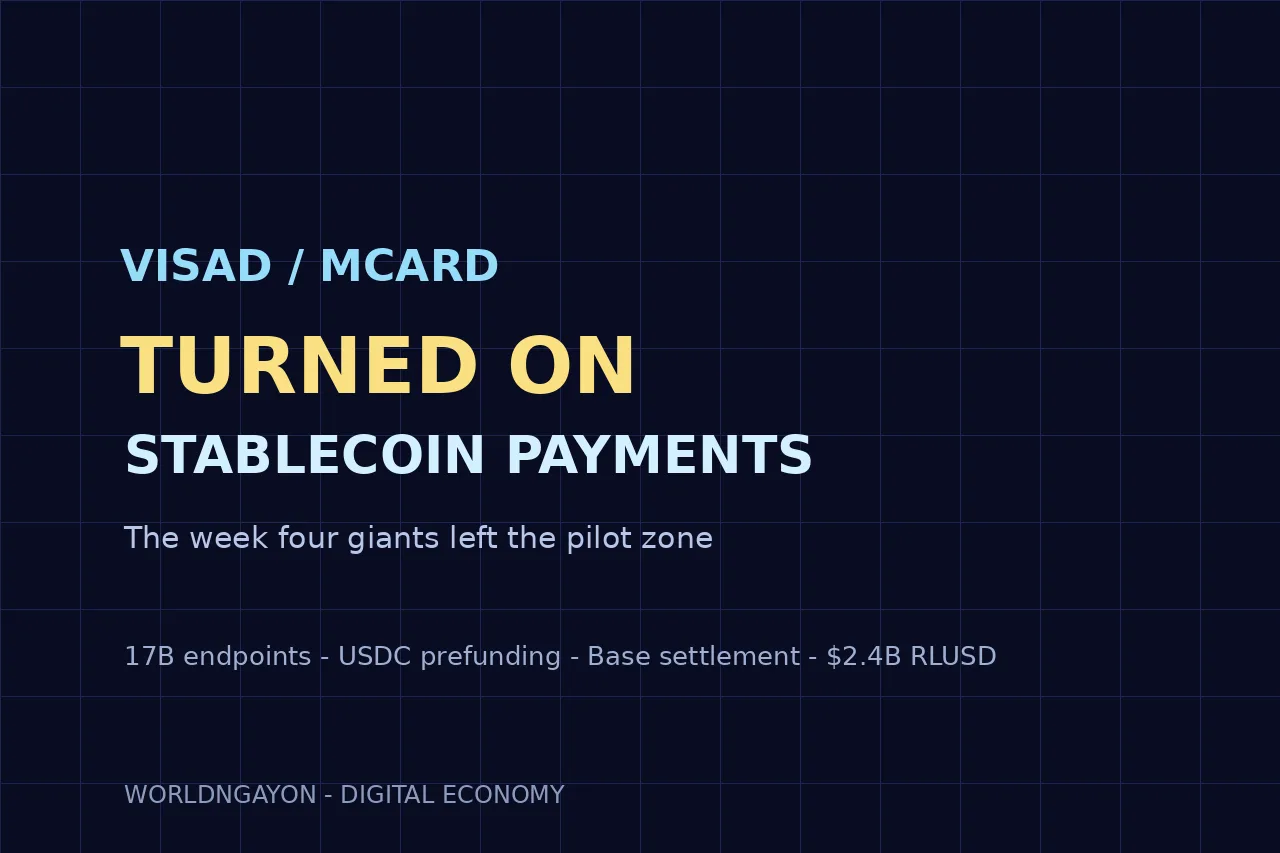
- The stablecoin payments era just crossed its hardest line this week: four of the world’s biggest payment companies moved stablecoins from pilot programs into live, commercial production.
- Visa Direct now funds cross-border payouts with USDC in near-real time through Inyo Global — its first production enabler — the first stablecoin payments capability running live at scale inside Visa’s network.
- Mastercard launched its Global Money Platform with BVNK: stablecoin balances spendable at 17 billion endpoints across 130+ issuing countries.
- Marqeta and Coinbase are backing card spending with stablecoin balances — custody and settlement run on Base — while Cross River Bank wired $2.4 billion of Ripple’s RLUSD directly into core banking.
What Happened in 48 Hours
Three announcements landed within two days, from three layers of the payment stack that normally take years to agree on anything.
On October 15, Visa’s investor site carried the news: Visa Direct’s stablecoin capabilities were moving from pilot stage to commercial deployment after the 2025 pilot programs demonstrated cross-border funding and liquidity management for eligible clients. Inyo Global — a processor serving money transmitters, fintechs, banks and payment businesses — became the first enabler to put stablecoin-enabled prefunding into production, giving its customers USDC funding of cross-border payouts in near-real time, around the clock, through the same APIs they already run — stablecoin payments arriving as an upgrade, not a migration.
On October 16, Mastercard and BVNK launched the Mastercard Global Money Platform — the first major collaboration between the two since Mastercard acquired BVNK in March 2026. The platform packages BVNK’s stablecoin infrastructure behind a single API: multi-currency accounts holding fiat and stablecoins side by side, real-time conversion, stablecoin-linked cards, and local bank payouts powered by Mastercard Move — which puts stablecoin payments within reach of 17 billion endpoints that accept Mastercard, in local currencies. Card issuing spans more than 130 countries, with hundreds of millions of merchant locations in reach. Nuvei, Marqeta and Bolt Group are the first companies on it.
The same day, Marqeta and Coinbase announced a collaboration to enable stablecoin-backed card payments. Coinbase handles custody of balances, converts to and from fiat, and settles fast and cheap on Base, its own blockchain; Marqeta issues the cards, processes the spending, and manages the bank and network relationships. The result: a business can fund a card program 24/7 with stablecoins, and a cardholder can spend stablecoin balances at millions of merchants that simply accept cards. No wallet app, no conversion ceremony — just a tap that used to be a crypto-to-fiat project.
The Fourth Move Nobody Should Ignore: banks
While the card world made headlines, two bank-adjacent moves did quieter work. Cross River Bank, the New Jersey bank behind countless fintech programs, announced on October 15 that Ripple’s RLUSD stablecoin had been added to its proprietary Core Operating System, with XRP Ledger support.
Fintechs plugged into its single API can now touch dollar and RLUSD payments — settlement across borders and treasuries around the clock, ACH, wires and real-time rails alongside.
Cross River’s release put XRPL-based RLUSD issuance above $1 billion, with the token’s total market cap near $2.4 billion as of October 16. Standard Chartered had moved the week before, launching RLUSD custody from its Dubai International Financial Centre branch for institutional clients on October 12. And Matera’s new Workspace platform — launched October 16 — lets banks and credit unions offer stablecoins and crypto inside their existing core systems, with a real-time “Digital Twin” ledger that holds dollars and USDC as equals — stablecoin payments recorded inside the bank’s own books and can pilot in about an hour.
What “Turned On” Actually Means
The distinction that makes this a trend rather than a press cycle is the word “production” — the exact threshold stablecoin payments had not crossed until now. In 2025, Visa ran stablecoin prefunding and payout pilots — demonstrations of what could work.
This week, real money-transmitter customers fund real payouts through a live processor. Mastercard’s platform is not a sandbox; Nuvei, Marqeta and Bolt are commercial customers with revenue to move. Marqeta’s stablecoin-backed cards are products for enterprise customers, not concept art — and the company already issues crypto-backed cards for Coinbase today, so the infrastructure path from “crypto card” to “stablecoin card” is a change of funding asset, not a new machine. When the four largest players in a market stop experimenting within the same 48 hours, the experiments are done, and stablecoin payments are the working product.
Why Remittances Are the First Battleground
Read the customer lists closely and one corridor dominates: cross-border money movement. Inyo Global’s customer base is money transmitters — the companies that form the plumbing of global remittances.
Stablecoin payments show their shape in Mastercard Move’s payout design: local-currency disbursement to bank accounts and cards — exactly what an inbound-remittance rail needs on the receiving end. Cross River’s API targets the fintechs processing those flows. A stablecoin payments leg moves value instantly and cheaply between counterparties; the network layer converts and delivers it locally. That is the remittance stack, redrawn with the settlement friction removed — the same corridor logic we mapped in China’s mBridge, where state-grade rails compressed cross-border cost and settlement time, and the ¥600 billion ledger showed what institutional-grade corridor rails can carry.
For a corridor like the Philippines — one of the world’s largest remittance markets — the practical version looks like this: a transmitter prefunds payouts with USDC through Visa Direct’s production capability, the receiving side converts through a network-issued channel, and the household gets pesos through local rails — stablecoin payments invisible in the interface, decisive in the plumbing. The money never sits in a correspondent bank queue overnight. Every player in that chain is a company that announced this week.
The Layered Map: Who Now Owns What
Step back and the week’s four moves assemble into something with a shape: a complete vertical, layer by layer, with stablecoin payments as the connective tissue.
At the base, custody and settlement: Coinbase holds balances and Base clears them for Marqeta’s cards, while Cross River’s core system records RLUSD the way it records dollars. Above that, the networks: Visa Direct moves prefunding into payout processors, Mastercard Move delivers local payouts to billions of endpoints. At the top sit the account layers — Mastercard-BVNK multi-currency accounts, Matera’s Digital Twin ledger — where a balance stops caring whether it was born as a dollar or a stablecoin. No single vendor built all of it. Four companies, four layers, one week: that is how a new product class stops being a product and becomes an environment.
The layering matters because remittance flows touch every layer on the way to a household. Money has to be prefunded (Visa’s layer), held in an account that settles instantly (Mastercard-BVNK or Matera’s), issued onto a card-or-account endpoint the recipient can actually use (Marqeta’s), and recorded in the books of a regulated institution (Cross River’s). Before this week, those layers were four different experiments. Now they are four live products that can be purchased as a stack — which means a mid-size fintech in Lagos, Dhaka or Manila can assemble a corridor without building any of the hard parts itself.
The Corridor Arithmetic
What does the stack change for the money that matters to readers of this desk — the $200 that leaves Riyadh, Dubai or Hong Kong for a Philippine bank account?
Today that transfer typically rides two sets of costs: the upfront fee the household sees, and the spread hidden inside the exchange rate, on top of whichever correspondent chain is holding the funds overnight. Stablecoin layers attack the hidden half first. The provider prefunds with a dollar token that settles in seconds; the receiving side converts at the spread it publishes; if the corridor volume is real, the savings show up as a thinner fee or a faster payout — usually both, eventually. The visible win is timing: no funding windows, no batch cutoffs, no two-business-day correspondent dance for the balance to arrive.
That said, a corridor is infrastructure plus habit, and habit moves slower.
Filipinos pay remittance fees because the alternatives have been slower or riskier, not because they love paying them; the first channels to win on price will be the ones already holding the household’s trust — the banks and wallets that can add a stablecoin rail without changing the interface, which is precisely what Matera sells and what stablecoin payments infrastructure of this week’s kind makes cheap.
The measure to watch: payout timing and effective cost on the busiest OFW corridors through the next two quarters, as processors like Inyo’s customers switch funding legs. The macro backdrop sharpens the stakes — with the region’s central banks still weighing inflation against growth, a rail that removes cost and idle time between two currencies arrives at a good moment: households, lenders and employers all want the same thing, a cheaper corridor, and the BSP’s Thursday decision will tell the region which way its own policy lever moves.
The Honest Caveats
The fine print still matters. Cross River’s RLUSD services are live in a limited number of US states the release did not name, with customer names and volumes undisclosed — “limited states” is the industry’s way of saying: watch what ships where.
Mastercard’s 17-billion-endpoint figure counts every acceptance point its network touches; real stablecoin spending at those endpoints depends on issuers, wallets and local rules adopting program by program, country by country. Custody on the card model is institutional, not self-custody — your stablecoin balance in a card program is what the issuer says it is, which is why Base-level transparency and issuer quality matter more than token price. None of these four moves puts stablecoins in a checking account at your neighborhood bank tomorrow; Matera’s one-hour pilot is the promise, not the reality across bank branches. The trend is real; so is the distance between launch day and ubiquity.
What to Watch Next
Four markers price the next stage of this story. First, Visa’s second production enabler — one was the proof, several make it a business line for stablecoin payments at the top of the stack.
Second, Mastercard’s platform adoption beyond the founding three (Nuvei, Marqeta, Bolt), especially issuers in remittance-heavy corridors like Southeast Asia and the Gulf.
Third, stablecoin-backed cards at scale: conversion costs and settlement latency on Base as Marqeta’s enterprise customers push volume. Fourth, RLUSD’s trajectory — $1 billion issued on XRP Ledger, $2.4 billion market cap, Standard Chartered custody in the Gulf, Cross River core banking at home: if RLUSD crosses toward $5 billion with bank-distribution pipes live — the clearest proof stablecoin payments can scale inside a bank, Ripple’s settlement asset stops being a story about XRP and becomes a story about bank rails.
The stablecoin payments layer is the rare story where the evidence is published as transactions, not promises — the next monthly numbers will confirm or embarrass everyone who called the trend too early.
Standard Chartered’s UAE turn to direct crypto earlier this month showed a bank crossing from custody to trading. This week’s four moves show the entire payment stack crossing from pilot to production. Both together sketch the same arc — stablecoin payments moving from narrative to infrastructure —: the institutions are not preparing to adopt stablecoins — they are already the ones running them.
Sources: Visa, Mastercard BVNK coverage, Marqeta and Cross River releases (Oct 15–16, 2026); market data CoinGecko Oct 17. Analysis, not investment advice.