Key Takeaway
- 📅 The GCash IPO offer runs October 6-12, with listing under the ticker “GCASH” on October 20 — the application window is days, not months, and the steps below are the whole sequence.
- 📱 Three application paths: GStocks inside GCash (retail lane), traditional brokers (PDAX participants), and PSE EASy (the small-investor lane with guaranteed allocation rules for local small investors).
- 💵 Board-lot math: GCash IPO shares price around the disclosed range, with board lots at roughly ₱800-1,000 minimum — the “₱12,000 minimum” myth circulating on social media is wrong.
- 🛡️ The oversubscription reality: popular IPOs get scaled down — your application is a request, not a guarantee, and allocation rules decide who gets what.
- ⚠️ Scam warning: no OFW “guaranteed allocation” exists. If someone offers guaranteed GCash IPO shares for a fee, that is fraud — report it.
Table of Contents
Update (Sept 26): Cornerstone investors committed ₱36.5B — about 68.8% of offer shares — and pricing below the ₱10 ceiling is expected (final price set Oct 1). Read the full signal analysis in The GCash IPO Just Told Everyone What It’s Worth.
Last week’s IPO playbook covered the big picture: Mynt listing October 20, up to ₱92.3 billion raised, the first issuer under the SEC’s 12%-float rule. This piece is the practical half — how to actually apply for the GCash IPO before the October 12 close, screen by screen, with the costs, the lanes, and the traps named. One read-through, then the two-week clock.
The Timeline You’re Working Against
PSE approval came September 18; pricing was set through the October 1-2 book-build; the offer period runs October 6-12; listing lands October 20. Application channels close on the 12th — and retail lanes typically see heavy traffic on the final day. The professional move: decide your lane and amount this week, fund the account before the window opens, and apply early in the window. Every step below takes minutes if the prerequisites are already in place.
Path 1: GStocks — the GCash IPO Retail Lane
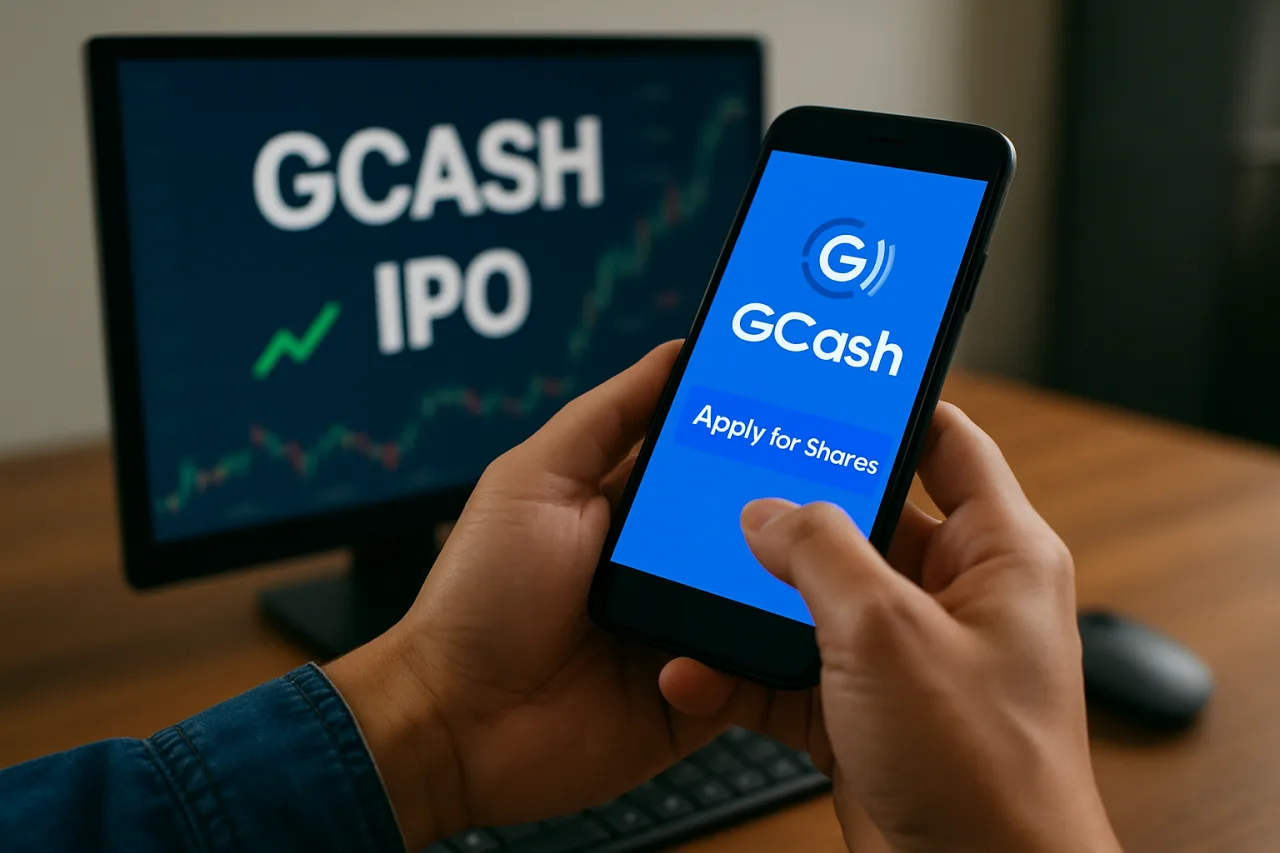
The home-court advantage: the app you already use hosts a securities arm that can take your IPO application. The sequence:
1. Update the GCash app to the latest version.
2. Open GStocks (verify your profile is fully KYC'd — ID + selfie on file).
3. Inside GStocks: IPO/Equity offerings → select GCASH.
4. Enter your application: board lots, payment via GCash wallet or linked bank.
5. Confirm and screenshot the application reference number.
Requirements: fully verified GCash account, funds available, and a registered GStocks account (opening one takes minutes; do it before October 6, not during the crush). The lane’s trade-off is allocation mathematics: retail demand exceeds retail supply in popular offerings, so expect scaling — apply for what you’d be happy receiving a fraction of.
Path 2: Through a Stock Broker
The traditional lane: a PSE-accredited broker (COL Financial, BDO Securities, BPI Trade, and others) takes subscription applications for IPOs. The steps: open/fund a brokerage account (do it this week — account opening takes 1-3 days), place the IPO application through the broker’s platform or form before their internal cutoff (often earlier than the PSE’s), and wait for the allocation notice. Brokers give better access for larger applications and handle the paperwork; the cost is the account-minimum dance and the broker’s own cutoffs, which are frequently a day or two before the official close.
Path 3: PSE EASy (the Small-Investor Lane)
The PSE’s EASy system exists precisely for small local investors: one application, one board lot minimum, with allocation rules designed so small subscribers aren’t crowded out entirely. Register at the EASy portal, verify your identity once, and the IPO application becomes a short form during the offer window. For a first-time IPO applicant with a small amount, EASy plus GStocks covers both the “simple” and “guaranteed-small-lane” philosophies — you can apply through more than one channel, but not for more than the maximum across all channels (oversubscription rules void overlapping excess applications).
The GCash IPO Money: Board Lots, Costs, and the Myth
The numbers, plainly. Board lots price in the low thousands per lot depending on final pricing — the working assumption for the smallest entry is ₱800-1,000. The “you need ₱12,000-15,000 minimum” posts circulating on Facebook misread the price-to-earnings disclosures; the minimum is one board lot, not one “amortized retail block.” Costs to budget: the application amount itself, plus possible transaction fees on the sell side later — and the reality that oversubscription scales everyone down. If you apply for ₱10,000 and demand outstrips supply ten-to-one, you receive roughly ₱1,000 worth. Refunds of the excess arrive after allocation — check the offering’s refund timeline (usually within two weeks of the close).
The OFW Angle: Applying From Abroad
Overseas applicants face one added wrinkle: identity and funding. A fully verified GCash account (KYC done on a home visit or via GCash’s overseas verification where available) makes the GStocks lane workable from abroad; the EASy portal accepts overseas Filipino applicants with valid IDs; brokers vary — several accept overseas accounts with additional documentation. The funding reality: peso funds parked in GCash or a brokerage account before the window make the application a two-minute job from any time zone; funding during the window from a remittance adds a delay you don’t want on deadline day. For the family-money layer — what to do with allocated shares versus the remittance budget — our ber-months plan and MP2 guide cover the surrounding envelope.
The Scam Layer: What “Guaranteed Allocation” Really Means
Wherever retail excitement meets a deadline, fraud follows. The guaranteed-allocation pitch — “send your application through me, guaranteed shares, service fee only” — is the 2026 version of a very old scam: allocations are never guaranteed in an oversubscribed IPO, and no legitimate party charges a “guarantee fee” for application access. The legitimate channels are exactly three: GStocks, PSE-accredited brokers, and PSE EASy. Anything else — a “broker’s cousin,” a Facebook group admin collecting applications, a Telegram “insider lane” — is a theft attempt aimed at exactly this news cycle. Report suspected fraud to the SEC and the PSE’s market regulation group; the offering’s own disclosures list where.
The One-Week Preparation Checklist
- Verify your GCash is fully KYC’d; open/verify GStocks.
- Fund the account you’ll apply through before October 6.
- If using a broker: confirm the account is open and funded by Thursday.
- Decide the application amount — an amount you’re content to receive a scaled-down fraction of.
- Read the final prospectus for the confirmed price and terms before confirming any application.
- Set the calendar reminder: applications close October 12; listing October 20.
UPDATE (September 27): The IPO’s cornerstone book is reportedly anchoring near ₱6.5 — analysts see the final price landing in the ₱6.50–8.00 band, below the ₱10 ceiling, with pricing October 1 and the retail window October 6–12. The steps below are unchanged. Full signal analysis here.
Frequently Asked Questions (FAQ)
- Q: When exactly can I apply for the GCash IPO?
- The offer period runs October 6-12, 2026. Channels close on the 12th, though broker cutoffs can be earlier — apply early in the window, not on deadline day.
- Q: What’s the minimum investment?
- One board lot — roughly ₱800-1,000 depending on the final price. The “₱12,000 minimum” claim on social media is a myth.
- Q: Can I apply through both GStocks and EASy?
- You may apply through multiple channels, but total applications must stay within the offering’s maximum per-applicant rules — excess applications get voided, not scaled.
- Q: When will I know if I got shares?
- Allocation notices go out after the October 12 close, with refunds for excess payments typically processed within two weeks — before the October 20 listing.
- Q: Is the GCash IPO a good investment?
- That depends on the final valuation, your goals, and your portfolio — the playbook piece covers the bull and bear cases. This walkthrough covers only how to apply; the decision is yours.
Financial Disclaimer: This article is for general information only and is not financial advice or a recommendation to invest. IPO terms, timelines, and allocation rules may change; verify with the offering prospectus and official channels before applying.