Table of Contents
Key Takeaway
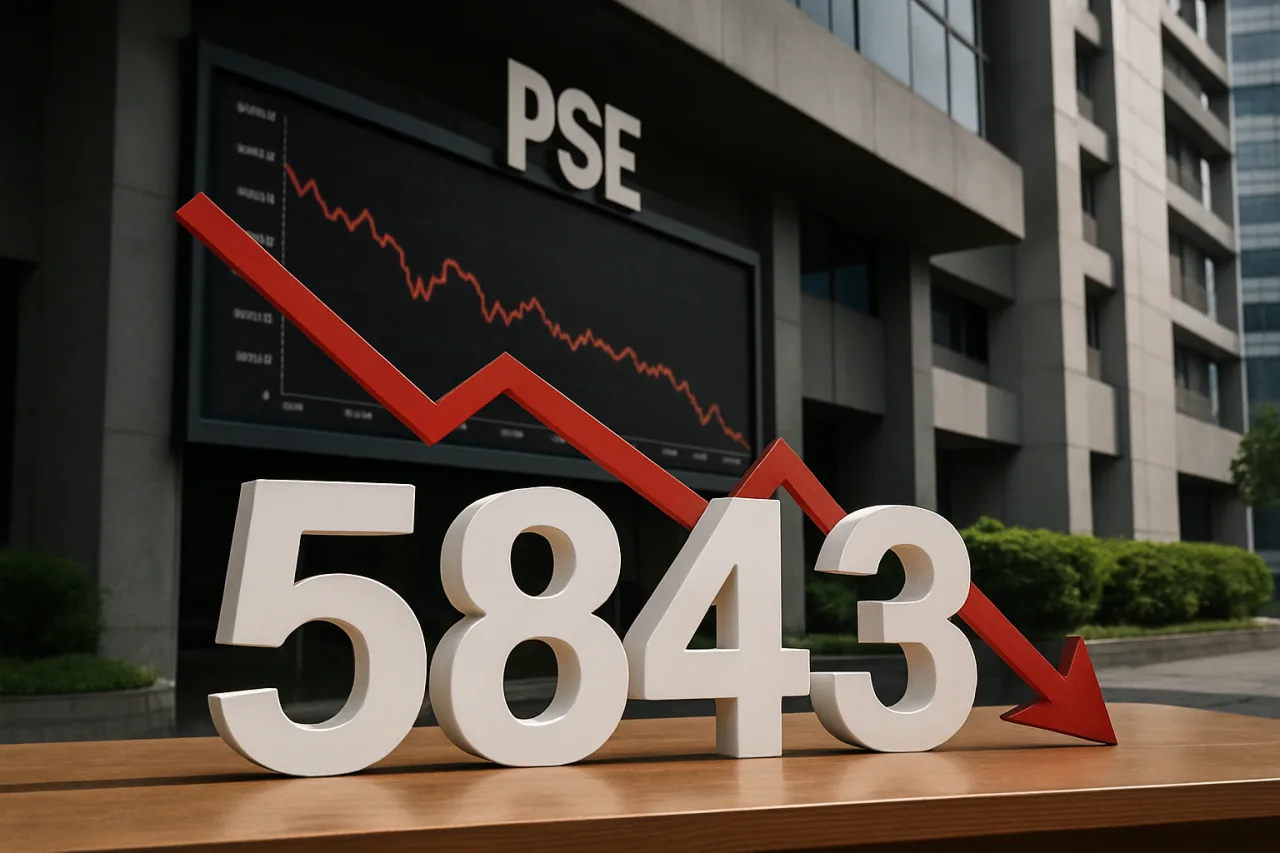
- 📉 The PSEi 5843 window is real and current: the index closed at 5,843.79 on September 21 and 5,840.07 on September 22 — down 6.58% for the month, down 4.55% year-on-year, per PSE and market data.
- 💸 The pressure is macro, not mystery: BSP raised its 2026 inflation forecast and hiked the policy rate to 5.00% in August; August inflation printed 6.10% — both direct headwinds on valuations and foreign positioning.
- 🧭 History says ber-months volatility is normal: the index traded 5,613–6,135 across Nov 2025–Sep 2026, and every prior selloff into Q4 met bargain hunters when inflation data cooperated.
- 🇵🇭 For Filipino investors, the setup is process, not prediction: define your levels, size positions in advance, and use the MP2/retail bonds alternative while the equity market settles.
- ⚠️ The honest map: Trading Economics models put the quarter-end around 5,835 and 12-month estimates lower — consensus sees range, not rocket. Plan for both directions.
Where the Index Stands: the PSEi 5843 Window in Numbers
The PSEi 5843 window opened quietly: the Philippine Stock Exchange index closed at 5,843.79 on September 21, 2026 — down 12.12 points, 0.21 percent, on ₱5.61 billion traded — and slipped further to 5,840.07 on September 22. The bigger frame is a monthly decline of 6.58 percent and a year-on-year dip of 4.55 percent, against an all-time high of 9,078.37 that January 2018 set. This is a market that has given back its 2026 gains and now sits roughly 35 percent below the peak — a level where every peso of foreign flow and every inflation print gets amplified.
The speed of the move tells the story. The index opened the month above 6,135 (September 15 closed at 6,007.78, already down 1.11 percent on ₱4.84 billion traded), rebounded to 6,093.89 on September 1 on bargain hunting, then slid through the 6,000 line and kept going. In under three weeks, the market repriced from “recovery” to “wait and see” — and the next print that matters lands at quarter-end, with Trading Economics’ model placing expectations at 5,834.72.
Window talk matters because of what sits inside it. The PSEi 5,800–5,850 zone is where the index traded in early November 2025 (5,613–5,867 range) — the last time valuations were this compressed before the December recovery. That is not a prediction; it is the map of who bought last time and where the memory of those buyers lives.
Why the Market Got Here: the Macro Chain
Three macro facts chained together to produce the PSEi 5843 window, and each one is checkable:
- Inflation re-accelerated. The August 2026 print came in at 6.10 percent, down only marginally from 6.20 in July, and the BSP raised its 2026 inflation forecast — the PNA-reported session where the index slipped to 5,972.82 was the market reading that forecast cut as a warning.
- The BSP hiked into it. The policy rate went to 5.00 percent in August (from 4.75), and the August 27 session that followed the hike saw the index tumble 2.16 percent to 6,004.58 — the moment the “6000 line” broke.
- Foreign flows stayed net-negative through the slide. MarketShack’s flow intelligence showed 30-day net foreign selling of ₱10.41 billion through early September, with ICT services the only pocket of sustained foreign buying (₱1.6 billion over seven sessions). The selloff is a positioning story, not a liquidity story.
The chain matters because it defines what would break it. The index does not need good news to recover — it needs decelerating inflation prints, which is exactly what September 3 and 4 delivered (the index gained on “softer inflation” headlines back then, closing 6,090.60 on September 4). Each CPI release between now and December is a decision point; the September figure, due in early October, is the first test.
The Ber-Months Context: Seasonality Meets Selloff
The Philippine market’s ber-months pattern is real but conditional. The seasonal story — remittances peak, consumer spending builds, retail and property names get their annual bid, and the “Christmas rally” folklore draws in retail money — works when the macro is neutral. What it does not do is override inflation and rates. In 2025, the index spent November in the 5,600s before closing December at 6,065: the seasonal bounce arrived, but from a low base, and it required the inflation picture to cooperate.
2026’s version is different in one uncomfortable way: this selloff is happening into the season rather than before it. The index entered the ber-months at 5,843 — a starting point 4.5 percent below last year’s equivalent — which means the seasonal lift has to fight a stronger headwind. The historical pattern says the lift can still work (November 2025’s 5,613 low recovered to 5,835 within sessions); the macro says the margin for disappointment is thinner.
The OFW lens sharpens the point. Remittance season raises peso liquidity in exactly the months when portfolios get funded — and the household that treats the PSEi 5843 window as a scheduled-review moment (not a panic moment) is following the same playbook that worked through every prior September selloff: nothing forced, everything sized in advance.
The Levels That Decide Q4
Three zones matter for the PSEi 5843 window, each with a reason that is checkable rather than mystical:
- 5,800 — the floor memory. The November 2025 swing low (5,613) and the November 4–6 consolidation (5,818–5,867) make 5,800 the level where the last bargain hunt began. A decisive close below it would confirm the Trading Economics model’s 5,193 twelve-month trajectory as live risk, not tail risk.
- 5,950–6,000 — the recovery gate. Every rebound this month died at the 6,000 line (September 1: 6,093; September 15: 6,007; August 27: 6,004). Reclaiming and holding 6,000 is the signal that the inflation-deceleration trade has restarted.
- 6,100–6,135 — the supply band. The September opening range and the July closes (6,325–6,404 in mid-July) sit above; rallies that clear 6,000 meet sellers who bought the recovery in early September.
The honest caveat: these are observation levels, not trade signals. The index is a CFD-tracked benchmark in the data above, and the PSE’s own official closes (5,843.79 on September 21) are the record to watch. Nothing here is a promise about tomorrow’s session.
The Filipino Investor’s Process for This Window
Window or no window, the process that survives volatility is the one decided before the session opens. Five steps, none requiring a trading terminal:
- Define your own levels in writing. If 5,800 is where you add and 6,000 is where you stop worrying, write it down now — the point of levels is to prevent in-session improvisation, and the PSEi 5843 window is exactly when improvisation costs money.
- Size positions in advance. Decide the peso amount per tranche before the market opens. The classic error is sizing by mood after a red day; the fix is arithmetic, not nerve.
- Keep the emergency fund out of the market entirely. The 6.58-percent month is a reminder, not a surprise: money you need within 12 months does not belong in equities this year.
- Use the alternative rails while the equity question settles. MP2 at its government-backed rate and retail treasury bonds exist for a reason — our MP2 calculator walkthrough covers the math, and the GCash IPO explainer covers the pipeline of local listings worth watching.
- Re-check the thesis at the next inflation print. The October CPI release is the next scheduled test of the chain described above. If inflation decelerates decisively, the ber-months recovery scenario strengthens; if it re-accelerates, the 5,800 floor gets tested for real.
Where the Money Sits While the Index Waits
The PSEi 5843 window has a mirror image on the fixed-income side, and the contrast explains where cautious Philippine money actually goes. MP2 — the Pag-IBIG Fund’s savings program — continues paying its government-backed dividend rate with five-year preservation of principal, and retail treasury bonds open windows whenever the government needs to fund at rates that suddenly look generous next to a falling index. The household logic is straightforward: when the equity market reprices 6.58 percent in a month, the zero-drama alternatives stop being boring and start being math.
The same window logic applies to peso-cost averaging, the strategy most Filipino retail investors actually follow. A falling index is not an argument against averaging — it is the mechanism that makes averaging cheaper — but only when the tranches are sized in advance and funded from money that was never the emergency fund. The 2026 difference is inflation: with prices rising 6.10 percent, cash held back from any investment loses real value, which is why “wait until it settles” has its own cost. The balanced read: averaging continues, sizes stay modest, and the fixed-income rails carry the money that cannot afford the ride.
Digital banks complete the picture. The deposit rate competition of 2026 — the same competitive wave that cut InstaPay fees — put respectable interest rates on fully-liquid digital-bank savings, and that combination (liquidity plus yield) is the practical parking spot for tranches waiting to deploy. The investor who sequences it correctly — emergency fund liquid, tranche money parked in a digital bank, equity tranches pre-scheduled — experiences a 6.58-percent month as a scheduled event, not an emergency.
The Foreign-Flow Detail Most Retail Investors Miss
One number deserves more attention than it gets: the composition of the selling. MarketShack’s data showed the 30-day net foreign outflow of ₱10.41 billion was concentrated — Ayala (₱295.1 million sold), Ayala Land, SM Investments, GT Capital — the large-cap conglomerate bloc, while ICT services attracted ₱1.6 billion of foreign buying over seven sessions. That is not a market-wide exit; it is a rotation with a rate-sensitivity logic. Conglomerate holding companies are the most rate-sensitive names on the board, and foreign funds managing global emerging-market risk trim exactly those positions when a central bank turns more hawkish than expected.
The retail takeaway is not to mirror foreign flows — retail money that chases foreign positioning is always late — but to recognize what the rotation says: the market’s problem is rates, not the Philippines. When the rate story turns (decelerating inflation prints, BSP signaling a plateau), the same large-cap bloc that led the selling historically leads the recovery. The investor who understands which names the market is punishing for rates — rather than for fundamentals — reads the window correctly: the PSEi 5843 zone is a rates story wearing a market-story costume.
Frequently Asked Questions
Why did the PSEi fall to 5,843?
A macro chain, not a single cause: the BSP raised its 2026 inflation forecast and hiked the policy rate to 5.00 percent in August, August inflation printed 6.10 percent, and foreign investors were net sellers of roughly ₱10.4 billion over 30 days through early September. The combination pushed the index from above 6,135 in early September to the 5,840–5,844 range by September 21–22.
What does the PSEi 5843 window mean for ber-months investing?
It sets a harder starting point than usual: the seasonal lift has to overcome a fresh selloff, not just build on it. History (the November 2025 5,613 low recovering within weeks) shows the seasonal bounce can work even from low levels, but each inflation print between now and December decides whether this year’s version repeats that pattern or extends the slide.
Is 5,800 a good level to buy?
That is a personal decision tied to a written plan, not a number with a guarantee attached. 5,800 is where the last comparable consolidation began (November 2025), which makes it observation-worthy — but position size, emergency-fund status, and time horizon decide whether any level is “good” for a specific investor, not the index alone.
What are the key PSEi levels to watch?
The map from public data: 5,800 (floor memory from November 2025), 5,950–6,000 (the recovery gate every September rebound failed at), and 6,100–6,135 (the supply band from early-September closes). Quarter-end model estimates sit near 5,835; the 12-month third-party estimate runs to 5,193.
Should OFW households invest in PSEi stocks during the ber months?
Only from the non-essential portion of savings, sized in advance, through a licensed broker, with the emergency fund untouched. The ber-months seasonal story is real but conditional on inflation cooperating, and remittance-funded investing should never borrow against the household’s safety net.
How does inflation affect the PSEi?
Through two channels: it raises the discount rate on future corporate earnings (pressuring valuations directly), and it drives the BSP’s policy decisions — the August hike to 5.00 percent triggered the selloff that broke the 6,000 line. Decelerating prints reverse both pressures; accelerating prints compound them.