Key Takeaway
- 🚫 The Philippines blocked Discord on the evening of September 23, 2026 — Globe, GOMO, TNT, and DITO users met a “Forbidden Access” page instead of their servers.
- ⚖️ The trigger: a CICC 24-hour ultimatum to designate a Philippine office amid child-safety concerns, justified under the parens patriae doctrine; Reddit got an extension and committed to a PH office.
- ✅ The ban lifted September 24 after Discord’s representatives committed to child-safety cooperation — DICT Secretary Henry Aguda apologized for the disruption.
- 🛡️ The access is back, but the lesson stands: configure the account before the next platform-government standoff — who can DM you, family controls, server trust.
- 👨👩👧 For parents: Discord’s Family Center and messaging filters do the protection work that a national ban cannot — and they survive every future controversy.
The shortest platform ban in Philippine internet history ran from Wednesday night to Thursday afternoon, and it said more about the future of the local internet than most policy speeches manage.
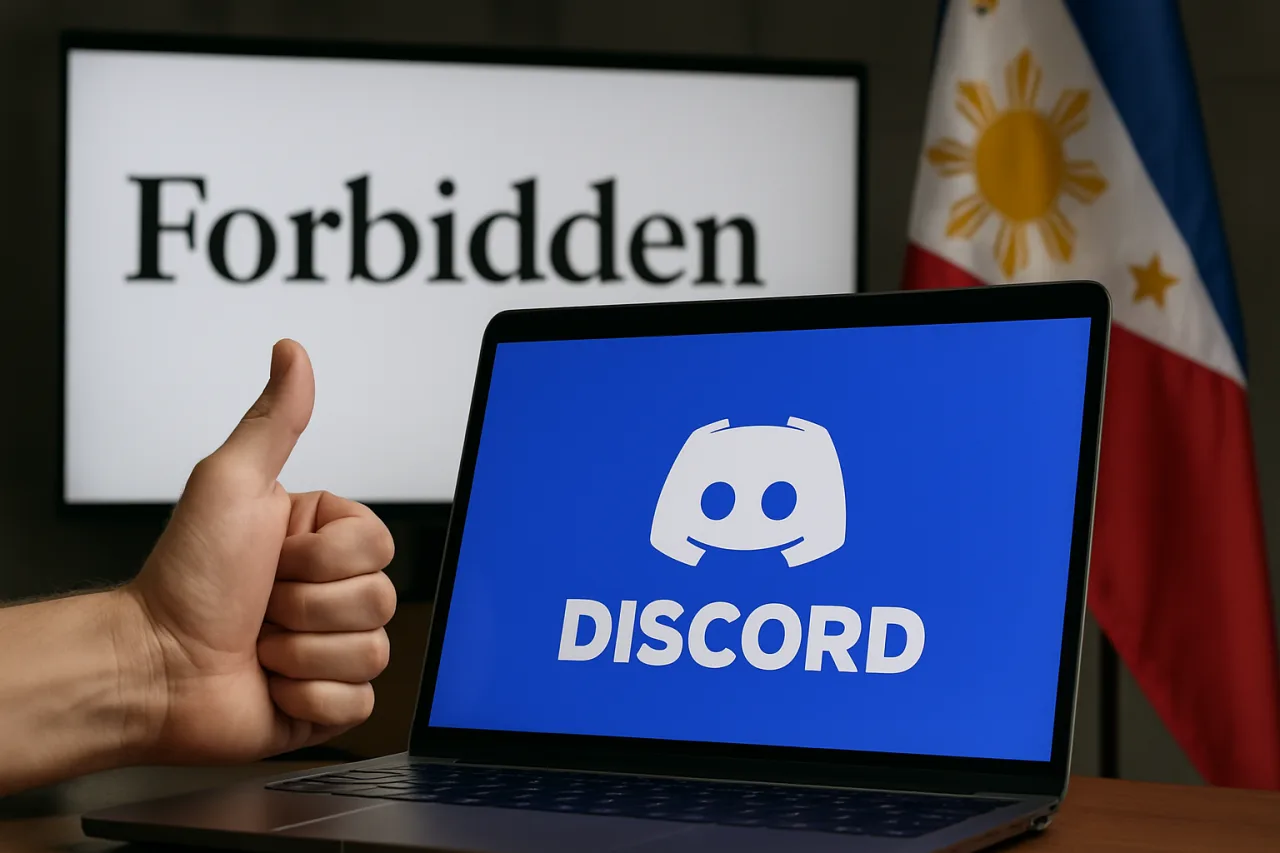
The Cybercrime Investigation and Coordinating Center blocked Discord across the major carriers on the evening of September 23 — Globe, GOMO, TNT, and DITO users saw a “Forbidden Access” page bearing the NTC’s logos — after the platform missed a 24-hour ultimatum to designate a Philippine corporate presence amid child-safety concerns.
On September 24, after Discord’s representatives sat with CICC and DICT officials, the Discord ban was lifted: DICT Secretary Henry Aguda confirmed the platform had committed to cooperate on online child safety per the Inquirer’s confirmation caught in the hours-long outage, and the National Telecommunications Commission was asked to restore access.
The Discord ban came and went inside a single news cycle — but its consequences will run for years.
Table of Contents
The 48-Hour Arc: Ultimatum, Block, Lift
September 22: CICC issued separate letters to Discord and Reddit — designate a Philippine office and demonstrate child-safety compliance, within 24 hours.
September 23: Reddit reached out and bought itself an extension (and, per CICC’s announcements, committed to establishing a Philippine office); Discord’s response did not satisfy the agency, and the blocking began that evening — users across Globe, GOMO, TNT, and DITO lost the app simultaneously, the signature of a network-level block rather than a service outage.
September 24: Discord’s representatives met the agencies, committed to child-safety cooperation, and the ban came off — with Aguda publicly apologizing for the inconvenience and CICC Executive Director Aboy Paraiso confirming the lift.
The speed is the story of the Discord ban. The government demonstrated it can block a major platform within hours — and then demonstrated that a committed conversation can undo it within a day.
Both halves of that demonstration matter: the Discord ban leverage is real, and so is the willingness to release it when a platform engages in good faith.
Why CICC Moved — the Child-Safety Case
The stated justification was online child safety: CICC’s concern centered on minors’ exposure to predators on platforms that operate in the Philippines without local legal presence — no local office means no local accountability chain, no Philippine-processable compliance contact, no jurisdictional handle when investigators need cooperation on grooming or exploitation cases.
The agency invoked the parens patriae doctrine — the state’s role as guardian of those unable to fully guard themselves — to justify acting against a platform whose local protections ran entirely through offshore channels.
Whether the legal theory holds is for the courts and the commentary; the operational message was unambiguous: platforms serving Filipino users need a Philippine handle for accountability. The ultimatum’s wording — local presence plus child-safety compliance — made the demand structural, not rhetorical.
And Discord’s decision to send representatives rather than lawyers’ letters is what separated its 24-hour outage from a longer absence.
What Discord Agreed To — and What Reddit Did Instead
Discord’s concession, per the confirmations from both agencies, was cooperation: engagement with CICC and DICT on child-safety enforcement — the beginning of the local-accountability relationship whose absence triggered the block.
The details of implementation will emerge in the platform’s follow-through, which the agencies have every incentive to inspect quickly, given the political cost of the outage they just demonstrated.
Reddit took the pre-emptive path: respond during the ultimatum window, secure the extension, commit to establishing a Philippine office. The comparison writes the market lesson for every platform with Filipino users — a local presence negotiated calmly costs less than a network block negotiated in a day.
Filipino communities that run on both platforms — the gaming servers, the study groups, the OFW forums — experienced the difference as one app going dark for a night and the other staying.
The OFW Angle: Community Servers and the Remote-Family Rule
The loudest users in the ban window were not gamers. OFW community servers — the province-mates’ groups in Dubai, the church servers connecting Hong Kong domestic workers to their Sunday services, the study halls of nursing-review candidates — run on Discord precisely because free group voice, text, and screen-share beat every paid alternative.
For those communities, the Forbidden Access page was not an inconvenience; it was a weekly gathering point going dark. The ban-lift announcement spread through those same servers within minutes of Paraiso’s confirmation — community faster than any press release.
The durable lesson for diaspora communities: the family-server setup should assume platform risk.
The province group chat that lives only in one app is one policy decision away from silence — the redundancy play is the same one remittance planners use: a primary channel, a verified backup, and the agreement on where the family meets if the primary goes dark.
Discord’s outage lasted a day; the habit of knowing where the community reconvenes costs nothing and survives every future standoff.
The Access-Verification Playbook: Confirming the Ban Is Gone on Your Carrier
Network-level blocks can clear unevenly across carriers and regions, so the verification takes one minute per device: open the app (or the web version at discord.com) on mobile data — not Wi-Fi — and confirm a connection.
Globe, GOMO, TNT, and DITO users who still see the Forbidden Access page should first update the app, then toggle airplane mode to force a fresh route, and only then contact the carrier — the NTC was asked to restore access on September 24, and propagation across networks can lag the announcement by hours.
The Wi-Fi path may never have broken at all: household connections often bypass the carrier’s network filtering entirely, which is why the ban felt invisible to some users and absolute to others.
The Account Settings That Matter Now
With access restored, the settings worth configuring before the next news cycle: who can contact you — Discord’s privacy settings let users restrict direct messages to friends only, or disable DMs from server members entirely, which removes most stranger-initiated contact in one toggle.
Server vetting — the invite links that arrive by DM remain the primary malware-and-grooming vector; join servers you can verify, not ones advertised in other servers’ announcement channels. Two-factor authentication — the account with 2FA survives the credential-stuffing attacks that chase every popular platform.
Blocked-words and sensitive-content filters — Discord ships content filters that catch explicit material in servers you cannot fully vet.
The settings take ten minutes and they persist through every future ban-lift cycle. The access question was the government’s to resolve; the safety configuration remains the user’s to own. Both roles were on display this week, and both matter more than the outage that reminded everyone of them.
The Settings Walkthrough, Click by Click
The ten-minute configuration, for readers who want the path rather than the principle. DMs: User Settings (the gear at the bottom of the app) → Privacy & Safety → “Allow direct messages from server members” off; the blanket rule that kills stranger contact from every server at once.
2FA: My Account → Enable Authenticator App (or SMS) — the two-minute setting that survives credential dumps. Content filters: Privacy & Safety → “Sensitive content” filtering set to the strictest option offered for your account age. Block invitations from unknown servers: the same Privacy page governs server-invite scanning on mobile.
Family Center: Settings → Family Center — parent scans, teen scans, supervision links; the parent view shows recent friends, new servers, and DM activity counts without touching message content.
Five minutes of clicking beats a week of worrying, and every setting above survives the next platform-government standoff intact. The ban made headlines; the settings make the account safe.
The Parents’ Guide: Family Center and the Real Protections
For parents of teen users — the population the child-safety case was about — Discord’s Family Center is the feature that matters: it links a parent’s view to a teen’s activity in a supervision framework that shows, without reading messages, who the teen talks to, which servers they join, and who newly contacted them.
Configuring it takes minutes: parent and teen each scan a QR from the Family Center section, and the visibility begins. Pair it with the DM restrictions above and the server-vetting habit, and the platform’s residual risk shrinks to something a present parent can manage.
The honest framing: the ban was never going to protect children by itself — the platforms where young Filipinos actually talk will always be one update away, and a block lasts hours while a configured account lasts years. The government’s leverage produced the commitments; the family’s settings produce the protection.
What This Means for Every Other Platform
The Discord episode is a precedent with an audience of every platform operating in the Philippines: the state can and will block first and negotiate after, accountability presence is the price of serving the market, and the window to comply is measured in hours.
The platforms that internalize the message will establish their Philippine presence and child-safety channels before an ultimatum arrives; the ones that wait will meet the NTC’s Forbidden Access page, and their Filipino users — the gamers, the learners, the communities — will pay the outage bill.
The 48-hour arc was the government’s demonstration of capability; the durable version of the story is the accountability framework it announced.
For users, the episode’s practical residue is small and worthwhile: the settings above, configured once, are the residue worth keeping — the Discord ban cycle ends, but the configuration endures across every future controversy the platform wades through.
For the platforms, it is larger: a Philippine office, a child-safety contact, and a cooperation posture are now the cost of admission to one of Southeast Asia’s most online populations.
Frequently Asked Questions
Is Discord working again in the Philippines?
Yes — CICC lifted the ban on September 24, 2026, and asked the NTC to restore access; users on Globe, GOMO, TNT, and DITO should have service back after the network-level block cleared.
Why was Discord banned?
CICC blocked the platform after it missed a 24-hour ultimatum to designate a Philippine office amid child-safety concerns; the agency invoked the parens patriae doctrine to justify the action.
What did Discord commit to?
Cooperation with CICC and DICT on online child safety — the beginning of a local accountability relationship; the ban was lifted after representatives met both agencies on September 24.
What happened to Reddit?
Reddit reached out within the ultimatum window, received an extension, and committed to establishing a Philippine office — avoiding the block Discord absorbed.
What should I configure on Discord now?
Restrict DMs to friends (or disable server-member DMs), enable two-factor authentication, set sensitive-content filters, and vet servers before joining — the settings that persist regardless of platform-government standoffs.
How do parents supervise a teen’s Discord?
Use Family Center: link the parent and teen accounts for activity visibility without message reading, combined with the teen’s own DM restrictions and 2FA.