
Table of Contents
Key Takeaway
- 📉 The global average cost of sending cash home is 6.36 percent. The World Bank’s latest survey puts banks at 14.99 percent on average, and the UN target sits at 3 percent.
- 🪙 Stablecoin remittances can run well under that average when the sender buys cheaply, uses a low-fee network, and the family cashes out on a BSP-licensed app with small exit fees.
- 🗺️ The corridor decides most of it. The same rails work differently from the US, the Gulf, and the EU, because licensing and market rules differ at the sending end.
- 🇸🇦 Saudi Arabia is the special case. The kingdom’s central bank has warned since 2018 that virtual currencies are unregulated there, so Saudi-based senders have no licensed home-market on-ramp even though more than 46 billion dollars leaves the kingdom as remittances yearly.
- ⚠️ Transactions of 50,000 pesos or more trigger the travel rule. Philippine platforms must exchange sender and recipient details on covered transfers, and irreversible sends plus wrong-network mistakes are the risks your fee line never shows.
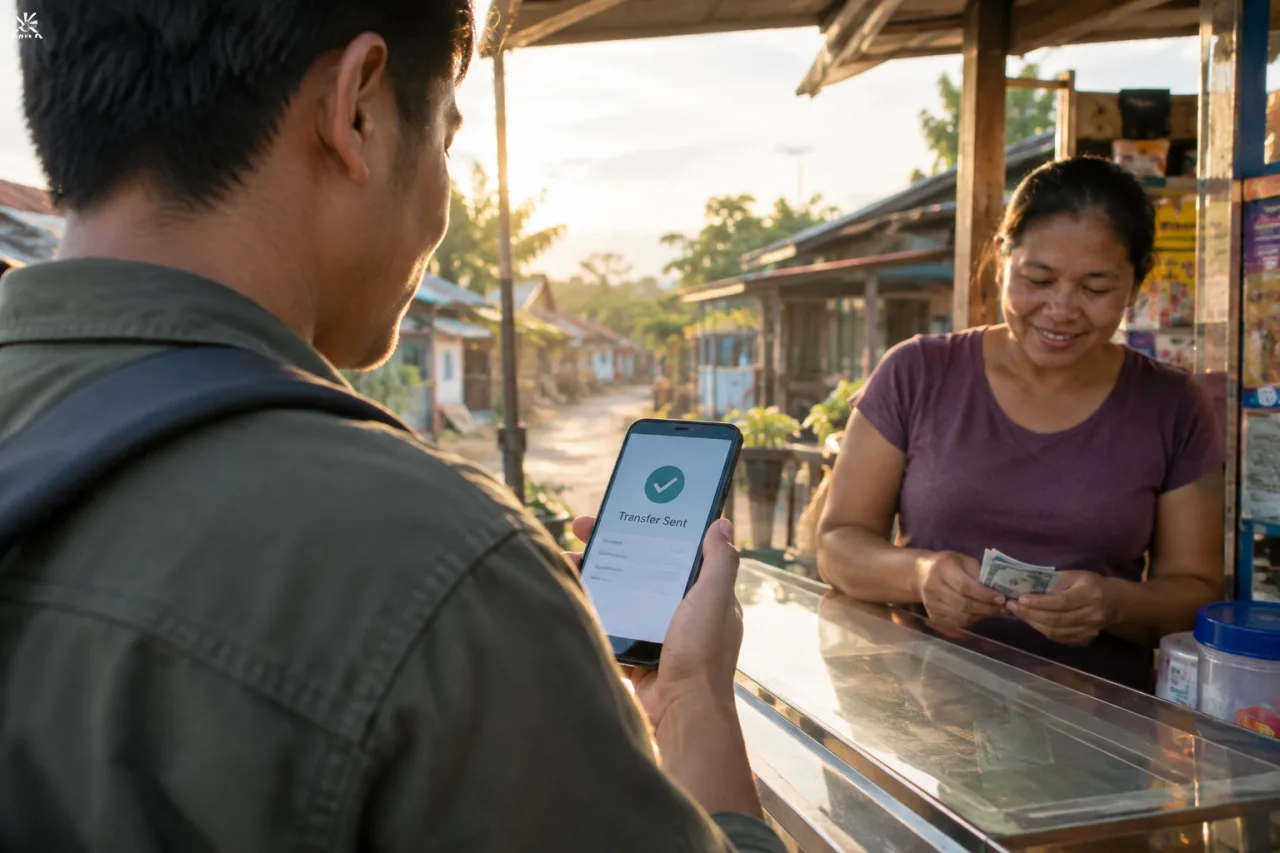
Stablecoin remittances start from the number nobody quotes at the counter: the World Bank’s Remittance Prices Worldwide survey puts the global average cost of sending cash out 6.36 percent in its Q3 2025 report, down from 6.49 percent the quarter before but still more than double the UN’s 3 percent target. On a 200-dollar send, that is roughly 12.72 dollars spent before the family sees a peso. Stablecoin remittances exist because blockchain rails can carry the same dollars for a fraction of that line, and Philippine platforms licensed by the BSP have been developing the exit side for years. Whether the rails are worth it for your family is a fee-and-corridor question, and this guide runs the numbers corridor by corridor.
The Fee Numbers: What the Banks and Apps Cost Today
The World Bank’s Remittance Prices Worldwide survey, the reference for the G20 cost-reduction goal, publishes the averages that define the comparison. The numbers matter because they are measured, not marketed.
- Global average 6.36 percent for sending 200 dollars per the Q3 2025 survey, and below 7 percent every quarter since 2019.
- Banks are the expensive end: 14.99 percent average, the costliest provider type on the survey. A bank wire to a bank account tends to run at survey-level costs.
- Digital remittances average 4.59 percent, the digital-only remittance index sits near 3.54 percent, and credit-or-debit-card funding runs 4.39 percent. The app era is cheaper than the counter era, and still above target.
- The 3 percent goal remains distant. The UN Sustainable Development Goal of under 3 percent by 2030 is why every zero-fee advertisement deserves a totals check: fees plus the exchange-rate margin decide the real cost.
Average cost is not your cost. A remittance app funded by bank debit from the US to a Philippine wallet can total under 2 percent, while cash-based transfers can run past 7 percent. The survey data shows why the receiving country matters too: sub-Saharan corridors average 8.46 percent while the cheapest receiving regions sit near 5 percent. Stablecoin remittances compete against these totals, and the comparison only works corridor by corridor. Set the amounts side by side before any send: write the app’s published fee, its exchange-rate margin, and the fixed peso cash-out line, then ask what your family actually receives in pesos for a fixed dollar amount. The provider that answers that question directly is usually the one worth trusting with the whole corridor.
How Stablecoin Remittances Actually Move
The mechanics are four steps, and each one carries a small cost and one hard rule. The receiving side is the Philippine side, where apps such as Coins.ph, PDAX, Maya, and GCash’s crypto service run under BSP licenses.
- Step 1, the sender buys the dollar coin. USDT or USDC is purchased on an exchange licensed where the sender works, funded from salary. The buy price versus the official dollar rate is the first cost line.
- Step 2, the coins cross on a network. The sender withdraws to the family’s receiving address on a network both platforms list. Cheap networks cost pennies; expensive ones cost several dollars per send, which is fatal on small amounts.
- Step 3, the family sells for pesos. On a BSP-licensed app the stablecoin sells into pesos at the platform’s rate, and spreads on licensed platforms have run in the neighborhood of 0.1 to 0.15 percent on smaller accounts, as the providers’ published fee materials show.
- Step 4, pesos leave for the bank or wallet. Domestic transfer fees apply: Philippine instant-payment systems have charged roughly 5 pesos for InstaPay cash-outs and had free PESONet routes at major platforms, though every fee table moves, so verify inside the app before a large send.
Add the four lines up and stablecoin remittances cost mostly the network fee plus small spreads, which is why larger sends benefit most: a flat network fee is a big percentage of 100 dollars and a rounding error on 1,000. The flip side is absolute: a completed blockchain send cannot be reversed, so an error you catch one minute late is still an error.
The Corridor Table
The corridor you are in decides which of these lines dominate. The table states the measured averages on the traditional side and the structural notes each corridor adds to the stablecoin choice.
| Corridor | Traditional-side average | What the stablecoin route adds |
|---|---|---|
| United States to the Philippines | US sends average 5.04 percent; app-funded sends to wallets often total under 2 percent when zero-fee promos run, per provider pages | Broadest licensed-exchange choice at the sending end; the receiving side (Coins.ph, PDAX, GCash crypto, Maya) is BSP-licensed |
| Gulf (Saudi Arabia) to the Philippines | Gulf corridors commonly run above the global average; Saudi Arabia alone sends over 46 billion dollars in remittances yearly, second worldwide | No licensed home-market crypto on-ramp: SAMA has warned since 2018 that virtual currencies are unregulated in the kingdom, so the coin purchase step has no local regulated venue |
| European Union to the Philippines | EU senders average near 4.6 to 5.2 percent depending on country | Stablecoin issuance and service sit under the EU’s MiCA framework, a licensed activity across member states; access varies by country |
Read the third column against your own bank’s published fees rather than the averages: the table is the structural map, the World Bank survey holds the measured averages, and your provider’s fee page holds your number.
The Corridors That Change the Answer
Three corridors deserve their own paragraphs, because the sending-end rules reshape the stablecoin remittances decision even when the receiving side is identical.
- Saudi Arabia, the biggest Gulf case. The Saudi central bank’s standing committee published its warning in August 2018 that virtual currencies are not regulated inside the kingdom, per its official statement, and SAMA leadership has repeated the threat assessment since. The practical consequence for stablecoin remittances is simple: there is no Saudi-licensed venue to buy Tether or USDC with a riyan salary. Saudi-based senders who use the rails do it against the kingdom’s stated position, and the cleaner play is the remittance app route, whose competition has brought Gulf corridor costs near global lows on good days.
- United Arab Emirates and the wider Gulf. The UAE took a different regulatory road and licenses virtual-asset activity, so Gulf corridors are not one rulebook. Check the sender country’s regulator before assuming the Saudi story applies.
- European Union. The EU’s MiCA framework made stablecoin issuance and service a licensed, passportable activity across member states, so a European sender can typically access regulated dollar-coin products, but fees and availability vary by country and platform. The receiving side back home is unchanged.
The Risks the Fee Line Never Shows
The fee table is the easy part. These are the lines that actually generate complaints.
- Irreversibility. Blockchain sends do not roll back. A typo in an address, or a send on a network the receiving app does not list, can strand funds with the platform warning that such coins may never be credited. Test with a small send before the real one, every single time.
- The network choice. The same coin on different networks reaches different apps; one app accepting a coin on a chain another rejects is the classic stablecoin remittances trap. Confirm the network exists in the family app’s receive screen before sending from the exchange.
- The rate window. The peso conversion happens when the family sells. Between send and sell, the family holds a dollar-token, and the peso rate is whatever the market shows at exit.
- The travel rule at 50,000 pesos. Under the BSP’s VASP rules, virtual-asset transfers of 50,000 pesos or more require platforms to obtain and transmit originator and beneficiary information, name, account, and identity details, across the chain. Your platform will ask; that is regulation, not friction for its own sake. Single-transaction payouts above 500,000 pesos face enhanced due diligence and must be paid by check or direct account credit.
- The shrinking licensed set. The BSP has continued a moratorium on new VASP licenses since September 2025, so the list of Philippine-licensed platforms is limited, which raises the value of verifying the receiving app before sending.
- Peer-to-peer and unhosted wallets get stricter treatment. BSP rules apply enhanced care to transfers touching unhosted wallets, and peer-to-peer deals outside licensed platforms carry fraud risk the apps cannot reverse.
When Banks and Apps Beat Stablecoin Remittances
A fair guide ends with the cases where stablecoin remittances lose, because they are common.
- Small regular sends. Below a few hundred dollars, flat network fees plus buy and sell spreads can exceed a zero-fee app promotion’s total, and promo-funded wallet delivery beats coin logistics on convenience. If the family wants app delivery, a global bank app such as the one covered in our Revolut Philippines guide can serve some corridors without touching crypto at all.
- Families who need cash pickup. Remittance companies deliver to pawnshop and branch networks nationwide. A stablecoin remittance ends in an app; converting to cash from there adds a step some families will not take.
- Senders in strict-endorsement jurisdictions. If the sending country has no regulated venue (Saudi Arabia’s position since 2018), the compliance burden of the whole exercise changes, and the app is the safer instrument for salary-based sending.
- Households that should not hold dollar exposure. If the money is budgeted to bills on arrival, any dollar-token step inserts a rate variable into a peso budget. Straight peso delivery is the cleaner instrument.
For the wider payments picture, our guide to reading BSP remittance data shows how corridor flows are trending, and the institutional side is moving too: global banks committed 270 million dollars to a stablecoin platform, which tells you where settlement costs are heading. If Tether exposure is the worry behind the USDT choice, our piece on whether USDT is traceable covers the audit-trail question.
FAQ
Are stablecoin remittances cheaper than banks?
Usually yes on paper: the World Bank’s average for bank-routed remittances runs near survey highs of 15 percent, while stablecoin remittances stack a network fee measured in cents or dollars plus small buy and exit spreads. The fair comparison is against digital remittance apps, shown in the same survey at 4.59 percent, and against any zero-fee promotion running on your corridor that month.
What does a stablecoin remittance cost for a 200-dollar send?
The components: the purchase spread abroad, the network fee, the selling spread on the Philippine app, and the peso cash-out fee. All-in totals commonly land below the 6.36 percent global average and can approach the best app rates on larger amounts, while small sends may lose to a zero-fee promo.
Is it legal to send stablecoins to family in the Philippines?
Receiving and converting on a BSP-licensed platform is the regulated route, and it carries the platforms’ obligations, including the travel-rule information exchange at 50,000 pesos and payout checks above 500,000 pesos in a single transaction. The sending end follows your host country’s rules, which range from licensed venues to, as in Saudi Arabia, an unregulated market the central bank has warned about since 2018.
Which coin should the family use?
Whatever token your licensed receiving app lists for direct deposit on a network your sending exchange supports, most often a dollar-pegged token like USDT or USDC. The coin matters less than the network match and the app’s published sell spread.
What is the biggest mistake in stablecoin remittances?
Sending without a test. A wrong network or a mistyped address is irreversible, and platforms warn that coins sent on unsupported chains may never be credited. A small test send costs cents and proves the whole path before the actual funds move.
Do I have to show my ID for large transfers?
The platforms already run identity checks under BSP know-your-customer rules, and transfers of 50,000 pesos or more additionally travel with sender and recipient information between institutions under the travel rule. Expect the questions and answer them through the app’s verified flow.
Financial Disclaimer
WorldNgayon publishes fee and cost information for general guidance only. Fee schedules, network costs, spreads, and regulatory thresholds change; verify every figure on the official provider pages and BSP issuances linked above before moving cash. Nothing in this article is financial or investment advice; digital assets carry loss risk, and averages from named surveys may not match any single transfer’s actual total.
- remittanceprices.worldbank.org — World Bank’s Remittance Prices Worldwide survey
- coins.ph/en-ph/blog — providers’ published fee materials
- Official sama.gov.sa/en-US/MediaCenter/News/pages/news12082018.aspx — official statement
- Official bsp.gov.ph/Regulations/Issuances/2021/1108.pdf — BSP’s VASP rules
External sources linked in this article, in order of first mention. Spotted an error or a broken link? Tell us.
Cite this pagePublished Nov 15, 2026
Agron, E. (2026, November 15). Stablecoin Remittances vs the Banks: the Fee Numbers, Corridor by Corridor. WorldNgayon. https://worldngayon.com/stablecoin-remittances-fee-math/
Agron, Edmon. “Stablecoin Remittances vs the Banks: the Fee Numbers, Corridor by Corridor.” WorldNgayon, 15 Nov. 2026, worldngayon.com/stablecoin-remittances-fee-math/.
Agron, Edmon. “Stablecoin Remittances vs the Banks: the Fee Numbers, Corridor by Corridor.” WorldNgayon, November 15, 2026. https://worldngayon.com/stablecoin-remittances-fee-math/.
Agron, E. (2026) ‘Stablecoin Remittances vs the Banks: the Fee Numbers, Corridor by Corridor’, WorldNgayon, 15 November. Available at: https://worldngayon.com/stablecoin-remittances-fee-math/.
E. Agron, “Stablecoin Remittances vs the Banks: the Fee Numbers, Corridor by Corridor,” WorldNgayon, Nov. 15, 2026. [Online]. Available: https://worldngayon.com/stablecoin-remittances-fee-math/
@online{agron2026stablecoinremittances,
  author       = {Agron, Edmon},
  title        = {{Stablecoin Remittances vs the Banks: the Fee Numbers, Corridor by Corridor}},
  year         = {2026},
  date         = {2026-11-15},
  organization = {WorldNgayon},
  url          = {https://worldngayon.com/stablecoin-remittances-fee-math/},
  urldate      = {}
}TY - ELEC AU - Agron, Edmon TI - Stablecoin Remittances vs the Banks: the Fee Numbers, Corridor by Corridor T2 - WorldNgayon PY - 2026 DA - 2026/11/15/ UR - https://worldngayon.com/stablecoin-remittances-fee-math/ Y2 - ER -
Cite the version you read; the page may be updated. Zotero and Mendeley can also import this page directly.