Table of Contents
Key Takeaway
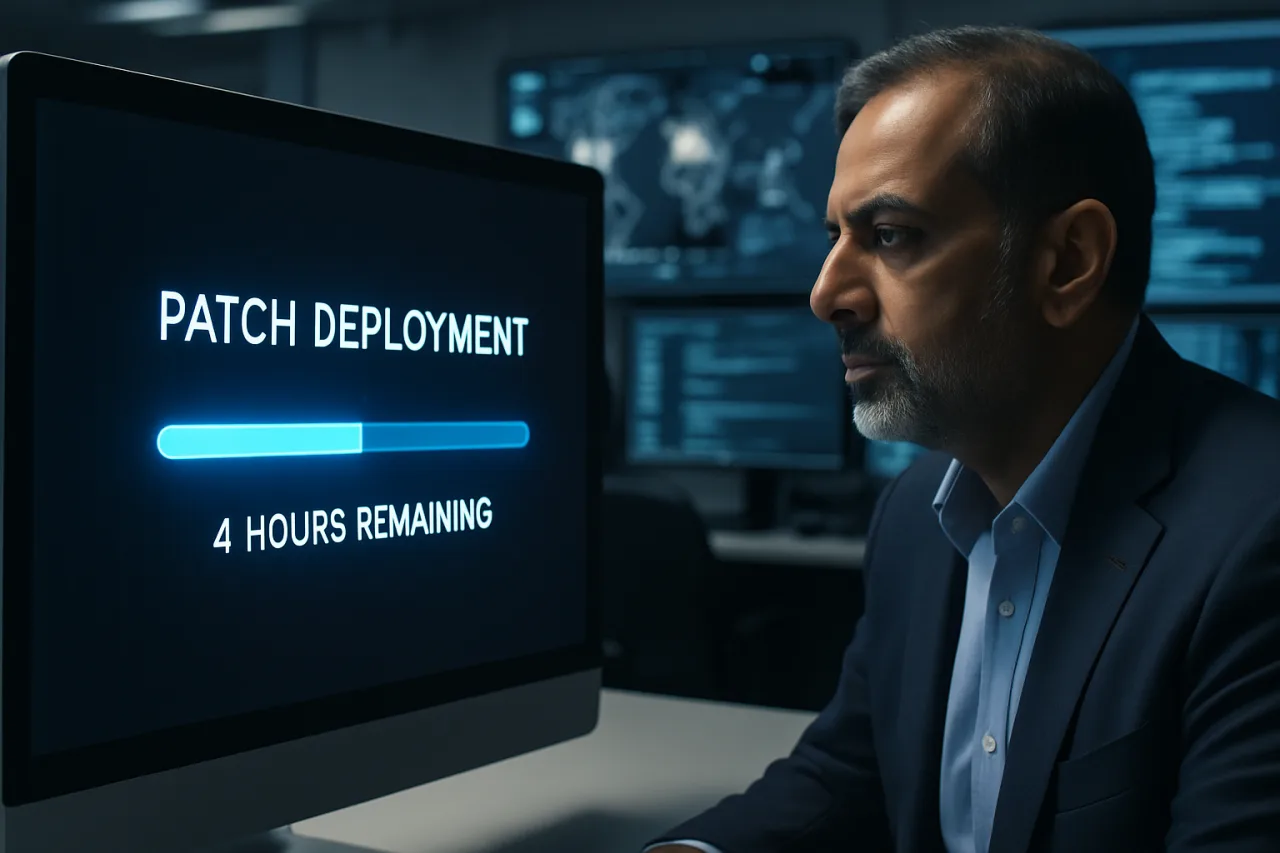
- ⚡ The Stat: Palo Alto Networks CEO Nikesh Arora announced at Black Hat 2026 that AI patch deployment now takes 4 hours instead of the industry’s historical average of 55 days.
- 🎯 The Gap: CrowdStrike’s 2026 Global Threat Report shows the average eCrime breakout time has collapsed to 29 minutes, with the fastest at 27 seconds — making the 55-day patch window a liability.
- 🏢 The Strategy: Arora built Palo Alto Networks from an $18 billion to a roughly $300 billion market cap through 40-plus acquisitions, including the $28 billion CyberArk deal and the Koi agentic endpoint acquisition.
- 🤖 The Prediction: Arora expects the entire software industry to be rewritten within 10 years as AI gives software its first “opinion” in two decades.
- 🔑 What You Should Do: Security teams must adopt AI-driven patch management now, because adversaries are already using AI to compress attack timelines faster than manual patching can respond.
The numbers are not subtle. For years, the cybersecurity industry treated the patch window — the time between a vulnerability’s disclosure and its deployment across an organization — as an operational nuisance measured in weeks. At Black Hat 2026 in Las Vegas, Palo Alto Networks CEO Nikesh Arora delivered a figure that reframes the conversation entirely: AI patch deployment now takes 4 hours instead of 55 days. That is not an incremental improvement. It is a 330x compression of the time between knowing about a vulnerability and closing it.
The statement, made during a podcast interview recorded at the conference and timestamped at 7:44, carries weight because of who said it and what his company has built. Under Arora’s leadership, Palo Alto Networks completed 40-plus acquisitions, including the $28 billion CyberArk deal that the market initially disliked, and carried the company from an $18 billion to a roughly $300 billion market cap. When the CEO of a $300 billion cybersecurity company says the patch window has collapsed by two orders of magnitude, security teams worldwide should pay attention.
Why 55 Days Was Never Sustainable
The 55-day figure is not invented. It reflects the historical reality of enterprise patch management, where vulnerabilities identified by vendors had to be tested, staged, scheduled, approved, and deployed across complex environments with hundreds of applications and thousands of endpoints. Each step introduced friction. Each delay widened the window during which attackers could exploit the known flaw.
The problem is that adversaries are no longer operating on 55-day timelines. CrowdStrike’s 2026 Global Threat Report documents that the average eCrime breakout time — the window between initial access and lateral movement — has fallen to 29 minutes, a 65% increase in speed from 2024. The fastest breakout observed was 27 seconds. When attackers move in minutes and defenders patch in weeks, the asymmetry is not a gap — it is a chasm.
AI patch deployment directly addresses this asymmetry. By using AI to automate the testing, prioritization, and deployment of patches, organizations can compress what once required manual coordination across multiple teams into a process that completes in hours. Arora’s 4-hour claim represents the point where defensive speed begins to match offensive speed for the first time in the history of enterprise security.
What Black Hat 2026 Revealed About AI and Security
Black Hat USA 2026 drew more than 23,000 verified attendees to Mandalay Bay in Las Vegas, a 15% increase from the previous year, according to organizer Informa Tech. AI was the dominant theme across the two-day main event and the inaugural AI Summit. Sessions covered AI security, LLM vulnerabilities, promptware, autonomous exploits, and the growing intersection of AI agents and cybersecurity.
Arora’s AI patch deployment announcement did not exist in isolation. It was part of a broader industry recognition that AI is rewriting both sides of the security equation. ReversingLabs reported that the conference highlighted three key takeaways: autonomous threat actors are a wake-up call, AI agents create new attack surfaces, and the industry must adapt to defend at machine speed. Mastercard’s dispatch from the conference noted that AI-driven cyberattacks were the talk of the show, with experts warning that the bots are teaming up.
The contradiction at the heart of Black Hat 2026 was that AI is simultaneously the greatest threat to and the greatest tool for cybersecurity. Arora addressed this tension directly during a quarterly investor call, saying: “As AI becomes more pervasive across the enterprise, it expands the attack surface area, more infrastructure, more machine-to-machine activity and new classes of risk that simply didn’t exist before.” His argument is that security cannot sit on the sidelines — it must use AI to match AI.
The CrowdStrike Data: Why 4 Hours Matters
The CrowdStrike 2026 Global Threat Report provides the threat-side context that makes Arora’s 4-hour AI patch deployment claim consequential. The report documents an 89% increase in attacks by AI-enabled adversaries year over year. Nation-state actors deployed LLM-powered malware. Cybercriminal groups automated credential theft. ChatGPT was mentioned in criminal forums 550% more than any other AI model. And 82% of detections in 2025 were malware-free, meaning adversaries are increasingly operating without traditional malware signatures.
When 82% of attacks are malware-free and the average breakout time is under 30 minutes, the traditional patch cycle — designed for a world where attacks used known malware and moved slowly — is structurally inadequate. AI patch deployment is not a luxury feature. It is the minimum viable response to a threat landscape where the time between initial compromise and lateral movement can be measured in seconds.
The CrowdStrike report also revealed a 42% increase in vulnerabilities exploited prior to public disclosure. This means attackers are finding and exploiting flaws before vendors can even announce them. In that environment, the ability to deploy patches in 4 hours rather than 55 days is the difference between a contained incident and a full-scale breach.
How Palo Alto Networks Built the AI Security Stack
Arora’s credibility on AI patch deployment is backed by an aggressive acquisition strategy. During his tenure, Palo Alto Networks completed 40-plus acquisitions, including the $28 billion CyberArk deal for identity security and the $3.35 billion acquisition of Chronosphere for observability. The company reported fiscal second-quarter revenue of $2.6 billion, up 15% year over year, and forecast annual revenue between $11.28 billion and $11.31 billion for fiscal 2026.
The most strategically relevant acquisition for AI patch deployment was Koi, completed on April 14, 2026. Palo Alto Networks announced that Koi’s technology defines a new category called Agentic Endpoint Security (AES), designed to secure the autonomous AI agents and coding tools that now operate on enterprise endpoints with deep access to sensitive data and unrestricted permissions. Palo Alto Networks documented that over 1,000 malicious skills were injected into a public marketplace (the Clawhavoc incident, January 2026), and 1.5 million developer environments were compromised by malicious AI extensions (the MaliciousCorgi incident, January 2026).
This means AI patch deployment is not just about patching traditional software faster. It is about securing an entirely new attack surface — the AI agents themselves — that did not exist two years ago. Koi’s integration with Prisma AIRS creates a single control plane for securing enterprise-wide AI adoption, including the agentic endpoints that bypass traditional security controls.
The 10-Year Software Rewrite Prediction
Arora made a prediction at Black Hat 2026 that extends well beyond patching: he expects the entire software industry to be rewritten within 10 years. His reasoning is that AI gives software its first “opinion” in two decades. Software has been passive — it executes what it is told. AI-infused software will actively determine what to do, how to respond, and when to act. This shift will transform not just security tools but every application layer from databases to user interfaces.
For AI patch deployment specifically, this means the 4-hour window is a waypoint, not a destination. As AI agents become more sophisticated, the patch cycle could compress further — potentially to minutes, as automated systems identify vulnerabilities, generate fixes, test them, and deploy without human intervention. The limiting factor will shift from technical capability to trust: will organizations allow autonomous systems to modify production code without human review?
Arora also made what the podcast noted as a “SaaS-pocalypse prediction” — that the existing software-as-a-service model will be disrupted by AI-native applications. While the podcast flagged this as self-reported and unverified, the strategic logic aligns with his acquisition strategy: Palo Alto Networks is positioning itself as the security layer for the AI-native software era, not the previous cloud era.
What AI Patch Deployment Means for Security Teams Worldwide
For security professionals, the 55-days-to-4-hours shift has three immediate implications:
1. Manual patch management is now a competitive disadvantage. Organizations that rely on human-coordinated patch cycles will face attackers who operate at machine speed. The CrowdStrike data shows adversaries already achieving breakout in under 30 minutes. A 55-day patch window is not a process — it is an open invitation.
2. AI patch deployment requires AI-driven detection. You cannot deploy a patch for a vulnerability you have not identified. AI patch management must be paired with AI-driven vulnerability detection and threat intelligence, creating an automated pipeline from discovery to remediation.
3. The agentic endpoint is the new perimeter. As Palo Alto Networks’ Koi acquisition demonstrates, AI agents operating on endpoints represent a fundamentally new attack surface. Traditional endpoint detection and response (EDR) tools were not designed for autonomous agents with deep data access and unrestricted permissions. Security teams must evaluate agentic endpoint security as a new category.
The Investor Reality: AI as Demand Driver
Wall Street analysts have expressed concern that AI could reduce demand for cybersecurity software by automating away the need for traditional security tools. Arora pushed back forcefully, arguing that AI expands the attack surface and therefore increases demand for security. TD Cowen managing director Shaul Eyal agreed, stating in a research note that “AI is emerging as an incremental demand driver, enhancing and extending existing security platforms rather than displacing core offerings.”
Palo Alto Networks’ acquisition strategy supports this thesis. The CyberArk deal added identity security. The Chronosphere deal added observability. The Koi acquisition added agentic endpoint security. Each acquisition addresses a new attack surface created by AI adoption, not a replacement of existing defenses. The company’s $300 billion market cap reflects investor confidence that AI creates more security problems than it solves — at least in the near term.
Frequently Asked Questions About AI Patch Deployment
What is AI patch deployment?
AI patch deployment is the use of artificial intelligence to automate the identification, testing, prioritization, and deployment of software security patches. Palo Alto Networks CEO Nikesh Arora stated at Black Hat 2026 that AI patch deployment can reduce the time from 55 days to 4 hours by eliminating manual coordination steps.
Why was the old patch cycle 55 days?
The 55-day patch window reflected the historical reality of enterprise environments where vulnerabilities had to be tested across multiple systems, approved by change management boards, scheduled to avoid business disruption, and deployed across hundreds of applications and thousands of endpoints. Each step introduced delays that compounded into weeks.
How does AI compress patch deployment to 4 hours?
AI compresses AI patch deployment by automating vulnerability testing across environments, prioritizing patches based on exploitability and asset criticality, generating deployment configurations automatically, and executing patches across endpoints without manual intervention. The AI handles the coordination that previously required multiple human teams.
Is the 4-hour AI patch deployment claim verified?
The claim was made by Nikesh Arora during a podcast interview at Black Hat 2026, timestamped at 7:44. It represents Palo Alto Networks’ internal capabilities and customer results. Independent verification across other organizations has not been published, but the claim is consistent with the industry trend toward AI-driven security automation.
What is agentic endpoint security?
Agentic endpoint security is a new category defined by Palo Alto Networks following its acquisition of Koi. It addresses the security gap created by AI agents and autonomous coding tools that operate on enterprise endpoints with deep data access and unrestricted permissions, bypassing traditional security controls designed for human users.
How fast are cybercriminals moving in 2026?
According to the CrowdStrike 2026 Global Threat Report, the average eCrime breakout time is 29 minutes, with the fastest observed at 27 seconds. AI-enabled adversaries increased attacks by 89% year over year, and 82% of detections were malware-free, meaning traditional signature-based defenses are increasingly ineffective.
Should organizations adopt AI patch deployment now?
Given that the average attacker breakout time is under 30 minutes and 42% of vulnerabilities are exploited before public disclosure, organizations that continue relying on 55-day manual patch cycles face an unacceptable risk gap. AI patch deployment is becoming a necessity, not an option, for any organization that processes sensitive data or operates critical infrastructure.
This article is based on publicly reported statements from Nikesh Arora at Black Hat 2026, the CrowdStrike 2026 Global Threat Report, and Palo Alto Networks press releases. It does not constitute professional cybersecurity advice. Organizations should consult qualified security professionals before implementing AI-driven patch management systems.