Table of Contents
Key Takeaway
- 🏦 The fake check scam runs on the bank’s speed, not yours: by law your bank releases deposited funds quickly, but a fake check can take weeks to bounce — the gap is where you lose your own money.
- 💸 The overpayment trick is the most common costume: a “buyer” on a marketplace sends a check above the agreed price and asks you to refund the difference; the check later fails and you repay the bank.
- 🚫 Never convert check money to unrecoverable channels: gift cards, wires, crypto and money orders sent to the scammer are near-impossible to claw back — our gift-card and wire scripts are linked below.
- 📞 Recovery is payment-method-specific: gift-card issuers, Western Union (1-800-325-6000), MoneyGram (1-800-666-3947) and USPS (877-876-2455) each have a fast lane — the playbook lists every route.
- ⚖️ The tonight-action: stop spending deposited check funds, call your bank with the return-deposit question, and report the fake check scam to the FTC, Postal Inspection Service and your state attorney general.
A stranger sends a real-looking check for several thousand dollars, asks you to send part of it back, and for a few days the money sits in your account like it’s yours. Then the check fails, the bank reverses the full amount, and every dollar you “refunded” comes out of your own pocket. That is a fake check scam — and it keeps working because banks must release deposited funds before they finish verifying the check. Federal consumer guidance is blunt about the mechanics: fake checks “can take weeks” for a bank to uncover, and even bank tellers can miss them, because the fakes carry real banks’ names and some are genuine checks written on stolen identities. Here is how the trick runs, the five costumes it wears, the recovery routes by payment method, and the one habit that makes you immune for good.
How the Fake Check Scam Works, Step by Step
The fake check scam follows a script that varies only in the story. Learn the seven steps once and every variant becomes visible:
- The approach. Someone you have never met offers you money — a buyer for something you listed, an employer, a prize administrator — and pays by check, cashier’s check, money order, or a digital check deposit.
- The excess. The check is deliberately larger than the agreed amount, and the story explains why: an assistant’s budget, tax fees, an accidental overpayment, supplies the “employer” wants you to buy.
- The ask. You deposit the check and send the difference back — to the scammer, or to a third party like a “supplier” acting as a money mule.
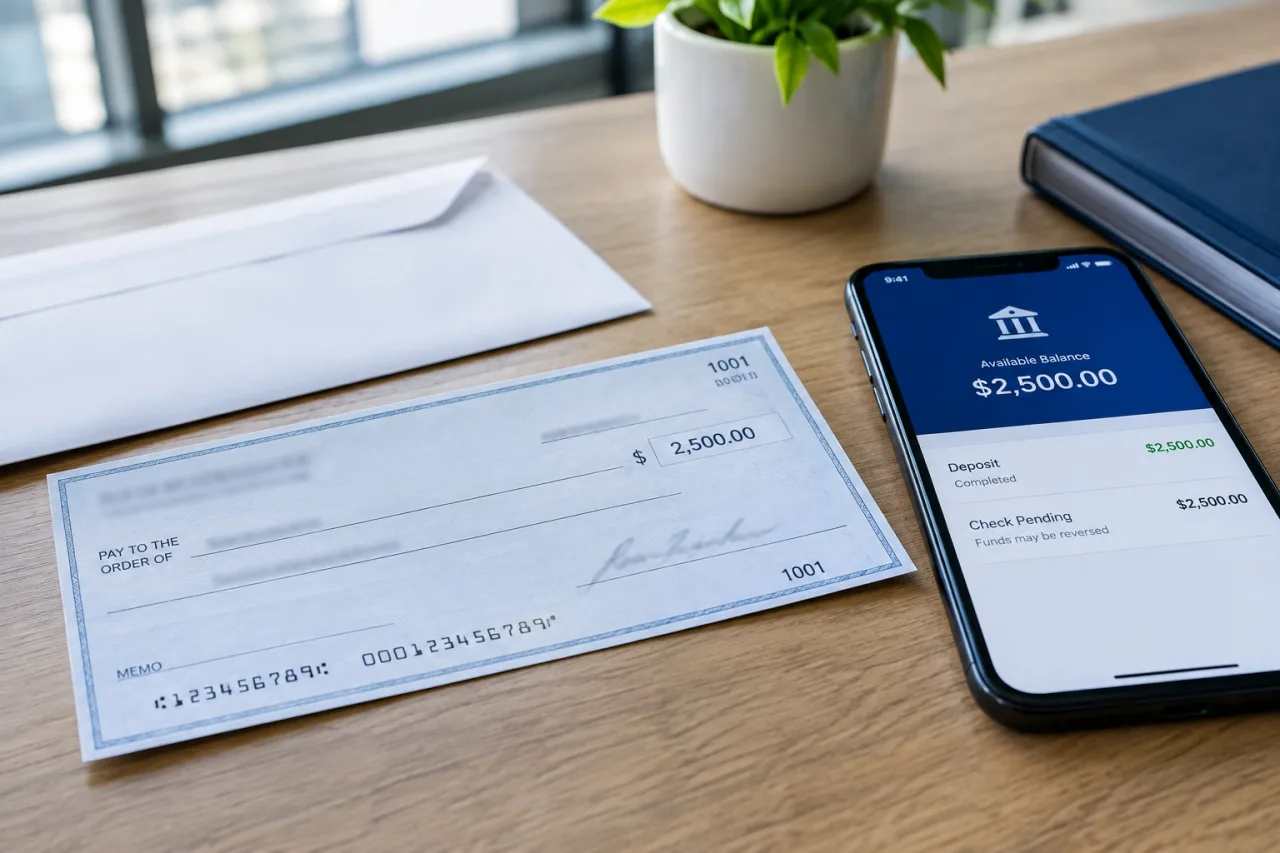
- The release. Your bank, following federal funds-availability rules, shows the money as spendable within days. You see the balance. You trust the balance. That is the trap.
- The drain. You send the refund — usually by a hard-to-reverse channel: gift cards with PINs, a wire service, cryptocurrency, or cash.
- The bounce. Weeks later the check completes its failure cycle. The bank reverses the entire deposit.
- The clawback. You owe the bank the full amount plus any overdraft and fee consequences — and the scammer has long cashed out your “refund.”
The reason this fake check scam defeats careful people is step four. Availability is not verification: the money in your account proves the check is being processed, not that it is real — the two clocks never run together, and the scam lives entirely in the days between them. When federal consumer authorities write that “even if you see the funds in your account, that doesn’t mean it’s a good check,” that single line is the whole defense — and it is worth a direct read in the FTC’s fake check scam advisory.
The Five Costumes
Regulators group fake check fraud into the same handful of stories. Each shares the steps above — only the cover story moves.
Mystery shopper
You are “hired” to evaluate a shop that sells gift cards, money orders or wire transfers; your first assignment is to deposit the check and wire part of it back. The job is the bait; the wire is the theft.
Personal assistant
An online “employer” sends a check and asks you to buy gift cards and send the PINs to your boss. The PINs are spent in seconds; the “job” never existed.
Car wrap decals
Get paid to advertise on your car: deposit the check, pay the “installers.” The installers belong to the scammer, the check is fake, and the vinyl never arrives.
Prize and sweepstakes payment
You “won” — but need to cover taxes, shipping or a processing fee from the enclosed check. Real sweepstakes do not charge winners to collect; paying to unlock a prize means the prize is the lure.
The marketplace overpayment
The classic fake check scam for sellers: a buyer “accidentally” includes extra and wants the difference refunded. The moment an overpayment appears, the deal is over — and the guidance in our Facebook Marketplace scam red-flags piece applies to every marketplace that takes checks off-platform.
How to Spot the Fake Before the Bank Does
Visual inspection fails — the fakes print real banks’ names on real check paper, and some are authentic checks from stolen accounts. Look for the pattern instead:
- Money arrives before you agreed to anything. An unexpected check is a probe, not a windfall.
- The amount exceeds the deal. A legitimate buyer has no reason to overpay, and a legitimate employer does not pay you before you work.
- The refund has a deadline. Urgency exists to beat your caution — a real counterparty waits.
- The payout method is irreversible. Gift cards, wire transfers, crypto, money orders — if the instructions send you toward one of those, you are being moved to the one place with no undo.
- The payer resists verification. Call the issuing bank directly to confirm the check — not the number printed on the check, which the scammer controls, but the bank’s official number. A suspicious payer hates this question.
- The digital check. Mobile-deposit instructions sent by a stranger deserve the same suspicion as paper: the fraud runs on the deposit, not on the paper.
If You Already Deposited and Sent Money: the Recovery Playbook
Move fast by payment method — hours matter more than days in every lane below — and start a record the same hour. A running file changes outcomes at the bank and at every agency: one note per event with the date and time (the listing, the first message, the deposit, the refund, the calls), screenshots of the messages and the payment confirmations, the check’s photos front and back, and the names or case numbers of every representative you speak with. Banks investigating a disputed deposit ask for exactly this packet; agencies ask for it again; and your own memory of a rushed week is no substitute for the file. Ten minutes of record-keeping is the cheapest step in this whole playbook — and the one people never regret.
- Freeze the drain first. If you have deposited the check but not yet sent the refund, send nothing and tell your bank the check is now suspect. Returning the “excess” to a scammer from unverified funds is the whole injury — declining to complete it leaves you with a weak but real position and no reversal debt.
- Call your bank with the right words. Say you believe you deposited a counterfeit check as part of a fraud and ask for the bank’s fraud department, not the teller line. Ask them to flag the deposit before it completes the return cycle, and ask what documents they need. You may still owe the reversal — the honest goal here is a flagged file, an early conversation and fee relief, not a guaranteed save.
- Gift cards: call the issuer immediately and report the card as used in a scam — the FTC’s gift-card guidance promises the fastest odds when you act quickly, and our gift card scams recovery piece carries the scripts per brand.
- Wire transfer: call the complaint department and ask for a reversal — Western Union at 1-800-325-6000, MoneyGram at 1-800-666-3947. Federal guidance is honest that reversal is unlikely, but the call is the only lane, and it also files the fraud record.
- Money order: contact the issuer to stop payment and stop delivery — if it moved by mail, the U.S. Postal Inspection Service handles interception at 877-876-2455.
- Cryptocurrency: contact the exchange or service you used, report the fraudulent transfer, and ask what reversal options exist for your specific case.
- Report it in three places. File at the FTC’s ReportFraud portal, at the Postal Inspection Service’s report page, and with your state attorney general through the NAAG consumer portal. The report creates the paper trail your bank and your card disputes will ask for.
One recovery fact to keep you honest: the bank is owed money because your account received a bad instrument — the refund you sent was your money leaving. No report forces the scammer to return anything; the reports help enforcement, the bank conversation shapes your burden, and the payment-method calls are your only real retrieval chances. Keep the same expectations with any scam: our report-a-scam routing guide maps every channel in one place, from the first screenshot to the final report.
How to Sell Without Ever Touching a Suspicious Check
Prevention here is a one-rule habit: deals that cannot pay at pickup do not pay at all. Accept payment methods that settle on the spot — cash, local pickup, in-app escrow where the platform holds funds until delivery. If a buyer insists on shipping-plus-check, offer platform-managed payment instead; real buyers take it, because it protects them too. The same skepticism scales to every stranger-bearing payment: the voice on the phone can be cloned and the “banker” verifying your prize can be a recording — the defense patterns in our voice-cloning scams piece apply to check-mailed cons as much as calls. A fake check scam needs your urgency; every rule above takes the urgency away.
FAQ
What is a fake check scam?
A fraud where a stranger’s check is deposited, part of the “cleared” funds is sent back to the scammer or a third party, and the check later bounces — leaving the depositor to repay the bank everything, including money already sent away. The fake check scam works because banks release deposited funds before checks finish clearing.
How long before a fake check bounces?
Often weeks. Federal guidance notes banks discover fake checks late because they look genuine, even to staff. The funds-availability window is days; the verification window is not — which is exactly the gap the scam is built on.
Can I keep the overpayment on a check?
No. An overpayment “by accident” is a defined scam pattern, and the FTC’s guidance says to reject any check above the selling price outright. Refunding the difference is the theft; keeping the full amount would just delay the same reversal once the check fails.
Can my bank reject a fake check before I deposit it?
Yes — verification is fastest before deposit. Call the issuing bank using its official public number, not any contact printed on the check, and ask whether the account and instrument are valid. Banks cannot always confirm instantly, but a payer who resists verification has answered the question anyway.
What should I do if I mailed a gift card or wire to the scammer?
Call the issuer or transfer company immediately — gift-card companies, Western Union (1-800-325-6000) and MoneyGram (1-800-666-3947) for wires, USPS (877-876-2455) for money-order interception. Then file the bank fraud report and the three fraud reports above. Speed decides which of those lanes still opens.
Am I liable if I deposited a fake check from a scam?
In most cases the bank recovers the deposited amount from your balance once the check fails — including any deficit your sent-away refund created. Early conversations with the bank’s fraud department, a filed police or FTC report, and documented fraud context are your best grounds for fee relief and, occasionally, goodwill write-offs; they are not guaranteed reversals.
What is the safest way to get paid when selling online?
Deal-local cash or platform-managed escrow. Both settle before you release the item and neither asks you to front money. Any sequence where you receive a paper instrument and then send something of value back is a fake check scam shaped like a sale.
- Official consumer.ftc.gov/articles/how-spot-avoid-and-report-fake-check-scams — the FTC’s fake check scam advisory
- Official reportfraud.ftc.gov — the FTC’s ReportFraud portal
- Official uspis.gov/report — the Postal Inspection Service’s report page
- naag.org/our-work/center-for-consumer-protection/consumer-file-a-comp… — your state attorney general through the NAAG consumer portal
External sources linked in this article, in order of first mention. Spotted an error or a broken link? Tell us.
Cite this pagePublished Nov 10, 2026
Agron, E. (2026, November 10). Fake Check Scam: How the Overpayment Trick Works and How to Recover. WorldNgayon. https://worldngayon.com/fake-check-scam-overpayment/
Agron, Edmon. “Fake Check Scam: How the Overpayment Trick Works and How to Recover.” WorldNgayon, 10 Nov. 2026, worldngayon.com/fake-check-scam-overpayment/.
Agron, Edmon. “Fake Check Scam: How the Overpayment Trick Works and How to Recover.” WorldNgayon, November 10, 2026. https://worldngayon.com/fake-check-scam-overpayment/.
Agron, E. (2026) ‘Fake Check Scam: How the Overpayment Trick Works and How to Recover’, WorldNgayon, 10 November. Available at: https://worldngayon.com/fake-check-scam-overpayment/.
E. Agron, “Fake Check Scam: How the Overpayment Trick Works and How to Recover,” WorldNgayon, Nov. 10, 2026. [Online]. Available: https://worldngayon.com/fake-check-scam-overpayment/
@online{agron2026fakecheck,
  author       = {Agron, Edmon},
  title        = {{Fake Check Scam: How the Overpayment Trick Works and How to Recover}},
  year         = {2026},
  date         = {2026-11-10},
  organization = {WorldNgayon},
  url          = {https://worldngayon.com/fake-check-scam-overpayment/},
  urldate      = {}
}TY - ELEC AU - Agron, Edmon TI - Fake Check Scam: How the Overpayment Trick Works and How to Recover T2 - WorldNgayon PY - 2026 DA - 2026/11/10/ UR - https://worldngayon.com/fake-check-scam-overpayment/ Y2 - ER -
Cite the version you read; the page may be updated. Zotero and Mendeley can also import this page directly.