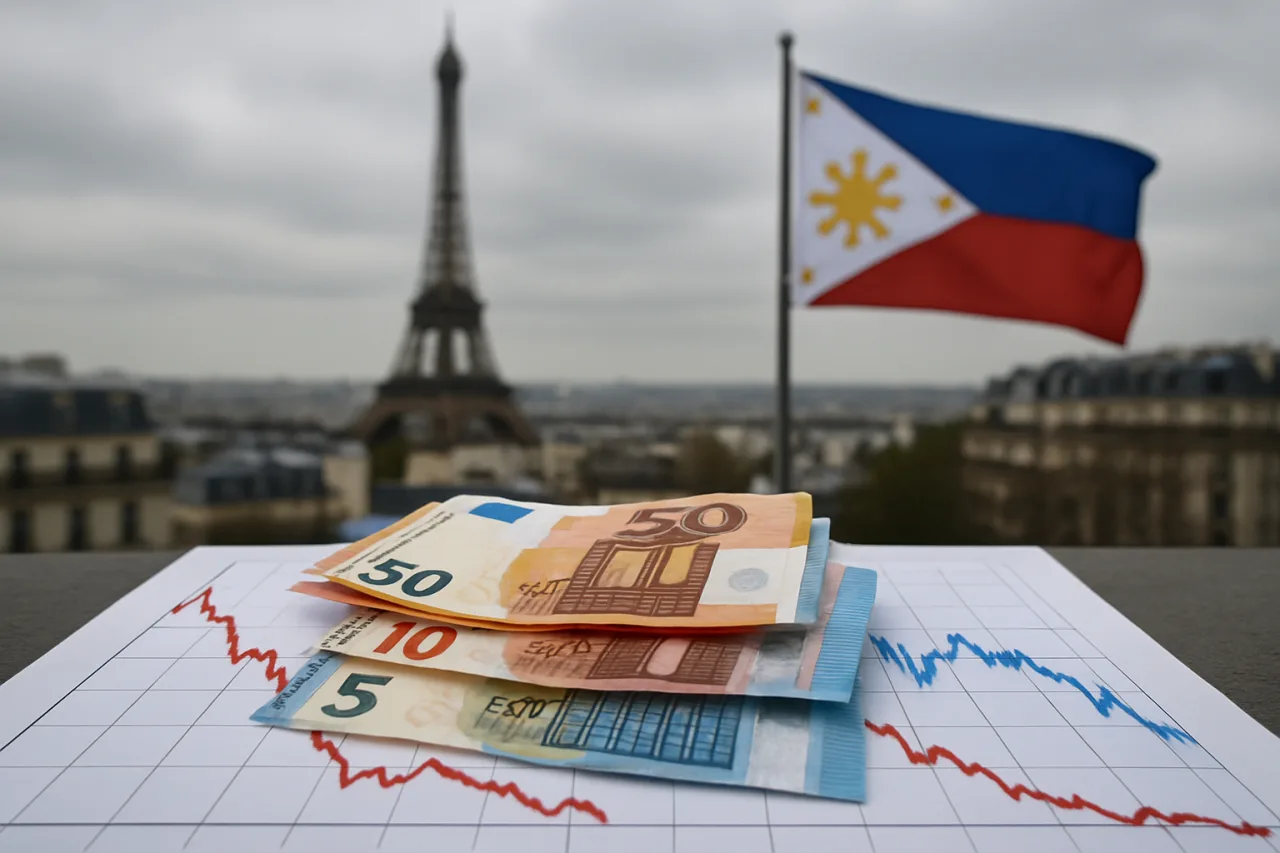
Key Takeaway
- 💶 The rate this morning: the euro to peso print sits at ₱70.60 (mid-market), down 0.59% on the day — the week’s band ₱70.10–71.27, with the week’s LOW printed YESTERDAY (Oct 5) as France’s fiscal crisis dragged EUR/USD through the 1.1200 floor.
- 🇫🇷 The driver: France’s budget breakdown widened the French–German bond spread, discounting every euro asset — while the dollar index climbed toward a 17-month high; the euro fell on its OWN story, not just the dollar’s strength.
- 🧾 The €500 math: €500 → ₱35,300 at the euro to peso print this morning. The same send at last Tuesday’s band top (₱71.27) would land ₱337 higher — and at the Oct-5 low, ₱251 lower. The spread layer (bank vs mid-market rails) runs bigger than the day’s FX move.
- 📐 The derived-rate law: EUR/PHP = EUR/USD × USD/PHP — the BSP moves only the peso-side leg; Paris moves the first. Euro-earners need BOTH charts, not one.
- 🎯 The routing edge: crisis weeks are exactly when bank counters widen hardest — the difference between converting through a bank and a mid-market rail can cover more of the household week than the intraday swings.
The most remittance-relevant chart in Europe this week is not a stock — it is a bond spread in Paris and a converter line in Manila. The euro to peso print slid to the week’s lowest yesterday as France’s fiscal standoff dragged EUR/USD through the 1.1200 floor, and every one of those basis points lands — converted — in the euro to peso payouts of Filipinos earning euros from Paris to Milan to Madrid sending pesos home to Albay, Iloilo, and Davao. This is the intelligence-not-news treatment: the rate this morning, the exact euro to peso driver, the €500 worked math, and the decision table a euro-earner runs this week — because a currency’s fall only matters when the reader is PAID in it.
The Rate This Morning: the Band and the Low, Receipted
Receipts first, per series discipline. Mid-market: ₱70.6018 as of this morning, −0.593% on the day, −0.585% on the week. The week’s structure: high ₱71.2738 (Sep 30), low ₱70.0988 (Oct 5 — the crisis-day print), average ₱70.6282. The decomposition tells the story cleanly: EUR/USD broke the 1.1200 floor on France’s budget crisis (the euro leg eroding the payout) while USD/PHP stands in the high-50s band (the peso leg still holding) — the derived print’s slide is arithmetically the euro’s fault, and the dollar’s strength can no longer mask it. The largest 24-hour move printed TODAY (Oct 6, −0.313%) — meaning the crisis leg is still LIVE this morning, not a stale Monday candle.
Related: Stablecoin Tax France: The 2027 30% Levy, 5 Facts for Holders
Why Paris Moves The Euro to Peso Converter: the Derived-Rate Law
The Philippines’ the euro to peso pricing is arithmetic before it is opinion: EUR/PHP = EUR/USD × USD/PHP. Neither leg is Philippine policy — the BSP influences only the peso side — so the euro-earner’s payout inherits every euro-asset panic wholesale. France’s crisis is Europe’s second-largest-economy discount: unfunded spending plans, a government that cannot form a durable majority, and a widening French–German spread (the market’s fear-priced premium for French paper versus German Bunds) — the euro pools those sovereign credits into one note, so a member-state panic IS a currency event. Add Friday’s soft US payrolls (usually euro-supportive, since it trims Fed-hike odds) and the read sharpens: the euro fell on its OWN fiscal story while the dollar STILL rose — weak currency meets strong hedge, and the tape is telling you which side carries the fear.
The €500 Worked Example: Priced Two Ways, Dated This Week
Take the standard monthly send — €500 from Amsterdam to Naga — and run it in TODAY’s rates. At this morning’s mid-market: €500 × 70.6018 = ₱35,300.90 before provider fees. At last Tuesday’s band top: €500 × 71.2738 = ₱35,636.90 — the day’s crisis drag costs the household ₱336 on this send alone. At yesterday’s crisis low: €500 × 70.0988 = ₱35,049.40 — the household riding the low instead of converting at open left ₱251.50 on the table. And the spread layer runs bigger than the FX move: a traditional bank counter typically quotes below mid-market plus a fixed fee (the corridor’s classic €10–25 in this corridor plus classic classic sub-mid quote) — on a €500 send, that combined cost routinely exceeds the day’s entire intraday FX swing. The translation: the rail you choose is worth more than the hour you choose it — sharpen the rail first, then time the send.
Who This Hits: the Euro Lane’s Filipino Geography
The euro lane is smaller than the US lane but concentrated — and each corridor converts through today’s print. Italy: the longest-settled community of the lane (decades-deep domestic and care workforce, heavy peso-side property holdings). France: domestic-work and care-work concentrated (Paris/Île-de-France first, Lyon behind). Germany: the nurse-and-care professional lane — the highest-earning euro cohort, most likely already on mid-market rails. Spain: hospitality, agriculture, and the growing care sector under the seasonal-worker programs. Netherlands/Nordics: compact professional communities with the sharpest routing habits. The seafarer overlay: euro-denominated cruise and yacht contracts — salary-is-FX-risk by design. Every corridor’s family budget is, functionally, an unhedged long-EUR/PHP position — which is why a French budget vote matters in a Filipino kitchen.
The Decision Table: what a Euro-Earner Does This Week
- Keep the schedule, sharpen the rail: deferral is a position and it prices against you in a falling currency — mid-market rails stay the cheapest lane in wide-spread weeks.
- Convert working balances at the stronger prints, not the crisis closes: the habit of converting at open captures the intraday windows volatility gives.
- Big-ticket peso spending (tuition, land, renovation)? Convert in tranches across the crisis window: averaging into the fall beats catching the knife.
- Top up peso-side buffers NOW: your euro income stream is temporarily cheap pesos to purchase — weight the household’s peso buffer while the euro-side stream holds value.
- Speculative EUR/USD positions: only with sleeves sized for crisis volatility — France’s parliament can move this pair more than any data release this month.
The Two-Buffer Principle: How Euro Earners Ride a Currency Fall
The durable answer is structural, not tactical: TWO currency buffers, weighted by income design. Euro-side buffer sized to Europe-side obligations (rent, transport, insurance — the contract’s bills), peso-side buffer sized to Philippines-side obligations (family maintenance, tuition, land amortization). The crisis discipline that follows: when the euro falls, top up the PESO buffer; when it rebounds, rebuild the euro side. This quarterly rotation converts currency volatility from a threat into a mild purchasing-power arbitrage the household runs every quarter — with one euro-lane adjustment: EUR/PHP’s crisis spreads run wider than USD/PHP’s, so the rail-sharpening rule matters even more on this lane.
The Corridor History of the Week: Why the Band Structure Matters More Than the Number
A euro to peso story deserves its structural close, because the diaspora’s practical FX habit is not predicting the rate — it is RESPECTING the band. The euro lane’s Filipino geography explains who respects which band: Italy’s decades-deep community treats every crisis band as a range to tranche through (the case studies are family-run); Germany’s professional cohort routes before it times (mid-market rails first, timing second — the sharpest habits in the lane); France’s domestic-work corridors convert on remittance-company schedules, which is why the spread layer hits them hardest; Spain’s seasonal programs time on contract dates rather than chart windows. The week’s band — ₱70.10 floor, ₱71.27 ceiling, ₱70.60 center — is the structure to work WITH: tranching across it beats forecasting through it, and the center (where today’s print sits) is the honest reference for any same-day send. Run your provider’s live quote at send time; the printed table’s number is history by lunchtime in a crisis week — but the BAND, respected quarterly, pays the household more reliably than any intraday forecast ever will.
The Corridor Map: How the Euro Lane Inherited This Week’s Mechanism
The structural close becomes a map when you lay the corridors on it — every lane inheriting the same euro to peso mechanism with different exposure profiles. The bank-queue corridors (Italy’s settled towns, France’s remittance-company schedules) inherit the SPREAD exposure hardest — their queues convert on posted schedules, and crisis weeks post the widest sub-mid quotes; the sharpened instruction for these corridors is not “convert somewhere else” — it is “verify the live quote against the mid-market print before the queue’s posted number executes.” The professional-brokerage corridors (Germany’s nurses, the Dutch cohort) inherit the TIMING exposure instead — their habits already route mid-market first, so their quarterly discipline is tranche-weighting across the band rather than hour-picking. The seafarer overlay inherits both at once: euro-denominated contracts mean the entire salary rides the mechanism, which is why the seafarer lane’s two-buffer drilling pays more than any other cohort’s. The map’s honest summary: the mechanism is ONE; the profiles are THREE; the household that knows its own profile runs the rotation correctly — queues sharpen their rail first, brokerages tranche their timing, seafarers do both with receipts. The discipline closes where Wednesday’s prints open it again: the corridor map’s three profiles stay, the band gets redrawn daily, and the household that receipts BOTH ends of the rotation — the rate it caught and the rate it missed — is the household that forecasts nothing and still lands ahead of every crisis week this lane prints.
The Watch List: What Changes the Story (and the Rate) Next
- Paris’s budget resolution: any credible funding plan or government formation narrows the spread and lifts the euro — watch for the vote that either breaks or passes the deadlock.
- ECB meeting posture: any easing signal shifts euro assets instantly; the next ECB communication lands with crisis-level attention.
- French rating commentary: agencies reviewing France’s AA-grade outlook can widen the spread overnight — the fastest single rate-mover available this quarter.
- The USD/PHP leg: BSP policy and global dollar flows also move the derived payout; watch the BSP’s next move for the peso-side leg.
- Corridor spread normalization: when bank EUR/PHP spreads normalize, this week’s routing edge narrows with them — recheck quotes before assuming the arbitrage persists.
Frequently Asked Questions
What is the current euro to peso rate amid the France crisis?
The euro to peso mid-market print sat at ₱70.6018 this morning — the week’s band ₱70.0988–71.2738, with the LOW printed Oct 5 as France’s budget crisis dragged EUR/USD through 1.1200. Check your provider’s live quote before sending: crisis-week rates move by the hour.
Why is the euro falling against the peso right now?
France’s fiscal crisis: unfunded spending plans, a government without a durable majority, and a widening French–German bond spread discount every euro asset. The euro pools those sovereign credits into one note — a member-state panic is always a single-currency event.
Should I send euros home now or wait for a rebound?
Deferral is a position, and in a falling currency it prices against you. Keep your schedule, convert through mid-market rails while bank spreads are wide, and split large conversions into tranches across the window.
How do I get the best euro to peso exchange rate today?
Three levers, in order of value: route through mid-market rails instead of bank counters (the spread you avoid is the yield you keep), convert earlier in the day rather than at crisis closes, and verify the live quote at send time — printed tables are history by lunchtime in a volatility week.
Where do most Filipinos earn euros in Europe?
Italy (the longest-settled community), France (domestic and care work), Germany (nurses and care professionals — the highest-earning cohort), Spain, the Netherlands and the Nordics, plus euro-denominated seafarer contracts — all converting through the same derived EUR/PHP mechanism.
Does the BSP control the euro to peso rate?
No — the exchange rate is market-derived (EUR/USD × USD/PHP); the BSP influences only the peso-side leg. Philippine authorities move the second factor, never the first.
Financial Disclaimer
General information only — not financial advice. FX rates reflect public feeds as of October 6, 2026 and change continuously; quotes, spreads, and corridor pricing vary by provider and hour. Verify live rates with your provider before transacting. Consult licensed professionals for personal financial decisions.