Key Takeaway
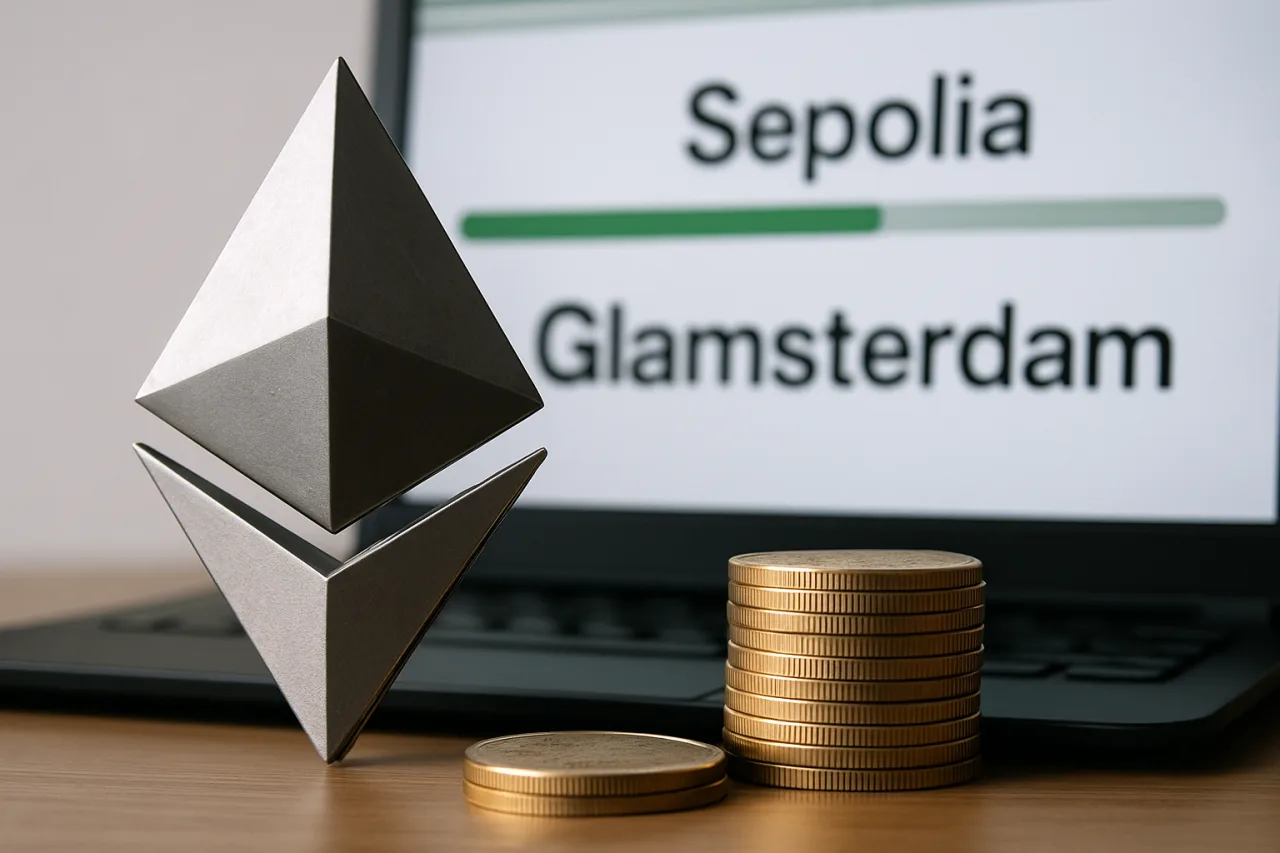
- ⏰ Monday, Oct 6, 13:53 UTC (9:53 PM Manila): the Ethereum Glamsterdam upgrade — the Ethereum Glamsterdam upgrade activates on the Sepolia testnet at epoch 353,024 — the full dress rehearsal for the network’s biggest hard fork since the Merge.
- ⛽ The headline target is a 3.3x bigger block: the gas limit path runs from today’s ~60 million to 200 million, carried by two structural changes — enshrined proposer-builder separation (EIP-7732) and block-level access lists (EIP-7928).
- 💸 The user-visible win is already priced into the fork: EIP-2780 cuts the intrinsic transaction floor, making standard ETH transfers between existing accounts up to 71% cheaper once the changes hit mainnet in Q4.
- 📊 The tape says patience: ETH trades ~$2,695 — up 58% in Q3 but 45% below its $4,946 peak — and history says testnet forks themselves move price less than the macro around them (one prior upgrade rallied 39%, another drew down 30%).
- 🇵🇭 The Filipino playbook: the fees that hit remittance-linked USDT transfers, freelancer payouts, and small stakers all get repriced by this fork — seven concrete moves below, from transfer timing to the exchange-supply tell (3.49%, a multi-month low).
Table of Contents
The Ethereum Glamsterdam upgrade stops being a developer document on Monday — at 13:53:36 UTC on October 6 (9:53 PM Manila time), it activates on the Sepolia testnet at epoch 353,024, and becomes the most consequential rehearsal Ethereum has run since the Merge. The Ethereum Foundation’s roadmap page carries the confirmed slot from the September 17 announcement after Glamsterdam cleared its latest private devnet rehearsal, and the package it carries explains why this one matters beyond the usual fork-cycle noise: a gas-limit path from roughly 60 million to 200 million — a 3.3x capacity expansion on Ethereum’s base layer — structural surgery on how blocks get built, and a gas repricing that makes the most ordinary Ethereum transaction, the plain wallet-to-wallet transfer, up to 71% cheaper on mainnet. That last number is the one Filipino readers should hold onto: the fees attached to USDT remittance transfers, freelancer ETH payouts, and small-staker operations are all downstream of this week’s testnet run. Here is what actually happens Monday, what it changes, and the seven moves worth making before mainnet.
Related: Crypto Watch #013: Glamsterdam Sepolia Fired at 9:53 PM Manila — the D
What Happens Monday at 13:53 UTC
Sepolia is a test network — the tokens carry no real value, which is precisely the point. Glamsterdam’s activation there at epoch 353,024 is the first public run of the full fork package under live-network conditions: every client team (Geth, Nethermind, Besu, Erigon and their consensus counterparts) running the same rules simultaneously, revealing incompatibilities, missed-slot failures, and payload quirks before any real money rides the code. The Ethereum Glamsterdam upgrade rehearsal follows its final devnet phase, where the complete ten-EIP bundle under Meta EIP-7773 was locked: EIP-7732, EIP-7928, EIP-7708 (ETH transfers and burns emit a log), EIP-7778 (block gas accounting without refunds), EIP-7843 (a SLOTNUM opcode), EIP-7954 (maximum contract size raised from roughly 24 KiB to 32 KiB), EIP-7975 (eth/70 partial block receipts), EIP-8024 (new opcodes), EIP-8037 (state-creation gas costs, finalized in May 2026), and EIP-8159. The name itself stitches the fork’s two halves: Amsterdam on the execution layer, Gloas on the consensus layer — the dual-track pattern Ethereum has used since proof-of-stake. If the Ethereum Glamsterdam upgrade runs clean on Sepolia, developer attention shifts to the Hoodi testnet and then mainnet, which has a Q4 2026 target and no committed date. If Sepolia stumbles, the timeline slips — and that is the first fork-related risk readers should price.
The Two Engines: ePBS and Block-Level Access Lists
The structural center of the Ethereum Glamsterdam upgrade — the reason 60 million gas becomes a 200 million target — is EIP-7732, enshrined proposer-builder separation (ePBS). Today, the validator who proposes a block usually relies on external, off-protocol middleware (MEV-Boost relays) to have professional builders assemble the block’s contents — a market that works, but lives outside the protocol and concentrates leverage with sophisticated players. ePBS moves that relationship into Ethereum’s core rules: the protocol itself guarantees the proposer payment for their block even when a separate builder assembles the payload, and — the detail that unlocks everything else — widens the data-propagation window from two seconds to roughly nine seconds. That widened window is what makes a 200M gas block physically deliverable without validators rushing validation and missing slots. The second engine, EIP-7928 (block-level access lists), gives every block an upfront map of exactly which accounts and storage slots its transactions will touch, plus the post-execution state values. With that map, client software can preload state and process unrelated transactions in parallel instead of strictly in sequence — the change that turns bigger blocks into actual throughput rather than just heavier ones. For ordinary holders, neither engine needs action; both are the plumbing that lets the fee cuts and capacity gains land without bloating node databases past the sustainability ceiling EIP-8037 set (state growth held under 120 GiB per year).
The Fee Math: 60M to 200M and the 71% Cheaper Transfer
The Ethereum Glamsterdam upgrade converts infrastructure into a wallet story with three numbers convert this infrastructure story into a wallet story. First, the gas-limit path: ~60M today to a 200M target — roughly 3.3x the base layer’s capacity, which developers say could reach 10,000-TPS-equivalent throughput under realistic workloads. The 200M figure is a design target the fork unblocks, not a value the fork itself enforces; the network raises limits in steps after validation. Second, EIP-2780 cuts the intrinsic transaction-gas floor, and the projection that matters to Filipinos is standard ETH transfers between existing accounts running up to 71% cheaper — the class of transaction that includes moving USDT or USDC between wallets on Ethereum’s mainnet, the rail many remittance-linked transfers actually ride. Third, context from the upgrade that shipped before this one: Fusaka’s PeerDAS has run for nearly a year and cut Layer-2 fees by over 95% — proof that this scaling cadence produces real user-side fee relief, not just benchmark wins. Stack the two: the cheap-layer L2s for high-frequency small payments, and after Glamsterdam mainnet, a meaningfully cheaper L1 for the transfers worth settling on the base chain. The fee morning-queue effect — gas spikes when Manila and global business hours overlap — narrows at both layers. None of this requires users to do anything at fork time; the Ethereum Glamsterdam upgrade’s changes are protocol-level and automatic. The only reader action is timing around them, which the playbook below covers.
The ETH Tape: What Price Already Knows
The ETH tape into the Ethereum Glamsterdam upgrade weekend trades around $2,695-2,719 — up roughly 58% in Q3 (ending a three-quarter losing streak) but still about 45% below the $4,946 all-time high of August 2025. The institutional tape stays constructive: Citi raised its ETH target to $3,028 (and Bitcoin to $113,000) on October 2, banking on $5 billion in ETF inflows; ETH exchange supply sits at 3.49%, a multi-month low that reads as reduced selling pressure. The flow wobble worth noting: US spot ETH ETFs snapped a 7-day inflow streak on September 29 with a net $2.81M outflow, after roughly $850.8M had come in over the prior week — noise, but the kind worth watching into a fork week. On the fork-price question itself, the honest read comes from history: past Ethereum upgrades produced a 39% rally once and a 30% drawdown once, and macro mattered more than code both times. Traders have had months to price the Oct 6 testnet date; testnets carry no value and no forced flows. The price-relevant milestones are a clean Sepolia run (removes mainnet-delay risk), a Hoodi date, and above all a mainnet activation announcement — the event that makes the 71%-cheaper transfer real. Citi’s $3,028 target implies roughly 12% headroom from the weekend tape; the fork is the credibility engine behind that kind of call, not the candle that prints it.
The Filipino Fee Playbook: 7 Moves Before Mainnet
- 1 — Keep the fee morning-queue rule, upgrade the windows. Gas still spikes in the Manila-evening/global-morning overlap. Post-Glamsterdam the spread narrows, but executing transfers outside 8-10 AM Manila (9 PM-12 NN UTC) remains the free win.
- 2 — Batch remittance-linked USDT transfers to mainnet-worthy sizes. If fees drop up to 71% on the floor, the effective cost of one larger transfer versus three small ones inverts — batch when amounts allow, and keep small routine flows on L2s.
- 3 — Treat Q4 as the migration window, not Monday. Sepolia proves code, not fees. No mainnet action is needed on Oct 6; the wallet-visible changes arrive with the mainnet activation announcement.
- 4 — Small stakers: read the ePBS pay guarantee before re-delegating. Protocol-guaranteed proposer payment trims the MEV-Boost-era leverage gap — relevant to solo/rpool operators deciding between staking services in the new landscape.
- 5 — Watch exchange supply as the flow tell. 3.49% and falling = accumulation behavior; a reversal into the 4-5% zone after a Citi-style target raise would mark distribution — the classic into-rally exit pattern.
- 6 — Track the two dates that move the asset: the Hoodi testnet slot and the mainnet activation announcement. Between them, the fork is a news cycle; after the second, it is a fee schedule.
- 7 — Budget the peso side like any fee change. A 71% cheaper transfer still converts at the weekend PHP rate — pair the fee saving with the remittance timing habits from our stablecoin-rails piece so the saving survives the spread.
Monday’s Watchlist
Four checkpoints, in order: (1) 13:53:36 UTC activation — Sepolia finalizes the fork at epoch 353,024 or it doesn’t; (2) client incident reports — any missed-slot or payload-validation failures surface in the following hours and shape the Hoodi conversation; (3) gas-limit signaling — post-fork testnet parameter moves hint at how fast the climb toward 200M begins on mainnet; (4) ETH into $2,807 — the resistance level traders cite as the line between range-bound and breakout; a clean fork plus a break gives the rally its next leg, a botched rehearsal gives the bears their window. For remittance-linked readers of the Ethereum Glamsterdam upgrade, none of Monday’s outcomes changes this week’s cost of sending — the practical effect arrives on mainnet, and the smart move stays exactly what it was: time the transfer, batch where it makes sense, keep small flows on the already-cheap L2s.
One cross-check ties the week together for holders: the fork-week flow picture — ETF streak snapped Sept 29 with a $2.81M dip after $850.8M of weekly inflows, exchange supply at 3.49%, Citi’s $3,028 call — reads as consolidation, not distribution. Consolidation into a rehearsal week is the historically favorable setup: it means the market already holds its fork expectations without leverage extremes. The risk case is equally legible: a Sepolia incident that slips the Hoodi slot pushes the mainnet conversation into 2027 pricing, and the $2,695 support gets its first real test. Both paths resolve inside the week — which is why Monday’s epoch 353,024 moment deserves the calendar slot it now has.
Frequently Asked Questions
What is the Ethereum Glamsterdam upgrade and when does it activate?
The Ethereum Glamsterdam upgrade is Ethereum’s next major hard fork — Amsterdam (execution layer) plus Gloas (consensus layer) — carrying EIP-7732 (enshrined proposer-builder separation), EIP-7928 (block-level access lists), and a gas repricing package, on a path from a ~60 million gas limit toward 200 million. It activates on the Sepolia testnet October 6, 2026 at 13:53:36 UTC, with mainnet targeted for Q4 2026.
Do ETH holders need to do anything for Glamsterdam?
No. The fork changes protocol rules, not wallets or tokens — holdings, balances, and addresses are unaffected. The only user-side decisions are timing-related: when to transfer (fee windows) and, for stakers, how to evaluate services under the new ePBS payment guarantees.
Will Glamsterdam make Ethereum transactions cheaper?
Yes, in specific ways: EIP-2780 cuts the intrinsic gas floor, projected to make standard ETH transfers between existing accounts up to 71% cheaper on mainnet, and the higher gas limit reduces competition-driven fee spikes. Layer-2 fees are already down 95%+ from Fusaka’s PeerDAS; Glamsterdam extends the relief to the base layer.
What is ePBS in the Ethereum Glamsterdam upgrade, in simple terms?
Enshrined proposer-builder separation moves the block-building market into Ethereum’s core protocol: the validator proposing a block gets protocol-guaranteed payment even when a separate specialized builder assembles its contents, and the wider 9-second propagation window makes large blocks deliverable — the structural change that enables the 200M gas target.
Will the Sepolia fork move ETH’s price?
History says testnet forks themselves are weak price drivers — prior Ethereum upgrades produced a 39% rally once and a 30% drawdown once, with macro mattering more. The price-relevant events are a clean Sepolia run (removing mainnet-delay risk) and, above all, the mainnet activation date. ETH entered the week near $2,695, up 58% in Q3, with Citi targeting $3,028.
Financial Disclaimer: This article is for general information and education only and does not constitute investment advice. Crypto assets are volatile; prices, targets, and upgrade timelines cited are reporting snapshots as of October 4, 2026. Verify with official sources and licensed advisers before financial decisions.