Key Takeaway
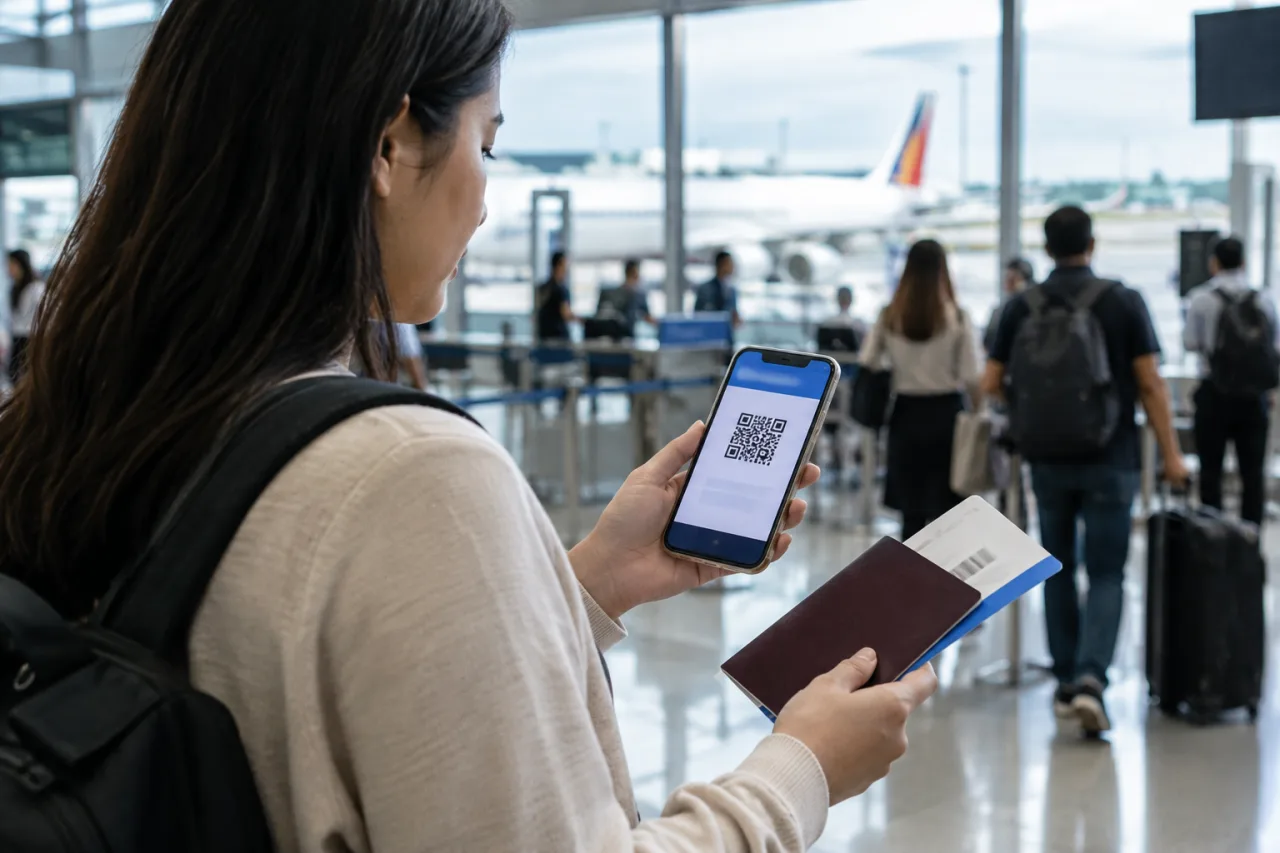
- 📱 eTravel registration is mandatory and free: departing Filipinos file the QR at etravel.gov.ph within 72 hours before departure — and not less than 3 hours before — with lookalike paid sites being the trap to skip.
- 🧾 The departure checklist has four lanes: the universal documents (passport 6+ months, visa, return ticket), the eTravel QR, the travel-tax obligation where it applies, and the special-case papers (OEC for OFWs, DSWD clearance for minors, CFO certificates for foreign-spouse travel) — the lane you’re in decides the pack.
- 💳 The fraud angle is live: paid “eTravel processing” sites clone the government portal — the official registration never charges a fee, and the QR is free the way the pastillas-scam era taught every desk to be suspicious of money changing hands at the airport.
- 🛂 Immigration asks in layers: the primary counter wants the basics; secondary inspection (when referred) wants proof of funds and ties — the document tiers from our offloading guide ride on top of the eTravel layer.
- ⏱️ Timing rules are strict: the 72-hour window exists so records are fresh — register the week before, not the hour before, and keep the QR screenshot plus a printout for the dead-battery scenario.
Table of Contents
eTravel registration is the newest mandatory step in the Philippine departure flow — the digital QR that replaced the old paper departure cards for Filipinos flying out of the country. Etravel registration is filed free on the government portal within a 72-hour window before the flight, it sits at the top of the pre-departure checklist alongside the documents immigration actually asks for: the valid passport, the visa where required, the return ticket, and the papers that prove your travel category. This etravel registration guide runs the full 2026 checklist — universal documents, OFW papers, minor-travel and foreign-spouse lanes, travel tax, and the special departure certificates — and flags the fraud pattern hanging off the newest step: paid lookalike eTravel portals that charge for what the government gives away. The guide also places the QR in context — of the three departure-side requirements (the QR, the travel-tax lane, and the immigration document pack), etravel registration is the newest and the easiest to fake, which is why the verification rules get their own section.
Why the QR exists is worth one paragraph, because the registration feels like paperwork until the reason shows up: the digital record replaces the paper departure card the airlines used to hand out, gives immigration a pre-arrival data layer it can verify before the passenger reaches the counter, and removes the handwriting variable from the inspection queue. The system pays for itself exactly where paper failed — legible data, timestamps, and a lookup the officer runs in seconds. The tradeoff is the one that follows every digital government service: the record lives behind an account and a window, and the traveler who treats the registration as a five-minute chore on flight day discovers the window rule the hard way.
eTravel Registration: The Rules That Actually Apply
- Register at the official portal only. The government’s eTravel portal is free; third-party sites that “process” eTravel registration for a fee clone the look and add the charge. Etravel registration takes minutes, asks for trip and passport details, and issues the QR — a paid middleman adds risk and nothing else.
- Respect the window. Registration opens 72 hours before departure and closes the last 3 hours — file it the day you pack, not the day you fly; the system rejects out-of-window filings and the counter cannot magic one in.
- One etravel registration per traveler, per trip. The QR binds to the flight and passenger — keep the confirmation screenshot AND a printout; airport cellular and portal peak-hour outages are documented causes of preventable counter delays.
- Check which lane you’re in. Filipinos departing register on the citizen side; foreign nationals have their own departure obligations (emigration clearance certificates for long-stay holders) — the universal documents below apply to both, the special cases differ.
The Departure Document Checklist: Universal Layer
- Passport valid at least six months beyond departure (the six-month rule is the most common self-inflicted trip-ender).
- Visa where the destination requires one — and the printout for e-visa destinations, since phone screenshots fail exactly when lines are long.
- Return or onward ticket — the one-way traveler to a strict-destination country is the classic secondary-inspection trigger.
- eTravel QR code — registered, saved, printed.
- Proof of funds and ties: certificate of employment or business papers, bank statements, school records — the tier-two pack from the NAIA offloading guide, carried when any screening factor could apply.
The OFW Lane: OEC, OWWA, and the Papers That Pre-Clear You
OFWs travel under a different arrangement: the OEC (Overseas Employment Certificate) — the exit document issued through the DMW’s channels, usually paired with the OWWA membership and e-card — pre-clears the worker’s departure lane and exempts or reduces travel tax. The practical sequence: secure or renew the OEC before flight week, carry the employment contract, and keep the OWWA e-card in the same folder — the OFW ID guide covers the e-card process step by step. Workers with complete papers sail through inspection for the reason that matters: their purpose of travel is documented by the government’s own system, which is the entire difference between the deployment lane and the tourist lane the offloading rules govern.
Special-Case Lane: Minors, Foreign Spouses, and Returning Irregulars
- Minors traveling alone or without both parents: a DSWD travel clearance is the gate — apply before flight week at the social-welfare office, not at the airport.
- Spouses and partners of foreign nationals departing to join them: the CFO Guidance and Counseling Certificate — first-time joiners attend the session and carry the certificate; the gate checks for it by category.
- Travelers with prior deferrals or repatriation history: expect automatic secondary scrutiny and bring the closure documents — cleared-departure paperwork or the IACAT clearances that ended the previous flag.
- Foreign nationals who stayed long: the emigration clearance certificates (ECC variants) processed at the Bureau main office before departure day, with fees that vary by type. The special-case lanes share one warning: each certificate needs lead time measured in office days, not minutes — a same-day fantasy is how legitimate travelers end up in the queue with the missing-paper problems the fraud sites promise to solve.
Travel Tax: Who Pays, Who Exempts, and Where It Gets Collected
Travel tax applies to Philippine residents departing on non-OFW travel, computed by ticket class and collected at check-in by the carrier, or pre-paid at authorized counters; the reduced-and-exempt lanes cover OFWs with valid papers, balikbayan-category travelers, and the specific exemptions the program defines. The practical advice mirrors the rest of the checklist: confirm your lane’s rate before the airport, keep the receipt with the QR printout, and remember the receipt doubles inside the immigration pack: an OFW’s exemption receipt is itself proof of the deployment lane, which is why the tax paper belongs in the same folder as the OEC rather than a jacket pocket., and never hand cash to someone offering to “process” the travel tax without an official receipt — the informal-collection pattern belongs to the same family as the airport corruption cases this site documents.
Frequently Asked Questions
eTravel Registration — Is It Really Free?
Yes — the government portal registers departing travelers at no charge, and the fee-charging sites that imitate it are the trap. The official flow asks for trip and passport details and issues the QR directly; if a site asks for payment to “process” an eTravel registration, it is not the government’s system, and the paid lane adds nothing the free portal doesn’t return in minutes — and the lookalike sites belong in the scam-reporting lanes.
When exactly should I complete my eTravel registration?
Within the 72-hour window before departure and no later than 3 hours before the flight — the practical move is the day before packing finishes. Out-of-window registrations bounce, and the departure counter cannot create a QR for a traveler who filed too early or too late. The pattern that catches business travelers: the return leg counts as a departure too — an etravel registration filed for the outbound trip does not cover the flight home, and the return journey needs its own window filing.
Do OFWs still need eTravel registration if they have an OEC?
Yes — the eTravel QR is a departure-system requirement separate from the OEC and OWWA papers; OFWs carry both. The OEC handles the deployment lane (and the travel-tax exemption), while the QR clears the digital departure formalities — one layer never substitutes for the other.
What happens at the airport if I lost my eTravel QR?
The registration record exists in the system under your details — the practical fix before asking for exceptions: recheck the email and account you registered with, re-download the QR, and bring the screenshot plus the printout. Travelers who never registered inside the window face the harder case, which is why the window rule gets repeated on every checklist.
eTravel registration failed or the site is down — what now?
Retry on the official portal on a different browser and network first; the portal’s peak hours before holidays create queue loads that clear within hours. Never complete the registration through a paid lookalike site to save time — a cloned-portal receipt is worthless at the counter, and the payment went to the exact fraud family the official portal’s zero-fee rule exists to starve. If the payment already went through, the card issuer’s fraud line is the next stop — and the details of the clone site become the report that protects the next traveler.
Financial Disclaimer
This article provides general travel-procedure guidance and does not constitute legal advice. Portal rules, registration windows, and travel-tax rates change over time and vary by traveler category; verify every step against the official eTravel portal, the Bureau of Immigration, and the Department of Tourism pages before acting. The author and publisher disclaim any liability for actions taken based on this information.
- Official etravel.gov.ph — eTravel portal is free
External sources linked in this article, in order of first mention. Spotted an error or a broken link? Tell us.
Cite this pagePublished Oct 28, 2026
Agron, E. (2026, October 28). eTravel Registration and Departure Requirements: the 2026 Pre-Flight Checklist for Filipinos. WorldNgayon. https://worldngayon.com/etravel-registration/
Agron, Edmon. “eTravel Registration and Departure Requirements: the 2026 Pre-Flight Checklist for Filipinos.” WorldNgayon, 28 Oct. 2026, worldngayon.com/etravel-registration/.
Agron, Edmon. “eTravel Registration and Departure Requirements: the 2026 Pre-Flight Checklist for Filipinos.” WorldNgayon, October 28, 2026. https://worldngayon.com/etravel-registration/.
Agron, E. (2026) ‘eTravel Registration and Departure Requirements: the 2026 Pre-Flight Checklist for Filipinos’, WorldNgayon, 28 October. Available at: https://worldngayon.com/etravel-registration/.
E. Agron, “eTravel Registration and Departure Requirements: the 2026 Pre-Flight Checklist for Filipinos,” WorldNgayon, Oct. 28, 2026. [Online]. Available: https://worldngayon.com/etravel-registration/
@online{agron2026etravelregistration,
  author       = {Agron, Edmon},
  title        = {{eTravel Registration and Departure Requirements: the 2026 Pre-Flight Checklist for Filipinos}},
  year         = {2026},
  date         = {2026-10-28},
  organization = {WorldNgayon},
  url          = {https://worldngayon.com/etravel-registration/},
  urldate      = {}
}TY - ELEC AU - Agron, Edmon TI - eTravel Registration and Departure Requirements: the 2026 Pre-Flight Checklist for Filipinos T2 - WorldNgayon PY - 2026 DA - 2026/10/28/ UR - https://worldngayon.com/etravel-registration/ Y2 - ER -
Cite the version you read; the page may be updated. Zotero and Mendeley can also import this page directly.