Table of Contents
Key Takeaway
- 📏 The gate test: The EPS TOPIK exam is Round 1 of Korea’s point-based selection system — 20 reading questions and 20 listening questions on a tablet, 50 minutes total, 100 points.
- 💰 One price, card only: The application fee is US$24, paid in pesos through the DMW registration portal with a Maya convenience fee, cash not accepted.
- 🎯 Passing floors differ by industry: Manufacturing required 60/100; Service 1 and Service 2 required 45/100 in the 2026 round, and only the highest scorers advanced to 1.1 times the recruitment quota.
- ⚙️ Strict application rules: One application per applicant, no industry change after passing Round 1, and false documents bring a four-year ban from the Employment Permit System.
- 📌 What to do next: Round-1 results land November 13, 2026; after that, watch the DMW advisory page for the next round’s registration window — slots are capped and first-come, first-served.
The EPS TOPIK exam is the Korean-language test that every Filipino worker must pass before South Korea’s Employment Permit System will consider them for a factory or service job in Korea. It sounds like a small formality, but the 2026 numbers say otherwise: 9,000 registration slots across three industries for the 11th point-based round — 8,000 for Manufacturing, 600 for Service 1, and 400 for Service 2 — and only 1,650 actual deployment quotas waiting on the other side. That ratio is the whole story of this exam. It is not a language test you take after being hired. It is a competition, and the score decides who gets in line first.
This guide walks through the full pipeline using the official documents: who may apply, what it costs, how registration works on the DMW portal, what the exam contains, how scores are counted, and what happens after you pass — the Skills Test, the Job Capacity Assessment, and the road that leads from a passing mark to a contract and a flight to Korea. Every number below comes from EPS-TOPIK Advisory No. 4, series of 2026, and the official DMW registration portal, checked this week.
What Is the EPS TOPIK Exam?
The EPS TOPIK exam is the Korean proficiency test used under the Employment Permit System, the government-to-government program between the Department of Migrant Workers and Korea’s Ministry of Employment and Labor. “TOPIK” stands for Test of Proficiency in Korean, and the EPS version is its employment edition — simpler than the academic TOPIK for university students, but tuned to workplace language: signs, instructions, conversations between a supervisor and a worker.
The exam matters because of how Korea now recruits. Under the point-based selection system announced jointly by MOEL and DMW in September 2026, Korean employers screen candidates using a wide range of information — Korean proficiency, skills, health, training history, academic background, qualifications, and work experience. The EPS TOPIK exam is Round 1 of that screening. Applicants who clear the passing floor advance through the second round, and final selection uses the combined score of both rounds.
One more naming note to keep you from confusion: the exam is officially called EPS-TOPIK by the agencies, and you will also see it described as the UBT — Ubiquitous-Based Test — because it runs on tablets in the test hall, not on paper. Searchers, employers, and this guide use “EPS TOPIK exam” in plain form; the official documents use the hyphen. They are the same test.
The 11th Point-System Round: 2026 Dates, Slots and Fees
The current round — the 11th under the point system — has its own verified structure. Registration opened on September 19, 2026 at 2:00 PM for Manufacturing, September 20 at 9:00 AM for Service 1, and September 20 at 11:00 AM for Service 2, and the submission window closed on September 29, 2026. Registration slots were capped — 8,000 applicants for Manufacturing, 600 for Service 1, and 400 for Service 2, first registrants only — while the actual recruitment quotas for the round are scheduled at 1,500, 100, and 50 respectively.
Read those two pairs of numbers together and you see the exam’s real filtering power: roughly nine thousand who got to register will compete for about one thousand six hundred fifty final slots. That score is the first cut, and in Manufacturing — where the passing floor is 60/100 — the survivors are then ranked down to 1.1 times the quota before anyone sees a round-two test hall.
The DMW registration portal confirms the round’s official documents: the fee is US$24, collected in PHP equivalent through card payment only, with a Maya convenience fee on top of the peso amount. DMW notes that the fee is refunded to applicants who withdraw within the submission period for unavoidable reasons — though a withdrawn application cannot be refiled, so that door closes once you exit it.
The full timeline for the 2026 round, as published in the advisory:
- September 17, 2026 — Advisory No. 4 published; industries and quotas announced
- September 19–29, 2026 — Registration period with capped slots per industry
- September 30, 2026 — Individual test requirements announced
- October 10 – November 10, 2026 — Round 1: the exam itself, by scheduled session
- November 13, 2026 — Round-1 results announced
- November 28–29, 2026 — Round 2: Skills Test with Job Capacity Assessment
- December 9, 2026 — Final successful candidates announced
DMW flags that all dates can move if Korea’s HRDK changes its official timeline or on-site conditions require it — so treat November 13 and December 9 as working dates, then confirm each one against the DMW advisory page the week it matters.
Who Can Take the EPS TOPIK Exam
The eligibility list is short, precise, and enforced. For the 2026 round, applicants must be 18 to 38 years old at the time of registration — born between September 20, 1987 and September 19, 2008. The age window is the single most common disqualifier, and it is why families who hear about Korea work from neighbors sometimes discover the door is already closed for the eldest child.
The remaining conditions from the official portal and the advisory:
- No total or partial color blindness, and no color weakness
- No restriction from leaving the Philippines (no travel ban)
- No record of a prison sentence or heavier legal punishment
- No deportation record from South Korea
- No stay in Korea of more than five years under an E-9 or E-10 visa (six years if an extension was granted under a specific provision of Korea’s employment law)
- An active personal email address and mobile number
The color-vision rule deserves emphasis because applicants discover it late. The point-based system treats color blindness and color weakness as ineligible conditions, and the Round-1 session includes a color vision check on test day. Applicants with herniated disc conditions, finger amputations, or similar physical histories may still apply — but they are thoroughly assessed in the Round-2 Job Capacity Assessment and may be excluded from final consideration for specific industries.
Former EPS workers should read the five-year rule carefully. The restriction applies to those who have already stayed in Korea five years or longer under the E-9 visa for non-professional work or the E-10 visa for skilled work. If you left Korea within a shorter period, you can register again; if you served out the maximum, this route has closed for you.
How to Register for the EPS TOPIK Exam
Registration runs on the official DMW portal at eps.dmw.gov.ph — the only channel named in the advisory. When a round opens, the portal lists the registration schedule for each industry, and each applicant registers directly there during their industry’s window. The flow is intentionally simple: fill the application form online, upload your documents, pay the fee by card through the portal’s payment step, and receive your application documents, including the test application number you will need on examination day.
Two documents carry strict specifications, and the file rules are enforced by the upload form itself:
- Recent ID photo — 3.5 × 4.5 cm, white background, taken within the last six months, JPG format, roughly 8 KB to 13 KB file size, sized within the portal’s pixel limits (300 × 400 px as stated on the registration page)
- Clear scanned passport copy — without the signature page, JPG format, 90 KB or smaller, 800 × 600 pixels, no filters, no discoloration, holographic image not visible
The advisory adds a warning that sounds bureaucratic until you understand its weight: the name spelling, date of birth, sex, and photo on your application form are carried through to your job applications in Korea for those who pass, and cannot be changed later. If your application details differ from your passport, entry to the test hall will be denied. DMW’s guidance is blunt — have your passport issued before you register, and make every field match it exactly.
Three application rules to memorize before the next round opens:
- One application per applicant. Duplicate registrations are not permitted.
- The industry cannot be changed after passing Round 1. Manufacturing and Service candidates are screened separately, so choose the industry you can sustain through both rounds.
- Do not submit anything false. Proven false documents nullify the test result, bring a four-year ban from the Employment Permit System, and can lead to legal action coordinated with the sending agency.
The advisory also carries a sentence worth quoting exactly, because it is unusual for a government document to say it this plainly: applicants are strongly encouraged to register only if they are ready and adequately prepared to take the examination. With capped slots and a first-come rule, a rushed application does not just risk a low score — it takes a slot from someone who prepared.
Inside the EPS TOPIK Exam: Format, Scores and Passing Floors
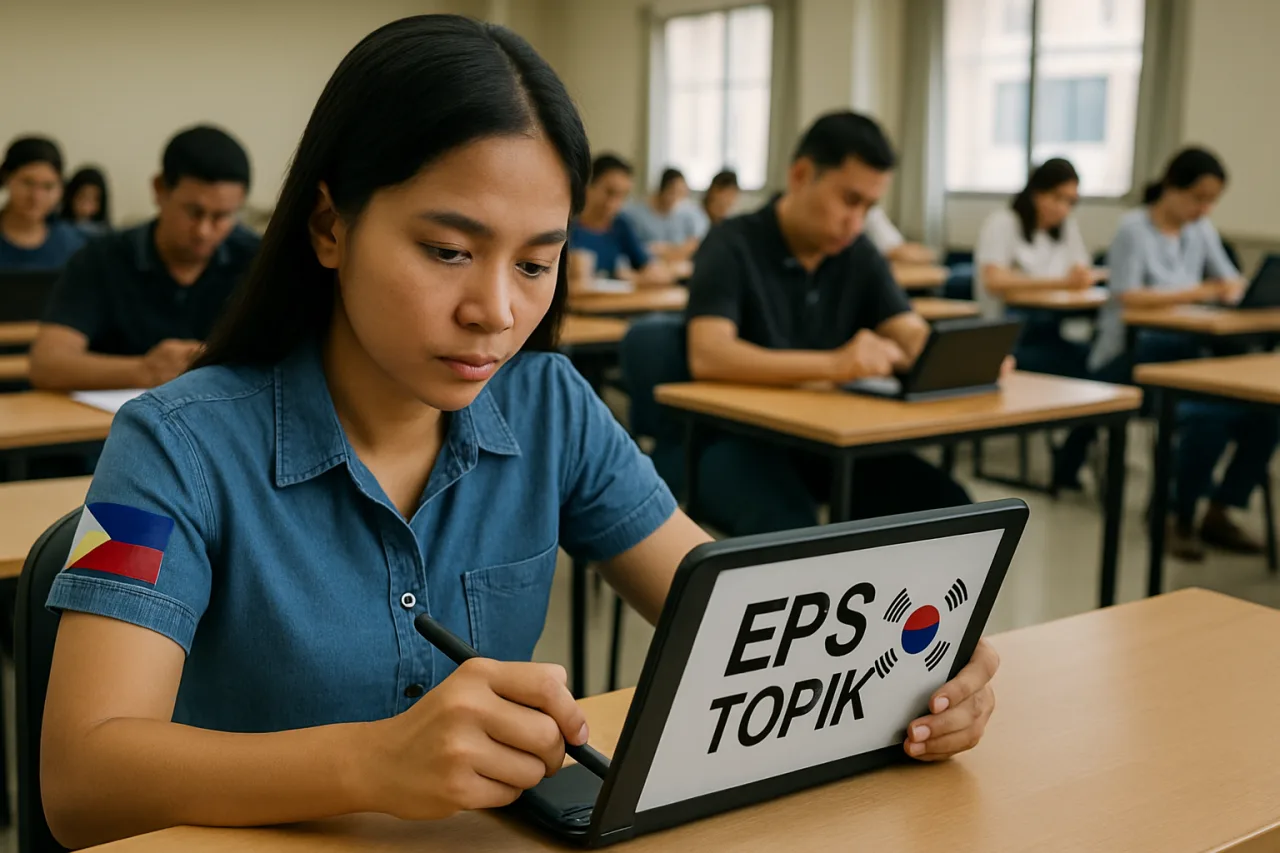
The exam is 40 multiple-choice questions in 50 minutes — 20 reading questions and 20 listening questions, 25 minutes each — for a perfect score of 100 points. Reading and listening run without a break in a single sitting, followed by the color vision check. Four test sessions run each day, with orientation times at 9:00 AM, 10:30 AM, 1:00 PM, and 2:30 PM depending on your assigned session.
The test venue for the 2026 round is the UBT test venue of the Philippines on the 6th floor of the DMW building at EDSA corner Ortigas Avenue, Mandaluyong City. UBT — Ubiquitous-Based Test — is the tablet-based format; you answer on a device, not a paper sheet, and earphone-delivered listening items play at the center.
The pass-fail logic is different from a school exam, and understanding it is the difference between passing and wasting a slot. The exam does not simply declare everyone above a mark “passed.” It sets a Lowest Score Limit per industry — Manufacturing 60/100, Service 1 45/100, Service 2 45/100 — then ranks everyone above their industry’s floor by score, and keeps only the top 1.1 times the recruitment quota, ties included. A 61 in Manufacturing is a passing floor, not a pass: whether you advance depends on how many applicants scored higher and where the 1.1× cutoff lands. In a round with 8,000 Manufacturing registrants for 1,500 quotas, the practical cutoff sits well above the floor.
That is the single most important strategic fact in this guide, and it reframes the whole preparation question. Your target is not the Lowest Score Limit. Your target is the score that keeps you inside the 1.1× band for your industry — which is why the preparation section below matters for every applicant, not only those worried about the floor.
After You Pass: Round 2, Scoring and the Road to Korea
Applicants who advance face the Skills Test on November 28–29, 2026, combined with the Job Capacity Assessment. The Skills Test measures physical fitness — hand strength and back strength — plus an interview and basic skills testing. Anyone who scores below 60 percent of the perfect score on the Skills Test is screened out regardless of their Round-1 result.
The final selection score combines the two rounds: 100 points from Round 1, 100 points from Round 2, up to 200 total. The Job Capacity Assessment adds a handful of additional points for verified merit — work experience on record, training experience, the equivalent of a junior college diploma or higher, and national qualification certificates — evaluated in three stages: document review by the sending agency, authenticity checks in the interview, and information reconfirmation with HRDK and the sending agency.
Final successful candidates are announced on December 9, 2026, selected on combined round scores while excluding those with color vision deficiency. What follows is the familiar overseas-employment sequence: medical screening, employer matching, contract, and departure processing. Two of our field guides cover that end of the pipeline — the OFW Pass that replaced the OEC, and the country-by-country contract verification map — and both are linked below.
One caution from the false-documents rule applies doubly in Round 2, because that round is where certificates and experience records are reviewed at three verification stages. A padded training certificate is not a fast-track; it is a four-year ban discovered at the worst possible moment.
How to Pass the EPS TOPIK Exam: Preparation That Fits the Format
Korea’s Human Resources Development Service publishes the standard exam textbook and practice materials free on its official site, and DMW’s portal links the same study resources for Filipino applicants. The textbook is built for exactly the exam’s two sections — workplace listening and everyday reading — so an applicant who works through the official book is studying for the precise shape of the test, not a generic Korean course.
A preparation plan that fits the exam structure:
- Weeks 1–2: Hangul and listening foundations. The reading section is text; the listening section is audio. Both begin with Hangul. The official textbook’s first units plus recorded vocabulary build both at once.
- Weeks 3–6: The official textbook, unit by unit. Work through the standard curriculum, then the practice test bank, keeping a running score log per section.
- Weeks 7–10: Timed full mock exams. Run the 20+20 format under the real clock — 25 minutes per section, no break — and score against the industry floor plus a margin.
- Ongoing: Session-day logistics. Know your venue (DMW Mandaluyong for the 2026 round), your session’s orientation time, and the document set — test application slip, passport as ID, competency documents in copy.
The advisory’s own instruction to “register only if you are ready” pairs with the capped-slot reality: preparation should be finished before the registration window opens, not after. Applicants who enter registration at a target comfortably above the floor — the textbook’s full practice bank scoring 70+ in Manufacturing terms, or 55+ for service candidates — walk into Round 1 with real margin, because the advancing band is a ranking, not a wall.
What Happens to the EPS TOPIK Exam After 2026
The point-based selection system is the new standing structure for Korean recruitment — MOEL and DMW announced it as a system, not a one-off. The 11th round’s dates will recur in later rounds with industry-specific quotas, and the “Special EPS-TOPIK” announcements DMW published in March 2026 show the system also runs special registrations outside the regular cycle.
For an evergreen read of the pipeline: the eligibility window moves forward about a year per round (the 2026 window was born September 20, 1987 to September 19, 2008), the registration fee has held at US$24 for this round, and the Lowest Score Limits are set per round by industry demand — Manufacturing higher, service industries lower. None of these parameters is permanent; every round’s authoritative source is the DMW EPS portal and its advisory list, which is where the next registration window will appear first.
The practical calendar for watchers: Round-1 results on November 13, 2026 will show the advancing scores, and the December 9 final list will show how many of the 1,650 quotas filled. Those two documents are also the best free forecasting data for the next round — they reveal score distributions per industry — and we will publish the analysis pieces when they land.
Frequently Asked Questions
What is the EPS TOPIK exam?
It is the Korean-language proficiency test for Filipinos applying to work in South Korea under the Employment Permit System. It is Round 1 of Korea’s point-based selection system: 20 reading questions and 20 listening questions, 40 multiple-choice items in 50 minutes, scored out of 100, with per-industry Lowest Score Limits set each round.
How much is the EPS TOPIK exam fee?
The application fee for the 2026 round is US$24, paid in its peso equivalent by card through the DMW registration portal, plus a Maya convenience fee. The fee is refunded to applicants who withdraw within the submission period, but a withdrawn application cannot be refiled.
How do I register for the EPS TOPIK exam?
Registration happens on DMW’s official portal at eps.dmw.gov.ph when a round opens, within your industry’s capped registration window. You fill the online application form, upload a recent 3.5 × 4.5 cm white-background ID photo under 13 KB and a passport scan under 90 KB, pay by card, and secure your test application number. One application per applicant only.
How to pass the EPS TOPIK exam?
Clear your industry’s Lowest Score Limit and rank inside the top 1.1 times the quota — 60/100 for Manufacturing and 45/100 for Service 1 and 2 in the 2026 round. Preparation is the real differentiator: the official HRDK textbook and practice tests cover the exact exam sections, and timed mock runs in the 25-minute-per-section format build the pacing the real session demands.
How to check EPS TOPIK exam results?
Round-1 results are announced on the sending agency’s website and the official EPS TOPIK website at epstopik.hrdkorea.or.kr. For the 2026 round, the announcement date is November 13, 2026; test schedule announcements per applicant came through the same channels on September 30, 2026.
Can OFWs who already worked in Korea apply again?
Only if they did not stay five years or longer under an E-9 or E-10 visa — six years in extension cases. Applicants with a shorter prior stay can register for a new round; those who served the maximum years are ineligible. A deportation record from South Korea is also a disqualifier in any case.
What happens after passing the EPS TOPIK exam?
Round-1 passers take the Skills Test — physical fitness, interview, and basic skills — then final selection combines both rounds’ scores up to 200 points, with small Job Capacity Assessment bonuses for verified experience, training and qualifications. Final passers then move to medical screening, employer matching, and departure processing for Korea.
Filipino Workers, Korea’s Work Route, and the Bigger Picture
South Korea remains one of the strongest destinations in the E-9 system for Filipino workers, and the salary math behind it is already documented in our OFW Korea guide. The exam is the entry point to that system, and its 2026 round shows how tight the pipeline has become: capped registration, a ranking-based cut, and a two-round combined score. Workers weighing Korea against other destinations should also read our fourth-round E-9 analysis for deployment numbers, and our OFW deployment overview for the full processing map.
Every figure in this guide traces to EPS-TOPIK Advisory No. 4, series of 2026, and the official registration portal, both published by DMW. Bookmark the DMW advisory page, prepare before registration opens, and treat the next EPS TOPIK exam window like the competition it is — because with nine thousand seats for one thousand six hundred fifty jobs, the exam is not a formality. It is the filter.