Key Takeaway
- 🇰🇷 South Korea’s fourth-round E-9 employer application window runs September 14-29, 2026 for 12,357 new foreign workers.
- 🏭 Manufacturing dominates with 9,020 slots — down 31% from last year; agriculture 1,906, fisheries 897, construction 394, services 140.
- 📉 Korea cut its 2026 foreign-worker intake to roughly 80,000 from 130,000 — the door is narrowing, and competition per slot is rising.
- 🧾 The Filipino action this month: DMW opened online EPS-TOPIK registration under the 11th EPS Point System Recruitment on September 16 — the exam gate that decides next year’s roster.
- 🏗️ New construction-sector rules let E-9 workers move between qualifying sites, widening options for those already in the system.
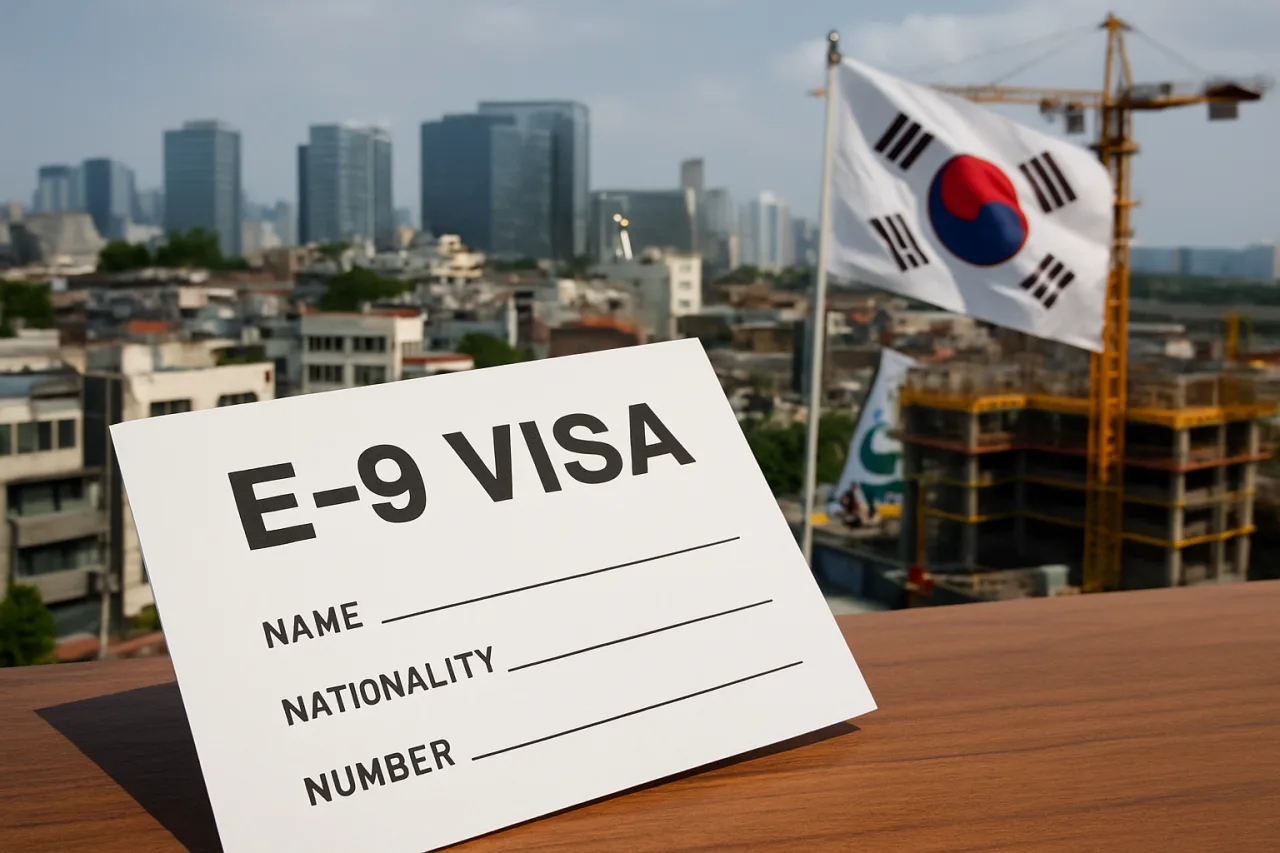
Korea E-9 visa plans changed this month, and most of the change is contraction. Korea’s Ministry of Employment and Labor opened the fourth round of 2026 E-9 visa employer applications on September 14 — the window closes September 29 — with 12,357 new employment permits on the table.
That is a real door still open for Filipino workers.
But inside the announcement sits the trend that should reshape how every aspirant plans: the manufacturing allocation of 9,020 is down 30.9% from the same round last year, and the government has trimmed the year’s total intake from roughly 130,000 to about 80,000 — the post-pandemic demand surge, officials say, has settled.
Table of Contents
What the Fourth Round Offers, Sector by Sector
The Ministry of Employment and Labor’s fourth allocation divides 12,357 permits across five sectors, and the distribution tells applicants where the demand actually sits. Manufacturing takes 9,020 — still the overwhelming share, feeding the small and mid-sized factories of Gwangju, Ansan, and the industrial belt that cannot fill shifts with local hires.
Agriculture and livestock gets 1,906, fisheries 897, construction 394, and services 140. The employer-side window runs from September 14 to 29 through regional employment labor offices nationwide: Korean SMEs declare vacancies they cannot fill, and the matching process pulls from the EPS-TOPIK passer roster — the list your registration feeds.
For Filipinos, the practical reading is arithmetic. Manufacturing remains four-fifths of the market — factory work remains the volume play. But the same report that documents the 9,020 allocation notes the decline from the prior year, and services — the sector many Filipino applicants prefer for English-friendly environments — remains the thinnest slice at 140.
Applicants who target by sector statistics rather than by hope will aim where the slots are and where the competition math works in their favor.
Why the Quota Shrunk — and What It Means for Applicants
Context first: Korea hosted a record 287,424 E-9 workers as of this year — the population the Employment Permit System was built to regulate has grown to a size the government now manages more tightly.
The 2026 plan trims the annual intake to about 80,000, and the fourth-round manufacturing allocation dropping nearly a third signals where the tightening bites.
Korean officials frame the cut as demand stabilization — the post-COVID labor shortage has eased — while SME associations in manufacturing warn the reduction leaves them begging for labor; both things are true, and they are the applicant’s opportunity and warning in one.
Tighter supply means the competition inside the Philippines sharpens: fewer slots per EPS-TOPIK round, longer waits between the exam passer list and the employer match, and more weight on test performance. The response is not discouragement — it is earlier, better-prepared registration.
The roster of passers is what employers draw from; a passer with a strong score sits at the top of the stack every time an SME declares a vacancy.
The Philippine Side: the DMW Registration Move This Week
Two Philippine-side actions matter this month, and both come from the Department of Migrant Workers. First, the DMW posted the advisory that online EPS-TOPIK registration is open under the 11th EPS Point System Recruitment — announced September 16, 2026 — the exam that gates the E-9 roster.
The registration portal is eps.dmw.gov.ph, the same official channel that ran the March special-EPS-TOPIK round (registration then was 24 USD for the special exam; check the current advisory for the general-recruitment fee and the capped applicant count — earlier rounds filled within days).
Second, registration is deliberately not a lottery ticket — the DMW’s standing guidance is to register only when genuinely exam-ready, because the point system ranks passers and a weak score buries an applicant in the roster no matter how many rounds open.
The honest sequence for a Filipino nurse’s aide or factory aspirant eyeing the E-9 track: study Korean to working proficiency, register in the current 11th-recruitment window, test on the announced CBT date, and enter the employer-matching pool with a score that survives the narrower quota.
The New Construction Rules
One reform in this round affects workers already in Korea: construction-sector E-9 holders may now move between qualifying construction sites under expanded employment rules — a flexibility the sector lacked when a single project’s end could strand a permit.
For Filipinos in the E-9 construction cohort, that mobility converts a rigid one-employer structure into something closer to a career track; for applicants, it slightly widens the value of targeting a sector whose in-country movement just improved.
The service sector, by contrast, added only 140 permits this round — the smallest allocation, and a sign that the easing everyone hopes for is not yet in the data.
The Wage Reality: What an E-9 Contract Actually Pays
The E-9 conversation should start with honest arithmetic, because the rumor mill inflates it.
Korea’s minimum-wage framework and standard EPS contracts put realistic annual earnings for a full-time non-professional worker in the range that Filipino returnees consistently report — commonly cited around the ₱1 million class for first-contract workers, stretching toward ₱1.5-1.8 million with overtime-heavy placements in manufacturing.
The draw is threefold: wages that dwarf Metro Manila equivalents, government-to-government protection that eliminates placement fees (the program charges no placement fee — anyone demanding one is defrauding you), and a three-year renewable structure with in-country progression.
Against a manufacturing slot that just shrank 31%, the value of a prepared, high-scoring application rises — scarcity rewards the prepared, in Korea as everywhere.
The cost side deserves the same honesty. Korean placement cities run expensive — a sharehouse room in Ansan runs hundreds of thousands of won monthly; remittance discipline decides whether the Korean salary builds anything.
The OFW households that win in Korea treat the contract as a savings engine with a defined term, not a lifestyle upgrade — and the new construction-site mobility rules, by letting workers follow better-paying qualifying sites, add one more lever to that engine.
The Scam Shield: What the E-9 Route Is Not
Every quota announcement revives the parallel industry of fake EPS recruiters, and the tightening makes their pitch more tempting: “reserved slots,” “guaranteed passing,” “direct employer contracts.” Every one of those phrases is a fraud signature.
The Employment Permit System has exactly one legitimate architecture: register through eps.dmw.gov.ph, take the EPS-TOPIK administered under HRD Korea’s system, match with employers through the government process, and pay no placement fee at any stage — the program is government-to-government precisely so that no private fee can stand between worker and contract.
The DMW publishes its advisories on its own site; a “registration link” from a Facebook page that is not the DMW portal is the scam, in its entirety.
The same shield covers the in-country move: an E-9 worker invited to “transfer to a better site” for a recruiter’s fee should verify the movement against the new construction rules and the employer’s contract — legitimate transfers run through the system, not through a broker’s envelope.
Korea’s 287,000-strong E-9 population includes thousands of Filipinos whose contracts, safety training, and grievance channels all run through the government process; the ones who stumble are almost always the ones who stepped outside it.
The Timeline That Decides Your 2027
Map the months. September 14-29: Korean employers apply for the fourth-round allocation. September 16 onward: DMW opens the 11th EPS-TOPIK registration window.
The exam runs as a computer-based test (CBT) on dates HRD Korea announces per country — the Philippines’ test-date line currently reads “undecided” on the schedule page, which means registration now, exam-date announcement later, and results feeding the matching pool that the next employer rounds pull from.
New E-9 workers admitted from the earlier rounds began entering in January 2026 after full procedures; the same rhythm puts a successful 11th-round applicant on a worksite in 2027.
The registration fee and capped applicant counts from previous rounds (7,500 applicants in one 2025 window, 24 USD for the special track) are the pattern to expect — windows are short and capacity-bound, so the account setup should not wait for the announcement.
Between Korea and Japan: Choosing the Right Door
Filipino workers who target East Asia generally weigh two doors, and this month both changed. Japan raised the cost of staying — residence fees jumped October 1 — but the work itself continues across a broad industrial base, and the specified-skilled-worker and engineer tracks keep admitting.
Korea narrowed the number of new doors while making the ones that remain more movable — lower quotas, but site mobility for construction E-9 holders and a record resident population that proves the system works.
The choice between them is a household decision as much as a labor-market one: Japan prices permanence (the PR track now costs ¥200,000 but converts into near-permanent security), Korea prices competition (fewer slots, but zero placement fees and tight government protection).
Neither door has an agent waiting to open it faster — that is the one constant.
What the data says about who should apply where is simpler than the group-chat wisdom. Workers with Korean-language preparation have no substitute for the EPS-TOPIK route — the language test is the gate, and this month’s registration window is the queue for it.
Workers with Japanese ability or carework credentials hold a Japan-side advantage that no Korean quota can offset. The mistake is not choosing wrong; it is waiting for the perfect round while both doors narrow.
The fourth-round numbers say Korea’s door is still open — 12,357 slots open this fortnight — and the registration page is the cheapest ticket to finding out whether your name fits through it.
Frequently Asked Questions
What is the E-9 visa?
Korea’s Employment Permit System visa for non-professional workers — a government-to-government program; for Filipinos the only legitimate route runs through the DMW’s EPS process and the EPS-TOPIK exam.
How many workers does the fourth 2026 round take?
12,357 new workers: manufacturing 9,020, agriculture and livestock 1,906, fisheries 897, construction 394, services 140.
When can employers apply?
September 14 to 29, 2026, through regional employment labor offices in Korea — the employer side of the matching.
What should Filipino applicants do this month?
Watch the DMW’s EPS Korea advisories — the 11th EPS Point System online registration opened September 16 — and register on eps.dmw.gov.ph only when exam-ready; the roster feeds the employer matching.
Why did the quota drop?
Korea cut 2026 intake from ~130,000 to ~80,000 as post-pandemic labor demand settled; manufacturing’s fourth-round allocation fell 31% year on year.
Can an E-9 worker change workplaces in construction now?
Yes — new construction-sector rules allow movement between qualifying sites, easing the lock-in that previously tied a permit to one project.
Do I need Korean language ability before registering?
The EPS-TOPIK exam tests exactly that — Korean listening and reading at working level — and registration is recommended only when you are prepared; the point system rewards scores, and the tighter quota makes weak scores expensive in waiting time.
How much does the EPS-TOPIK registration cost?
Previous rounds set the registration at 24 USD for the special track; confirm the current advisory on the DMW portal before paying, and never pay anyone who promises a slot — the roster has exactly one legitimate door.
Financial Disclaimer: This article is for general information only and is not professional financial advice. Wage figures vary by contract, sector, and overtime; verify current program rules with the DMW and HRD Korea before acting.