Table of Contents
Key Takeaway
- 🔍 Verdict first: a deepfake detector Philippines professionals can rely on is not one app — it is five working tools (McAfee Deepfake Detector, Hive Detect, Sensity AI, Resemble AI Detect, and the free Deepware/EyeSift layer) plus one workflow that never trusts a single score.
- 📊 The threat is measured, not hypothetical: BSP put 2024 cyber losses in supervised institutions at ₱5.82 billion, and the AMLC now runs a standing advisory on deepfake-driven investment scams — with hotlines to verify any “celebrity endorsement” at SEC (02) 8818-1898 and BSP (02) 8811-1277.
- 💸 It already happened: a Tarlac dentist handed over ₱93 million to a deepfake “endorsement” video; the SEC separately flagged a wave of fake Vico Sotto investment clips in June 2026.
- 🧪 The 60-second scam test exists: provenance check → browser-side triage → one dedicated scan → human tells → verify the OFFER (not the face) with the regulators. Five steps, no paid enterprise stack required.
- 🚫 Three approaches fail the scammer’s test: vendor-owned accuracy claims, single-score verdicts, and the old rule that “a video call proves identity” — the CICC itself now says a call no longer settles it.
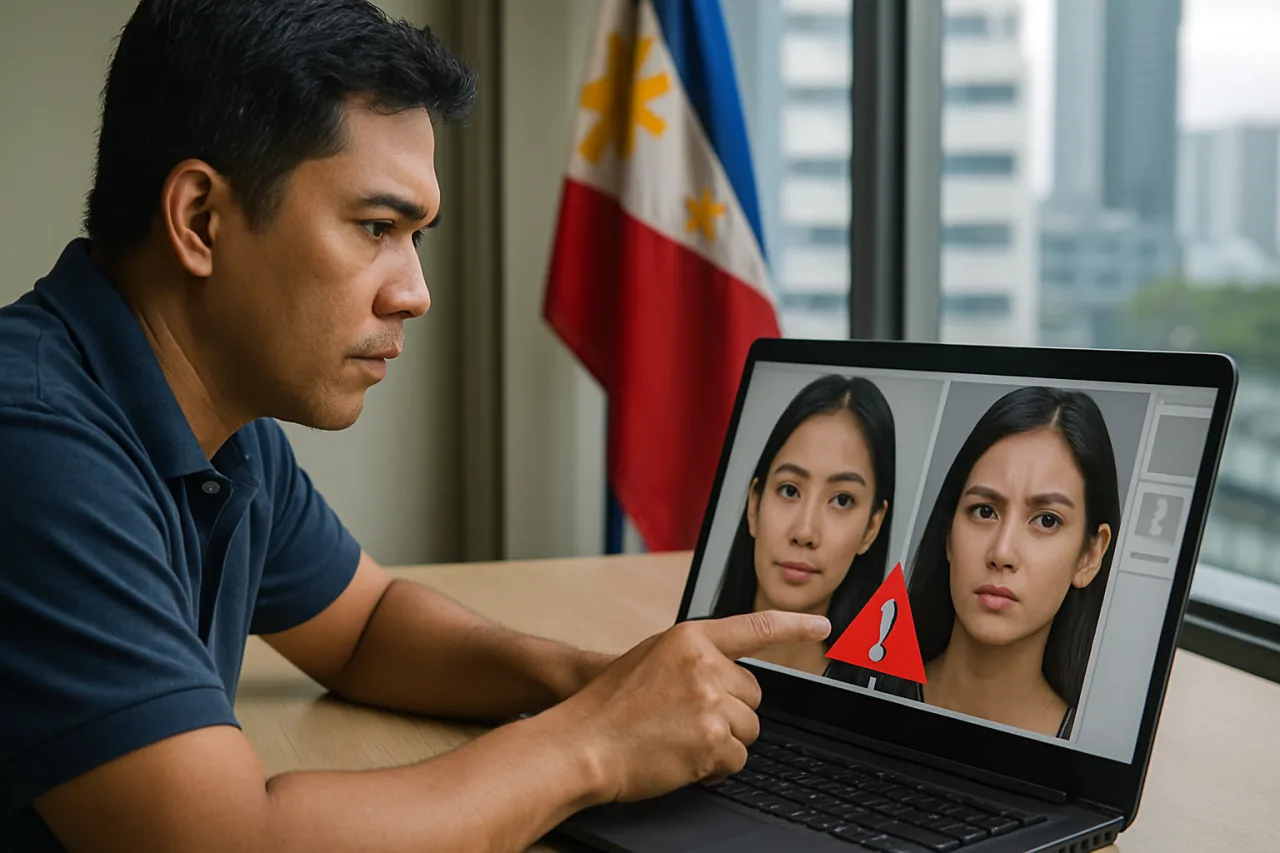
Every deepfake detector Philippines search this month is being run by someone who just watched a video of a familiar face ask for money — a president endorsing an investment, a mayor promising fixed returns, a boss texting from a new number. This guide ranks what actually works, shows the three approaches that fail, and gives you the scam check you can run before any peso moves.
Why Deepfake Detection Suddenly Matters in the Philippines
The Philippine scam economy already ran on text blasts, fake investment groups, and cloned e-wallet pages. What changed in 2026 is that the video — long the one channel you could trust — flipped sides. In the case police point to most often, a dentist in Tarlac handed about ₱93 million to people connected to an investment pitch backed by a video of President Ferdinand Marcos Jr. endorsing it. The face and voice were convincing enough to survive her judgment for months. Two suspects were later arrested in Angeles City, Pampanga. The timeline and figures come from the Manila Times deepfake reporting (October 2026). Nothing in that video was real, and nothing about it was exotic — it was built with consumer-grade AI. That single case is why every deepfake detector Philippines search now ends on a page like this one, and why tool choice has become a family decision.
The regulators stopped assuming awareness would save anyone. The Anti-Money Laundering Council (AMLC) issued a standing advisory warning that deepfake videos and voice recordings of “well-known personalities, CEOs, or influencers” now endorse fake investment schemes, and told the public to stop treating any video as proof of legitimacy. The Securities and Exchange Commission (SEC) followed with its own alert in June 2026 after a surge of fabricated Vico Sotto investment videos. The Cybercrime Investigation and Coordinating Center (CICC) — the agency you would expect to defend video calls — said the quiet part out loud: a video call no longer settles the question of whether you are talking to the real person.
And the money at stake is not trivia: Bangko Sentral ng Pilipinas Deputy Governor Chuchi Fonacier reported cyber losses across supervised institutions at ₱5.82 billion in 2024 — up from ₱5.67 billion the year before — with AI-driven “identity takeover through deepfake technology” named among the top risks. If you want one sentence that explains why the old reflexes no longer protect anyone: the scam arrived, the video lied, and the detectors finally matter.
The 5 Deepfake Detector Tools That Pass a Scammer’s Test (Philippines)
“Passing” means a tool survives contact with how Filipinos actually get scammed: compressed Viber clips, re-encoded reels, bank video calls, and voice notes that arrive after a text blast. These five earn their place on the deepfake detector Philippines test — the one that matters when real money moves:
1. McAfee Deepfake Detector — the consumer shield
Bundled into McAfee’s consumer security lineup since 2024, McAfee Deepfake Detector was the first mainstream antivirus vendor to put AI-video flagging where normal people already look: inside the scanner they already run. It watches for AI-generated indicators in video shared across apps and flags suspicious clips before you engage. For families whose scam exposure starts with a forwarded video, this is the lowest-friction first line — it works where they already are.
2. Hive Detect — the enterprise-grade workhorse
Hive’s Detect API is what platforms and verification teams reach for when volume matters: image and video classification tuned for AI-generated and face-swapped content, with per-frame scoring at production speed. It is not free, and it is not for one personal video — but when a newsroom, a bank’s fraud team, or a verification desk needs to process batches of suspect clips, Hive is a legitimate first call, and its models update continuously against new generators.
3. Sensity AI — the visual deepfake specialist
Sensity built its name on visual deepfake intelligence: face-swap detection, generative-model attribution, and monitoring across platforms. Its accuracy figures are self-reported, which the honest buying guide treats as a caveat rather than a disqualifier — but its decade-long focus on synthetic-media forensics puts it in the passing set for organizations that need investigation-grade visual analysis rather than a consumer shield.
4. Resemble AI Detect — the independently benchmarked audio leader
Voice is where the Philippines’ scam losses are quietly concentrated, and Resemble AI’s Detect engine is the only consumer-auditable claim in its field: on Podonos, the independent audio deepfake benchmark with private labels, it scored 98.05% accuracy with a 1.4% false-negative rate on two consecutive runs — roughly one missed deepfake per seventy. A free Chrome extension brings spot-check capability to the browser. When a “president” or a “senior manager” leaves a voice note asking for money, this is the class of tool that answers with evidence.
5. Deepware Scanner and EyeSift — the free layer that catches the obvious
Two free tools anchor the consumer floor. Deepware Scanner uploads a clip or URL and runs a dedicated deepfake scan against face-manipulation models — with the honest caveat that heavily re-encoded platform video degrades accuracy. EyeSift’s video detector takes the opposite, privacy-safe path: it never uploads the file, screening container metadata, bitrate patterns, frame characteristics, and encoding signatures entirely in the browser, and reports a triage score with explicit reliability labels. Between them, the forwarded-at-midnight Viber clip gets a real second opinion before anyone sends money — the free deepfake detector Philippines layer doing exactly its job.
The 3 Approaches That Fail a Scammer’s Test
Fail 1 — Trusting vendor-owned accuracy claims
“99% accuracy” on a vendor’s website usually means 99% on the vendor’s own test set — the failure the benchmark vendors themselves admit. Resemble’s own comparison page concedes that most accuracy claims “cluster around 99 percent and are computed on test sets the vendor controls, which makes them incomparable.” The honest buying rule: independent third-party benchmarks or nothing. One independent audio benchmark with private labels exists as of 2026; claims computed at home do not pass.
Fail 2 — Believing a single score
No single detector — free or paid — is a verdict. Even the best models carry false-negative rates around 1-4%, and scam-grade re-encoding strips exactly the artifacts they look for. The newsroom standard for contested footage is origin, context, and multi-signal review; the family standard should be no lower. A deepfake detector Philippines tool that answers with one number and no explanation is a triage input, not an answer.
Fail 3 — The video call as identity proof
This is the one that hurts, because “just video call me” used to be the safety advice. The CICC has publicly said a video call no longer settles whether the person on screen is real — cloned faces now answer calls. Every playbook that still lists a video call as the final verification step for money movements is training victims. The replacement is below: verify the transaction with institutions, not the face with your eyes.
The 60-Second Deepfake Scam Test for Filipinos
Run this before any video, voice note, or call triggers a payment:
- Seconds 0-15 — check the provenance. Where did the clip originate? Official pages and C2PA Content Credentials beat forwarded files. No origin, no trust.
- Seconds 15-30 — run the free triage. EyeSift in-browser screen (privacy-safe), then Deepware’s scan on the file or URL. These catch the crude 80%.
- Seconds 30-40 — check the human tells. Unusual blink patterns, lighting that does not match the background, lip-sync drift after the first second, fingers and jewelry that blur, and audio that lacks room echo. AI still fails at physics.
- Seconds 40-50 — verify the OFFER, not the face. Investment “endorsements” go to the SEC at (02) 8818-1898 and banking concerns to BSP at (02) 8811-1277 — the AMLC’s own hotlines. A real celebrity endorsement is verifiable because real institutions register such offers; a fake one dies on this call.
- Seconds 50-60 — apply the money law. The Anti-Financial Account Scamming Act (RA 12010) and BSP Circular 1213 (live since June 25, 2026) shifted liability: banks and e-wallets can no longer clear high-risk transactions on an OTP alone. An urgent, unusual transfer demand that pressures you around these controls is itself the scam signal.
Filipinos who live in the text-scam lanes know the companion playbook well — the Viber scam defense guide covers the message half, the Philippines cybersecurity guide for OFWs covers the household baseline, and the scam-awareness companion piece lives at AI deepfake scams in the Philippines. This page is the detector half.
Deepfake Attack Statistics Every Filipino Household Should Know
The numbers behind the warnings, as reported by Philippine institutions and detection vendors: BSP pegged cyber losses in supervised institutions at ₱5.82 billion for 2024. Pindrop’s fraud intelligence estimates that roughly 3 in 10 retail fraud attempts are now AI-generated, with financial services absorbing the largest share of deepfake contact. The AMLC advisory describes deepfake endorsements as an active investment-scam vector, not a forecast. Behind every statistic sits the same mechanism the Tarlac case made famous: a familiar face, an urgent request, and a payment channel that trusted video too much.
Deepfakes and Philippine Law: What Applies Today
Detection is a consumer problem; consequences are a legal one — and the deepfake detector Philippines strategy now includes knowing which instruments moved in 2026. RA 12010, the Anti-Financial Account Scamming Act signed in 2024, gives the BSP power to investigate scam-linked accounts — the tool regulators use when deepfake-driven money moves. BSP Circular 1213, effective June 25, 2026, bans high-risk transaction approvals on a bare OTP and requires real-time fraud monitoring at covered banks and e-wallets — shrinking the window deepfake social engineering exploits. And in Congress, House Bill No. 3214, the proposed Deepfake Regulation Act, would criminalize malicious synthetic media with imprisonment and fines starting at ₱50,000 — it remains a pending bill, so until it passes, existing fraud and cybercrime instruments carry the enforcement load. Reporting routes run through the SEC, BSP, and the CICC.
Frequently Asked Questions About Deepfake Detector Philippines
What is the best deepfake detector Philippines users can get in 2026?
There is no single “best” — there is a working stack. For households: McAfee Deepfake Detector where already installed, plus free Deepware and EyeSift triage for forwarded clips. For teams: Hive Detect for volume, Sensity AI for visual forensics, and Resemble AI Detect for audio, the only major engine independently benchmarked at 98.05% accuracy. The stack beats any single pick because scam-grade attacks are engineered to defeat exactly one detector at a time.
Is there a free deepfake detector that actually works?
Yes — with honest limits. EyeSift’s browser-side detector never uploads your file and surfaces container and encoding anomalies; Deepware Scanner runs a dedicated deepfake scan on clips and URLs; Resemble AI offers a free Chrome extension for quick voice checks. Free tools are triage, not verdicts — treat their scores as reasons to slow down, not reasons to feel safe.
Are deepfakes illegal in the Philippines?
Malicious use already falls under fraud and cybercrime law, and the financial enforcement tools are active: RA 12010 lets the BSP follow scam-linked accounts, and the AMLC has issued formal deepfake advisories. A dedicated Deepfake Regulation Act (HB 3214) is pending in Congress and would add specific criminal penalties starting at ₱50,000 in fines plus imprisonment. Until it passes, detection-plus-reporting is the practical shield.
Can video calls still prove someone’s identity?
No. The CICC itself now says a video call no longer settles the question — cloned faces and voices answer calls. The working replacement: verify the transaction through official channels (SEC and BSP hotlines for investment offers), use institution-controlled callbacks, and treat any video-call “clearance” for money movement as unverified.
Where do I report a deepfake scam in the Philippines?
Investment-scheme endorsements: the SEC at (02) 8818-1898. Banking and e-money fraud: the BSP at (02) 8811-1277. The AMLC advisory also directs deepfake-scam reports to these agencies for investigation — and preservation matters: keep the original file, the sender’s number, and the payment trail before reporting.
Do banks check for deepfakes now?
Increasingly, yes — because the rules changed. Since June 25, 2026, BSP Circular 1213 forbids covered banks and e-wallets from approving high-risk transactions on a bare OTP and requires real-time fraud monitoring. Call centers layer voice-liveness scoring on top. But institutional checks are backstops, not substitutes — the first sixty seconds of your scam test remain yours to run.
The Deepfake Detector Philippines Checklist, Recapped
- Five tools pass: McAfee Deepfake Detector, Hive Detect, Sensity AI, Resemble AI Detect, and the free Deepware/EyeSift layer.
- Three approaches fail: vendor-owned accuracy claims, single-score verdicts, video calls as identity proof.
- The 60-second test: provenance → free triage → human tells → verify the offer with SEC (02) 8818-1898 or BSP (02) 8811-1277 → apply the money law.
- The threat is quantified: ₱5.82 billion in 2024 cyber losses, a ₱93-million deepfake endorsement case, and an active AMLC advisory.
- Report early, preserve the evidence, and never let urgency outrun the hotline call.