Table of Contents
Key Takeaway
- Ledger confirmed an unauthorized ledger implant in at least one device sold through Southeast Asian reseller CryptoBilis — a reseller listed for Indonesia, Malaysia and the Philippines.
- On-chain researchers estimate $86 million to $93 million drained from more than 300 wallets across Bitcoin, Ethereum and Tron following the ledger implant disclosures; Ledger has not confirmed the totals.
- The implant design reconstructed recovery phrases from the screen’s own data lines and transmitted them over an eSIM — a genuine check verifies the secure element, not the circuitry around it.
- The XRP Ledger emergency-patched a 2015-era bug that could have minted roughly 18 trillion XRP in one transaction — found by an AI agent, earning the largest known bounty ever paid for an AI-discovered vulnerability.
- Holder rule unchanged after the ledger implant week: never initialize a pre-set-up device, and rotate the signer and the seed together if the device came from an untrusted chain of custody.
The Ledger Implant: What Ledger Confirmed, and What It Has Not
The week’s defining security story is not a smart-contract exploit. It is a chip. On October 9, Ledger’s support account opened an investigation into missing funds reported by customers in Southeast Asia who bought devices from CryptoBilis, a reseller Ledger’s own directory listed as authorized in Indonesia, Malaysia and, as CryptoBilis PH, the Philippines. The company asked the reseller to pause all sales and shipments, told anyone who bought in the previous 90 days not to initialize an unused device, and told active users to consider moving assets to a new signer with a new seed. On October 10 the story hardened: Ledger confirmed that one impacted user’s device contained an unauthorized hardware implant.
That single sentence reframes the entire hardware wallet threat model. The attacks buyers train on — phishing, host malware, a fake app — all assume the device itself is honest. The confirmed ledger implant removes that assumption. Ledger says all confirmed cases involve CryptoBilis-sold devices, that its internal systems and direct sales channels were not compromised, and that it is cooperating with authorities and the SEAL 911 incident response group. What Ledger has not confirmed: how many ledger implant units circulated, the exact stage where the implant entered the supply chain, and any official loss figure.
The loss numbers in circulation come from third parties. Pseudonymous on-chain researcher Specter published addresses tied to reported drains; Bitquery’s tracking puts the damage at roughly $92.9 million across 311 wallets spanning TRON, Bitcoin, Ethereum, BNB Chain and Polygon. Independent estimates cluster from $86 million to $94 million. These are preliminary wallet-tracking figures for the ledger implant case, not confirmation — but the pattern Bitquery describes reads like one operator working from a stack of pre-harvested recovery phrases: 25 TRON wallets emptied within three seconds of each other, small test transfers in the weeks before, and a majority of victim wallets first funded from June 2026 onward.
The remediation Ledger issued is blunt, and its wording carries the diagnosis. Do not initialize unused devices from this channel, because a ledger implant harvests the seed at first setup — an unopened tampered unit is a loaded trap. If the device is already in use, move funds to a wallet created with a completely new recovery phrase on trusted hardware. Resetting the suspect device achieves nothing if the words were already transmitted, and restoring the old phrase onto a new device would carry the leak with it. The signer and the seed are one decision.
CryptoBilis and the Philippines: Why the Reseller Chain Matters Here
This is not a distant incident for Filipino readers. CryptoBilis was listed in Ledger’s own reseller directory for the Philippines, alongside Indonesia and Malaysia. The affected distribution channel is one of the paths a Manila or Cebu buyer could reasonably have taken, because authorized reseller status carries implied assurance: the listing said the device came through a legitimate chain. The confirmation that a ledger implant — a physical modification — reached buyers through an authorized-seeming channel is precisely the scenario the directory was supposed to exclude.
The ownership trail adds a worrying layer to the ledger implant investigation. Former CryptoBilis co-founders stated publicly that new owners acquired the company, completing the handover earlier in 2026, that they have had no access to backend systems or customer records since, and that the acquisition agreements delayed any public announcement until mid-October. They named the current person in charge; no public evidence ties the new owners to the implants, and neither Ledger nor the investigators has established who installed them, or where.
Binance co-founder Changpeng Zhao alleged publicly that the attackers effectively bought the reseller and had it sign a non-disclosure agreement. That claim is unproven — treat it as an allegation, not a finding. What is proven is the sequence: ownership changed, then wallets bought through the channel began draining.
For the practical buyer, the working conclusions are uncomfortable but simple. Authorized-seeming reseller status is not a security guarantee. Marketplace listings, gift purchases and “official reseller” badges on e-commerce platforms all inherit the same unresolved question: who touched this device between the factory and your desk? Filipino buyers of any cold storage device should treat the purchase channel as the first security decision, made before a single peso of crypto is ever loaded. The durable version of that decision lives in our hardware wallet buyer shield guide — this week proved why it exists.
How the Ledger Implant Defeats the Genuine Check
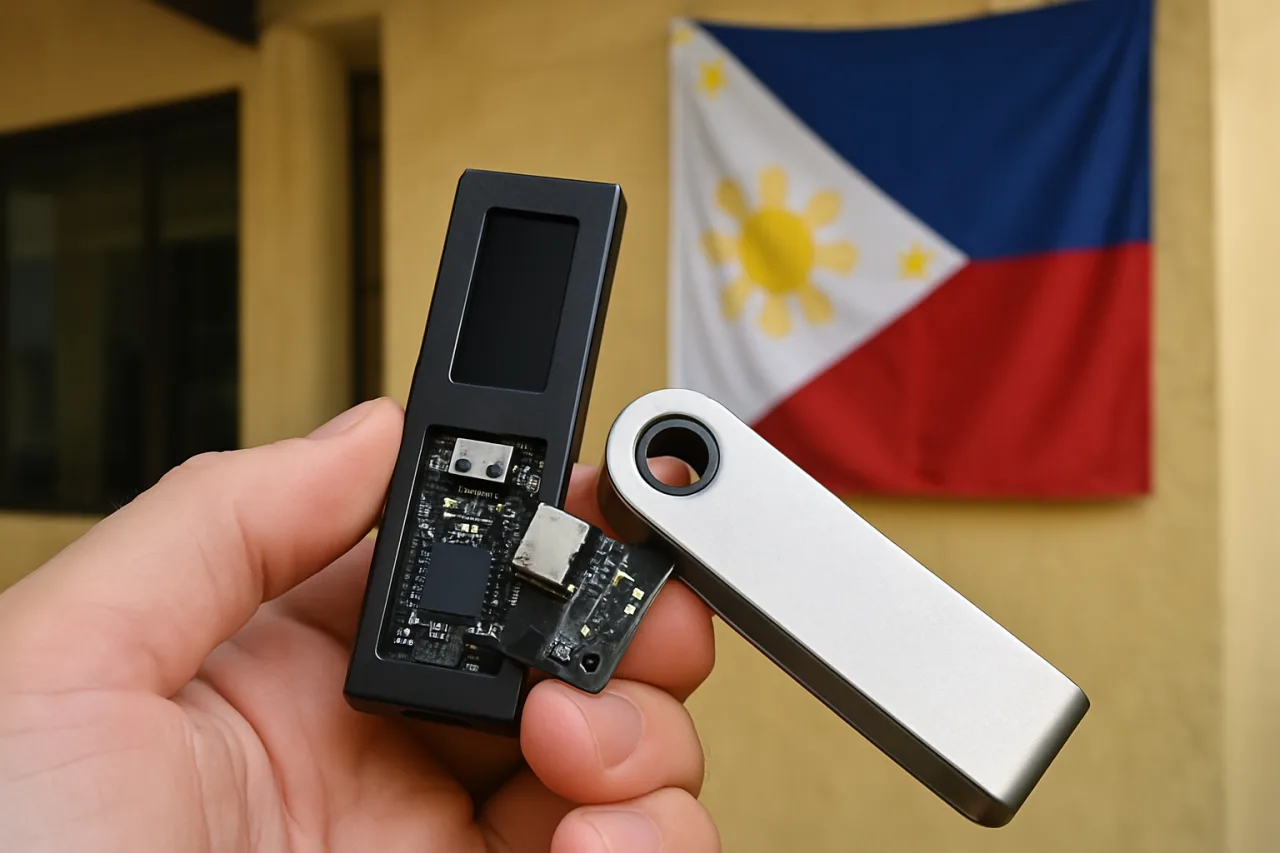
The teardowns published in the aftermath describe hardware that reads like a counterintelligence plot. Research attributed to Tibane Labs documents modified devices carrying extra circuitry on the internal lines that feed the display. When a new owner sets up the wallet, the genuine secure element generates the recovery phrase and sends each word to the screen for display. The ledger implant reconstructs those words from the display data itself, then transmits them through a cellular modem with an eSIM and a custom antenna. Nobody cracks the chip, guesses a PIN or tricks an owner into signing anything. The attacker simply waits for the wallet to be funded, then rebuilds it elsewhere from the stolen words.
The documentation describes three generations of the implant design: an early version with visible wires and a replaced battery, a mid generation on purpose-built flexible circuit boards, and a ledger implant generation three that keeps the original battery while hiding the circuitry beneath the screen. The lab’s specimens came from Japanese marketplaces and it established no link between them and CryptoBilis — the teardown proves the design exists, not that it matches every victim unit.
The reason this works is definitional. Ledger’s own security documentation states that the genuine check verifies the secure element and cannot detect unauthorized physical modifications to the hardware, such as spying implants, when the original chip remains intact, and cannot verify the device’s physical supply chain history. A device can pass every electronic authenticity test and still carry a second, hostile circuit. That is the structural lesson of the ledger implant week: software attestation certifies the chip that was designed, not the board that was delivered.
It also arrives less than two months after Ledger disclosed three software flaws in its Secure SDK and Ethereum apps — bugs that could alter what the screen shows — none exploited, but all pointing at the same trust surface: what a screen displays is not automatically what the secure element decided.
The XRP Ledger Bug: How an AI Agent Found What a Decade of Audits Missed
The same week delivered a second security landmark, software-side this time. RippleX disclosed that the XRP Ledger’s payment engine carried an integer overflow bug dating to 2015 — one that could have minted spendable XRP beyond the network’s fixed 100 billion supply in a single transaction. The mechanism: balances are 64-bit integers, and a payment consuming hundreds of deliberately priced offers could overflow the total, crediting every seller in full while charging the buyer a wrapped, tiny amount. The difference would be XRP that never existed. The supply invariant added in 2017 used the same unchecked arithmetic and overflowed with the very calculation it was auditing — the guard was blind to its own job.
Two details elevate the story from a bug report to a security-history marker. First, the scale: roughly 18 trillion XRP creatable in one transaction, about 184 times the total supply, per Veria Labs co-founder Cayden Liao. Second, the discoverer: an AI agent built by Veria Labs found the bug and produced a working exploit — and Ripple paid the program’s maximum $250,000 bounty, which Liao describes as the largest ever paid out for a vulnerability found entirely by an AI agent.
Liao’s hypothesis on why a decade of audits and more than $1 million in bounties missed it: the exploit chains two bugs that are low-severity individually. An AI that enumerates combinations at machine scale finds what human reviewers walking single paths do not.
There is no evidence the XRP bug was ever exploited on mainnet — RippleX states it found none, and the Foundation says it verified supply across the ledger’s full history at roughly 99.986 billion XRP, slightly under cap because fees burn. Holders take no action; server operators needed version 3.4.1. But the demonstration stands beside the ledger implant case as the week’s paired lesson: hardware and software trust both ran on assumptions no one had tested, and an AI-driven disclosure cycle blew through both.
The Governance Rupture: When Patching Fast Meant Breaking the Rules
The fix itself triggered the second argument. XRP Ledger rule changes normally pass through an amendment process: more than 80 percent of trusted validators supporting for two weeks, with corrected code public from day one. Emergency release 3.4.1 skipped that. Reported September 22, reproduced and rated critical September 23, shipped September 25 — taking effect on each server the moment it upgraded, before its source code was published.
It was the first deliberate bypass of the amendment process in more than ten years. Critics, most prominently Cyber Capital founder Justin Bons, called it two weeks of closed-source operation on a public ledger. RippleX’s answer is the era in one sentence: with AI able to reverse-engineer a patched bug quickly, you cannot sneak a critical fix through a routine public release window anymore.
The Foundation’s defense, posted October 11 and defended again through the week, draws governance boundaries worth noting. The decision was made jointly by the Foundation, RippleX, core developers and validators; every operator still chose whether to install; the release only became mandatory once the fixBatchV1_2 amendment passed the standard vote. Coordination is not control, they argue — independent operators reached the same conclusion without surrendering independence. A patched validator rejecting what an unpatched one accepted risked a brief split; developers judged a stalled network preferable to 18 trillion phantom XRP.
The precedent matters beyond XRP. Every major chain now has an answer to the question this week exposed, first through the ledger implant story and then through the XRP patch: when AI compresses exploit development from months to days, does governance move at validator speed or incident speed? Expect the emergency-release template — assessment, coordinated binary release, retroactive amendment — to become the reference play cited in the next chain incident. Expect the decentralization critique to arrive with it, on schedule.
The Holder Playbook After the Ledger Implant Week
For device holders, the ledger implant playbook is short and mostly mechanical. If you bought any cold storage device from CryptoBilis in the past 90 days: do not initialize an unused unit, and move funds to a new signer with a newly generated seed, on hardware from an unambiguous channel. If you bought from any reseller or marketplace and cannot vouch for the chain of custody: the same rotation logic applies after this week’s evidence, at your next opportunity rather than in a panic.
Never load an old phrase onto new hardware to “check” it — if the words leaked, that check imports the leak. Expect scammers to ride the headlines: no legitimate support agent will ever ask for a recovery phrase, call you, or DM first.
For XRP holders specifically: nothing to do. The supply was never violated, the patch is live, and holders need no step. For validator and node operators on any chain, the week’s lesson is procedural — know your emergency-update path before the emergency. For everyone else, the one-time worth-taking step after a ledger implant disclosure is the audit of your own purchase receipts: where did each device physically pass through between factory and home? An honest answer to that question is worth more than any tamper seal. The step-by-step version of that audit is the hardware wallet buyer shield.
The Remittance-Rail Check: Freeze Powers in the Same Week
The security stories shared the week with a regulatory drumbeat aimed straight at stablecoin rails. The Financial Stability Board published its chair’s letter to G20 finance ministers ahead of the October 15 meeting, covering AI risks in finance and the cross-border vulnerabilities of global stablecoin arrangements. The same G20 window carries an FATF message already on record: stablecoins accounted for 84 percent of illicit virtual-asset transaction volume in 2025, and the FATF urges issuers toward controls including freeze, burn, allowlisting and denylisting. Separately, an IMF analysis put tokenized equities at about $2.3 billion, roughly 1.5 times more volatile than the underlying shares, with over half of trading outside US market hours.
For Filipino and OFW readers the thread runs one line deep and lands on the wallet: every freeze power regulators encourage is a freeze your remittance USDT must survive. The compliant-issuer route — the direction USDT-on-PH-rails already travels after the Coins.ph suspension playbook drew the map — builds those controls in, which is why the rail analysis matters more here than the tokenized-stocks numbers. Our BSP stablecoin 2027 analysis frames the domestic end of that same corridor. The buyer shield is the personal-side hedge; the rail-side story is who can freeze, when, and with what notice — the mechanics are unpacked in what stablecoin payment rails must survive.
The Tape: Calm Prices, Heavy Security News
Markets took the week’s heavy security news with surprising calm. Bitcoin held above $84,000 at its week’s best and trades near $83,600, absorbing ETF outflows without breaking structure; total market capitalization sits near $2.8 trillion with Bitcoin dominance just under 60 percent. Ether and Solana ETFs stayed in the red for October — Ether’s outflow streak reached nine days per The Block’s flow tracking — yet spot prices barely moved, with ETH near $2,550 and SOL near $112.
The privacy trade did the loud moving: Zcash pushed toward $1,310, up 6.7 percent in a day on the AI-and-quantum-threat narrative. The read after a ledger implant disclosure and an AI-found protocol bug: security incidents are being priced as operational, not systemic — until one of them is not. The exchange-custody version of that risk profile is the one we mapped in the Bitget breach analysis, and it behaves differently from self-custody risk.
What to Watch After the Ledger Implant Week
Dated triggers for the coming stretch: France’s National Assembly resumes floor debate on the 2027 budget October 13 — the package includes a proposed declaration requirement for self-custody wallets over 100,000 euros, a stablecoin-conversion tax from January 1, 2027, and an exit tax above 800,000 euros; none is law yet, and the committee-stage revenue section was rejected October 9. The G20 finance ministers meeting lands October 15 with the FSB stablecoin and AI reports tabled.
Strategy set October 29 for its next Bitcoin treasury update. And the XRPL governance follow-up: whether the emergency-release template gets formalized into procedure — watch the Foundation’s next amendments post. On the implant front, watch Ledger’s reseller-control review and any final ledger implant casualty count, which could reprice the incident from cautionary to systemic.
Related reading: the story continues on two fronts — how the crypto-bank wall is thinning and who controls your money, and the Shai-Hulud npm worm’s third act that made supply-chain risk personal.
Financial Disclaimer
This analysis is for general information only and is not financial, investment or legal advice. Crypto assets are volatile and may lose value; nothing here is a recommendation to buy, sell or hold any asset. Do your own research and consult a licensed adviser before making financial decisions. WorldNgayon is not liable for actions taken on the basis of this content.
FAQ
Did anyone actually mint extra XRP?
No. RippleX found no evidence the XRP Ledger overflow bug was exploited on any public network, and the Foundation verified supply across full history at roughly 99.986 billion XRP — under the 100 billion cap because fees burn.
Is my Ledger device safe if I bought it from Ledger directly?
Ledger states all confirmed ledger implant cases involve CryptoBilis-sold devices and that direct channels were not compromised. Buy direct from ledger.com or an official store, and the known risk path does not include your order.
I bought a device from CryptoBilis. What do I do?
Follow Ledger’s guidance: never initialize an unused device from that purchase, and move funds to a new signer with a brand-new recovery phrase. Do not restore the old phrase anywhere — if the ledger implant captured it during setup, restoring it re-creates the exposure.
Can the genuine check detect a ledger implant?
Not reliably. Per Ledger’s own documentation, the genuine check verifies the secure element but cannot detect unauthorized physical modifications such as spying implants when the original chip stays intact, and cannot verify the device’s supply-chain history.
How did a ledger implant get the seed phrase without touching my computer?
The implant tapped the display data lines inside the device, reconstructed the words shown on screen during setup, and transmitted them over an eSIM radio. The secure element stayed honest — the leak happened after it, at the screen.
What does the AI-found XRP bug mean for other chains?
It proves AI agents can find decade-class criticals in days and that emergency patches can bypass normal governance under time pressure. Expect every major chain to formalize an emergency-release template — and expect the decentralization debate about it.
Should I rotate my seed phrase as a precaution?
Rotate when the chain of custody is unknown or the device’s origin is unverifiable — that includes marketplace and reseller purchases you cannot trace, which is the exact exposure class the ledger implant exploited. Rotation means a new phrase generated on trusted hardware, with funds moved fresh; an old phrase can never be “washed.”