
id=”ez-toc-container” class=”ez-toc-v2_0_89 counter-hierarchy ez-toc-counter ez-toc-light-blue ez-toc-container-direction”>
Table of Contents
Key Takeaway
- 🛒 The plan has a price tag: a buy now, pay later plan is an installment loan: in the Philippines it can cost anywhere from genuinely 0 percent (Atome’s three-payments model, GGives promo windows) to BillEase’s disclosed ceiling of 41.88 percent APR once monthly interest and service charges are added.
- 🧮 The fee rule: the checkout screen shows one number, but the final cost combines interest (0-5.49 percent monthly on GGives, 0-3.49 percent on BillEase), service charges (up to 10 percent on BillEase; 3.99 percent assumed on Maya Easy Credit) and late fees that get paid off first before your principal, per GGives’ own terms.
- 🏦 Your credit record is watching: the Philippines’ Credit Information Corporation confirms that buy now, pay later repayment histories feed the credit data pool Filipino lenders check: delinquency here follows you to the next loan or card application.
- ⚠️ The downturn warning is on the record: AMRO flagged that buy now, pay later and online-lending risks could rise in a Philippine downturn: consumer loans there have grown about 18 percent yearly since mid-2022 while consumer trust in online lending apps sits at just 57 percent.
- 🎯 The safe pattern exists: 0-percent promo windows paid on schedule, one plan at a time, total-cost check before checkout, and essentials over impulse, and that is the whole discipline.
Eighty percent of Filipinos now know what buy now, pay later means: the share is higher than the number who know what credit cards are, and 78 percent told TransUnion the service feels safe. That comfort is exactly why the fine print deserves a hard look: the products are easy, the defaults are rising in comparable markets, and the regional risk monitor for this part of the world has already said in public what it means if growth turns down. This piece adds up the cost you wish the checkout screen would show, in pesos you can verify.
The argument underneath is simple. Buy now, pay later is not a payment method: it is a loan with a checkout screen’s manners. In the Philippines its cost runs from a true zero under a promo to an APR north of 40 percent, the difference hiding in three parts: interest, service fees, and penalties. Whether the combination costs you almost nothing or a fifth of your purchase price is not luck. It is a short list of behaviors, and this piece names each one with the numbers attached.
Why Buy Now, Pay Later Is Suddenly Everywhere in the Philippines
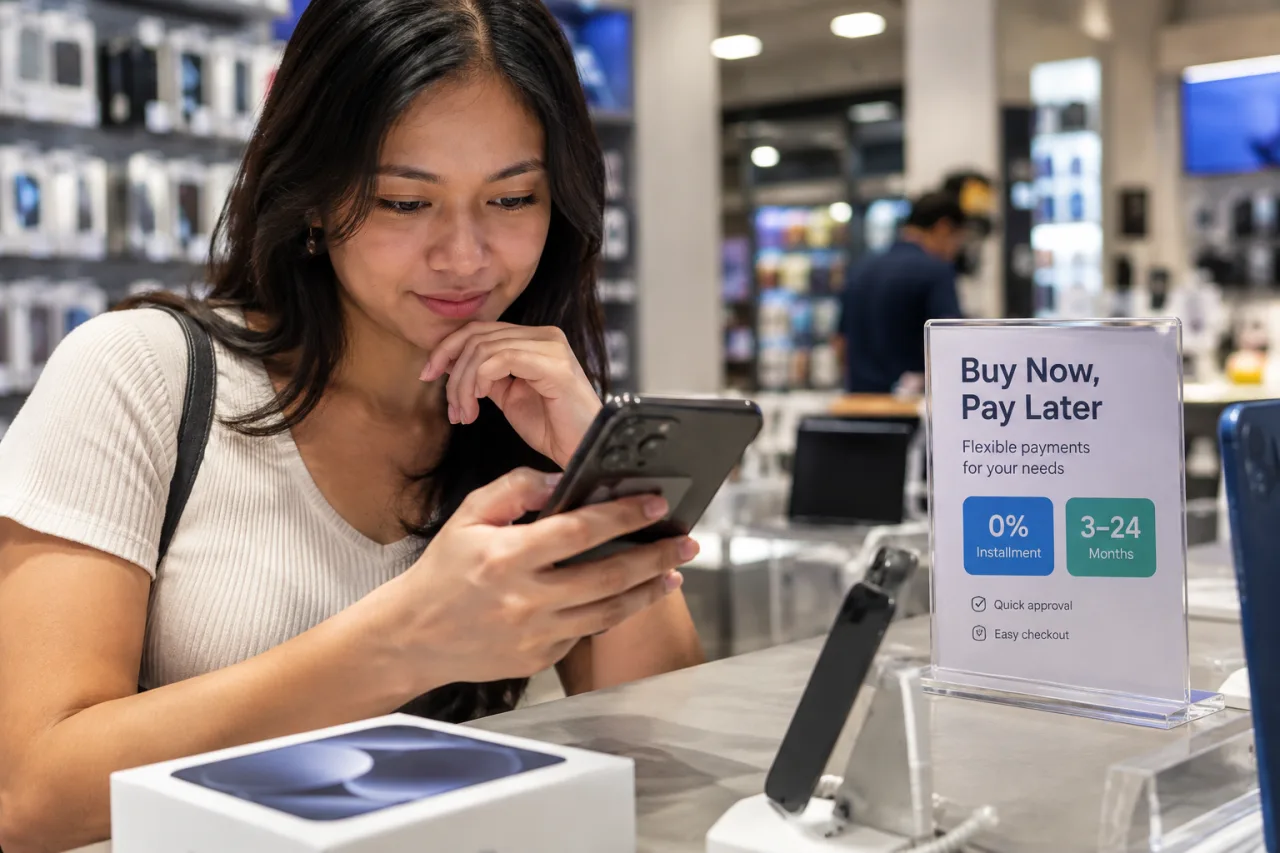
The adoption data explains the checkout screens you now see at Shopee, Lazada and even appliance stores. TransUnion’s survey work reported by Rappler shows 80 percent of Filipino consumers aware of buy now, pay later services, ahead of the 79 percent who know credit cards, and 78 percent rating them safe, up six points in a year.
Compare that with digital money-lending apps, which polled at just 57 percent safety with 31 percent of respondents calling them outright risky. The trust gap is the business model. BNPL rides inside apps and brand checkouts you already use, approves lines in minutes based on your app activity, and skips the branch-visit embarrassment of credit applications.
The industry has matured around that trust. BillEase says more than 10 million Filipinos use it; the operator booked a net profit of ₱840 million in 2025, acquired a rural bank to extend credit further, and targets 50 percent loan-book growth in 2026. Grab spent $1.49 billion acquiring a BNPL operator to turn its super-app into a regional consumer lender, the deal our Grab Atome acquisition breakdown analyzed, and Atome itself carries BNPL-card partnerships across Maya checkouts, per Rappler’s Finterest reporting. When ride-hailing, e-commerce, and wallet empires all converge on the same product, the question stops being whether buy now, pay later is mainstream. It is. The question becomes what it costs the mainstream buyer.
What the Installment Actually Costs: How Each Fee Adds Up
Start with the published ranges, straight from provider documents. GCash’s GGives charges 0 to 5.49 percent interest per month depending on eligibility and term, on borrowings of ₱1,000 up to ₱125,000 across 2 to 24 months: its help center documents the range, and its promo window even features a 0.9 percent rate on Apple purchases of ₱15,000 or more.
BillEase’s Google Play disclosure lists 0-3.49 percent monthly interest, a total APR range of 0 to 41.88 percent, service charges of 0-10 percent, loan sizes of ₱500-50,000 and terms of 2-24 months. Its own worked example: a ₱12,000 plan repaid over three months at ₱4,539 per month totals ₱13,617, ₱1,617 of cost on a ₱12,000 purchase.
Maya Easy Credit’s computation assumes a 3.99 percent service fee and loans up to ₱50,000. Atome’s model splits the bill into three equal payments across three months at zero interest, with a one-time ₱300 administration fee when a payment runs late.
Two conversions make the ranges real. First, monthly rates are not APRs: GGives’ 5.49 percent monthly ceiling translates to roughly 66 percent on a simple annualized view: arithmetic, not a quoted APR, but the direction is the point. Monthly numbers multiply, and a plan that feels like a small tax becomes a credit-card-class rate inside two years of tenor.
Second, the APR disclosure BillEase itself prints (up to 41.88 percent) is what happens when interest and that separate service-charge layer both apply. The checkout screen shows the installment, but the plan has two cost lines stacked, not one.
Then there is the part of the terms that punishes exactly the people the product courts: late payment. GGives’ terms and conditions state late payment fees accrue on any overdue amount at the rate in your Disclosure Statement, and any payment you make applies to those penalties first, before touching the loan itself. That ordering matters in a bad month: pay what you can, and you may have mostly paid the fee, not the furniture.
A US survey datapoint frames the risk for anyone tempted to treat BNPL casually: LendingTree’s March 2026 tracking found 47 percent of buy now, pay later users admitted paying late in the previous year, a share that has climbed three years running. Behavioral patterns travel. The Philippine market is younger, but the discipline the products demand does not change with the currency.
Why AMRO’s Warning Matters in a Downturn
The ASEAN+3 Macroeconomic Research Office (the region’s macro surveillance arm) published the caution in two layers this year. In its consumer-credit review, AMRO noted Philippine consumer loans have grown about 18 percent annually since mid-2022, faster than total lending, with the third quarter accelerating past 21 percent, and warned that new products could shift risks beyond the traditional banking sector into buy now, pay later, fintech wallets and related services. In early October, Manila Bulletin carried AMRO’s sharper warning: online lending and BNPL risks “could rise in a Philippine downturn.”
The mechanism is worth understanding in plain terms. BNPL is short-duration, small-ticket, unsecured consumer credit, concentrated in discretionary purchases made at moments of high purchase-momentum. In a downturn, that is the first spending to stop and the first collection to fail.
The lender’s protection is data and velocity: approve fast, penalize fast. The borrower’s protection is nothing except their own schedule. That is the asymmetry: AMRO’s own conclusion is that the consumer-credit surge is “a test the system is passing, for now,” with the outcome depending on lender discipline, borrower judgment and regulator oversight continuing to work together. A recession test does not care that 78 percent of users feel safe.
The regulatory map adds another reason for reader-side care. The Philippines has no single self-contained BNPL statute; the product is regulated by what it does in substance: the Truth in Lending Act requires disclosure of the finance charge and true cost of credit, the Consumer Act covers credit transactions, and the Financial Products and Services Consumer Protection Act adds the consumer-protection layer, as the compliance analysis at Global Law Experts details. Disclosure protects the reader who reads it. It does not protect the reader who taps through checkout at midnight.
The Credit Record You Are Actually Building
The most under-appreciated line in the whole product is the one consumers assume away: these loans are on the record. The Philippines’ Credit Information Corporation has said it plainly in its own consumer education: your repayment history for buy now, pay later loans availed in shopping feeds the CIC credit report pool, and the agency directs consumers wanting to see what lenders see to request their CIC report and score through CRIF Philippines. In the United States, TransUnion and the CFPB note that many 4-payment BNPL products do not report unless a debt goes to collections; the Philippine infrastructure, by contrast, has been built to see wallet and installment behavior. Treat the difference as a feature and a warning at once: build a clean record and your BNPL behavior is evidence of discipline; miss repeatedly and the next lender reads it in your file before you explain anything.
Practical consequences follow the file. A delinquent BNPL history can color the approval decision for the products that matter more later (a housing loan, a car loan, a credit card upgrade), the application documents of which already price your existing obligations. Our credit card approval guide for OFWs walks through what lenders read; the short version is that every small installment plan you open and close on time is a small vote in your favor, and every missed one is a vote against that compounds with the next application. The wallets themselves (the gLoan and GCash versus Maya Credit cost comparison) carry the same file logic inside their limits: repay on schedule and your ceiling rises; pay late and it narrows.
When a Buy Now, Pay Later Plan Is the Right Call
With the costs and the file-effects on the table, the safe-use pattern needs only four rules. Rule one: the promo is the product. When a genuine 0-percent window exists (Atome’s three-payment structure, GGives’ featured 0-percent and 0.9 percent promo windows), and you can commit the total before the window closes, the plan costs nothing at all; the arithmetic works when the schedule is certain, not hopeful. Rule two: one plan at a time. The danger is not a single ₱4,539 installment; it is four of them spread across four apps, none individually scary, jointly absorbing your monthly buffer. Rule three: read the two extra lines before checkout. The service charge rate and the late-fee schedule on the Disclosure Statement; BillEase and GGives both publish theirs, and the 30 seconds is cheaper than either fee. Rule four: essentials beat momentum. The appliance that keeps your fridge cold justifies a plan; a checkout-impulse upgrade at 2 a.m. does not, at any interest rate, in anyone’s currency.
For the larger credit products the same file governs: our credit-card guide covers secured-path options for readers establishing history. And inside the wallets, where much of the buy now, pay later growth actually flows, the gLoan versus Maya wallet comparison maps the rates side by side. The tools are not the trap. The unexamined checkout is.
FAQ
Does buy now, pay later affect your credit record in the Philippines?
Yes, repayment histories for BNPL loans feed into the CIC credit report pool that Philippine lenders consult, per the Credit Information Corporation’s own consumer guidance. On-time behavior supports your file; delinquency can surface on it. Request your CIC report through CRIF Philippines to see what lenders see.
What is the cheapest buy now, pay later plan available?
Genuine 0-percent structures: Atome’s three-payments-across-three-months model at zero interest (a ₱300 one-time fee applies only if a payment runs late), and GGives’ 0-percent promo windows. The cheapest plan is the one whose total you can pay before any fee applies.
How expensive can a buy now, pay later plan get?
Provider disclosures: BillEase’s published APR range tops out at 41.88 percent once its 3.49 percent monthly interest and up-to-10-percent service charges are added; GGives’ monthly interest range reaches 5.49 percent, which annualizes well above that APR figure on a simple arithmetic view. Maya Easy Credit assumes a 3.99 percent service fee. The checkout installment hides this total. The Disclosure Statement shows it.
What happens if I miss a buy now, pay later payment?
Penalty fees accrue per your Disclosure Statement, and under GGives’ terms, any payment you make hits late fees first before reducing your principal, so partial payments in a bad month mostly cost you fees. Misses also feed the BNPL repayment history inside the CIC credit data, which next lenders will read. If a payment will be missed, contact the provider before the due date.
Is buy now, pay later safer than online lending apps?
Perception says yes: TransUnion’s survey found 78 percent of Filipinos consider BNPL safe versus 57 percent for digital money-lending apps, which 31 percent called outright risky. The credit substance (unsecured consumer installment) resembles the riskier category more than the reputation suggests, particularly in a downturn, which is why AMRO flagged both together.
Why is AMRO warning about BNPL in the Philippines?
Consumer credit has grown about 18 percent annually since mid-2022, faster than total lending, and AMRO assesses that a downturn would raise risks in online lending and BNPL specifically because the product is short-duration, unsecured and concentrated in discretionary spending. Its overall read: the system is passing the test “for now,” dependent on lender discipline, borrower judgment and regulator oversight holding together.
Financial Disclaimer
WorldNgayon.com is not a lending company, a licensed financial adviser, or a creditor. This article is general information, not financial advice, and does not recommend any BNPL product. Rates, fees and terms cited come from provider disclosures as of publication and change per user evaluation: verify the Disclosure Statement in your own account before committing to any installment plan.
- mb.com.ph/2026/10/05/amro-warns-online-lending-buy-now-pay-later-risk… — Manila Bulletin carried AMRO’s sharper warning
- amro-asia.org/philippines-consumer-credit-surge-a-test-the-system-is-… — AMRO’s own conclusion
- globallawexperts.com/news/buy-now-pay-later-philippines — Global Law Experts
External sources linked in this article, in order of first mention. Spotted an error or a broken link? Tell us.
Cite this pagePublished Nov 10, 2026
Agron, E. (2026, November 10). Buy Now, Pay Later Philippines: How the Installment Plan Really Costs You. WorldNgayon. https://worldngayon.com/buy-now-pay-later-philippines/
Agron, Edmon. “Buy Now, Pay Later Philippines: How the Installment Plan Really Costs You.” WorldNgayon, 10 Nov. 2026, worldngayon.com/buy-now-pay-later-philippines/.
Agron, Edmon. “Buy Now, Pay Later Philippines: How the Installment Plan Really Costs You.” WorldNgayon, November 10, 2026. https://worldngayon.com/buy-now-pay-later-philippines/.
Agron, E. (2026) ‘Buy Now, Pay Later Philippines: How the Installment Plan Really Costs You’, WorldNgayon, 10 November. Available at: https://worldngayon.com/buy-now-pay-later-philippines/.
E. Agron, “Buy Now, Pay Later Philippines: How the Installment Plan Really Costs You,” WorldNgayon, Nov. 10, 2026. [Online]. Available: https://worldngayon.com/buy-now-pay-later-philippines/
@online{agron2026buynow,
  author       = {Agron, Edmon},
  title        = {{Buy Now, Pay Later Philippines: How the Installment Plan Really Costs You}},
  year         = {2026},
  date         = {2026-11-10},
  organization = {WorldNgayon},
  url          = {https://worldngayon.com/buy-now-pay-later-philippines/},
  urldate      = {}
}TY - ELEC AU - Agron, Edmon TI - Buy Now, Pay Later Philippines: How the Installment Plan Really Costs You T2 - WorldNgayon PY - 2026 DA - 2026/11/10/ UR - https://worldngayon.com/buy-now-pay-later-philippines/ Y2 - ER -
Cite the version you read; the page may be updated. Zotero and Mendeley can also import this page directly.