Table of Contents
Key Takeaway
- 🏦 The plan is real and dated: BSP Deputy Governor Mamerto Tangonan said the central bank is planning to produce polymer banknotes locally from 2027, dedicating one new line at the Security Plant Complex that can turn out roughly 500 million pieces of the First Philippine Polymer series yearly.
- 🧾 Four denominations already circulate: the First Philippine Polymer series launched December 20, 2024 in ₱1,000, ₱500, ₱100 and ₱50 notes, printed abroad while the ₱1,000 polymer had been in wallets since earlier that year.
- 🧪 The counterfeit record is strong: BSP counted only one documented counterfeit of the ₱1,000 polymer banknote per 82,000,000 pieces in circulation, and countries that adopted polymer saw counterfeiting cases fall.
- 💳 The switch costs something: polymer notes are the most expensive the BSP has ever produced per Rappler’s reporting, abaca farmers fear lost demand, and imports from Australia continue, the new local line covers only a slice of national demand.
- 🤲 What you should actually do: don’t fold polymer notes: retailers and cash handlers have refused crumpled or taped bills; check the clear window, tactile dots and tilt feature, and remember every paper note remains legal tender.
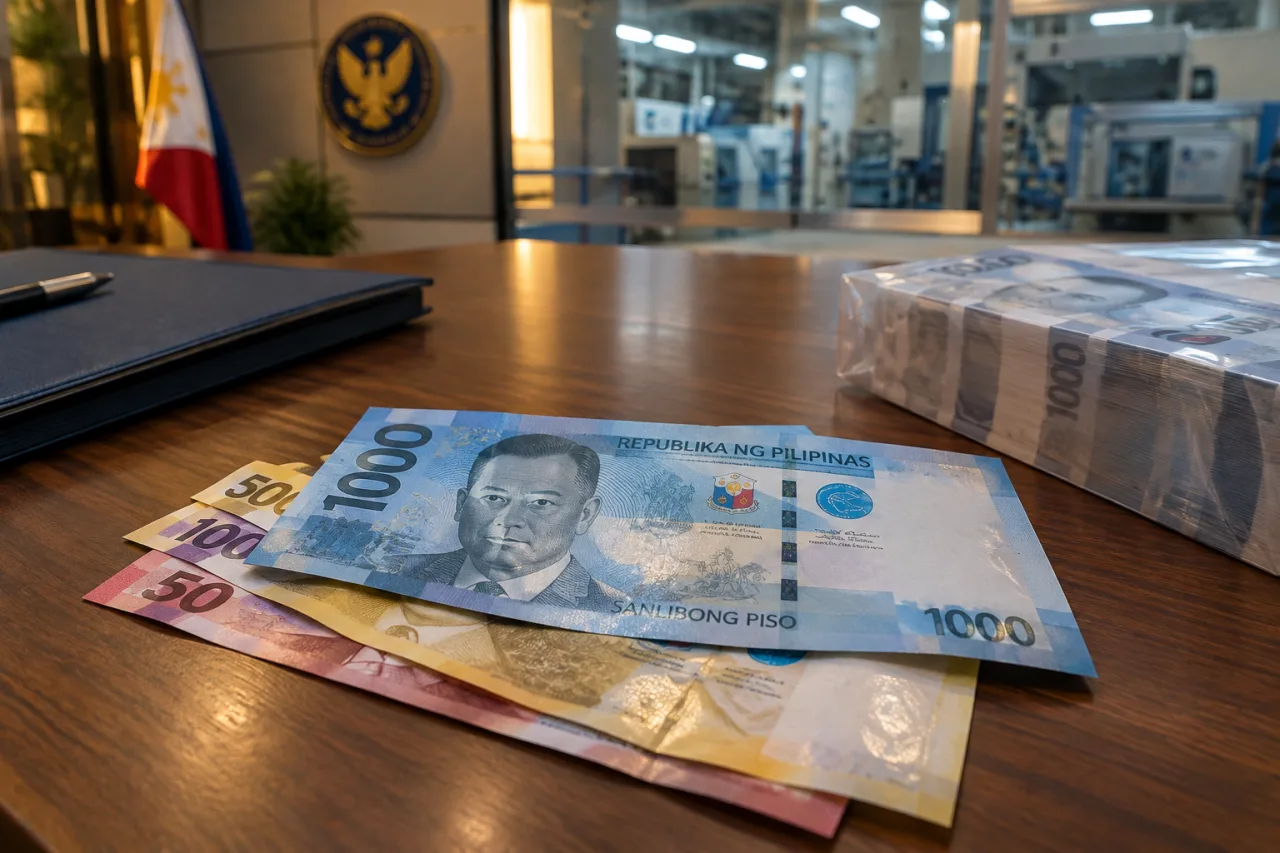
The Bangko Sentral ng Pilipinas prints almost nothing of its plastic money today. Every polymer banknote in your wallet was made overseas, shipped into the country, and only then handed to tellers, ATMs and jeepney drivers. That is the dependency a top central bank official wants broken: on November 9, 2026, Deputy Governor Mamerto Tangonan said the BSP is planning to begin producing the First Philippine Polymer (FPP) banknote series locally by 2027, starting with a single dedicated line at its Security Plant Complex in Quezon City that can manufacture around 500 million pieces per year. The stakes are practical, not ceremonial: the currency you receive tomorrow will be smarter to check, stronger in a wet market, more expensive to make, and for the first time in the polymer era, printed on Philippine soil for a share of demand.
This report assembles what the BSP’s own documents, business wires and the critics agree on, and separates the confident facts from the open questions. The 500-million-piece line is a plan with no firm start date. The four-denomination polymer banknote series is physical, circulating fact. The counterfeit record is documented. The cost criticism is real. And the handling habits that get consumers in trouble (folding bills, taping tears, refusing valid notes) are exactly where your money meets your hands.
The 500 Million Pieces a Year Plan
Here is what the newest announcement actually says. BusinessWire-level reporting from BusinessWorld on November 9, 2026 quotes Deputy Governor Tangonan (head of the new Payments and Currency Management Sector) confirming the BSP will initially dedicate one production line at the Security Plant Complex to polymer notes, with an output estimate of 500 million banknotes a year. The same report is explicit about the limits: the SPC’s existing facility currently prints only the New Generation Currency series on abaca-cotton paper and has no polymer capacity today, Tangonan did not provide a specific start date for local production, and the BSP will keep outsourcing polymer bills from Australia to meet national demand “because of the size of the requirement.” His own framing: the BSP has to “learn, learn to operate the polymer lines so that we’re not forever just importing.”
Manila Bulletin’s version of the same announcement adds the motive: reducing reliance on imported banknotes, with 2027 named as the target year to begin domestic printing. Read the two reports together and the picture is honest: 2027 is an aspiration with production learning curves attached, one line cannot yet match national demand, and Australia’s Note Printing Australia remains the manufacturer of record for the series that already circulates.
What Polymer Banknotes Change: The BSP Review
The BSP’s case for polymer banknotes rests on three claims, each with documents behind it. First, counterfeiting: the BSP’s official polymer page states that countries which shifted to polymer (Canada, Australia, New Zealand, Malaysia, Mexico, Fiji and Vietnam) all saw declines in counterfeiting cases, while the Philippines itself “does not have a major counterfeiting problem” but faces crime syndicates that keep adopting new techniques. The documented local number is striking: Philstar reported that counters of the ₱1,000 polymer note found just one documented counterfeit per 82 million pieces.
Second, durability in exactly the environments Filipinos use cash: the same BSP page notes that polymer resists dirt, water and oil, the practical realities of wet markets and public transportation, and that BSP heat-resistance studies concluded the country’s tropical climate does not shorten polymer note life. Third, the environment: a BSP-commissioned study found the ₱1,000 polymer banknote carries a lower carbon footprint than its paper counterpart, requiring less energy and fewer resources to produce over its longer life cycle.
The security design is the part BSP wants every holder to actually use. The FPP series carries a list of features per the BSP’s booklet on the series: polymer substrate, flora clear windows with embossed line structures, vertically aligned value panels with a rolling bar effect, tactile dots and embossed prints built for persons with vision impairment, shadow threads, vertical clear windows, metallic dynamic waves, and serial numbers. This is the checklist that matters when a jeepney driver or a sari-sari store owner hands you change.
The Criticism and the Side BSP Has to Manage
An honest assessment carries the costs side too, because the critics’ points are on the record. Rappler’s investigation when the series was announced flagged three: polymer notes are the most expensive the BSP will have ever produced: one insider called the combination of a ₱1,000 denomination with a costlier substrate “the most expensive banknotes we will ever produce”; abaca farmers (the fiber inside paper currency) face demand risk, with Tangonan himself assuring that early limited circulation would affect only around 0.4 percent of jobs in the abaca sector, or at most 481 people; and the dependence on Note Printing Australia meant the “Made in Australia” stamp sat on Philippine legal tender. The BSP’s own posture acknowledges the tension: it will “not forever just import,” but it also cannot yet print what it needs domestically.
The 500-million-piece line is the compromise in motion: enough to build local expertise without pretending the import dependence ends on day one. National demand for banknotes runs into billions of pieces a year, which is why the same deputy governor who announced the target also confirmed the continue-importing reality. Watch how fast the BSP scales from one line to more; that pace, more than the 2027 date itself, tells you whether localization is a strategy or a press release.
What Plastic Bills Mean for Your Money Today
For readers handling cash this month, four behaviors decide whether polymer banknotes work for you or against you.
One: do not fold polymer notes. The habit that was harmless with paper is the single fastest way to damage a polymer note: a sharp crease does not recover, and crumpled or taped notes have been refused by retailers and cash handlers in widely shared examples. Carry them flat (a wallet with a flat pocket beats a jeans pocket) and if you receive one already creased, know that it remains legal tender and can be exchanged or deposited at any bank.
Two: expect them in ATMs now. GMA News reported that banks recalibrated 17,304 ATMs (about 92 percent of the machines nationwide) to dispense polymer ₱1,000 bills. Withdrawals increasingly hand you plastic notes, which is why the flat-carry habit matters at the ATM moment itself: take the notes out and store them unfolded.
Three: paper still works everywhere. Every denomination of the traditional paper series remains legal tender, and the BSP explicitly says both series can be used for payment. Nobody is swapping your savings; the old abaca-cotton notes circulate until they are worn out, and the polymer series enters alongside them. Damaged banknotes of either series follow the same redemption rules at banks and the BSP.
Four: cash is no longer the whole story anyway. The digital rails now carry the majority of retail payment volume in the country, and the wallet comparison that decides where your peso lives is in our GCash vs Maya rates and fees breakdown. Carrying less cash also means carrying fewer counterfeiting and refusal risks, and sending money home without cash in transit is priced line by line in our remittance fees breakdown, the OFW playbook for a wallet-first approach. For the security habits behind every app-based peso, the lockdown checklist in our e-wallet security guide covers the OTP and phishing layer that digital money adds.
How to Check Polymer Banknotes in 30 Seconds
The BSP designed the series around three sensory checks (feel, look, tilt) and the 30-second version runs like this. Feel: run your fingers over the embossed prints and the four highly embossed dots; the polymer substrate itself feels smooth and different paper. Look: find the clear windows: the flora clear window depicting a native orchid with the text “BSP” embossed inside it, and the vertical clear window, plus the serial numbers, which should be crisp and regular. Tilt: move the note against the light and watch the value panel’s rolling bar effect and the metallic dynamic waves shift; a counterfeit flatness shows immediately next to the real movement.
Two extra checks carry the weight in real transactions. First, the tactile dots and embossed prints exist for the elderly and persons with vision impairment: if you handle cash for a family member who is elderly or sight-impaired, teach them the dot count as their primary check, and note that the 2020 New Generation Currency redesign was itself built for the same inclusive purpose. Second, when a suspicious note reaches you, the practical sequence is: do not return it, note the circumstance, and surrender it to a bank or the BSP rather than attempting to pass it on: circulating a known counterfeit is the one act that turns a victim into an offender.
The Road to Printed in the Philippines
What would the localization timeline actually look like? The public record gives three anchors. The 2024 launch proved the design and security engineering is settled. The November 2026 announcement proves the industrial intent: one line at the SPC, roughly 500 million pieces yearly, production learning under Tangonan’s new Payments and Currency Management Sector. What is not public yet is the conversion timeline for additional lines, the first locally printed denomination, and the point at which import volumes begin to fall: those are the three markers that would move this from plan to policy. The maintenance facts for readers are simpler: both series are legal tender, polymer notes should be carried flat, and the security-feature checklist above works the same whether the note inside your wallet says Australia or Quezon City on its provenance.
FAQ
Are polymer banknotes already circulating in the Philippines?
Yes. The First Philippine Polymer series (₱1,000, ₱500, ₱100 and ₱50) launched on December 20, 2024 after the ₱1,000 polymer note’s earlier debut, and these polymer banknotes circulate alongside every paper denomination. ATMs across roughly 92 percent of the country have been recalibrated to dispense them.
When will the Philippines start printing polymer banknotes locally?
The BSP’s stated plan targets 2027 for the start of local production, using one new line at the Security Plant Complex in Quezon City with an estimated output of 500 million pieces per year. Deputy Governor Mamerto Tangonan announced the plan on November 9, 2026, and confirmed the BSP will keep importing from Australia to meet the rest of demand because the national requirement is far larger than one line’s output.
Are old paper bills still legal tender?
Yes. All paper denominations of the New Generation Currency series remain legal tender and circulate alongside the polymer banknotes. The BSP has never demonetized the paper series; damaged notes of either series can be exchanged at banks.
Why is the Philippines printing money in Australia?
The BSP’s Security Plant Complex could not print polymer at all when the series launched in 2024, so the initial production was outsourced to Note Printing Australia. The current plan (one local polymer line by 2027, at 500 million pieces a year) is the first step away from that dependency, with imports continuing in the meantime.
Do polymer banknotes survive the tropical climate?
According to the BSP’s heat-resistance studies, the Philippine tropical climate does not affect polymer-banknote durability. Polymer notes resist dirt, water and oil, which is why the BSP calls them well-suited to wet markets and public transportation. The real threat to their lifespan is mishandling: folding, stapling and taping are the behaviors that damage a polymer note.
What do I do if I receive a fake bill?
Do not pass it on to anyone. Surrender a suspected counterfeit banknote to your bank or directly to the BSP, and note the details of where you received it. Counterfeiting cases have declined in countries that adopted polymer, and the BSP’s documented counterfeit rate for the ₱1,000 polymer is one per 82 million pieces, but but surrendering is the only legally clean move, and circulating a known counterfeit can convert you from victim to offender.
Financial Disclaimer
WorldNgayon.com is not a bank, a licensed financial adviser, nor an agent of the Bangko Sentral ng Pilipinas. This article is general information, not financial or legal advice. Currency policies, denominations and production plans reflect their stated sources as of publication; verify current rules with the BSP or your bank before acting on any decision.
- bworldonline.com/top-stories/2026/11/09/792509/bsp-eyes-polymer-bankn… — polymer banknotes locally from 2027
- mb.com.ph/article/10943996/business/banking-finance/made-in-philippin… — Manila Bulletin’s version
- Official bsp.gov.ph/SitePages/CoinsAndNotes/PolymerBanknote.aspx — the BSP’s official polymer page
- philstar.com/headlines/2024/12/27/2410060/bsp-polymer-bills-lead-drop… — Philstar reported
- Official bsp.gov.ph/Coins%20and%20Notes/Polymer/Infosheet/FPP_Booklet.pdf — the BSP’s booklet on the series
- rappler.com/business/australia-print-philippines-first-polymer-bankno… — Rappler’s investigation
- gmanetwork.com/news/money/economy/858876/bsp-p1k-polymer-bills-availa… — GMA News reported
External sources linked in this article, in order of first mention. Spotted an error or a broken link? Tell us.
Cite this pagePublished Nov 10, 2026
Agron, E. (2026, November 10). BSP Polymer Banknotes by 2027: What Plastic Bills Mean for Your Peso. WorldNgayon. https://worldngayon.com/bsp-polymer-banknotes/
Agron, Edmon. “BSP Polymer Banknotes by 2027: What Plastic Bills Mean for Your Peso.” WorldNgayon, 10 Nov. 2026, worldngayon.com/bsp-polymer-banknotes/.
Agron, Edmon. “BSP Polymer Banknotes by 2027: What Plastic Bills Mean for Your Peso.” WorldNgayon, November 10, 2026. https://worldngayon.com/bsp-polymer-banknotes/.
Agron, E. (2026) ‘BSP Polymer Banknotes by 2027: What Plastic Bills Mean for Your Peso’, WorldNgayon, 10 November. Available at: https://worldngayon.com/bsp-polymer-banknotes/.
E. Agron, “BSP Polymer Banknotes by 2027: What Plastic Bills Mean for Your Peso,” WorldNgayon, Nov. 10, 2026. [Online]. Available: https://worldngayon.com/bsp-polymer-banknotes/
@online{agron2026bsppolymer,
  author       = {Agron, Edmon},
  title        = {{BSP Polymer Banknotes by 2027: What Plastic Bills Mean for Your Peso}},
  year         = {2026},
  date         = {2026-11-10},
  organization = {WorldNgayon},
  url          = {https://worldngayon.com/bsp-polymer-banknotes/},
  urldate      = {}
}TY - ELEC AU - Agron, Edmon TI - BSP Polymer Banknotes by 2027: What Plastic Bills Mean for Your Peso T2 - WorldNgayon PY - 2026 DA - 2026/11/10/ UR - https://worldngayon.com/bsp-polymer-banknotes/ Y2 - ER -
Cite the version you read; the page may be updated. Zotero and Mendeley can also import this page directly.