Table of Contents
Key Takeaway
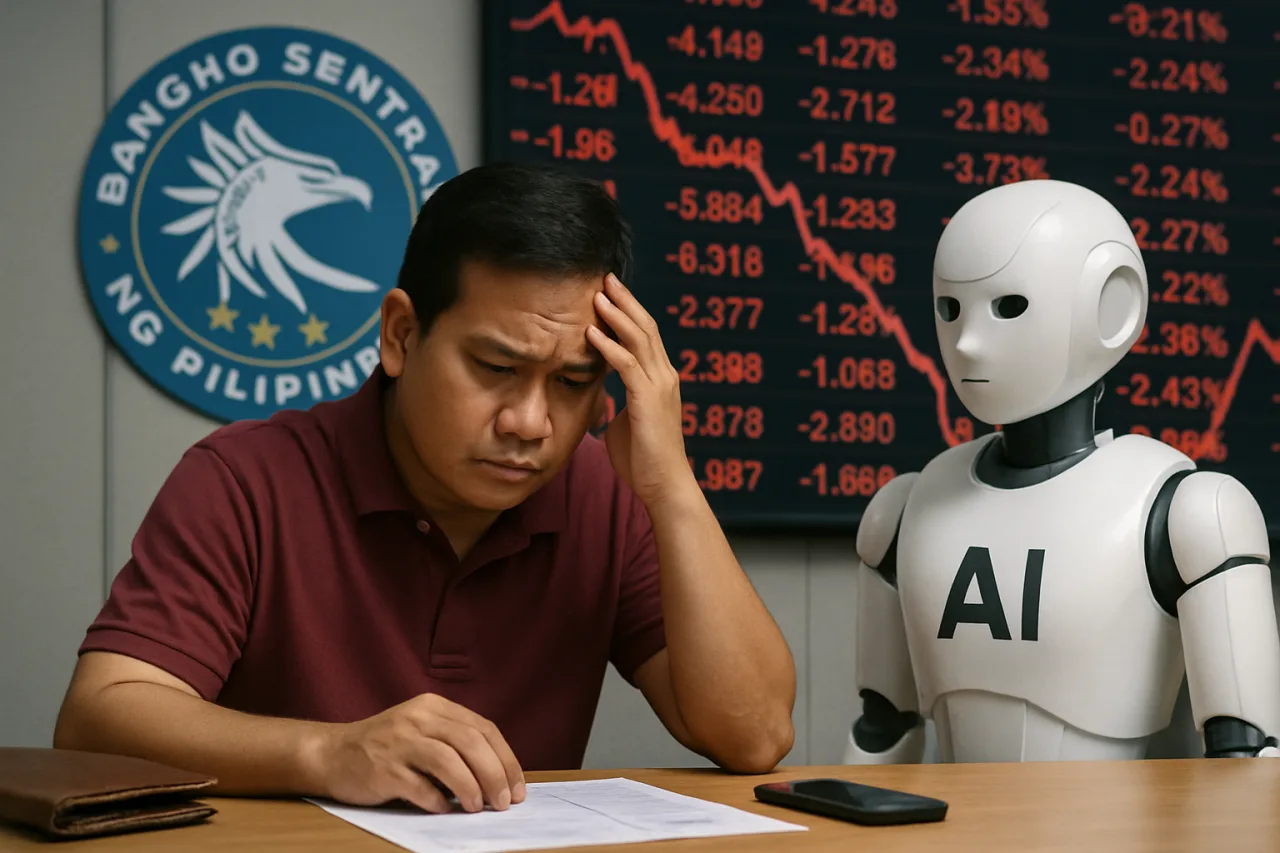
- 🏦 BSP AI capital markets verdict, on the record: Mark Anthony B. Perez of the BSP’s Technology & Digital Innovation Office says local investors are not ready for AI in trading, investment advice, or market forecasting — “we are not ready for something like that at the moment.”
- 📉 The hesitation has history: roboadvisors launched in the Philippines four to five years ago and “didn’t fly” — familiarity, not just regulation, is the binding constraint.
- 🌐 Perez names the deeper risk as AI asymmetry: the world’s models are concentrated in a few developed countries, and the Philippines runs on their rails — which is why “AI sovereignty” now has real policy weight.
- 🇵🇭 For Filipino retail investors the practical takeaway is protection: AI-generated stock picks and robo-advice carry no regulatory safety net yet — verify, diversify, and treat AI output as research, not advice.
- 🧭 The readiness gaps Perez ties together — infrastructure, skills, data capabilities, investment — are the roadmap items government can close with targets, responsible-AI guidelines, and controlled testing environments.
What the BSP Actually Said (Quote by Quote)
The BSP AI capital markets position came from Mark Anthony B. Perez, Technical Advisor/Director for the Artificial Intelligence and Data Analytics Hub at the BSP’s Technology & Digital Innovation Office, speaking to reporters on the sidelines of an event last Friday — as reported by BusinessWorld’s Aaron Michael C.
Sy on September 18 and republished by FINEX. The quotes matter because the social-media summary strips the nuance; the original is more careful than “BSP bans AI trading.” It’s a diagnosis of BSP AI capital markets readiness, not a prohibition:
On investor readiness: “Customers are resistant to the use [of AI in capital markets]. They’re hesitant… because it’s not familiar. At the end of the day, it goes back to what’s appropriate in the market… it should fit the client and the market.”
On algorithmic trading specifically: “What we’re talking about is market movements. I don’t know how comfortable people are to actually leave it to an algorithm or a model to do that. These ideas of algorithmic trading and all that, we are not ready for something like that at the moment.”
On the global context: the Philippines is not an outlier — AI use in capital markets is “not that extensive” even worldwide, with adoption tied to market maturity. That framing matters for every Filipino investor who reads an American roboadvisor success story and wonders why the local version never arrived: the markets that adopted successfully had deeper liquidity, longer retail-investing cultures, and regulators that wrote AI rules before the products scaled.
The Roboadvisor History Nobody Mentions Anymore
Perez’s roboadvisor callback is the most useful part of the speech because it’s empirical, not theoretical: “Roboadvisors became popular four or five years ago, but it didn’t fly. And I think it’s because maybe the technology was too early, or maybe people are not comfortable with it.” He’s right on both counts — and the local record shows it.
The Philippine roboadvisor wave of the early 2020s (several P2P and micro-investing platforms promised algorithm-driven portfolios) either pivoted, shrank, or quietly sunset; the mass-market Filipino saver stayed with MP2, time deposits, and remittance-adjacent products instead.
The lesson compounds into today’s BSP AI capital markets stance: readiness is a two-sided gate. The supply side needs infrastructure, skills, data, and capital — the gaps the readiness studies name. The demand side needs trust, and trust is built by familiarity, disclosure, and a track record of models behaving predictably through market stress.
Neither side of that gate is open in the Philippines yet — which makes the BSP’s public candor less a brake and more a map of what has to be built before the products return.
BSP AI Capital Markets and the AI Asymmetry Layer
The portion of Perez’s remarks most coverage skipped is the one with the longest shadow. He described AI asymmetry — “the well-developed countries that have the concentrations of the AI, and the rest of the world is basically using their models and their systems” — and connected it to the sovereignty debate now running through every central bank in Asia.
The mechanism: cloud, PaaS, SaaS, and IaaS mean technology no longer needs to move into a country to serve it; a Filipino institution can use world-class AI without ever being able to build it. “While we might learn skills, it doesn’t necessarily mean we’ll be able to build our own.”
His BSP AI capital markets remedy — lessening third-party dependence for better cost control, regulation, and local datasets — reads like the central-bank BSP AI capital markets version of the same conclusion the eGovAI launch reached domestically: build domestic capability, even if it starts small. For BSP AI capital markets supervisors, third-party AI risk is now a supervisory topic worldwide; the institutions that depend on a handful of foreign model providers inherit their outages, their pricing, and their policy changes.
That is the structural reason “AI sovereignty” moved from conference rhetoric to policy language.
What It Means for Filipino Investors Right Now
Strip the policy layer and three practical rules remain for the individual investor this year. First, the regulatory perimeter is honest: no SEC-registered AI advisory product has cleared the trust gauntlet locally, so any “AI picks this stock” content — from group chats, apps, or overseas robo-platforms — is unregulated research at best. Second, the AI tools that are safe today are the boring ones: our own MP2 calculator, dividend trackers, and budgeting aids — math tools, not market oracles.
Third, the PSEi angle from our 5,843 levels analysis stands unaffected: ber-months flows move on rates and liquidity, not on models — and the investors who treat AI output as one input among many, never as the decision itself, are exactly the users Perez’s caution assumes.
There is also a personal-sovereignty echo for the AI-professional reader: the same asymmetry logic applies to your own stack. Skills that travel (prompting, evaluation, data hygiene) are yours; platform lock-ins are not. The central banker’s advice to a nation is, oddly, sound personal finance advice for a career.
The BSP AI Capital Markets Readiness Roadmap
The BSP AI capital markets readiness studies Perez cites name four gaps — infrastructure, skills, data capabilities, investment — and the standard prescription list maps onto them directly: clear AI-readiness targets, responsible-AI guidelines for financial services, stronger digital infrastructure and cybersecurity, AI skills programs, and controlled testing environments (regulatory sandboxes) where institutions can trial AI without betting the market. The BSP has already moved on the framework side — its 2025 Artificial Intelligence Readiness and Risk Management Framework for BSP-supervised financial institutions set the governance baseline; the capital-markets layer now waits on the same BSP AI capital markets sequencing: rules, then pilots, then products.
The honest timeline: the Philippines will get AI-assisted investing eventually — the question the BSP is really asking is whether it arrives through a managed gate or through another roboadvisor-shaped failure.
Frequently Asked Questions
Who is the BSP official who said the Philippines is not ready for AI in capital markets?
Mark Anthony B. Perez, Technical Advisor/Director for the Artificial Intelligence and Data Analytics Hub at the BSP Technology & Digital Innovation Office, speaking to reporters as reported by BusinessWorld (September 18, 2026).
Did the BSP ban AI trading or robo-advisors?
No — the statement is a readiness assessment, not a prohibition. Perez said investors remain hesitant and unfamiliar, that algorithmic trading is not something the market is ready for “at the moment,” and that adoption depends on market maturity. There is no prohibition in the remarks.
Why did roboadvisors fail in the Philippines?
The platforms that launched four to five years ago never achieved mass adoption — the BSP’s own read is a mix of unfamiliar technology, comfort gaps, and timing. The lesson for the AI wave: supply alone doesn’t create adoption; trust and familiarity do.
What is AI asymmetry?
Perez’s term for the concentration of AI capability in a few developed countries while the rest of the world consumes their models through cloud services. His point: using AI does not build the ability to make it, which is why countries now discuss “AI sovereignty” — skills, infrastructure, and data independence.
Can I use AI to pick stocks in the Philippines today?
You can use AI tools as research aids, but no AI investment-advice product is locally regulated yet, and the BSP’s statement signals the regulator knows it. Treat any AI stock pick as unverified research, cross-check against filings and official disclosures, and never automate a decision you can’t explain.
What would make the Philippines ready for AI capital markets?
The readiness agenda Perez points to: AI-readiness targets, responsible-AI guidelines for financial services, digital infrastructure and cybersecurity investment, AI skills development, and controlled sandbox environments for supervised testing — sequenced so trust is built before products scale.