Key Takeaway
There is no single best digital bank Philippines — the right pick depends on your balance and your habits.
Table of Contents
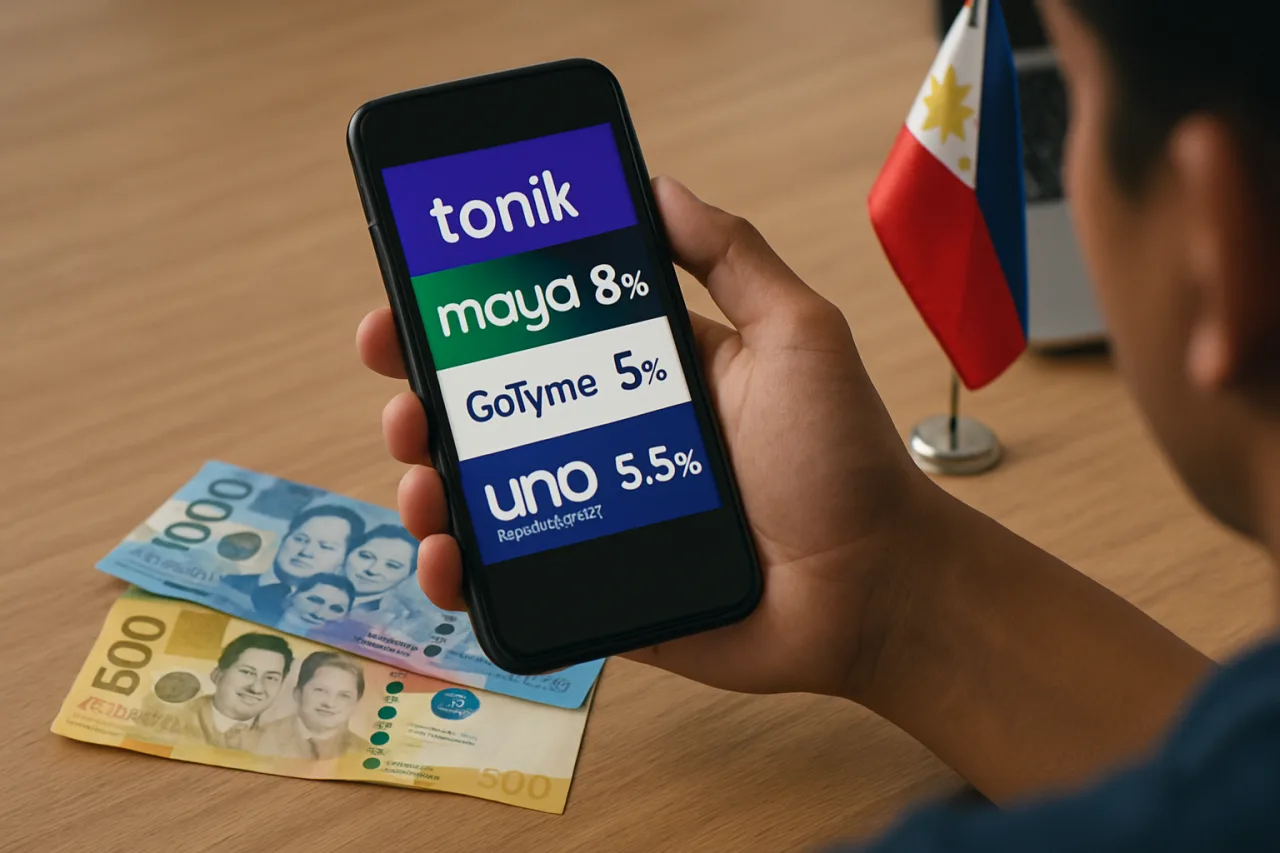
On clean base rates after the 20% final tax, Tonik pays the most on park-and-forget savings at 4.00%, UNOBank tops time deposits at 5.50% for twelve months, Maya dangles the region’s highest headline boost at up to 15% — but only on the first ₱100,000 and only for heavy monthly spenders — and GoTyme remains the simplest no-conditions account with free mall kiosks that suit OFW families. Every bank on this list holds a BSP digital-bank license, which means every peso in these best digital bank Philippines candidates is PDIC-insured up to ₱1,000,000 per depositor per bank. This comparison prices each option in actual pesos on ₱100,000, after tax, using rates published October 2, 2026.
How we priced the best digital bank Philippines question
The best digital bank Philippines search misleads when it quotes gross yields. Philippine bank interest carries a 20% final withholding tax, so a 3.00% advertised rate actually nets 2.40% — and some lenders’ boosted headline rates apply only to capped balances or require monthly spending missions. The table below uses base rates as listed on each bank’s own rate page as of October 2, 2026, on a ₱100,000 balance over twelve months, net of the 20% tax. Boosted or conditional numbers get their own rows labeled clearly, because a rate you cannot reliably earn is not a rate the best digital bank Philippines decision should plan around.
The universe matters too: the Bangko Sentral ng Pilipinas lists the licensed digital banks in its Verifier directory, last updated September 28, 2026 — GoTyme Bank Corporation, Maya Bank Inc., Tonik Digital Bank Inc., UNObank Inc., Overseas Filipino Bank, and UnionDigital Bank among them, with MariBank and CIMB’s digital products serving savers through adjacent licenses. Only BSP-licensed digital banks carry the full PDIC cover; e-wallet money that sits in GCash or Maya’s wallet layer is a different product with different protection. The deposit sweep matters when you are choosing where six figures sleep.
The savings rate table, in pesos
On ₱100,000 kept for twelve months, here is what each clean base rate actually pays after tax. Tonik Solo Stash at 4.00% keeps ₱3,247.35 — the most of any digital or traditional savings account in the market. UNOBank’s UNOready at 3.50% keeps ₱2,836.21, though the tier drops to 1.00% above ₱5,000,000. GoTyme Go Save and Maya Savings base both at 3.00% keep ₱2,426.58. The best regular savings account at a traditional universal bank — CIMB UpSave at its current rate — keeps ₱1,855.60, and a typical big-bank savings account at 0.25% keeps roughly ₱208. The spread between the top digital pick and the traditional floor is fifteen-fold, which is why this category keeps growing.
Two conditional products deserve honest labels rather than dismissal. Maya’s boosted rate — up to 15% on the first ₱100,000 — requires completing monthly spending missions across bills, QR payments, and card use, plus Easy Credit activity at the top tier; households that already transact heavily inside Maya can genuinely compound there, but the boost resets every month and vanishes the moment activity stops. Tonik’s Group Stash pays 4.50% but needs at least three people saving toward a shared goal; solo savers get the flat 4.00% anyway.
Time deposits: where the locked money earns
Twelve-month commitments pay better everywhere, but the best digital bank Philippines field spreads widely. Tonik pays 8.00% on the 12-month tenure — the highest locked rate in the category — and 7.00% for nine months, 6.00% at six. UNOBank’s UNOboost runs up to 5.50% across tenors while UNOearn pays 4.75% for twelve months with monthly payouts instead of a maturity lump. Maya’s Time Deposit Plus reaches 5.50% effective October 1, 2026. MariBank’s upfront three-month product pays 3.75% with interest paid at the start. On ₱100,000, the spread between Tonik’s 8% and a 3% savings rate is ₱4,800 gross versus ₱2,400 net — the lock is worth nearly double when the money is truly undisturbed.
The catch named plainly: time deposits do not open early without penalty, so the ladder only works for money whose date you know — a return-home fund, next year’s tuition, a planned down payment.
The honest rule: park the emergency layer in a liquid stash, and only ladder what twelve months of certainty can hold.
Which best digital bank Philippines fits which saver
Passive savers asking which best digital bank Philippines pick involves zero tasks: Tonik Solo Stash or GoTyme Go Save — flat rates, no missions, no caps, nothing to maintain. Balances that can hold ₱5,000 daily: UNOready at 3.50% or, outside the licensed-digital list, BanKo’s 5.00% TODO savings from ₱5,000 to ₱1,000,000 — the strongest liquid conditional-free tier in the market, with the catch that balances below ₱5,000 earn nothing and above ₱1,000,000 collapse to 0.0625%. Heavy Maya-ecosystem households: the boosted 15% headline can out-earn everything, on the first ₱100,000, when the monthly missions were going to happen anyway. Goal-based ladders: Tonik time deposits at up to 8.00%.
For OFW families — the readers this site serves — the best digital bank Philippines answer leans different. GoTyme’s free InstaPay and PESONet transfers plus physical kiosks in Robinsons malls make it the friendliest landing account for remittances — the family can withdraw and transact without living in the app. OFBank, the Landbank-owned digital bank built for overseas Filipinos, offers zero-fee remittance features though near-zero savings yield.
The pattern that works: remittance lands in the transaction-friendly account, surplus sweeps weekly into the highest clean rate the balance qualifies for, and the PDIC ₱1,000,000-per-bank ceiling decides when to split across two institutions.
The ₱1,000,000 rule and what PDIC actually covers
Since March 15, 2025, PDIC insurance runs to ₱1,000,000 per depositor per bank, doubled from the old ₱500,000 ceiling. The rule’s arithmetic shapes everything above: a ₱2,000,000 balance split across two licensed banks keeps every peso insured, while the same sum in one bank leaves half exposed to the bank’s failure — remote in a BSP-supervised system, but the whole point of deposit insurance is that it costs nothing to respect. Digital bank licenses are capped and supervised directly by the BSP, and no licensed digital bank has failed, but the discipline costs nothing and scales to any balance.
Interest above the insured ceiling is where the real comparison shifts: UNOBank’s savings tier collapses to 1.00% above ₱5,000,000, Maya’s boost caps at ₱100,000, and MariBank tiers up only at ₱1,000,000. Big balances therefore end up laddered across banks by design — the best digital bank Philippines question was never which one bank, but which mix.
Verdict: the 2026 shortlist
For the cleanest no-conditions yield on ordinary balances, Tonik Solo Stash at 4.00% is the best digital bank Philippines answer for passive savers.
For households already transacting in Maya, the conditional boost remains the market’s highest reachable rate.
For OFW remittance landing with free transfers and physical kiosks, GoTyme. For locked twelve-month money, Tonik’s 8.00% tenure. And for balances crossing ₱1,000,000, split across two or three institutions and collect the PDIC cover multiple times over. Rates here are snapshots dated October 2, 2026, and digital banks reprice multiple times a year — confirm the live rate inside each app — the best digital bank Philippines answer changes with every repricing — before moving serious money, and treat every number above as the starting question, not the final answer.
Fees and the fine print that changes the math
The best digital bank Philippines sticker rate is only half the product; the fee schedule is the other half, and it varies more than the rates do. InstaPay transfers remain free on GoTyme within its monthly allowance while most traditional banks charge ₱25 per interbank push — for a family receiving remittances twice weekly, that difference alone covers a decent dinner. Card issuance runs free at Tonik and GoTyme but some competitors charge for the physical card or levy dormancy-style inactivity fees on idle wallets. Maya bundles its boost ecosystem with spending mechanics that quietly cost money unless the household was already paying those bills through the app.
None of these line items is large alone; together they are the difference between the sticker yield and the lived yield, which is why the net-of-everything comparison — rate after tax, after fees, after conditions — is the only one worth making.
Account-opening friction varies too. Every bank here opens fully online with video KYC; most accept the same two IDs and approve within a day.
The real differentiator is what happens at month six: whether the app still makes checking the balance effortless, whether transfers to the family’s accounts stay free, and whether a lost card means a mall kiosk or a support queue.
GCash wallet versus licensed digital bank: the protection gap
The most common confusion in the best digital bank Philippines conversation treats e-wallets and digital banks as the same thing. They are not, and the difference is legally concrete. Money parked in a wallet layer sits outside the PDIC guarantee — the wallet is a payment instrument, not a deposit. Money parked in a BSP-licensed digital bank’s savings account is a deposit, insured to ₱1,000,000.
GCash itself addresses the gap through its bank partners — GSave deposits sit inside CIMB, a licensed bank, and inherit PDIC cover through that relationship — but wallet balances above the transactional float that stay in the raw wallet carry no such cover. The practical instruction for families: the wallet is for moving money, the licensed bank account is for keeping it, and six-figure sums should sleep only on the insured side of that line.
This distinction also explains why the {A} search keeps returning e-wallet marketing. Filter for the BSP Verifier list first, then compare rates — the license, not the app store rating, is what stands behind the peso.
Why digital bank rates run so far ahead of traditional banks
The best digital bank Philippines premium over legacy savings rates — fifteen-fold — has a structural reason worth understanding before trusting it. Traditional banks finance expensive branch networks, and their savings books are sticky — customers leave money there by default, so the bank pays default rates. Digital banks carry no branches, acquire customers at app-install cost, and must pay visibly better rates to pull deposits away from incumbents that insure the same peso.
The BSP caps digital-bank licenses at a small number and supervises them on the same standards as universal banks, so the rate premium is a customer-acquisition strategy, not a risk signal. The premium also has a natural ceiling: when rates dropped across the market in early 2026 — GoTyme trimming its base to 3%, CIMB trimming prime — the cuts followed the BSP’s policy cycle. These yields float with the rate environment; they are not promo promises that will implode.
What could shrink the premium: consolidation, deposit growth outpacing loan demand, or a sustained BSP easing cycle. What could widen it: competition for the remaining license slots and the ongoing migration of remittance flows into digital channels. Neither scenario changes the immediate advice — but it does mean this comparison deserves a bookmark and a re-read every quarter as rates reprice.
A remittance sweep that works on autopilot
The highest-yield habit for an OFW household is not picking one best digital bank Philippines winner — it is the sweep.he sweep. Step one: remittance lands in the transaction account (GoTyme or the family’s existing wallet) where withdrawals and transfers cost nothing.
Step two: on a fixed day weekly, the surplus above the month’s budgeted expenses sweeps to the highest clean rate the family’s current balance qualifies for — Tonik Solo Stash from ₱0, UNOready from ₱5,000, BanKo from ₱5,000 where its 5% tier applies. Step three: once reserves cross six months of expenses, the excess ladders into twelve-month time deposits at the best tenor rate — currently Tonik’s 8% — sized so no single maturity ever holds money the family might need early. Step four: balances beyond ₱1,000,000 per institution split across a second licensed bank to keep the PDIC cover whole.
Automate where the app allows. Several of these banks support scheduled internal transfers between the transaction account and the stash; families that automate the sweep save more in practice than families choosing by hand, because the decision happens once instead of fifty times a year.
The rate-cut scenario: what to do when the BSP eases
Digital bank rates float with policy, so a saver needs a playbook for the easing cycle. When the BSP cuts, the best digital bank Philippines leaderboard reshuffles — liquid savings rates reprice downward within one to two quarters — that is the moment to lock twelve-month time deposits, because the old higher rate holds until maturity while fresh liquid rates sink.
When the cycle pauses, laddering matters more than timing: equal tranches at three, six, and twelve months keep liquidity while averaging whatever the curve pays. And when rates rise, the penalty-free stashes (Solo Stash, Go Save, UNOready) let money chase the improving liquid rates without lock-in regret. The {A} decision is therefore not one decision — it is the sweep.wo positions per household: the permanent liquid home, and the tactical lock the rate cycle justifies.
Primary rate sources referenced for this comparison: TaxCalculator.com.ph digital-bank rate table (October 2, 2026 snapshot), Fintech News PH deposit-rate comparison, and the Bangko Sentral ng Pilipinas Verifier directory for license status.
How to cite this page
Cite as: Worldngayon, “Best Digital Bank Philippines 2026: Rates Compared After Tax,” 2026. Rates as listed on each bank’s rate page October 2, 2026; BSP Verifier directory September 28, 2026; PDIC ceiling per PDIC advisory effective March 15, 2025.