Key Takeaway
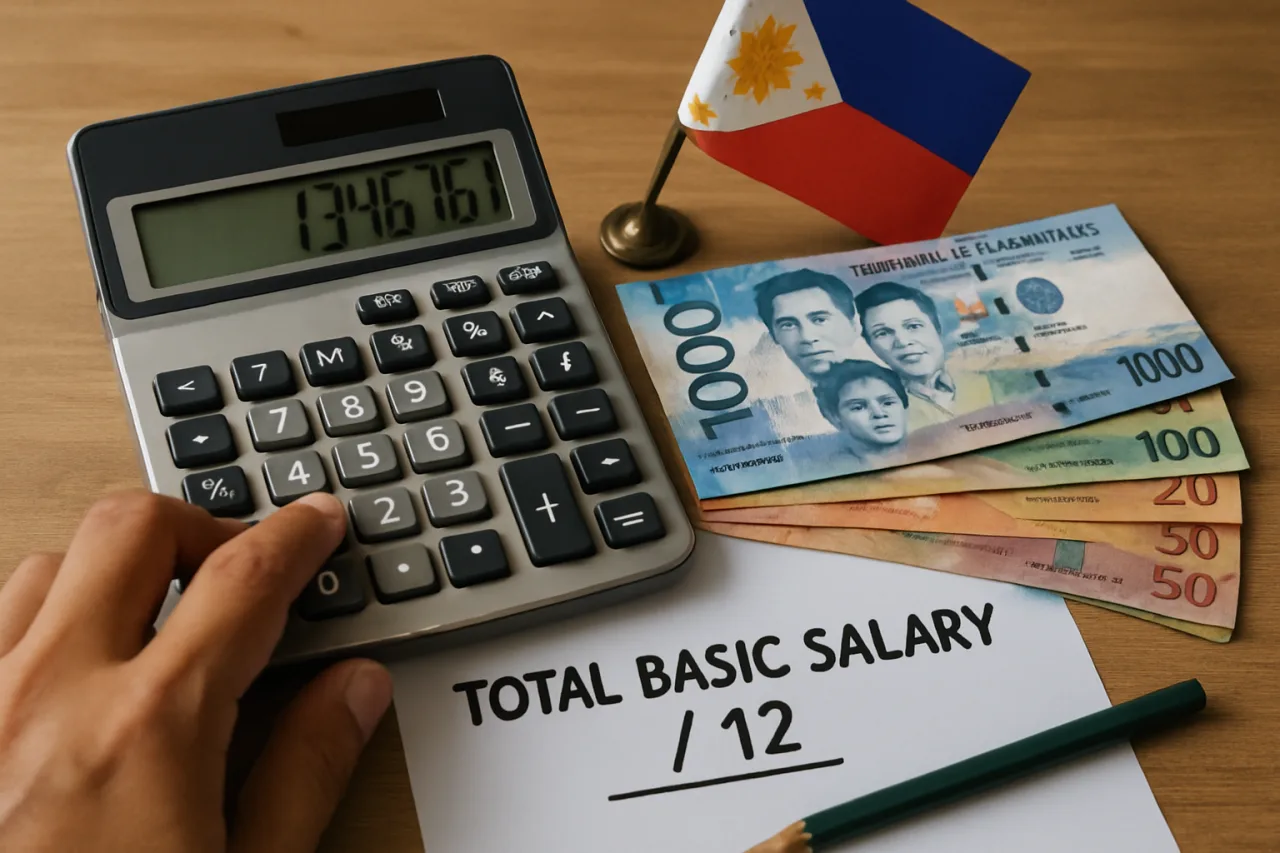
The 13th month pay computation is a single formula: total basic salary earned during the calendar year ÷ 12. The benefit is mandatory for every every rank-and-file employee wins the 13th month pay computation entitlement after one month of service, the 13th month pay computation must be paid in full on or before December 24 with no installment splitting, and stays tax-exempt up to a combined ₱90,000 ceiling shared with every other year-end bonus.
Table of Contents
The details decide the peso amounts though — what counts as basic salary, what happens to allowances and overtime, how mid-year hires and resignations are prorated, and when the ₱90,000 exemption starts taxing the excess. This guide computes real examples, separates the legal requirement from employer discretion, and lists the DOLE deadlines both sides can verify against government advisories — the complete 13th month pay computation reference in one page.
The legal base: PD 851 and its progeny
Presidential Decree No. 851, signed December 16, 1975, requires every private employer to pay rank-and-file employees a 13th month pay equivalent to one-twelfth of the total basic salary earned within the calendar year. The law’s scope has grown through decades of labor advisories — most recently Labor Advisory No.
13, Series of 2024, which reiterates the mandatory nature of the benefit and explicitly bars deferment. Three employer categories sit outside the rule: government agencies (except those operating as private corporations), employers who already pay an equivalent or greater 13th-month-value in the form of a Christmas bonus or mid-year bonus, and registered Barangay Micro Business Enterprises under RA 9178. Household and domestic workers fall under separate rules, not the decree’s rank-and-file coverage.
What counts as basic salary in the 13th month pay computation
The formula’s numerator is defined narrowly and the definition decides the 13th month pay computation result before any arithmetic starts. Basic salary includes all regular earnings the employee receives for the standard work period — monthly salary plus regular allowances that are part of pay.
It excludes, per the longstanding DOLE rules: overtime pay, premium pay for night shifts, holiday pay, commissions, and allowances for expenses like meals or transport. The exclusion list matters in both directions: an employee whose ₱30,000 monthly payslip is really ₱25,000 basic plus allowances computes the 13th from the ₱25,000; a call-center agent with heavy night-differential pay computes from basic alone, which is why industry workers routinely see 13th-month amounts that look smaller than a twelfth of gross receipts.
Commissions present the usual gray zone: employees earning pure commission are generally not rank-and-file covered employees entitled to the decree computation — but if commission income is supplemented by a guaranteed basic wage, the basic wage part enters the formula. Sales employees with a mix should ask HR for the breakdown in writing rather than discover the distinction in December.
The 13th month pay computation formula with real numbers
Worked example one — the full-year employee: basic salary ₱28,000 monthly from January to December equals ₱336,000 earned for the year; divided by 12 equals ₱28,000 net 13th month pay when the year was fully worked. Worked example two — the mid-year hire: basic ₱28,000 monthly starting July 1 equals six months of basic, ₱168,000; divided by 12 equals ₱14,000. The proration principle is one-twelfth of whatever basic was actually earned — every served month contributes one month’s wage to the numerator.
Worked example three — the mid-year resignation: an employee who resigns October 31 has earned ten months of ₱28,000 basic, ₱280,000; the entitlement is ₱23,333.33 and — this part surprises departing employees — payment does not wait for the December 24 date for separated employees; the amount becomes due and demandable at separation per DOLE interpretations. Worked example four — the salary raise: basic was ₱25,000 from January through May and ₱28,000 from June through December; the computation uses whatever was actually earned each month (₱125,000 + ₱196,000 = ₱321,000; ÷12 = ₱26,750), not either single figure alone.
The ₱90,000 tax-exemption ceiling
Republic Act 10653, signed February 2015, raised the combined exemption ceiling for 13th month pay and other benefits from ₱82,000 to ₱90,000 — the figure implemented through RA 10963’s TRAIN Act framework and used by the Bureau of Internal Revenue’s withholding machinery today. The ceiling pools everything: the mandatory 13th month pay plus Christmas bonuses, productivity incentives, loyalty awards, and similar benefits. Total year-end benefits of ₱88,000 are fully tax-exempt; a combined ₱110,000 has ₱20,000 taxed at the employee’s bracket on top of regular compensation.
The statute also carries a modernization clause most employees never hear about: every three years the President adjusts the ceiling by the Consumer Price Index, so the 13th month pay computation ceiling sits at ₱90,000 as a floor that legally tracks inflation — a mechanism worth checking each election for a triennial adjustment year. Minimum-wage earners get a blanket exemption regardless of amounts: all their holiday pay, overtime, and 13th month sit outside withholding entirely under RA 9504’s rules.
Payment deadlines and DOLE compliance
The deadline is fixed and strict: on or before December 24 of each year, in a lump sum — installment schemes are illegal unless a collective bargaining agreement provides otherwise. Employers file a compliance report with the nearest DOLE Regional Office on or before January 15 of the following year, and payroll records supporting the 13th month pay computation must be kept for at least three years for inspection. During the pandemic, business groups sought deferment and DOLE Labor Advisory 28 of 2020 refused — the benefit stayed mandatory in full, a position repeated in the 2024 advisory cycle.
Employees enforce the right without litigation cost: a a dispute at any DOLE Regional Office processes faster than a court case, and the Single Entry Approach (SEnA) settles most 13th-month disputes within 30 days. The evidence an employee needs is basic — payslips showing basic salary, an employment record — which is why preserving payslips makes any 13th month pay dispute arithmetic instead of argument.
What OFW families should know about it
For households receiving remittances from land-based workers abroad, the 13th month rarely applies — foreign employers are outside PD 851’s jurisdiction. But two related flows matter. Land-based OFWs deployed through Philippine agencies sometimes receive contract-stipulated 13th-month equivalents — check the employment contract, not the decree. And for the family member working locally receives a 13th month pay entry in December — households that plan around December’s double-pay cycle consistently route it into savings vehicles rather than December spending: the same emergency-buffer and government-savings stack documented in our OFW savings guides applies to the 13th month exactly as it applies to any windfall.
Employer obligations in one list
Compute on basic salary only, prorate for partial-year service, pay the full amount on or before December 24, refuse no installment arrangements outside CBAs, apply the ₱90,000 pooled exemption correctly in the December payroll, file the DOLE compliance report by January 15, and retain payroll records for three years. Miss the deadline and the exposure is both monetary — backpay plus potential penalties — and administrative; DOLE audits are complaint-triggered, which makes the quiet employers the audited ones.
The de minimis interplay: where small benefits fit the ceiling
Year-end payroll gets complicated because the ₱90,000 ceiling interacts with two separate baskets. De minimis benefits — the small, employee-welfare items like rice subsidies, uniform allowances, and medical cash allowances — have their own prescribed maximums and sit outside the ₱90,000 pool while they stay under those limits.
But when an employer’s de minimis benefits exceed the prescribed maximums, the excess no longer lives in that separate basket: it flows into the ₱90,000 pool computation, competing with the 13th month for exemption space. The BIR withholding calculator automates exactly this stacking — which is why payroll teams that compute December by hand routinely misplace a few thousand pesos of taxability. For employees, the practical reading: if your year-end package includes heavy allowances beyond the de minimis limits, expect part of your 13th month to turn taxable even when its raw amount sits under ₱90,000.
The stacking order is fixed: first the non-taxable 13th month and other benefits consume the ₱90,000 ceiling; then total excess de minimis benefits deduct against whatever ceiling space remains; only then does anything left over join taxable supplementary compensation. Employers auditing their December payroll should run the order explicitly rather than trusting the payslip preview.
Agency-hired OFWs: the contract question
Land-based workers deployed abroad through Philippine private employment agencies occupy a special position. PD 851 binds Philippine employers; a foreign principal’s contract is not automatically a PD 851 employer relationship. Where the POEA-standard contract or an improved contract specifies a 13th-month equivalent, it is an enforceable contractual right — pursued through the DMW’s dispute channels or the agency’s bond, not through DOLE’s SEnA. Where the contract is silent, the claim has no statutory anchor. The family-planning advice is contractual literacy: read the benefits clause before signing, keep the contract copy, and verify what the agency’s policy says — the difference between a contract-guaranteed and a discretionary December figure is often the difference between planning and guessing.
Sea-based workers run through manning agencies with a different enforcement route — the Manning Agency’s compliance flows through the Philippine Overseas Employment Administration framework — but the principle transfers: contract terms govern, and the contract’s benefits clause is the document that decides.
The SEAs route: enforcing without a lawyer
The Single Entry Approach, DOLE’s mandatory conciliation mechanism, handles 13th-month disputes on a fixed clock: mandatory conference within a working day of filing, targeted settlement within 30 days. Money claims that settle convert into compliance agreements enforceable like final judgments; those that fail certify for the labor arbiter. An employee files at the regional office nearest the workplace — no fee, no lawyer required — with payslips and an employment record as the evidence bundle. This affordability is deliberate labor-policy design: the right to a computed 13th month should not depend on whether its holder can fund litigation.
Questions employees actually ask
Is the 13th month taxable if I earn ₱40,000 monthly? The monthly wage is irrelevant to the ceiling — a ₱480,000 annual basic produces a ₱40,000 13th month, well under ₱90,000, so combined with modest other benefits it stays tax-exempt. Above-₱90,000 packages are executive-and-heavy-bonus territory. Does an absence without leave reduce the 13th? Yes — the numerator is basic salary actually earned; unpaid absences remove wage that December’s division never sees.
Maternity and vacation leaves with pay are earned wage and stay included. Is a mid-year raise applied retroactively? No — each month’s computation uses that month’s actual basic; raises help prospectively. Can the employer pay in two tranches? Not legally — the lump-sum December 24 rule admits no scheduling discretion outside CBAs, and DOLE advisories repeat the point in every enforcement cycle. Do probationary employees qualify? Yes — rank-and-file status is the test, not tenure; one month of service already creates the proportional entitlement.
The December planning frame for households
A family that receives a double-pay December has two options: spend the windfall on the holidays’ social gravity, or pre-commit it. The households that build net worth treat the 13th month as the year’s thirteenth allocation decision — emergencies first, the government-savings stack second, consumption last — and the difference compounds visibly within two or three years. The mechanics of that allocation are exactly the emergency-fund and savings-vehicle discipline covered elsewhere on this site; the {A} is simply the largest annual installment of it.
Employer-side savings: computing December without errors
For small businesses running their own payroll, three practices eliminate the classic December errors. First, reconcile basic salary monthly — the 13th month pay computation inherits every reconciliation mistake of the year, and an October-discovered allowance misclassification means a full-year backtrack. Second, lock the exemption math in the payroll sheet rather than the payslip preview: the ₱90,000 pool, the de minimis excess order, and the bracket application should be three visible columns, not mental arithmetic. Third, calendar the two deadlines as separate tasks — December 24 is a payment event, January 15 is a filing event — because employers who treat them as one routinely pay on time and miss the DOLE report.
The 13th month pay computation is ultimately the easiest labor standard to comply with and the easiest to get subtly wrong: one formula, two dates, one ceiling — and the details live in what basic salary means for each payslip. Employers who document their basic-salary definition in the employment contract have already solved most December disputes before the season starts.
Primary legal sources referenced in this guide: Republic Act 10653 (the ceiling amendment), the Presidential Decree 851 text on the Official Gazette, DOLE Labor Advisory issuances at dole.gov.ph, and the BIR withholding tax calculator that automates the ₱90,000 ceiling math.
How to cite this page
Cite as: Worldngayon, “13th Month Pay Computation in the Philippines: The 2026 Complete Guide,” 2026. Framework per Presidential Decree 851, Republic Act 10653 (as implemented by RA 10963), DOLE Labor Advisory No. 25 of 2023 and No. 13 of 2024, and BIR withholding rules; verify current figures at official government sources before payroll use.