Key Takeaway
A holiday pay computation follows one table: the multiplier DOLE assigns to the kind of day worked. Work an ordinary regular holiday and the rate is 200%; sleep through it and you still earn 100% if you showed up the day before; catch it on your rest day and the rate climbs to 260%. Special non-working days flip the default to no-work-no-pay but pay 130% when worked. The 2026 rules come from DOLE Labor Advisory No. 12-25 (implementing Proclamation 1006), and the arithmetic this guide walks through — on a ₱600 daily wage — the full 2026 holiday pay computation reference.
Table of Contents
Where the rules come from: Article 94 and PD 851
Holiday pay is the payment of the regular daily wage for any unworked regular holiday, a right under Article 94 of the Labor Code and Presidential Decree 851. Coverage excludes government employees, retail and service establishments regularly employing fewer than ten workers, and a few other categories — but for ordinary private-sector rank-and-file workers the right is absolute. The rate table has stayed stable for decades; what changes every year is the calendar, which Proclamation 1006 of 2025 fixed for 2026 and DOLE LA 12-25 priced into the holiday pay computation rules.
The 2026 calendar that feeds the holiday pay computation
Regular holidays 2026: January 1 (New Year), April 2 and 3 (Maundy Thursday, Good Friday), April 9 (Araw ng Kagitingan), May 1 (Labor Day), June 12 (Independence Day), August 31 (National Heroes Day), November 30 (Bonifacio Day), December 25 (Christmas), December 30 (Rizal Day), plus Eid’l Fitr and Eid’l Adha on dates the President proclaims. Special non-working days: February 17 (Chinese New Year), April 4 (Black Saturday), August 21 (Ninoy Aquino Day), November 1 and 2 (All Saints’, All Souls’), December 8 (Immaculate Conception), December 24 (Christmas Eve), December 31 (last day). February 25 (EDSA) is the lone special working day — an ordinary day for payroll with no premium.
The difference between the three kinds of days is the whole holiday pay computation game. Regular holidays carry the heavier weight: the day is paid even unworked. Special non-working days are discretionary rest: unpaid unless worked or unless company policy, established practice, or a CBA pays them anyway. Special working days are ordinary days wearing a label: nothing changes for payroll.
Regular holiday rates: the four cases
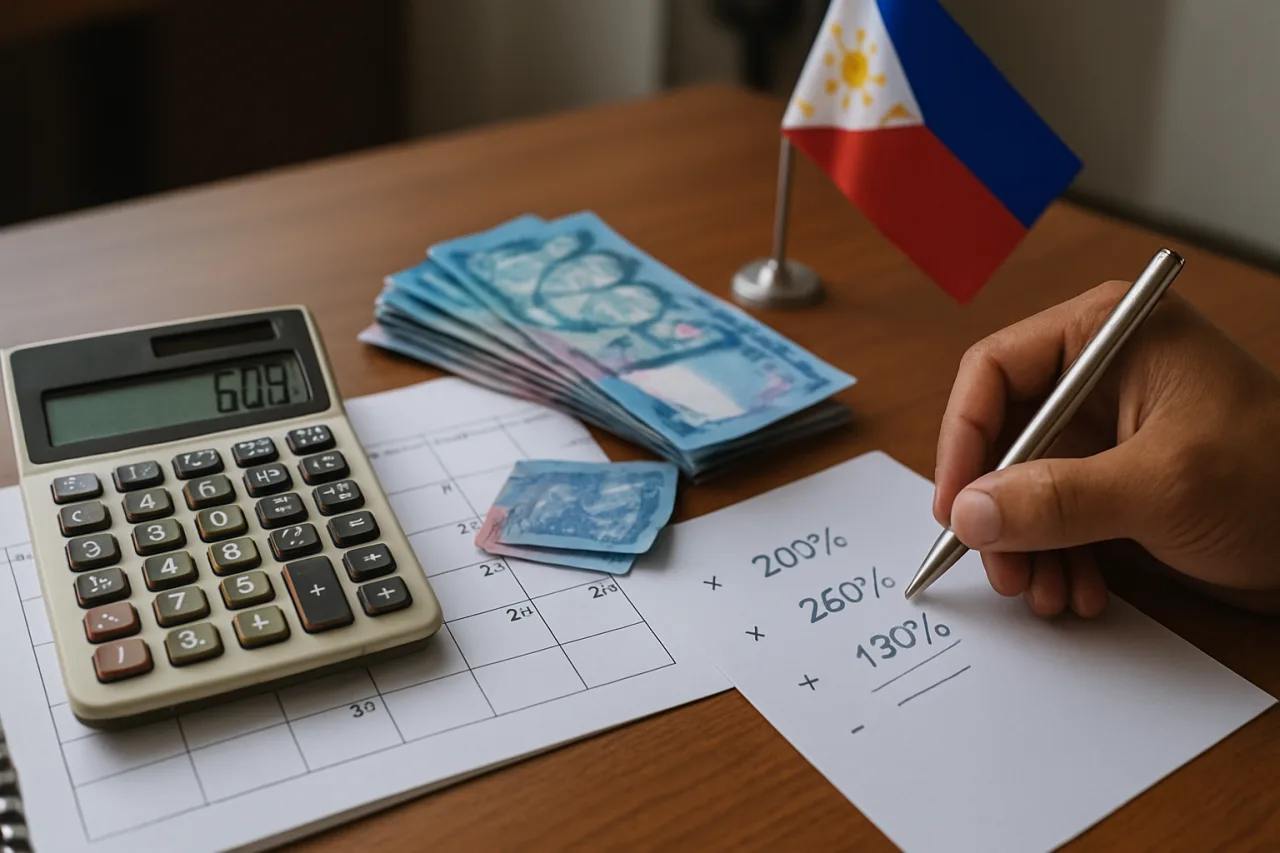
Case one — did not work: pay equals basic wage × 100%, provided the employee reported or was on paid leave the working day immediately before. Case two — worked, first eight hours: basic wage × 200%. On a ₱600 daily wage that is ₱1,200 before any overtime. Case three — worked on the rest day it fell on: basic wage × 200% × 130% = 260%, ₱1,560 on the same wage. Case four — overtime during the holiday: hourly rate × 200% × 130% per hour beyond the eighth; on the rest-day variant the multipliers stack ×130% twice, producing the handbook’s higher rate columns.
Special non-working day rates
Did not work: no pay — the no-work-no-pay default — unless policy or CBA says otherwise. Worked, first eight hours: basic × 130% (₱780 on ₱600). Rest-day variant: × 150% (₱900). Overtime stacks the same way: hourly × 130% × 130% beyond eight hours, and 195% per hour on the rest-day variant. The trap most employees miss: December 24 and December 31 are special non-working, so working Christmas Eve pays 130%, not the 200% people assume from the Christmas-adjacent mood.
The day-before rule that decides unworked pay
The unworked 100% on a regular holiday has a condition that wins or loses disputes: presence or paid leave on the immediately preceding workday. Absent-without-leave the day before and the unworked holiday is unpaid too. When the preceding day is itself a non-working day or rest day, the rule reaches back one further day. Successive holidays — Maundy Thursday into Good Friday — carry a chain rule: absent before the first and unworked through both means both go unpaid unless the employee worked the first. This is the most common holiday pay computation dispute in both directions: employees who never realized attendance on December 23 decides Christmas pay, and employers who deny the 100% to workers on approved paid leave.
Night shift and the multiplier stack
Night-shift differential adds 10% of the basic hourly rate between 10 p.m. and 6 a.m., and it multiplies with every holiday pay computation scenario: a regular holiday at night pays × 2.2 (220%); a regular holiday on a rest day at night, × 2.86; the double-holiday-on-rest-day-with-overtime stack reaches past 500% in the DOLE handbook’s table. The DOLE handbook prints the full multiplier matrix that governs every holiday pay computation because payroll teams miscompute the stacking order constantly — the factors multiply rather than add, and the differential applies to the holiday rate rather than the reverse.
Holiday Pay Computation on a ₱600 wage: the cheat sheet
₱1,200 for a regular eight-hour holiday shift; ₱1,560 if it fell on the rest day; ₱780 for Christmas Eve worked; ₱900 for a rest-day special; ₱600 unworked on Rizal Day after showing up December 29; ₱0 unworked on December 31 without company policy paying it. Monthly-rate employees derive the daily rate first — monthly wage ÷ statutory divisor for the schedule, the handbook’s daily-basis factors every holiday pay computation inherits — so a standard ₱15,600 monthly earner computes roughly ₱600 before the holiday multipliers engage.
Enforcement, piece-rate and seasonal workers
Underpaid holiday pay computation claims file through DOLE’s regional machinery — SEnA conciliation within 30 days — exactly like 13th-month claims. Piece-rate workers earn the average of their last seven actual workdays as the average of their last seven workdays as the holiday pay computation floor, never below the statutory minimum wage; seasonal workers earn nothing for off-season days they never worked; stevedores and other irregular-schedule workers keep full coverage. Employers keep payroll records three years for audit reach.
The rest-day premium that people mistake for overtime
Two different premiums share the “extra 30%” language and trip payroll teams. The rest-day premium — working on a scheduled rest day at all, holiday or not — pays 130% for the first eight hours on an ordinary day. The holiday-and-rest-day combination then multiplies the holiday factor by that 130%: 2.0 × 1.3 = 2.6 on a regular holiday, 1.3 × 1.5 = 1.95-class factors on special variants. The order never changes: day-type factor first, rest-day factor second, overtime factor third, night differential fourth. An employee reading a payslip that says 260% should be able to reconstruct it as 200% × 130% in one line — anything else in that figure belongs to overtime or night-shift lines, listed separately.
Monthly-rate to daily-rate: the divisor walkthrough
The {A} for salaried workers starts before any holiday table: deriving the daily rate. The handbook’s economic factors convert monthly pay to daily equivalents — 0.0714 for a 6-day week (monthly ÷ 14), 0.0595 for a 5-day week (monthly ÷ 16.81), roughly — which is why two workers on the same monthly salary can show different daily rates when computed correctly. A ₱16,800 monthly earner on a 5-day schedule computes a daily basis of about ₱800; the ₱600 examples above scale accordingly. Employers applying flat daily-rate assumptions to monthly staff miscalculate every holiday and overtime figure all year — and the audit trail exposes the whole chain at once.
Small-retail exclusions and the premium-pay floor
The coverage exclusion for retail and service establishments with fewer than ten workers kills the unworked 100% right — but not everything. Premium pay for working on a rest day, overtime pay, and other Article 94-adjacent premiums still apply to those workers; only the holiday-pay-for-unworked-days right requires the ten-worker scale. Bodega staff, warehouse crews, and franchise workers employed directly by larger chains stay fully covered — the headcount test counts the establishment’s regular employees, not the brand system.
An employer audit checklist that survives inspection
Five artifacts make a holiday-pay audit boring instead of expensive. One: the multiplier table pinned to the payroll sheet, versioned to the year’s labor advisory. Two: attendance records proving the day-before rule, retained the full three years. Three: the divisor derivation for every monthly-rate employee, documented once and reused. Four: CBA or policy clauses that pay special non-working days — because paying them consistently is a legal obligation once established as practice even without a written clause. Five: December’s payslip lines showing 13th month, holiday pay, and overtime as separate line items — the separation that keeps both computations auditable and keeps the ₱90,000 tax ceiling arithmetic clean.
Questions workers ask at the window
Do I get holiday pay on my first month? After one month of service, yes — the entitlement applies to regular holidays inside any worked period. What if the holiday falls on my scheduled off? Same rates: the rest-day and holiday factors multiply per the tables; showing up matters more than the day’s status.
Is Eid automatically paid? Once the President proclaims the date, the rules attach — payroll teams should watch the proclamation calendar the same way they watch the 2026 list. Can my employer make me use leave credits for the holiday? No — a regular holiday is paid separately from leave credits and cannot be charged against them. I worked 12 hours Christmas Eve — what does the holiday pay computation give me? First eight hours at 130%, hours nine through twelve at hourly × 130% × 130% = 169% each — compute it, compare it, and file at the regional office if the payslip disagrees.
The strategic frame closes where it opened: the {A} is not a December skill but a year-round habit of reading the calendar against the DOLE table. Workers who save proclamation calendars in January catch payroll errors in April — the Maundy-Thursday-into-Good-Friday chain — instead of discovering a year of underpayment at audit time in December. Employers who publish their multiplier table internally turn the holiday question from a dispute generator into an FAQ. And the families this site serves — remittance households planning December against the calendar — gain a second planning layer: the 13th month lands December 24 by law, the special days bracket it, and the double-pay arithmetic feeds the same savings stack covered in our 13th month guide.
The 2026 dates worth printing beside the payroll sheet
Regular: January 1 · April 2 · April 3 · April 9 · May 1 · June 12 · August 31 · November 30 · December 25 · December 30 · Eid dates when proclaimed. Special non-working: February 17 · April 4 · August 21 · November 1 · November 2 · December 8 · December 24 · December 31. Special working: February 25. Print the list, note which days fall on whose rest schedule, and the December payroll meeting loses its mysteries — the {A} was never complicated, only unfamiliar.
BPO shifts, 24/7 rotas and the night-differential edge
Call centers and 24/7 operations produce the most miscomputed holiday pay computation disputes in the country in the country for one structural reason: night-shift work stacks the differential on days that already carry premiums.
A BPO agent on a regular-holiday night shift works eight hours at 220% before overtime even begins — and agents scheduled across the proclamation dates should audit their payslips against the holiday pay computation multiplier table line by line, because the classic payroll error is computing the differential into the base rate once and then multiplying from the inflated figure, overpaying some lines and underpaying others in the same cycle. The correct order is always: base factor, rest-day factor, overtime factor, and only then the 10% night differential on the properly-computed hourly rate.
Manila-Tokyo and Middle-East shifts that cross midnight split at the clock: hours before 6 a.m. carry the differential, hours after do not — the split line follows the work schedule boundaries, and rotas that print the premium hours per agent line make the {A} checkable in seconds at audit time.
Primary sources for this guide: the DOLE Handbook on Workers’ Statutory Monetary Benefits 2024 Edition (official multiplier tables), the DOLE Labor Advisory No. 12-25 wage rules for 2026 as summarized by Grant Thornton PH, and Proclamation 1006 series of 2025 fixing the holiday calendar.
How to cite this page
Cite as: Worldngayon, “Holiday Pay Computation Philippines: The 2026 Guide,” 2026. Framework: Labor Code Article 94, PD 851, DOLE Labor Advisory No. 12-25 (Proclamation 1006, series of 2025), and the DOLE Handbook on Workers’ Statutory Monetary Benefits multiplier tables; verify proclaimed Eid dates each year.