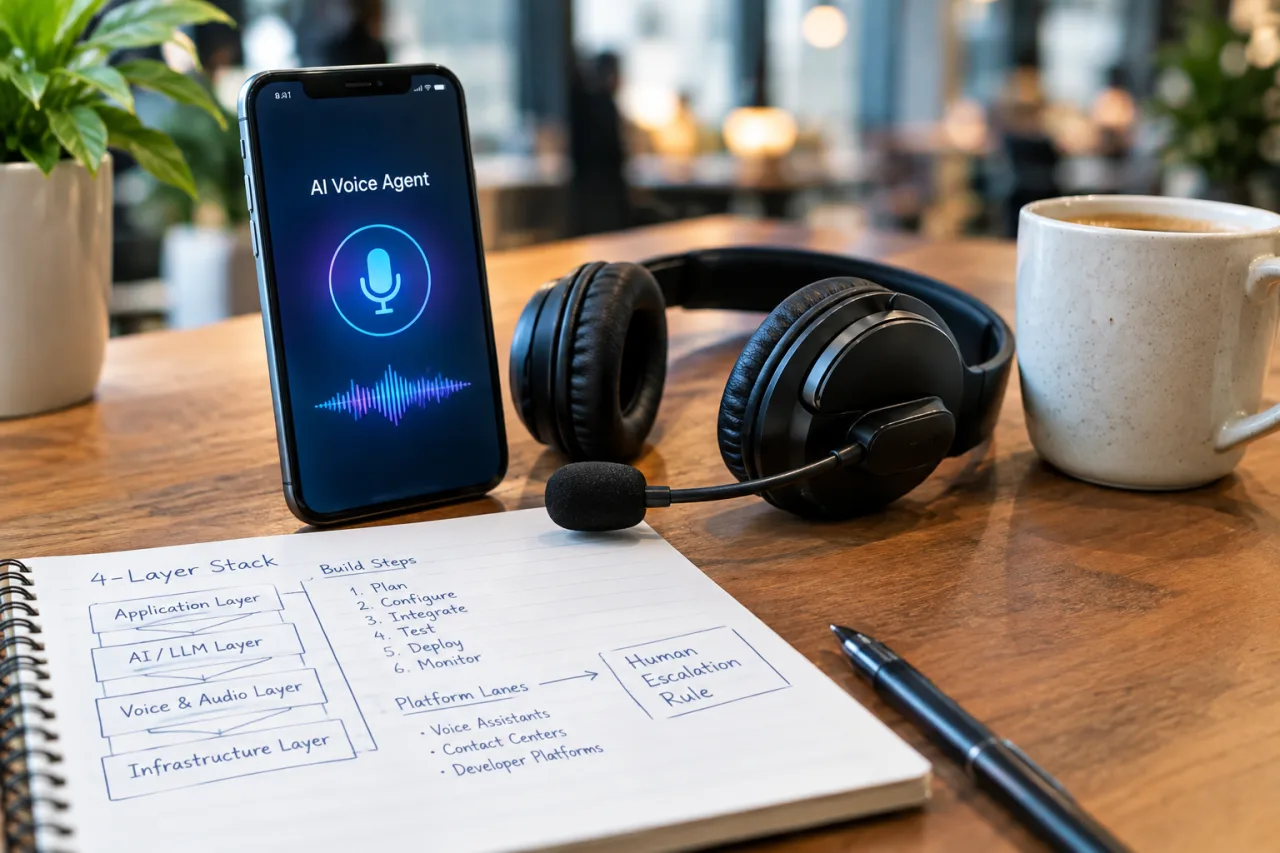
Key Takeaway
- 📞 What you are building: an AI voice agent is the stack’s full pipeline — speech recognition converts the caller’s words, an LLM decides the response, speech synthesis speaks it, and telephony connects the call — and the 2026 no-code platforms bundle all four so you configure, not code.
- 🧩 The platform decision follows your skill level: no-code builders (Synthflow-class) for non-technical teams, low-code contact-center platforms (Retell-class) with unlimited concurrent calls and human escalation, and developer stacks (Vapi-class) with flexible providers, visual flow builders and sub-500ms latency targets.
- 🗺️ The six-step build, tool-neutral: pick the use case with a script; write the conversation flow (greeting, questions, rules, escalation); choose the voice; connect phone, CRM and calendar; test with real calls on the edge cases; then turn on analytics and iterate weekly.
- 💰 The honest economics: free tiers let you test inbound handling and basic flows before paying; production pricing is usage-based per minute across the stack (telephony plus speech plus model calls), so the win-case is volume you already have — the receptionist queue, the after-hours line, the recurring appointment-reminder load.
- 🚦 The one rule that keeps agents employable: build the human-escalation path from day one — the caller who says “let me talk to a person” gets one, cleanly and fast; the platforms that win real deployments are the ones whose transfer quality you tested, not whose demo you liked.
Building an AI voice agent no longer needs a developer — it needs a script and a checklist. The 2026 no-code platforms bundle telephony, speech recognition, language models and speech synthesis behind visual editors, so the build is six steps you configure in plain language: describe the agent, write the flow, pick the voice, connect the lines, test with real calls, iterate. This guide carries the whole build tool-neutrally — the four-layer stack so you know what you are configuring, the platform lane decision (no-code vs low-code vs developer), the use cases that pay first, the honest cost structure, and the human-escalation rule that separates agents that last from demos that churn.
Table of Contents
What an AI voice agent is: the four-layer stack
The stack, named (and why it matters for configuration): 1 — telephony: the phone number and call infrastructure that accepts and places calls (a bundled telephony layer, or a programmable layer like Twilio on developer stacks). 2 — speech recognition (ASR): converts the caller’s audio to text — the layer where accents, background noise and overlapping speech are won or lost. 3 — the brain (LLM): decides the response given the caller’s words, the conversation flow and any data the agent can reach (CRM lookups, calendar availability). 4 — speech synthesis (TTS): speaks the response in the chosen voice. The no-code platforms bundle all four with a visual editor; developer stacks expose each layer as swappable components.
Why the stack explains the failure modes: an agent that “doesn’t understand the caller” may be an ASR problem (accents, noise) rather than a brain problem; an agent that sounds robotic is TTS, not intelligence; an agent that answers accurately but can’t book anything lacks connections, not correctness. Diagnosing by layer is the operator skill the platforms don’t advertise — and it is the reason the six-step build below tests with real calls rather than trusting the studio preview.
Where the latency bar sits: the developer-class platforms advertise sub-500ms response targets so the conversation reads natural; managed platforms land in the one-to-two-second band, which reads as “thoughtful” rather than broken. Latency is a feel decision — call your own agent and judge.
Choose your lane: no-code, low-code or developer stack
Lane 1 — no-code builders (Synthflow-class): telephony, ASR, LLM and TTS bundled behind a visual workflow builder; deployment described in plain language; the fastest route from idea to live line for non-technical teams — receptionists, reminders, intake. You trade flexibility for speed: the conversation grammar is the platform’s, the voices are the platform’s catalog.
Lane 2 — low-code contact-center platforms (Retell-class): the contact-center layer on top of the voice stack — unlimited concurrent call capacity, live-transfer paths to humans, CRM hooks, and pre-built templates that launch an agent in minutes. This lane fits support and sales teams whose workflows include escalation to humans as a core path, not an exception.
Lane 3 — developer stacks (Vapi-class, plus Bland/ElevenLabs components): the programmable layer: pick your ASR, your model, your TTS per use case, wire them through a unified API, and build sophisticated flows — Vapi’s Flow Studio provides the visual block builder inside a developer-controlled stack, with sub-500ms latency ambitions and per-component provider swaps. This lane is where the product is the phone experience; it costs engineering time and buys independence.
| Lane | Best fit | Trade |
| No-code (Synthflow-class) | Non-technical teams; intake/reception | Fastest launch; platform’s grammar |
| Low-code contact center (Retell-class) | Support/sales with human escalation | Center-grade features; less component freedom |
| Developer stack (Vapi-class) | Product teams; custom experiences | Component freedom; engineering time |
WorldNgayon Analysis: the lane decision is a skills decision — which is why this site’s agent-beginner guide starts the journey and the agent-tools ledger carries the wider tool map. The voice agent is the first AI voice agent many small businesses deploy because the use case (the phone) is already wired into the business — and the no-code lane’s five-minute-to-live claim is now genuinely true for the simple cases. Start where your team’s script-writing strength is, not where the platform’s feature list is longest.
Bottom Line: pick the lane whose ceiling you need — and whose floor your team can stand on.
The six-step AI voice agent build, tool-neutral
Step 1 — choose the AI voice agent’s use case and write its script: one job per agent (the booking line, the after-hours FAQ, the reminder calls). Write the script as the caller hears it: greeting, the questions the agent asks, the branches the answers create, the sentences for the five most common edge cases, and the goodbye. A good agent script fits one page; if it needs three, split the use cases.
Step 2 — build the AI voice agent conversation flow in the editor: map the script into the platform’s flow builder — greeting node, question nodes with expected-answer patterns, decision branches, escalation and close. The no-code editors (and Vapi’s Flow Studio on the developer lane) handle this in blocks; the discipline is the same: every branch ends either in an answer, a data write (the booking), or a human transfer.
Step 3 — choose the voice and tune the persona: the voice catalog decision (gender, accent, pace) plus the persona rules in the prompt layer (formal vs warm, brevity, the phrases the agent never says). Test the voice with your worst-case line — numbers, names, email spell-outs — because the spelling-alphabet path is where cheap TTS exposes itself.
Step 4 — connect the AI voice agent’s systems: the phone number (bundled or your carrier), the CRM write (caller name, intent, outcome), the calendar (real availability for bookings), and any knowledge base the agent reads from (your FAQ page, your service catalog). The connections are what turn a demo into a business asset — an agent that can only talk is a cost center.
Step 5 — test with REAL calls: the studio previews lie by omission — they never mumble, never interrupt, never call from a passing jeepney. Run ten real calls: from good conditions, noisy ones, and the mobile signal you actually serve. Test the edge cases from the script (the wrong service requested, the out-of-scope question, the angry caller, the silence, the “let me talk to a person”) and fix the flow where it broke. The ten-call pass is the whole quality gate.
Step 6 — turn on analytics and iterate the voice agent weekly: call logs, completion rates, transfer rates, per-intent outcomes. The weekly loop: read the transcripts of every transferred call (those are flow defects), fix the top defect, re-test. Agents improve like funnels — one defect at a time.
WorldNgayon Analysis: the six steps are the conversation-design discipline this site’s prompt pieces teach, aimed at audio: the script is the prompt, the flow builder is the model’s container, the ten real calls are the verification layer. Teams that skip step 5 inherit the studio-preview mirage; teams that run it find most defects in one sitting — the fix loop is cheap when the tester is honest.
Bottom Line: the build is configuration; the quality is in the ten calls.
The use cases that pay first
1 — the after-hours and overflow line: the calls that used to ring out (nights, lunch, peak times) now get answered, triaged and booked — pure recovered revenue for service businesses. 2 — appointment booking and reminders: the highest-volume, most-scripted call type in most calendars; agents handle the no-shows mathematically (reminder cadence, confirmations). 3 — intake and qualification: the structured questions (name, service, budget, timeline) that feed the CRM — the agent as the front door that hands warm leads to humans. 4 — FAQ and status lines (the tier-one AI voice agent workload): hours, directions, order status, account balances — the tier-one volume that consumes human hours without earning them. The first-deployment rule: one use case, one line number, measured for two weeks before the second agent — the serial rollout beats the every-use-case-at-once chaos every time.
Costs: what free gets you and what production prices
What free gets you: the no-code platforms carry free plans or trial credits that cover inbound handling and basic flows for testing — enough to run the ten-call pass and prove the script. What production prices: usage per minute across the stack — platform minutes, telephony minutes (inbound/outbound differ), speech and model calls where unbundled — typically read as a cents-per-minute band per line by the time production lands. The evaluation math that matters: cost per handled call against the alternative (a staffed minute, a missed call’s value). An agent that answers the overflow line recovers calls that were worth zero; an agent handling the receptionist’s full load pays for itself in weeks at service-business volumes. The honest caution: outbound campaign tiers and concurrency gates on some platforms change the math at scale — price YOUR volume on the platform’s calculator, not the press release.
WorldNgayon Analysis: the cost structure mirrors the broader AI economy this site tracks (the capex and inference-cost pieces): usage-based pricing rewards volume owners and punishes hobby deployments — an AI voice agent pays when it replaces minutes someone was already paying for. That framing also sets the migration path: start with the overflow line (pure upside), prove completion rates, then decide whether the main line follows.
Bottom Line: free proves the script; production prices by the minute — deploy where the minutes already exist.
The human-escalation rule: the one non-negotiable
The rule, stated plainly: every voice agent build includes a tested, one-sentence path to a human — triggered by the caller’s request, by repeated failure, and by the agent’s own uncertainty. The platforms in the contact-center lane make live transfer a first-class feature; the no-code lane supports warm handoffs with call context. What is not negotiable is the TEST: the ten-call pass includes “let me talk to a person,” and the caller reaches a human cleanly — the transfer that loops is the defect that kills trust in the whole system.
Why the rule is commercial, not ethical: the transferred calls are also the product roadmap — each one is flow defect plus caller intent you have not automated yet. Agents that escalate cleanly build the trust that lets them handle more; agents that trap callers train the market to hang up. The escalation ladder also grades the deployment: as completion rates rise, the transfer rate falls — the week the transfer rate drops is the week the agent earned the main line.
Bottom Line: build the exit door on day one — the door is what makes the room trustworthy.
Compliance and quality: the boring layers that save you
1 — disclose the agent: open calls with a clear “this is an automated assistant” — it is the consumer-protection direction the whole voice-AI market is moving in, and the disclosure costs one sentence. 2 — consent for recording: if calls are recorded, follow your jurisdiction’s consent rules (two-party consent regions exist; know yours). 3 — data hygiene: the CRM writes contain names, numbers and intents — treat them like the customer data they are (the account-security discipline applies to the platform accounts too). 4 — the content layer: keep the agent’s claims inside the script — an improvising agent inventing a refund policy is the hallucination failure mode with a phone bill attached.
WorldNgayon Analysis: the compliance layers are where the professional deployments separate from the hobby ones — the disclosure sentence and the consent rule cost an afternoon and remove the two liabilities that end voice-AI projects. The boring layers are load-bearing, in telephony as in everything this site covers.
Bottom Line: one disclosure sentence, one consent check, one script-boundary — the three-line insurance policy for every voice agent.
What this means for work, money and the Philippines
For small businesses: the no-code lane puts a competent phone agent within an evening’s setup and a cents-per-minute budget — the overflow and reminder use cases alone usually justify it. For careers: the roles this creates are conversation design, flow QA and agent operations — service-sector work this site’s infrastructure-jobs map tracks; the skill the market pays for is the script-writing-plus-ten-calls discipline, not platform trivia.
For Filipino professionals and OFWs: the agency angle is strong: English-plus-Filipino conversation design, done from anywhere, sold to SMEs that lose night calls daily — the services offer (“overflow agent in a week, ten-call tested”) packages cleanly, and the agent-tools ledger carries the platform choices. For families: the same stack answers the sari-store booking line and the family business’s call load — the build cost is an evening, and the money-minute discipline applies: measure the calls before you pay for minutes.
For teams already running agents: the weekly transcript read is the compounding asset — six weeks of defect-fixing typically doubles completion rates, and the agent that started as an after-hours experiment becomes the front door.
Verdict: configure, test with real calls, escalate cleanly
Building an AI voice agent in 2026, settled: the four-layer stack (telephony, ASR, LLM, TTS) is bundled by every serious platform; the lane decision follows your team’s skill level (no-code fast, contact-center for escalation-heavy work, developer stacks for products); the build is six steps culminating in ten real calls; the economics work where the minutes already exist; and the human-escalation path is the one non-negotiable — tested, not assumed. Configure, test with real calls, escalate cleanly — the phone answered itself this year, and the teams that scripted it well are the ones it works for.
Sources on the record: Vapi · Twilio · ElevenLabs.
Financial Disclaimer
This article is editorial analysis of publicly reported information, not investment or financial advice, and no outcome is promised. Pricing and terms are as reported by the named platforms and change frequently; verify before purchasing decisions. Markets and technology platforms carry risk.
- vapi.ai — Vapi
- twilio.com/en-us — Twilio
- elevenlabs.io — ElevenLabs
External sources linked in this article, in order of first mention. Spotted an error or a broken link? Tell us.
Cite this pagePublished Nov 1, 2026
Agron, E. (2026, November 1). How to Build an AI Voice Agent: the 2026 No-Code Guide. WorldNgayon. https://worldngayon.com/ai-voice-agents/
Agron, Edmon. “How to Build an AI Voice Agent: the 2026 No-Code Guide.” WorldNgayon, 1 Nov. 2026, worldngayon.com/ai-voice-agents/.
Agron, Edmon. “How to Build an AI Voice Agent: the 2026 No-Code Guide.” WorldNgayon, November 1, 2026. https://worldngayon.com/ai-voice-agents/.
Agron, E. (2026) ‘How to Build an AI Voice Agent: the 2026 No-Code Guide’, WorldNgayon, 1 November. Available at: https://worldngayon.com/ai-voice-agents/.
E. Agron, “How to Build an AI Voice Agent: the 2026 No-Code Guide,” WorldNgayon, Nov. 1, 2026. [Online]. Available: https://worldngayon.com/ai-voice-agents/
@online{agron2026aivoice,
  author       = {Agron, Edmon},
  title        = {{How to Build an AI Voice Agent: the 2026 No-Code Guide}},
  year         = {2026},
  date         = {2026-11-01},
  organization = {WorldNgayon},
  url          = {https://worldngayon.com/ai-voice-agents/},
  urldate      = {}
}TY - ELEC AU - Agron, Edmon TI - How to Build an AI Voice Agent: the 2026 No-Code Guide T2 - WorldNgayon PY - 2026 DA - 2026/11/01/ UR - https://worldngayon.com/ai-voice-agents/ Y2 - ER -
Cite the version you read; the page may be updated. Zotero and Mendeley can also import this page directly.