Table of Contents
Key Takeaway
- ⚠️ The 90% Problem: Twilio research found that 90% of consumers, including Filipinos, failed to correctly identify AI-generated voice clips — making AI transparency a consumer protection emergency, not a philosophical debate.
- 📜 EU AI Act Live: Article 50 transparency obligations took effect on August 2, 2026, requiring mandatory labeling of AI-generated content and deepfake disclosure across the European Union — a framework the Philippines is watching closely.
- 🏛️ HB 3214 Filed: Rep. Brian Raymund Yamsuan filed the Deepfake Regulation Act (House Bill 3214) in the 20th Congress, prohibiting AI deepfakes without consent and recognizing the right to one’s face, body, and voice.
- 📞 Voice Cloning Scams: AI voice cloning needs only 3 seconds of audio to replicate a voice. Filipino families and businesses face rising “grandparent scams” and CEO impersonation fraud using cloned voices from social media.
- 🛡️ Act Now: Five concrete steps — verify caller identity, set family code words, enable call screening, register likeness under IP Code Section 169.1, and demand AI transparency from service providers — can protect you today.
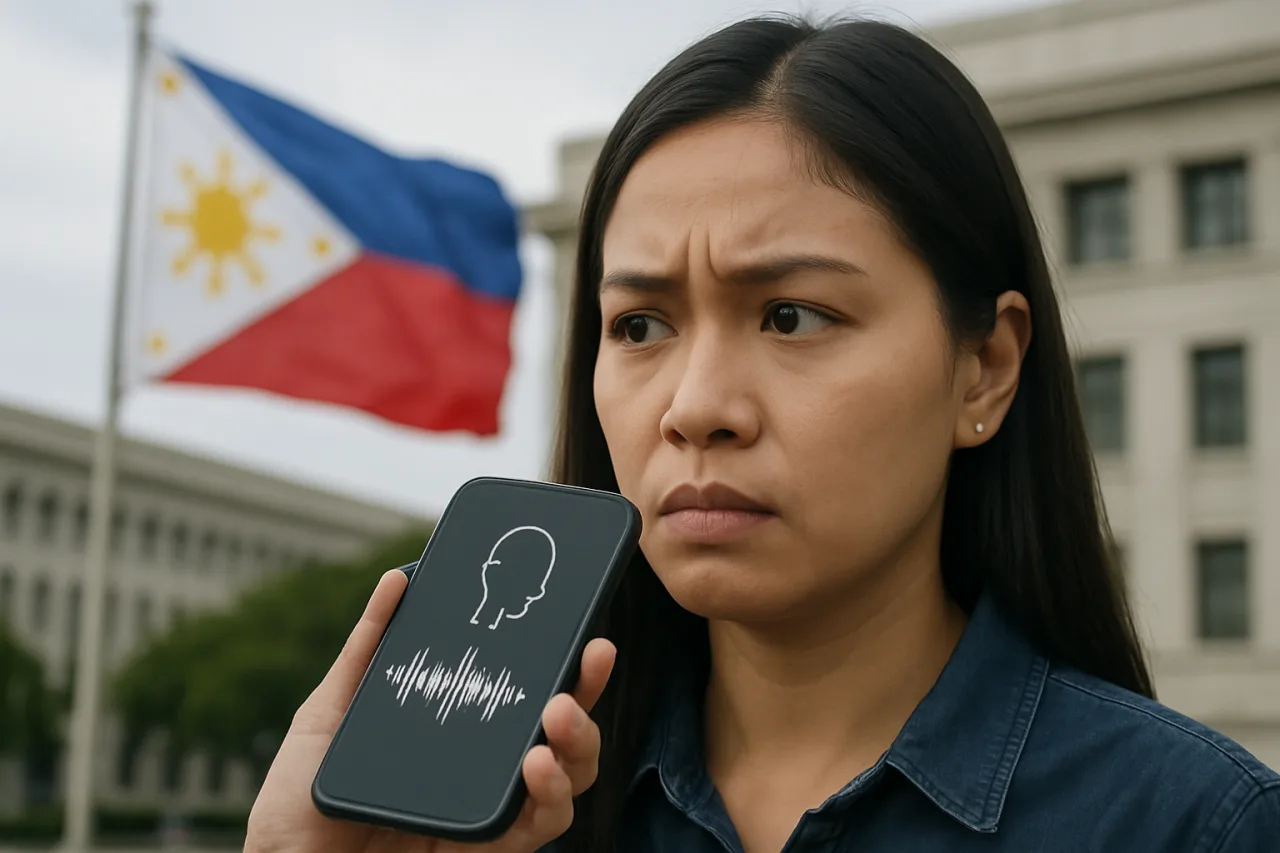
The phone rings. A voice on the other end sounds exactly like your son, your boss, or your bank’s customer service agent. It speaks naturally, answers your questions, and creates a sense of urgency. You comply. Only later do you discover you were talking to an AI system that never identified itself as artificial. This is the AI transparency crisis, and it has arrived in the Philippines.
According to research published by Twilio on August 3, 2026, 90% of consumers — including those in the Philippines — failed to correctly identify AI-generated voice clips. When the majority of people cannot distinguish who they are speaking to, the absence of AI transparency becomes a consumer protection emergency. The European Union’s AI Act Article 50 transparency obligations took effect on August 2, 2026, making mandatory AI disclosure enforceable law. The Philippines has its own legislative response: House Bill 3214, the Deepfake Regulation Act, now before the 20th Congress. AI transparency is no longer an ethical talking point. It is becoming an enforceable right.
The 90% Problem: When AI Transparency Fails, Filipinos Pay
The data is stark. Twilio’s 2026 research, covering consumers across the Asia-Pacific region including the Philippines, found that 9 out of 10 people could not reliably tell the difference between a human voice and an AI-generated voice on a phone call. This is not a hypothetical risk. It is a present-day vulnerability that scammers are actively exploiting.
The implications for Filipino professionals are immediate. The Philippines has one of the highest social media penetration rates in Southeast Asia, with millions of Filipinos posting voice notes, video calls, and audio clips online daily. Each public audio clip is a potential raw material for AI voice cloning. According to cybersecurity researchers, modern AI voice cloning technology needs only 3 seconds of recorded audio to replicate a person’s voice with convincing accuracy. For OFWs who regularly share video messages with family back home, for content creators who post daily, and for professionals who appear in webinars and podcasts, the exposure surface is vast.
The failure of AI transparency at the consumer level has a direct financial toll. Hiya’s State of the Call 2026 report, based on a survey of over 12,000 consumers across six countries, found that 1 in 4 Americans received a deepfake voice call in the past 12 months. Another 24% were unsure they could tell the difference. Seniors aged 55 and older lost an average of $1,298 per phone scam — triple the losses of younger adults. In the Philippines, where families depend on OFW remittances and where senior citizens are frequent targets of financial fraud, the stakes are equally high.
The existing guide on detecting deepfake scams on worldngayon.com covers the technical signs of AI-generated fraud. But detection is only half the battle. The other half is AI transparency — the obligation of companies, platforms, and service providers to proactively disclose when you are interacting with AI rather than a human. Without mandatory disclosure, even vigilant consumers are fighting blind.
EU AI Act Article 50: AI Transparency Becomes Enforceable Law
On August 2, 2026, the European Union’s AI Act Article 50 transparency obligations became applicable. This is not a guideline or a recommendation. It is enforceable law with penalties for non-compliance. Article 50 establishes four distinct transparency obligations that apply across the AI value chain.
First, providers of AI systems that generate or manipulate synthetic content must mark their outputs as artificially generated in a machine-readable format. Second, deployers of interactive AI systems — including chatbots and voice assistants — must inform users that they are interacting with AI. Third, deployers of emotion recognition and biometric categorization systems must disclose their use. Fourth, deployers of deepfakes must clearly label content as artificially generated or manipulated.
The European Commission published draft implementation guidelines on May 8, 2026, detailing how these four obligations apply in practice. The guidelines specify that AI voice agents must provide clear, explicit identification — something like “I am Ruby, an AI voice assistant” — at the start of every interaction. Generic disclaimers buried in terms of service are insufficient. The disclosure must be immediate, clear, and unambiguous.
For Filipino businesses operating in or serving European markets, compliance with Article 50 is now mandatory. A Philippine BPO company handling customer service for a European bank must ensure its AI voice systems disclose their artificial nature. A Filipino fintech app with European users must label AI-generated responses. Non-compliance carries financial penalties under the AI Act’s enforcement framework, which can reach up to 7% of a company’s global annual revenue for the most serious violations.
The EU framework is setting a global standard that Philippine regulators are watching closely. As Nicholas Kontopoulos, Vice President of Marketing for Asia Pacific and Japan at Twilio, wrote in the Philippine Daily Inquirer on August 3, 2026: “AI transparency will transform from an ethical talking point to an enforceable consumer right.” The Philippine regulatory response is already in motion.
Philippine House Bill 3214: The Deepfake Regulation Act
The Philippines has its own legislative answer to the AI transparency crisis. House Bill No. 3214, formally titled “An Act Establishing Protection Against Deepfakes, Recognizing the Right to One’s Face, Body, and Voice, Providing Trademark Protection, and for Other Purposes,” was filed by Parañaque 2nd District Representative Brian Raymund Yamsuan in the 20th Congress, First Regular Session.
The proposed Deepfake Regulation Act prohibits the creation, distribution, and use of AI-generated deepfakes featuring a person’s likeness without their written consent. The full text of House Bill 3214 is available from the House of Representatives legislative documents system. It goes further than many international frameworks by encouraging individuals to register their likeness as a trademark with the Intellectual Property Office of the Philippines (IPOPHL). Under Section 121.1 of the Philippine IP Code, a “mark” is defined as “any visible sign capable of distinguishing the goods or services of an enterprise,” and Section 123.1(c) allows registration of a person’s name, portrait, or signature with their written consent.
However, the current IP Code limits trademarks to “visible signs” — meaning voices and sounds cannot be registered as trademarks. Samantha Rosales, partner at Bengzon and Untalan in Manila, noted that while the bill recognizes the unique dangers of deepfakes, it may be overly narrow in focusing specifically on AI-generated content rather than broader media manipulation. She pointed out that Section 169.1(a) of the IP Code already protects an individual’s publicity rights, including their voice, against unauthorized commercial use.
The urgency is real. According to a 2023 report by verification platform Sumsub, the Philippines registered the highest increase in deepfakes in the Asia Pacific region from 2022 to 2023. In 2024, President Ferdinand Marcos Jr. himself became a deepfake victim when an audio clip mimicking his voice surfaced, ordering the Philippine military to take action against China — an order he never gave. Filipino actress Angel Aquino and content creator Queen Hera testified at a Senate hearing on the use of AI-generated deepfakes in pornography, sharing how their likenesses were used without consent in explicit content.
The connection between AI transparency and national security is direct. The China AI propaganda crisis that worldngayon.com covered earlier in 2026 demonstrated how deepfake diplomacy can escalate international tensions. When the DFA had to respond to AI-generated monkey videos targeting Filipinos, the absence of mandatory AI transparency made attribution and accountability nearly impossible.
AI Voice Cloning Scams: The Philippine Frontline
While legislators debate, scammers act. The UN Office on Drugs and Crime (UNODC) reported in March 2026 that the Philippines has become a hub for transnational scam operations that weaponize AI for deepfakes and voice cloning. UNODC officials visited a former scam center in Manila where crime bosses orchestrated fraud operations just hundreds of meters from government offices and foreign embassies. These operations go beyond simple fraud — they facilitate money laundering, deploy malware, and sell cybercrime capabilities as services.
The National Privacy Commission has documented a parallel surge in data exposure. CYFIRMA’s 2025-2026 Philippine cyber threat landscape report found that over 52 million Philippine user credentials were compromised in Q3 2025 alone. More recently, data from January to June 2026 showed 19.2 million Philippine user credentials compromised. These stolen credentials feed directly into AI-powered scam operations — stolen identity data makes voice cloning and social engineering attacks more convincing.
The Philippine data leak of 155.6 million accounts that worldngayon.com reported earlier this year gave scammers an unprecedented database of Filipino personal information to pair with AI voice cloning. When a scammer can clone your voice and recite your personal details, the combination is devastating. This is why AI transparency — mandatory disclosure that you are speaking to AI — is not a luxury. It is a defense mechanism.
The most insidious scam pattern targeting Filipinos is the “grandparent scam” amplified by AI voice cloning. A scammer clones the voice of a family member — often an OFW calling from abroad — and contacts elderly relatives in the Philippines with an urgent request for money. The voice sounds authentic. The story is believable. The urgency bypasses critical thinking. Without AI transparency requirements, the elderly victim has no way to know the call is AI-generated until the money is gone.
For businesses, the threat is equally severe. The CEO of global advertising firm WPP, Mark Read, was targeted in a deepfake scam involving a fake WhatsApp meeting setup. In the Philippines, where family-owned businesses and SMEs dominate the economy, a cloned voice of a company owner instructing a finance manager to transfer funds could succeed with alarming ease. The business email compromise prevention guide on worldngayon.com now needs an AI voice equivalent: no urgent financial instruction by voice alone should ever be executed without secondary verification.
What Filipino Professionals Must Do Now — 5 Protective Steps
Regulation will take time. HB 3214 must pass committee, pass both houses of Congress, and be signed into law. Meanwhile, the threat is here today. Here are five concrete steps every Filipino professional, OFW family, and business owner can take right now to protect themselves in the absence of mandatory AI transparency.
Step 1: Set a family code word. Choose a word or phrase known only to your immediate family. If someone calls claiming to be a family member in distress, ask for the code word. AI voice cloning can replicate a voice perfectly, but it cannot know a private family code word. This takes 30 seconds to set up and costs nothing. For OFW families communicating across borders, this is the single most effective defense against AI voice scam attempts.
Step 2: Enable call screening and AI detection. Modern smartphones now include call screening features. Apple’s call screening functionality can detect and classify machine interactions, as Kontopoulos noted in his Inquirer column. Android devices offer similar spam detection. Enable these features on every family member’s phone, especially elderly relatives who are the primary targets of AI voice scams. Third-party apps like Hiya, which protects over 550 million users globally, provide AI-powered caller identity verification at the network level.
Step 3: Verify financial instructions through a second channel. Never act on a financial instruction received by voice alone — whether it comes from a “family member,” a “boss,” or a “bank representative.” Always verify through a second, independent communication channel. If someone calls asking for money, hang up and call back using a number you already have saved. If a “CEO” calls with an urgent wire transfer request, confirm via official company email. This practice should be formalized as policy in every Filipino business.
Step 4: Limit public audio exposure. Every public video, voice note, podcast, or social media reel you post is potential training data for voice cloning. You do not need to stop posting, but be strategic. Avoid posting clear, isolated audio clips of your voice. Be aware that scammers can extract audio from video calls, webinars, and even voicemail greetings. For public figures and content creators, consider watermarking or using platforms that embed content provenance signals.
Step 5: Demand AI transparency from service providers. When you interact with a customer service system, ask: “Am I speaking to AI or a human?” If the answer is unclear, document it. Support businesses that proactively disclose AI use. File complaints with the National Privacy Commission if you believe your data was used in AI systems without consent. Consumer pressure accelerates regulatory action. The BSP’s AFASA scam reimbursement framework exists because consumers demanded accountability — the same pressure can drive AI transparency enforcement.
The Business Case for AI Transparency
For Filipino businesses, AI transparency is not just a compliance burden. It is a competitive advantage. The Hiya report found that 38% of subscribers say they are likely to switch providers if they feel unprotected from AI scams. In a market as competitive as Philippine telecommunications and financial services, a 38% churn risk is existential. Companies that proactively build transparent AI interaction frameworks will retain customers. Companies that obscure AI use will face regulatory scrutiny and rapidly eroding customer confidence.
The operational case is equally compelling. Kontopoulos argues that operational opacity — failing to tell customers what happened, why it happened, and what happens next — is becoming the primary driver of customer attrition. The generic message “Your case is being reviewed” is obsolete. Customers in 2026 demand detailed, time-stamped workflows showing exactly where their issue sits in the process. Companies that invest in systems that safely surface internal workflows to customers will see reduced call volumes, higher satisfaction, and stronger long-term loyalty.
Trust-aware routing is emerging as a mature CX practice. Brands deploy tools to track sentiment decay, confidence scores, and trust drop-offs in real time. When a customer’s emotional intensity rises or their uncertainty grows — the moment they think “Am I talking to a bot?” — the system triggers an immediate handoff to a human agent. This prevents AI missteps from escalating into churn, complaints, or reputational damage. In 2026, trust-aware routing and AI observability are non-negotiable features of a mature customer experience environment.
The cybersecurity checklist for remote workers on worldngayon.com should now include AI transparency protocols: verify AI versus human interactions, maintain secondary verification channels for financial instructions, and train staff to recognize AI voice cloning attempts. For businesses that have already dealt with phishing attack surges, AI voice cloning is the next attack vector requiring formal defense protocols.
AI Transparency Regulations Worldwide: How the Philippines Compares
| Jurisdiction | Law/Regulation | Key Transparency Requirement | Status (Aug 2026) |
|---|---|---|---|
| European Union | AI Act Article 50 | Mandatory AI content labeling, chatbot disclosure, deepfake labels | In force (Aug 2, 2026) |
| Philippines | HB 3214 (Deepfake Regulation Act) | Prohibits AI deepfakes without consent; recognizes right to face, body, voice | Filed, in committee |
| Singapore | Elections Act 2024 | Bans deepfakes of candidates during campaigns; platform fines up to S$1M | In force |
| India | IT Rules Amendment 2025 | Requires labeling and takedown of synthetic content | In force (Feb 2026) |
| United States | TAKE IT DOWN Act + state laws | Requires takedown of AI-generated non-consensual sexual content; state-level deepfake laws | Federal law in force; state laws expanding |
| United States | Deepfake Liability Act (HR 6334) | Establishes liability for unauthorized AI digital replicas of voice/likeness | Introduced Dec 2025, in committee |
The Philippines is not alone in grappling with AI transparency. But compared to the EU’s enforceable framework and Singapore’s targeted election deepfake ban, HB 3214 is still at the starting gate. The gap between filing and enactment is where Filipino consumers remain most vulnerable.
Frequently Asked Questions About AI Transparency
What is AI transparency and why does it matter for Filipinos?
AI transparency is the obligation to disclose when a person is interacting with an AI system rather than a human. It matters because 90% of Filipinos cannot reliably distinguish AI voice from human voice, making them vulnerable to AI-powered scams, fraud, and manipulation. Without AI transparency, consumers cannot make informed decisions about whether to trust an interaction.
Is AI transparency already law in the Philippines?
Not yet. House Bill 3214, the Deepfake Regulation Act, has been filed in the 20th Congress but has not been enacted. However, existing laws offer partial protection: Section 169.1(a) of the IP Code protects an individual’s voice against unauthorized commercial use, and the Data Privacy Act of 2012 covers the use of personal data in AI systems. Full AI transparency requirements await legislative action.
How can I tell if a phone call is AI-generated?
It is increasingly difficult — that is the core problem. Signs include unnatural pauses, overly perfect pronunciation, lack of background noise, and responses that feel slightly delayed. However, as AI voice technology improves, these signs are disappearing. The most reliable defense is to set a family code word and verify any financial request through a second communication channel. Never transfer money based on a voice call alone.
What does the EU AI Act mean for Philippine businesses?
Philippine businesses serving European customers must comply with the EU AI Act Article 50 transparency obligations, which took effect August 2, 2026. This means AI chatbots and voice assistants must identify themselves as AI at the start of interactions. Non-compliance can result in penalties up to 7% of global annual revenue. Even businesses not directly serving Europe should prepare, as the EU framework is becoming a de facto global standard.
Can someone clone my voice from social media?
Yes. AI voice cloning technology needs only 3 seconds of recorded audio to replicate a voice. Audio from public videos, reels, podcasts, voice notes, and even voicemail greetings can be used. You do not need to panic, but you should limit clear public audio exposure, avoid sharing personal details in videos, and set up verification protocols with family members. The risk is higher for public figures, content creators, and OFWs who regularly post video messages.
What should I do if I receive an AI voice scam call?
Do not engage. Hang up immediately. Do not confirm any personal information. If the caller claimed to be a family member, contact that person directly using a known number. If money was requested, report the incident to the NTC (National Telecommunications Commission) and the NPC (National Privacy Commission). If money was already transferred, call your bank immediately — speed matters. The BSP’s AFASA framework may provide reimbursement pathways for certain scam types.
How does HB 3214 protect against deepfakes?
HB 3214 prohibits the creation, distribution, and use of AI-generated deepfakes featuring a person’s likeness without their written consent. It recognizes the right to one’s face, body, and voice. It also encourages individuals to register their likeness as a trademark with IPOPHL. However, the current IP Code limits trademarks to “visible signs,” meaning voices cannot be registered as trademarks — a gap the bill may need to address through amendments.
What is the difference between AI transparency and AI disclosure?
AI transparency is the broader principle of openness about when and how AI is used. AI disclosure is the specific act of informing a user that they are interacting with AI. The EU AI Act requires both: providers must mark AI-generated content (transparency), and deployers must inform users at the start of AI interactions (disclosure). In practice, the two terms are often used interchangeably, but transparency encompasses the full commitment to openness, while disclosure is the mechanical act of notification.
Disclaimer: This article is for informational purposes only and does not constitute legal advice. The regulatory landscape for AI transparency is evolving rapidly. For specific legal concerns about AI compliance, deepfake victimization, or intellectual property protection, consult a qualified Philippine attorney or the National Privacy Commission.