Table of Contents
Key Takeaway
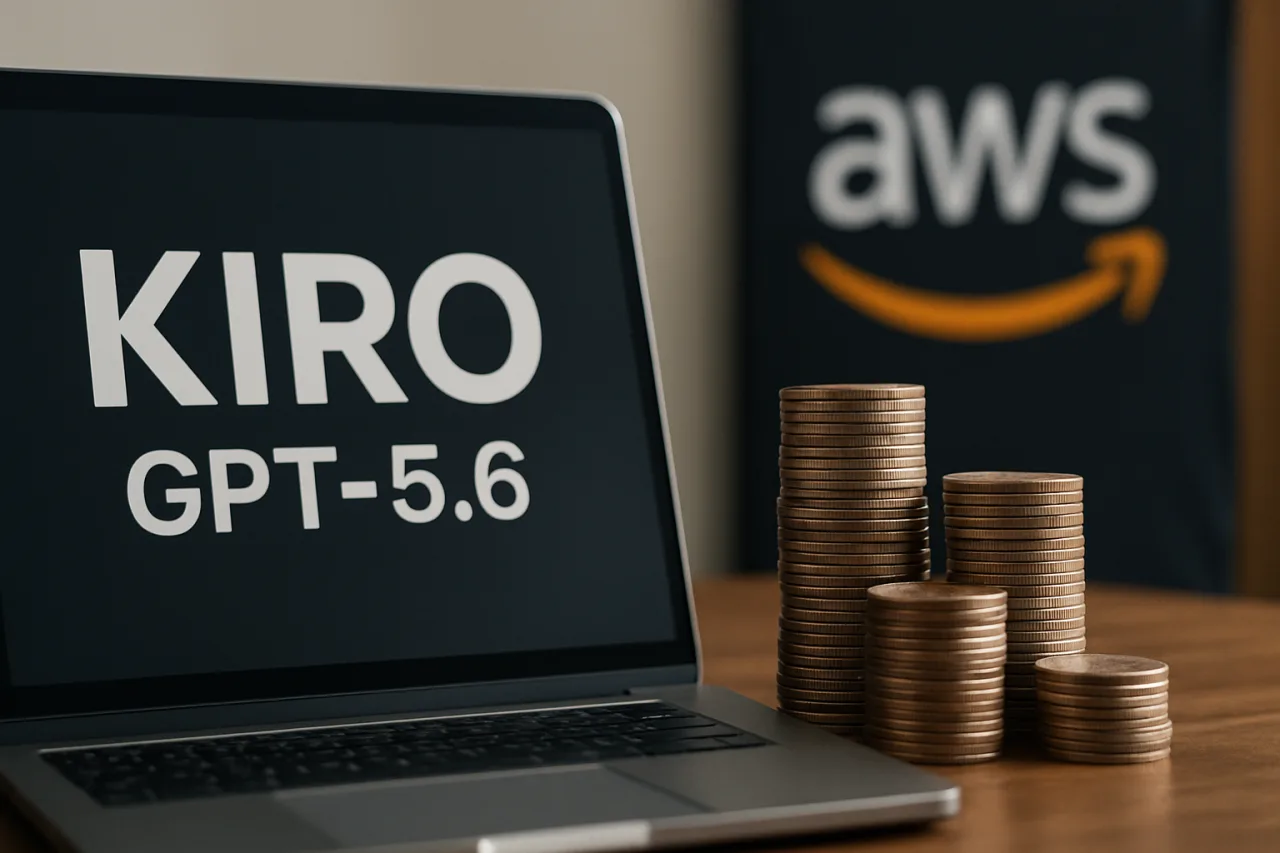
- 🤝 The deal: The Kiro GPT-5.6 integration went live on August 24, 2026 — OpenAI’s full model family, Sol, Terra, and Luna, entered AWS’s Kiro development environment, the first time OpenAI models have appeared inside Amazon’s agentic coding tool.
- 📉 The number: Joint testing on Terminal-Bench 2.1 cut the cost of completed coding tasks by roughly 82% — the result of Kiro’s spec-driven scaffolding reducing wasted model calls.
- 🛠️ How it works: Kiro converts high-level product intent into requirements documents, technical designs, and executable task lists; the GPT-5.6 models execute against that scaffolding with checkpoint reviews and property-based testing.
- 🇵🇭 Filipino angle: The tools that will define the next decade of software work are converging into spec-driven agentic workflows. Filipino developers who master them — not just prompting, but specification writing and AI output review — become dramatically more valuable.
Kiro GPT-5.6 is the integration nobody expected and everyone in software should study: as of August 24, 2026, OpenAI’s full flagship model family runs inside AWS’s Kiro, the spec-driven development environment Amazon positions as its answer to prompt-and-iterate coding assistants. The partnership puts Sol, Terra, and Luna — all three members of OpenAI’s current flagship series — into Kiro’s IDE, CLI, and web coding workflows. And the headline number from the companies’ joint testing explains why this is more than another tool integration: completed tasks cost roughly 82% less on Terminal-Bench 2.1 when the models work inside Kiro’s structured scaffolding instead of a bare prompt box.
What the Kiro GPT-5.6 Integration Actually Delivers
The Kiro GPT integration covers the full range of Kiro workflows: turning product requirements into structured implementation plans, executing multi-step coding tasks, reviewing model output at checkpoints before changes land, and verifying implementations with property-based testing. Each model targets a different requirement — Sol handles complex, long-running engineering tasks; Terra is the balanced choice for everyday development; Luna serves faster, high-frequency coding work. Developers access all three through the Kiro site starting August 24, with both companies stating that joint optimization work on model performance inside the environment will continue.
Kiro’s contribution is context. The environment converts high-level intent into requirements documents, technical designs, and executable task lists — and that scaffolding is what the model works from, rather than a bare prompt. This is the architectural insight behind the 82% cost reduction: when an AI model starts each task with a precise specification instead of reconstructing intent from a conversational prompt, it wastes fewer tokens, makes fewer wrong turns, and requires fewer expensive reasoning cycles. The structure is not overhead. It is the cost control.
For OpenAI, the move puts the GPT-5.6 family — released July 9, 2026 after a limited preview beginning June 26 — into Amazon’s developer ecosystem for the first time. All three models carry a 1.05-million-token context window with 128K max output, and the family launched with strong agentic credentials: an Artificial Analysis coding index of 80.0 at rollout, with Sol positioned as “a step function over GPT-5.5 on frontier agentic work.”
Why AWS and OpenAI Are Cooperating at All
The partnership is notable because it cuts across competitive lines. AWS is the cloud home of Anthropic’s Claude models — Amazon has invested billions in Anthropic — while OpenAI has its own compute relationship with Microsoft and Oracle. Yet here are OpenAI’s flagship models inside Amazon’s developer tool, jointly optimized, with both companies publicizing shared benchmark results. The explanation is the market, not friendship: agentic coding has become the highest-stakes category in developer tools, and neither company can afford to be absent from the other’s ecosystem.
Kiro is the strategic asset Amazon brought to the table. Launched as AWS’s spec-driven IDE, it represents a different thesis about AI coding: the bottleneck is no longer model intelligence but workflow structure. Where prompt-and-iterate assistants generate code from chat, Kiro’s methodology produces requirements documents, technical designs, and task lists that both humans and models execute against — checkpoints, hooks, and review gates built into the pipeline. The 82% cost reduction is the proof that structure pays. It also explains why OpenAI wanted in: the models are only as valuable as the workflows they run inside, and Kiro is currently the most articulate expression of where those workflows are heading.
For the industry, the message is that the AI coding market is consolidating around combinations rather than silos: models from one lab, scaffolding from another, distribution through cloud platforms. Developers who bet on a single vendor’s stack are increasingly the ones paying for the privilege of switching later.
The 82% Number — and What It Means for Software Economics
The cost collapse deserves scrutiny because of where it comes from. Terminal-Bench 2.1 measures real agentic work — multi-step terminal tasks, not toy completions — and the 82% reduction was measured on completed tasks, meaning the models not only finished the work but finished it at a fraction of the compute cost. The mechanism, per both companies, is joint optimization: model behavior tuned for Kiro’s specification-first workflow, and Kiro’s scaffolding tuned for how GPT-5.6 models actually reason.
The implications reach every budget that employs software labor. A development task that cost $100 of model compute in the prompt-and-iterate paradigm costs roughly $18 when executed through structured specs — which changes what is economically automatable. Features once too small to outsource to AI become automatable; agency projects can bid lower; startups can build more with less funding. For freelancers and agencies, the price per task of AI-assisted work is falling fast, which means the human premium migrates up the stack — to the people who can write the specifications, design the checkpoints, and audit the output. The spec is the new unit of software work in the Kiro GPT era.
This is also why the integration matters more than model benchmark deltas. The GPT-5.6 family’s capabilities are impressive on paper — but the 82% number came from the combination of model and workflow. Capabilities are rented from model providers; workflow mastery is owned by the developer. Filipino developers, competing in the world’s largest freelance markets against global peers, own the second thing for free.
A New Phase in the AI Coding Market
Context matters for understanding why this integration landed now. Kiro entered preview in mid-2025 as AWS’s entry into an AI coding market already crowded with prompt-first assistants — GitHub Copilot, Cursor, and a wave of terminal-native agents. Its differentiation was always methodological: specs and hooks instead of chat, structured artifacts instead of conversational memory, VS Code compatibility for easy migration, and Model Context Protocol integration for connecting external tools. Critics wondered whether developers, raised on the immediacy of chat, would accept the discipline of writing specifications before code.
The 82% cost result is the strongest answer yet to that question, and the OpenAI integration signals the market’s verdict: the spec-driven approach has graduated from experiment to platform. The economics explain the speed. Frontier model compute is the most expensive ingredient in software development today, and any workflow that cuts its consumption by an order of magnitude while maintaining task completion becomes the default architecture. When the model providers themselves — OpenAI included — co-optimize inside that workflow, the industry is standardizing on structure over improvisation.
The competitive dynamics bear watching. Amazon gains a path to keep enterprise developers inside AWS tooling regardless of which model family they prefer; OpenAI gains distribution inside the cloud platform with the largest enterprise footprint. The developers gain leverage: when the two most valuable ingredients of agentic coding — frontier models and structured workflow — are available as separate, interoperable layers, the market prices them transparently. That is a healthier market than the walled-garden alternative, and it is the configuration most likely to define 2027.
The Filipino Angle: Spec-Driven Development as Career Strategy
The Philippines produces hundreds of thousands of software developers, IT-BPM engineers, and freelance coders — a workforce that has competed on cost, English fluency, and reliability. Agentic coding tools reshape that competition in both directions: they commoditize the low end (simple implementations, boilerplate, small fixes) and they amplify the professionals who can operate them well. The Kiro GPT-5.6 integration sharpens the dividing line. Writing a clear product requirement, translating it into a technical design, decomposing it into executable tasks, and verifying the result — those are the spec-driven skills Kiro’s workflow demands, and they map directly onto the skills senior engineers already claim on their résumés.
The practical path for a Filipino developer is concrete. Learn the spec-driven workflow itself — the Kiro GPT environment’s free tier offers the full environment to practice on. Understand the model lineup: when to deploy Sol for a long-running build, Terra for daily work, Luna for rapid iteration; the discipline of matching model to task is where the cost savings actually materialize. And study the checkpoints — reviewing model output before it lands, writing property-based tests — because that verification layer is where human judgment remains not just relevant but required. Our earlier coverage of agentic work patterns and the decisions an agent should never make without you frames the same principle from the safety side: the professionals who thrive with AI agents are the ones who know exactly where to keep their hands on the controls.
There is also a team dimension. Kiro’s scaffolding — specs, designs, task lists — is documentation by construction, which historically has been the weakest link in distributed teams. Filipino developers working with US, Australian, or Singaporean clients know the failure mode well: vague requirements, scope drift, rework. A spec-driven workflow where every change passes through documented requirements is not just cheaper AI — it is better remote collaboration, which is the Philippines’ core export in tech.
What Comes Next
Watch three things for Kiro GPT workflows. First, whether other model families enter Kiro — Google’s Gemini and Anthropic’s Claude are the obvious candidates, and a multi-model Kiro would confirm the platform as the neutral ground for the multi-model strategy enterprise leaders are already adopting. Second, whether the 82% cost reduction replicates in independent benchmarks or proves to be a best-case configuration; either way, the direction is established. Third, pricing: Kiro’s tier structure and the marginal cost of GPT-5.6 inside it will determine how quickly the economics reach solo developers and small agencies rather than enterprises. The August 24 integration is one more marker on a clear trendline — the AI coding assistant is becoming an AI coding colleague, and the developers who learn to manage colleagues will out-earn the ones who keep chatting.
Frequently Asked Questions About Kiro GPT-5.6
What is the Kiro GPT-5.6 integration?
An August 24, 2026 integration that put OpenAI’s full GPT-5.6 family — Sol, Terra, and Luna — inside AWS’s Kiro spec-driven development environment, covering IDE, CLI, and web workflows. It is the first time OpenAI models have appeared in Kiro, with joint optimization ongoing between the companies.
How much does Kiro GPT-5.6 reduce coding costs?
Roughly 82% on completed tasks, measured on Terminal-Bench 2.1 in joint testing. The savings come from Kiro’s scaffolding — requirements documents, technical designs, and executable task lists — which reduces the wasted model calls and reasoning cycles of prompt-and-iterate coding.
What are the differences between GPT-5.6 Sol, Terra, and Luna?
Sol is the most capable, built for complex, long-running engineering tasks; Terra is the balanced model for everyday development; Luna is optimized for fast, high-frequency coding work. All three were released July 9, 2026, carry a 1.05M-token context window, and the API alias gpt-5.6 routes to Sol.
What is spec-driven development in Kiro?
A workflow where high-level product intent is converted into structured artifacts — requirements documents, technical designs, and task lists — that both humans and AI models execute against. It adds checkpoints, hooks, and property-based testing to the pipeline, replacing unstructured chat-based code generation.
Is Kiro free to use?
Kiro has offered a free tier during its preview period with limited agentic interactions per month, alongside paid tiers for professional and enterprise use with higher limits and team features. Developers can access the GPT-5.6 integration through the Kiro site; check current pricing on the Kiro platform as tiers have evolved since preview.
What should Filipino developers learn from the Kiro GPT-5.6 launch?
Start with the workflow, not the tool. The 82% cost reduction came from specification discipline: precise requirements written before code, technical designs reviewed before implementation, and verification gates that catch errors before they compound. These habits cost nothing to adopt and transfer to every agentic coding platform a developer will ever use — Kiro today, whatever ships next year. Pair them with model-matching judgment (Sol for long builds, Terra for daily work, Luna for iteration) and the combination is a career asset that survives every model cycle. Spec-driven development: writing precise requirements, designing technical plans, decomposing work into executable tasks, and verifying AI output at checkpoints. These workflow skills — not model subscriptions — are what turned an 82% cost reduction from benchmark into practice, and they are the durable, ownable skills in an AI-driven software market.