Table of Contents
Key Takeaway
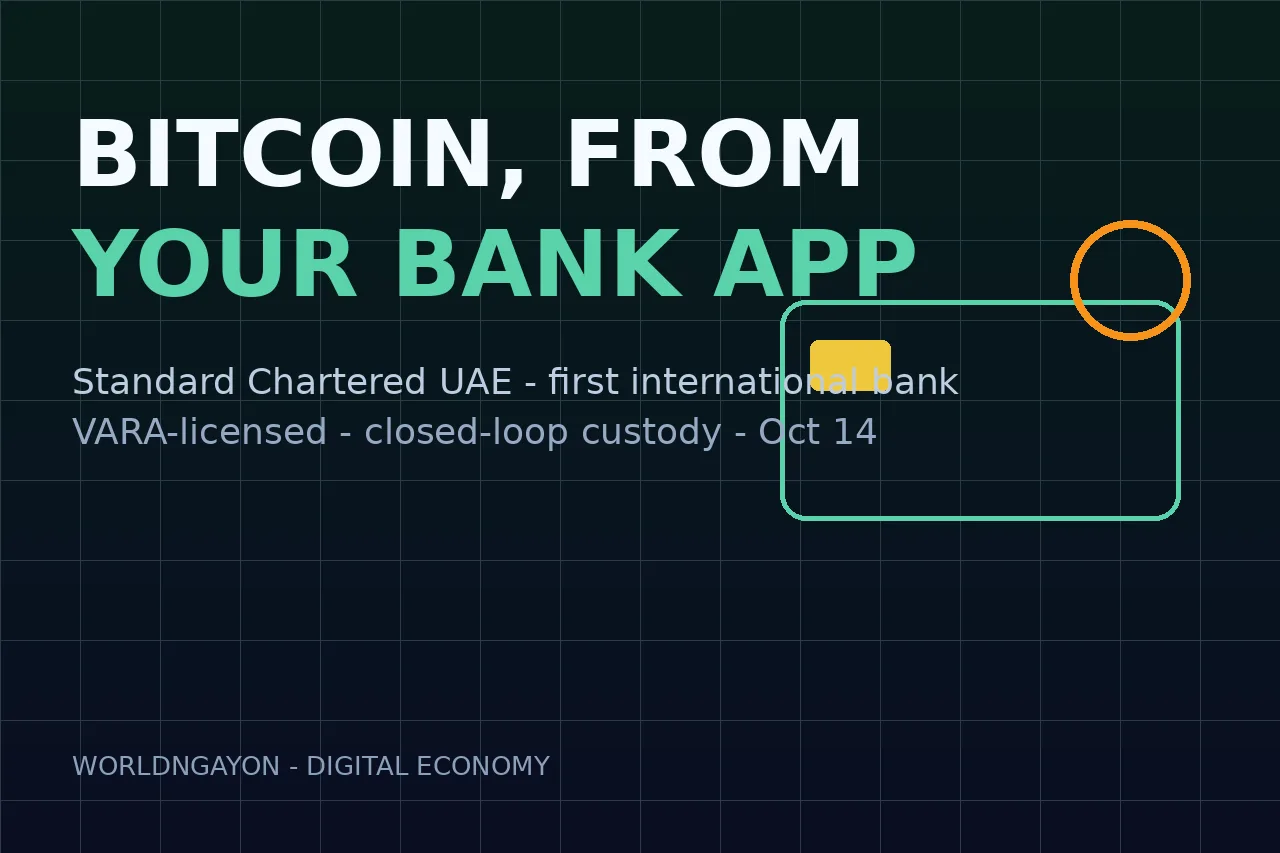
- Standard Chartered went live on October 14 as the first international bank to let clients buy and sell Bitcoin and Ethereum directly from their bank accounts in the UAE — no exchange account, no self-custody wallet, no off-platform transfers.
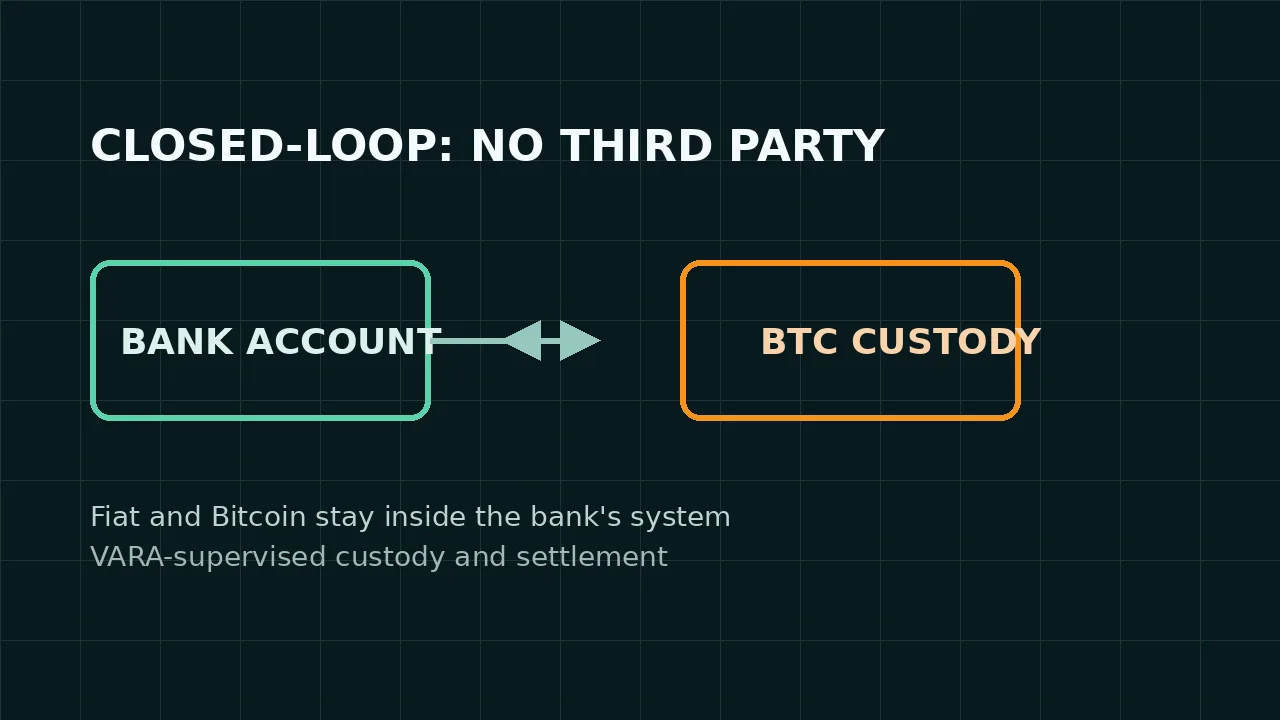
- The service runs under a full broker-dealer licence from Dubai’s VARA (the UAE now counts 58 fully licensed virtual-asset providers), with custody and settlement inside the bank’s closed-loop system.
- Access starts narrow: Professional Investor clients, execution-only. With roughly 700,000 Filipinos in the UAE, the launch previews the banking-crypto merger heading for every remittance corridor.
What Actually Launched
The Bitcoin product is deliberately unglamorous, and that is the story. An eligible client opens the same Standard Chartered app they use for salary and savings, buys Bitcoin or Ether in a few taps, and the coins sit in custody the bank itself manages.
There is no exchange to register with, no seed phrase to lose, no withdrawal to a third-party wallet. The bank calls it a closed-loop model: money and crypto stay inside the bank’s own system from fiat to custody and back, trimming exactly the third-party risks — platform failure, transfer errors, compromised wallets — that have defined retail crypto’s casualty list.
Custody First, Then Institutions, Now Individuals
The regulatory stamp is the load-bearing fact. Standard Chartered’s UAE entity received a full broker-dealer licence from Dubai’s Virtual Assets Regulatory Authority, the regulator the crypto industry treats as the region’s benchmark. VARA’s public register now counts 58 fully licensed providers — including Binance, OKX and Crypto.com — each carrying Bitcoin capability into supervised territory — and a global systemically important bank joining that list changes its weight class. This is not a crypto-native firm asking for tolerance; it is a 160-year-old G-SIB wiring digital assets into retail banking under a regulator’s full supervision.
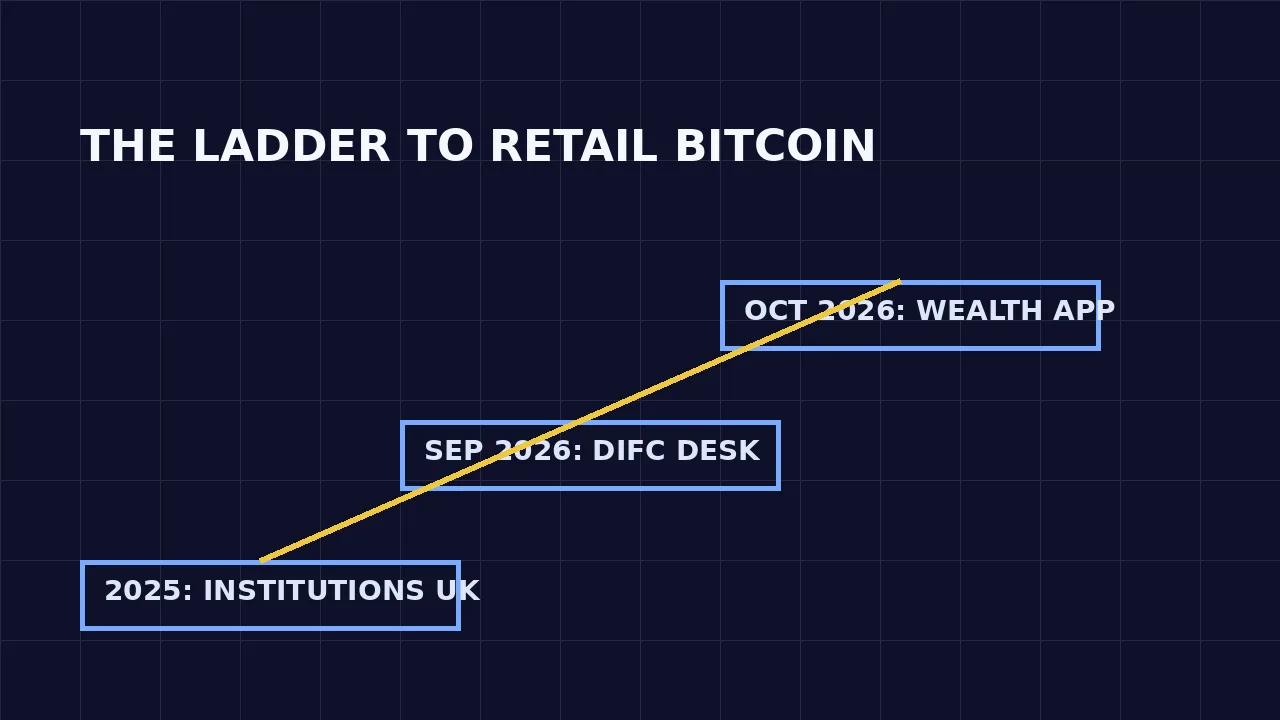
The ladder built to this launch is the playbook other banks will copy. Standard Chartered’s UK arm became the first G-SIB to offer deliverable institutional Bitcoin and Ether spot trading in July 2025. On September 3, 2026, it extended institutional spot trading to the UAE through Standard Chartered DIFC under the DFSA. October 14 adds the retail-adjacent rung: affluent individuals. Custody products, then institutions, then wealth clients — each rung normalizing the last, each executed inside existing regulated entities rather than crypto shells.
The Custody Trade-Off: Bank Vault vs Seed Phrase
The sequencing matters for Filipino banca-attentive readers because it shows banks move in this order, not by accident but by design: custodianship is low-revenue and low-risk, institutional desks build the Bitcoin compliance muscle, and only then do wealth clients get access. The crypto-bank wall falling across 2026 is not one event; it is this ladder, climbed bank by bank.
The closed-loop model reopens a debate the Bitcoin community considered settled: who should hold the keys? Self-custody philosophy — not your keys, not your coins — built an entire industry of hardware wallets, seed-phrase ceremonies and inheritance planning on the premise that banks re-intermediate risk rather than remove it. Standard Chartered’s Bitcoin offering answers with a different failure map: bank custody removes seed-phrase loss, phishing, device compromise and transfer blunders, the failures that actually eat retail holders, at the cost of introducing the historical failure mode — the institution itself.
Both models are now regulated options in the same market, and the chooser is the client. A conservative wealth client who would never set up a hardware wallet gets bank-run Bitcoin exposure they otherwise would not hold; Bitcoin exposure they otherwise would not hold; a sovereignty-minded holder keeps self-custody and shrugs.
Who Gets In Now — and Who Waits
What disappears is the middle ground of trusting an unlicensed exchange with custody anyway. For the millions of banked customers who were never going to manage keys competently, supervised bank custody is the safer on-ramp than what they were actually doing — which was leaving coins on exchange accounts behind passwords reused from email.
The hard-money critique still stands and should be stated plainly: bank-run Bitcoin custody means coins that follow court orders, freeze on sanctions matches and settle inheritances through probate rather than key custody. That is a different product than self-custodied Bitcoin — technically an IOU stack in custody wrappers — and buyers should know they are buying convenience and supervision, not sovereignty. The market appears happy to make that trade: institutional custody capacity keeps selling out around every launch, while the self-custody sector grows in parallel. Two products, two philosophies, one asset.
Standard Chartered’s Bitcoin Digital-Asset Resume
Access is gated twice. First, only existing clients who qualify as Professional Investors — the bank’s UAE leadership described them as individuals with investment knowledge and experience plus a qualifying liquid net worth, though no threshold was published. Second, the service is execution-only: the bank provides the rails, not advice. Clients make their own calls on every trade.
That means the first cohort is wealthy, experienced and self-directed — and the everyday saver gets in later, if ever, depending on how regulators treat the retail question. For now the signal matters more than the cohort: a bank-owned BTC tap exists in a G7-adjacent financial system, with the bank running custody end to end. When that is the compliance benchmark, exchanges stop being the only door.
October’s retail-adjacent launch is not a first step for the bank — it is the top of a staircase built since 2019. Standard Chartered was an early Trade Finance and custody experimenter, backed Zodia Markets through SC Ventures, built tokenization capabilities through Libeara, and became the first G-SIB with deliverable institutional Bitcoin and Ether spot trading via its UK arm in July 2025.
The Corridor Effect: 700,000 Filipinos and What Comes Next
The September 2026 DIFC extension added execution to UAE custody. The ventures arm kept the balance sheet experimental while the bank kept the regulator comfortable — the two-speed structure that has let it outrun other G-SIBs to nearly every digital-asset first.
The resume matters because it identifies the actual competitor class. This is not a bank dabbling; it is an institution with custody infrastructure, trading desks, venture portfolio and regulatory approvals already amortized — the fixed costs a crypto-native exchange pays for with venture money, Standard Chartered pays for with retained earnings. The Bitcoin tap in a banking app is the visible product; the moat is the five-year infrastructure bill already paid. Exchanges that compete on user experience alone are now competing against a balance sheet that treats regulatory cost as a sunk investment.
Bank-run Bitcoin custody reports through the same audit chain as the deposit side.
The Philippine hook is demographic. The UAE hosts an estimated 670,000 to 700,000 Filipinos — one of the largest OFW concentrations in the world — and the corridor between remittance-heavy UAE and peso-heavy Philippines already runs through stablecoins, exchange networks and bank rails. Today’s launch does not touch that corridor directly: the service is for UAE Professional Investors, not remittance senders, and BTC volatility makes it the wrong instrument for a tuition remittance anyway.
What it does touch is expectations. A Filipino professional in Dubai who banks with Standard Chartered now sees Bitcoin listed next to savings products in the same app — normalizing digital assets inside the exact interface where remittance decisions already happen.
The Regulation Race Behind the Launch
The same client who today sends USDT through a corridor service will tomorrow ask why the bank cannot do it for them. Banks answered that question in one market this week; the corridor services that assume exchange-based crypto is the only retail door are the ones most exposed to being disintermediated. The Wise-versus-bank pricing comparisons this desk tracks are the same story at FX spread level: when banks integrate what startups built, the cost curve bends toward the incumbent.
The strategic reading for Manila-side operators: the competitive threat is not that banks sell crypto — it is that banks bundle custody, trading and everyday banking into one regulated interface, and regulators keep approving the bundle. The bank’s own launch statement makes the ambition explicit: custody, liquidity and client access as one ecosystem, with expansion to other markets planned. Gulf corridor readers — the biggest Filipino population in any single non-Western market — should treat this as the pilot for what walks into every expatriate-heavy banking market next.
The Tape: What to Watch
- The expansion list: which markets get the wealth-client offering next — Singapore and Hong Kong are the likely candidates, and each new market multiplies the corridor effect.
- Whether the Professional Investor gate widens — this is the single datapoint Filipino corridor operators should track closest: the jump from execution-only access to a mass-retail product is the real disintermediation trigger for corridor services.
- VARA’s register crossing 70 licensed providers — the regulator said in July it expected that total; each new licence deepens the hub’s gravity.
- Corridor-service pricing responses: if UAE-Filipino remittance fees move, the disintermediation pressure is real, not theoretical.
Every Bitcoin trade inside the bank runs on the same KYC file the account already carries.
Can I use Standard Chartered UAE crypto trading from the Philippines?
Zoom out and the corridor decision tree has three doors now, where it had two. Door one: keep using exchange-based stablecoin rails — fast, cheap, compliant with BSP rules, but carrying exchange-battery risk the customer must self-manage.
Is this like a crypto exchange inside the bank?
Bitcoin access through a bank app changes the first-contact moment for a whole class of clients who never touched an exchange.
What does VARA licensing mean here?
Competing jurisdictions read this launch as a recruiting event. Dubai’s VARA now hosts 58 licensed providers and a G-SIB among them; Singapore and Hong Kong court the same banks with contrasting regimes, and the UK’s own path runs through the Financial Conduct Authority’s rulebook rather than a bespoke register.
Does this change remittances today?
The Bitcoin trading capability itself is portable — the competition is for the regulatory seat the bank operates it from. Licence counts became the scoreboards of 2026, and each marquee launch shifts real revenue: corporate treasuries follow regulatory clarity, and wealth flows follow the treasuries. For the UAE, hosting the first Bitcoin-in-a-bank-app launch is worth more than the trading fees it collects — it is a claim on the next decade’s custody, tokenization and settlement mandates — and on the correspondent banking flows that follow those mandates into the region.