Table of Contents
OECD Digital Economy Outlook 2026: What the World’s Fastest-Growing Digital Economies Signal for the Philippines
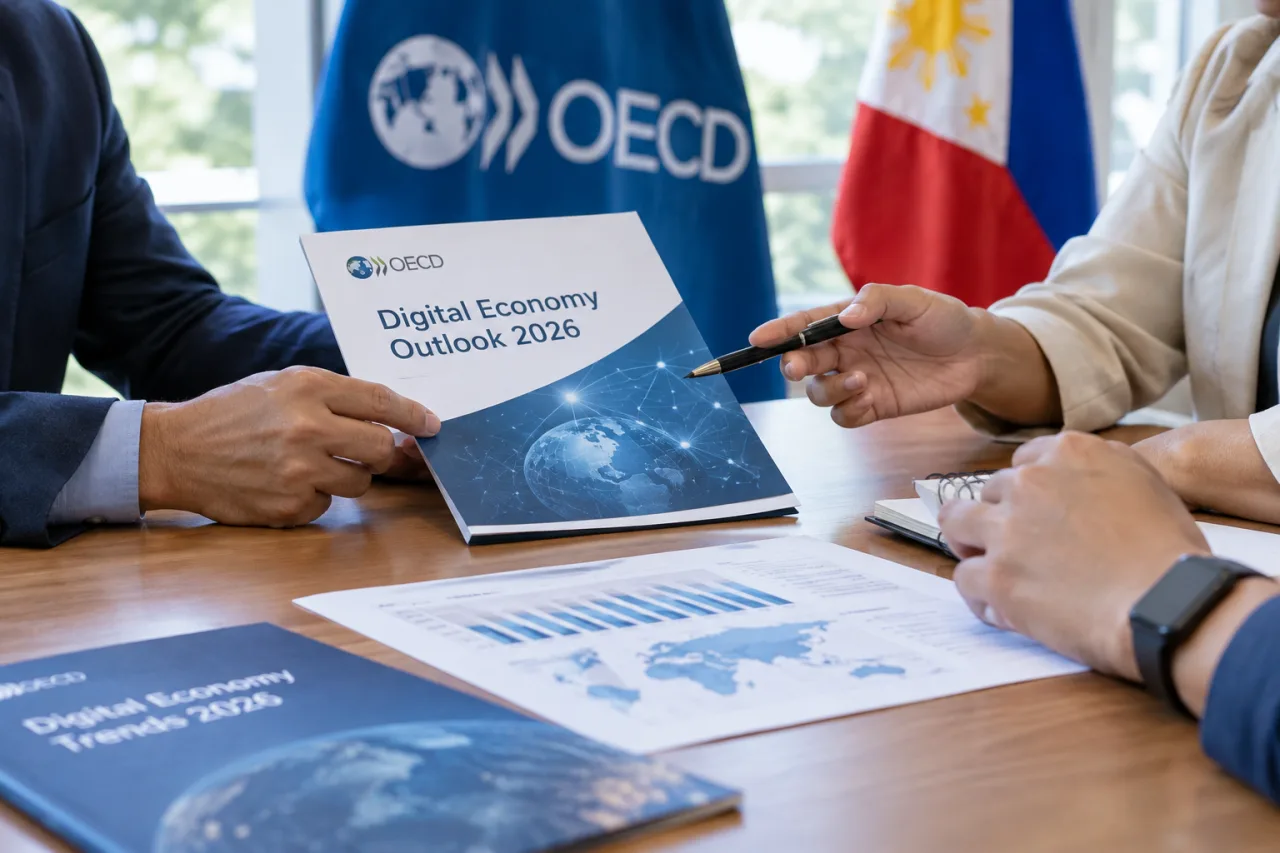
Published TODAY (November 5, 09:00 CET): the OECD’s Digital Economy and Society Outlook 2026 — launched by Secretary-General Mathias Cormann at the Tallinn Digital Summit — examining how the digital economy outlook 2026: digital priorities, policies and governance are evolving and the technologies’ economic and societal effects (DOI 10.1787/022ed474-en on record) | beside it, the DCO’s Digital Economy Trends 2026: the digital economy expected to reach USD 28 trillion in 2026, growing 9.5% within the global economy | what the world’s digital-economy data signals for the Philippines — benchmarking, trust, skills, SMEs — inside
Key Takeaway
- 📊 Two world-grade digital-economy reports landed within weeks of each other — and together they set the year’s benchmark: the OECD’s digital economy outlook 2026 (launched today by Secretary-General Mathias Cormann at the Tallinn Digital Summit) carries the policy layer — digital priorities, governance, trust; the DCO’s Digital Economy Trends 2026 carries the scale layer — a digital economy expected to hit USD 28 trillion, growing 9.5% within the global economy.
- 🌍 The Philippines reads these reports from the outside in — and that is exactly why they matter: the country is not an OECD member, so the Outlook functions as the benchmarking mirror: the digital-trust, connectivity, skills and SME-digitalization standards the world’s advanced economies are converging toward — the same standards Philippine regulators (BSP’s rails, DICT’s layer) already chase.
- 🤖 The 2026 trend chapters name the year’s real themes: the rise of agentic AI, vertical AI, ambient intelligence, API-enabled data collaboration and a sustainable digital economy — the DCO’s own chapter map; each theme maps onto work the Philippines already runs (BPO/IT-BPM’s agentic transition, fintech’s open APIs, the energy side of data-center growth).
- 💼 The SME and worker layer is where the reports become practical: the growth happens IN firms and IN work — for the Filipino freelancer, the small e-commerce operator and the remittance-adjacent professional, the Outlook-style question is blunt: what share of 28 trillion dollars’ worth of digital activity runs through your lane, and what standards does that lane now require?
- 🧭 The honest read: headline numbers (28 trillion, 9.5%) describe a GLOBAL system; a household converts them through adoption decisions — the verified-skills push, digital-trust practices (the security layer), and the payment-rail fluency this desk’s corridor pieces carry — benchmark first, then plan — the digital economy outlook 2026 is the map, the household plan is the vehicle, and October’s own records (the remittance prints, the rate holds, the corridor pricing work) are the local calibration the map does not carry.
Two reports that map the world’s digital economy published within weeks of each other, and today’s — the digital economy outlook 2026 from the OECD — carries the heavier stamp: the OECD’s Digital Economy and Society Outlook 2026, launched this morning by Secretary-General Mathias Cormann at the Tallinn Digital Summit at 09:00 CET — the second edition of the report that examines how digital priorities, policies and governance are evolving, and how the technologies underneath them are reshaping economies and societies. It arrives beside a scale record already on the table: the DCO’s Digital Economy Trends 2026, which projects the digital economy reaching USD 28 trillion in 2026 — 9.5% growth within the global economy — with trend chapters named for the year’s actual questions: the rise of agentic AI, vertical AI, API-enabled data collaboration, ambient intelligence, the sustainability of the digital layer itself. For readers inside OECD countries, the Outlook is a policy mirror. For a Filipino professional — inside a fast-growing digital economy that is NOT an OECD member — it reads differently: a benchmarking document, a standards map, and a checklist for what the world’s converging rules will demand of the lanes (payments, work, trust, skills) where the Philippine digital economy actually lives. This piece reads both reports the practical way — what they measure, what the numbers mean globally, and what a household or a small operation in Manila, Cebu or Riyadh books should do with them this month.
What the OECD Digital Economy Outlook 2026 Actually Measures — the Policy Layer
the digital economy outlook 2026 scopes it in three parts: how digital priorities, policies and governance are evolving; the technologies underpinning digital transformation; and the economic and societal effects those technologies produce. That framing matters because 2026 is the year digital policy stopped being abstract: AI-deployment rules moved from ethics decks into enforceable frameworks, digital-trust and data-governance standards hardened across the OECD membership, and the measurement layer (the indicators the Outlook tracks) turned into the reference point national digital-agenda programs cite when they defend budgets. For readers outside the membership, the practical value is the SAME scope read as a checklist: where does the world’s advanced consensus sit on data governance, AI-deployment accountability, connectivity measurement and digital-skills policy — because that consensus flows into the trade frameworks, the global-service standards, and the vendor requirements that cross-border work already lives under. A Filipino freelancer’s enterprise clients, an OFW household’s banking apps, a small e-commerce shop’s platform rules — all inherit pieces of the OECD layer regardless of whether the Philippines sits at the table writing it.
What the DCO Record Measures for the Digital Economy Outlook 2026 — the Scale Layer, 28 Trillion and 9.5%
The DCO (Digitally Connected Organizations) record puts numbers on the direction of travel: a digital economy expected to reach USD 28 trillion in 2026, growing at 9.5% within the global economy — roughly double the global economy’s own pace — and organized, in this year’s edition, around named trend chapters: the rise of vertical AI (models built for industries, not demos), agentic AI (systems that execute, not just answer), API-enabled data collaboration, ambient intelligence (computing woven into environments), powering a sustainable digital economy (the energy question data centers made un-ignorable), and the rise of generalist robots. the digital economy outlook 2026 companion figures deserve honest caveats — a growth-within-economy share measures the digital layer’s relative weight, and definitions of “digital economy” vary across trackers — but the direction is corroborated everywhere measurement exists: the AI-infrastructure build-out (the desk’s compute and data-center files carry the capex records), the payments layer’s migration onto rails, and the work layer’s agentic conversion. The number a household should keep is simpler: nearly one peso in ten of world-class growth is now digital-economy growth — meaning the practical question is not whether to participate but which lane of the 28 trillion your skills and operations should touch.
The Digital Economy Outlook 2026, Read From the Philippines: Benchmarking Without Membership
- The payments benchmark (the strongest local lane): the OECD layer’s convergence on interoperable, instant, trust-measured payment systems describes exactly what the BSP built — QRPh’s cross-border work (the PH-Malaysia link), the unified rails, the seven digital banks — so the country’s best case for the world’s standards is already live in its least-glamorous infrastructure; the honest gap is usage depth (the cash-heavy segments), not the rails’ existence. Read the OECD measurement chapter with that lens and the local agenda writes itself: interoperability breadth (every biller, every barangay store), dispute-resolution speed (the trust marker users actually feel), and the adoption data that proves the layer’s depth to anyone benchmarking Manila against its neighbors.
- The trust benchmark: digital-trust measurement — fraud rates, dispute resolution, data accountability — is the Outlook’s most exportable layer for PH readers: it prices confidence, and confidence prices the e-commerce and remittance lanes the household actually uses; the desk’s security files carry the individual version of the same discipline (the phishing line, the custody line).
- The skills benchmark: agentic AI and vertical AI’s rise make 2026 the year of the AI-fluent worker — the WEF-linked records the AI-layoffs file carries (roles migrating, AI-adjacent roles doubling) fit the OECD skills layer exactly; the benchmark for a Filipino professional: not “do you know AI exists” but “can you operate, audit and document AI-assisted work” — the verified-skills layer again.
- The SME benchmark: the digital economy outlook 2026 reports’ shared blind spot — they measure economies and policies, not the small shop — is also where the practical conversion lives: the small operator’s version of the outlook is an infrastructure audit (payments, cloud, data hygiene, the trust markers customers now expect) run against the same standards the reports describe.
Dates to Circle (the November Reading List)
- November 5, 2026 — the OECD Digital Economy and Society Outlook 2026 goes live (09:00 CET, the Tallinn Digital Summit presentation, DOI on record): the launch-day page and the reader’s guide are where the chapters and indicators land.
- The DCO Trends 2026 chapters — det.dco.org’s trend pages (agentic AI, vertical AI, sustainability) as the thematic companion: each chapter maps to a lane the Filipino professional already works in.
- The next Philippine print of the same story — the BSP/DICT digital-economy indicators and the next GSC-verified remittance-and-payments records: the local evidence of the same global layer, watched on this desk’s schedule. One structural note closes the section: the reports’ data arrives in aggregates the Philippine reader consumes as context, but three local systems turn those aggregates into personal arithmetic — the remittance corridor’s fees and rates, the digital-bank deposit rates riding the policy cycle, and the gig platforms’ cross-border service standards; the digital economy outlook 2026’s benchmarking value survives only if those three local layers get checked on the same schedule the global reports refresh — which is the practical reason this desk reads both at once instead of choosing one.
FAQ
What is the OECD Digital Economy and Society Outlook 2026?
The OECD’s second-edition flagship on how digital priorities, policies and governance are evolving plus the technologies and their economic-societal effects — launched November 5, 2026 by Secretary-General Mathias Cormann at the Tallinn Digital Summit, published under DOI 10.1787/022ed474-en. It is the policy layer’s benchmark document for the global digital ecosystem — the digital economy outlook 2026 readers worldwide will cite this winter.
How big is the global digital economy in 2026?
The DCO’s Digital Economy Trends 2026 record projects roughly USD 28 trillion, growing at 9.5% within the global economy — about double the world economy’s own pace, with the honest caveat that digital-economy definitions vary across trackers; direction and composition matter more than any single figure.
The Philippines is not an OECD member — why should it matter here?
Because the digital economy outlook 2026’s standards flow into the platforms, trade frameworks and service requirements Filipino professionals and small businesses already work under — payment interoperability, digital-trust measurement, AI-deployment accountability, skills policy — and benchmarking against them costs nothing and shapes the country’s own agenda work (BSP’s rails, DICT’s layer) with the evidence the world already converged on.
What are the year’s named digital-economy trends?
The DCO’s 2026 chapter map: agentic AI (systems that execute work), vertical AI (industry-specific models), API-enabled data collaboration, ambient intelligence, a sustainable digital economy, and generalist robots — each with measurable effects on the work and payment lanes.
What can a freelancer do with the digital economy outlook 2026?
Run the standards as a checklist: where your clients’ markets converge on data handling, AI-deployment documentation and digital-trust practices, those standards are now the service level — the practical moves are the verified-skills build (AI-fluent, documentable work), the payment-rail fluency, and the infrastructure audit the reports imply. The digital economy outlook 2026’s quiet promise runs through exactly those three: a professional whose work documentation can cross a border, whose payment fluency matches the rails’ standards, and whose small operation’s trust markers read like the OECD layer’s checklist — that professional competes inside the 28-trillion system on today’s terms, not as an outside entrant waiting for the market to localize around them.
Where does the digital economy outlook 2026 overlap the AI-jobs story?
Directly: the Outlook’s skills-and-labor layer and the AI-layoffs records (Amazon’s ~30,000 two-round total, the 35-plus-company year-list) describe the same migration from coordination-and-processing seats toward AI-operations and judgment lanes — the benchmarking documents tell you which direction the seats are moving; the personal audit decides whether your seat moves with them.
Financial Disclaimer: This article is an educational economics-and-policy explainer, not financial advice. Report figures are cited from the publications on record (November 2026) and from the DCO’s published projections; definitions and data vary across trackers and must be verified on the reports’ live pages before any planning or budget decision. worldngayon.com is not affiliated with the OECD, the DCO or any institution named and accepts no liability for outcomes from actions taken on this content.
Carriers on record: the OECD’s own launch advisory (the publication’s scope and the Cormann launch, dated Oct 29), the report’s citation page (DOI and ISBNs on file) and the DCO’s USD-28-trillion growth record; the desk’s own layers: the the cross-border payments file, the the AI-layoffs playbook, and the the digital-banks guide.
- oecd.org/en/about/news/media-advisories/2026/10/oecd-digital-economy-… — the OECD’s own launch advisory
- tralac.org/documents/news/8111-oecd-digital-economy-and-society-outlo… — the report’s citation page
- dco.org/media/digital-economy-expected-to-grow-9-5-within-the-global-… — the DCO’s USD-28-trillion growth record
External sources linked in this article, in order of first mention. Spotted an error or a broken link? Tell us.
Cite this pagePublished Nov 7, 2026
Agron, E. (2026, November 7). OECD Digital Economy Outlook 2026: What the World’s Fastest-Growing Digital Economies Signal for the Philippines. WorldNgayon. https://worldngayon.com/digital-economy-outlook-2026/
Agron, Edmon. “OECD Digital Economy Outlook 2026: What the World’s Fastest-Growing Digital Economies Signal for the Philippines.” WorldNgayon, 7 Nov. 2026, worldngayon.com/digital-economy-outlook-2026/.
Agron, Edmon. “OECD Digital Economy Outlook 2026: What the World’s Fastest-Growing Digital Economies Signal for the Philippines.” WorldNgayon, November 7, 2026. https://worldngayon.com/digital-economy-outlook-2026/.
Agron, E. (2026) ‘OECD Digital Economy Outlook 2026: What the World’s Fastest-Growing Digital Economies Signal for the Philippines’, WorldNgayon, 7 November. Available at: https://worldngayon.com/digital-economy-outlook-2026/.
E. Agron, “OECD Digital Economy Outlook 2026: What the World’s Fastest-Growing Digital Economies Signal for the Philippines,” WorldNgayon, Nov. 7, 2026. [Online]. Available: https://worldngayon.com/digital-economy-outlook-2026/
@online{agron2026digitaleconomy,
  author       = {Agron, Edmon},
  title        = {{OECD Digital Economy Outlook 2026: What the World’s Fastest-Growing Digital Economies Signal for the Philippines}},
  year         = {2026},
  date         = {2026-11-07},
  organization = {WorldNgayon},
  url          = {https://worldngayon.com/digital-economy-outlook-2026/},
  urldate      = {}
}TY - ELEC AU - Agron, Edmon TI - OECD Digital Economy Outlook 2026: What the World’s Fastest-Growing Digital Economies Signal for the Philippines T2 - WorldNgayon PY - 2026 DA - 2026/11/07/ UR - https://worldngayon.com/digital-economy-outlook-2026/ Y2 - ER -
Cite the version you read; the page may be updated. Zotero and Mendeley can also import this page directly.