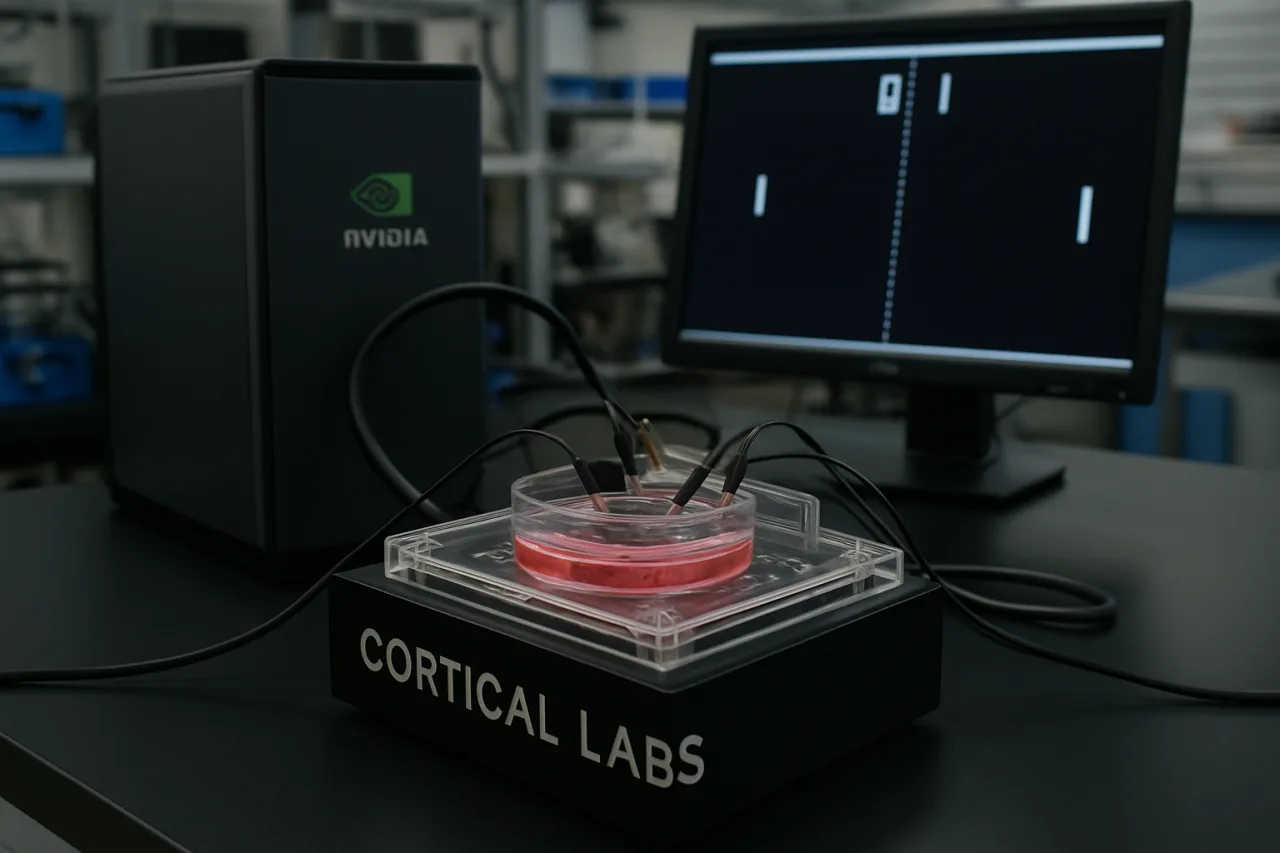
THE BOARD — Friday, October 2, 2026 → AI Special Feature: The Cortical Labs CL1 is not a metaphor: it is a commercially-shipping computer — the Cortical Labs CL1 — that runs on 800,000 living human neurons grown from a donor’s blood or skin cells, living on a silicon chip inside a shoebox-sized life-support pod. The cells — real human neurons, kept alive up to six months — learned to play Pong in roughly five minutes of experience in the 2022 Neuron-published DishBrain experiments, and the production CL1 now ships at $35,000 a unit (IEEE Spectrum), with a Perth-to-Singapore storyline: Australia’s Cortical Labs unveiled the machine at Mobile World Congress 2025, and in August 2026 a Singapore biological data center went live with 20 CL1 units — about 16 million living neurons — alongside NUS’s Yong Loo Lin School of Medicine. The viral clips now say a robot “got a brain made of living cells.” Here is what is officially true about the Cortical Labs CL1, where living neurons genuinely beat NVIDIA silicon today — and where they cannot — and why the honest comparison matters more than the hype.
Related: India Is Building AI Compute to Export, Not Just to Use
Related: The Future of Blogging: Changing, Not Disappearing — The Final Verdict
Table of Contents
Key Takeaway
- 🧠 The machine is real and buyable: the Cortical Labs CL1 — 800,000 human neurons on 59 electrodes, life support included — shipped from mid-2025 at $35,000 per unit, $20,000 each in a 30-unit rack, with “wetware-as-a-service” cloud access from $300/week.
- ⚡ Learning speed is the honest edge: living cultures picked up goal-directed behavior (Pong) in ~5 minutes with no backpropagation, no training GPU, no dataset — because neurons are self-programming; the CL1 rack (30 units) draws 850–1,000 watts total.
- 🔥 The power math is dramatic but narrow: one NVIDIA GB200 GPU draws 1,200W — more than the average US home (1,232W/year average) — while a full CL1 rack runs on roughly the same wattage as two gaming PCs; but neurons compute at insect-brain scale (800,000 cells), so they don’t replace trillion-parameter models.
- 🇸🇬 Singapore hosted the first bio data center: August 2026 — 20 CL1 units, ~16M neurons, with NUS Yong Loo Lin medicine researchers on board; the first institutional footprint for wetware compute.
- 🤖 The robot integration is declared, not yet demonstrated: Cortical Labs positions CL1 for next-generation robotics, and viral clips (Motley Fool included) run ahead of the evidence — the verifiable next acts are price declines, bigger cultures, and the first peer-reviewed robot-neuron demos.
The Cortical Labs CL1, explained: from a blood draw to a thinking chip
The Cortical Labs CL1 pipeline is exactly as shocking as the headline version says — and the company’s own founder has the receipts (Cortical Labs CL1 page).Dr. Hon Weng Chong, a physician-turned-founder who started the company in Melbourne in 2019, described it on record: “We take blood or skin and we can transform them into stem cells and from stem cells into brain cells or neurons that we then use them for compute and intelligence.” The donors are volunteers — including, by the company’s own telling, Chong himself. Blood cells are reverted to induced pluripotent stem cells, differentiated into cortical neurons, and cultured for roughly six months before they go to work (the company’s chief scientist has said some cultures survived closer to a year).
What lands on the chip is not a brain — it is a flat culture of about 800,000 human neurons laid across a grid of 59 stimulating/recording electrodes, bathed in nutrient fluid inside the CL1’s “body-in-a-box” life-support unit: pumps, gas mixing, temperature control, filtration. Software called biOS closes the loop. You ping the cells with electrical pulses across the electrode grid; the neurons respond with their own firing patterns; you record, adapt, and repeat. The neurons sit inside a simulated environment (Pong in the famous demo) where the feedback — predictable signals when the network’s output does something useful, random noise when it fails — is the entire curriculum. That is the full horror and the full miracle: no gradient descent, no labeled dataset, no electricity-hungry training run. The cells, per the free-energy principle the team cites, simply behave like cells: they minimize the unpredictability of their sensory world.
The history of the Cortical Labs CL1 matters for judging the noise. In 2022, Cortical Labs — with co-authors from Monash, RMIT, University College London, and CIFAR — published the DishBrain results in Neuron (EurekAlert / study writeup): mouse and human cultures, in under five minutes of gameplay, coordinating activity to control a virtual paddle. Reviewers were skeptical; the paper survived. In March 2025 at Mobile World Congress, the commercial product arrived: the CL1, pitched as “the world’s first code-deployable biological computer,” with USB ports, a Python API, and shipping to the first buyers in June 2025 at $35,000 — $20,000 per unit when bought in 30-unit server racks. A cloud tier followed: researchers rent access to Cortical’s in-house cultures at $300 a week.
One independent researcher, Sean Cole, reportedly taught ~200,000 cells to play a Doom-engine game in a week using the Python API — with no prior neuroscience experience. That detail is the real accessibility story: the on-ramp is a signup page and a Python script.
Neurons vs NVIDIA: where the CL1 genuinely wins and where it cannot follow
Now the comparison everyone asks for — done with the discipline the hype demands. First, the silicon baseline: NVIDIA’s current data-center stack runs from the H100 (700W) through the B200 (up to 1,000–1,200W each, 208 billion transistors on TSMC 4NP, ~20 petaflops FP4) up to the GB200 NVL72 rack — 72 GPUs drawing about 120 kilowatts per rack, requiring 480V power feeds and direct liquid cooling (Introl deployment guide). SemiAnalysis’s analysis lands the sharpest number: the average US household draws about 1,232 watts on an annual average — a single GB200 GPU consumes 1,200W. Against that, the Cortical Labs CL1’s economics read like science fiction: a full 30-unit rack consumes 850–1,000 watts — roughly 28–33W per unit, the draw of a bright LED bulb per shoebox-sized thinking machine.
The power ladder, one glance
| Machine | Draw | What it runs |
|---|---|---|
| One Cortical Labs CL1 unit | ~30W | 800,000 living neurons, closed-loop learning |
| CL1 30-unit rack | 850–1,000W | Bio data center workload per cabinet |
| Average US home (annual avg) | 1,232W | Everything a household does |
| One NVIDIA GB200 GPU | 1,200W | Trillion-parameter inference slice |
| GB200 NVL72 rack | ~120,000W + liquid cooling | Frontier model training clusters |
And the per-signal latency on the CL1 runs under a millisecond — about 5× faster than the original DishBrain rig.
| Cortical Labs CL1 | NVIDIA B200 GPU | GB200 NVL72 rack | |
|---|---|---|---|
| Core fabric | 800,000 living human neurons | 208B transistors (TSMC 4NP) | 72 B200-class GPUs |
| Power draw | ~850–1,000W per 30-unit rack (~30W/unit) | 700–1,200W per GPU | ~120kW per rack + liquid cooling |
| Learning style | Self-programming cells, feedback loop, no dataset | Gradient descent, needs GPUs + data | Trains frontier models at scale |
| Scale ceiling | Insect-brain neuron count (today) | Trillion-parameter models | Trillion-parameter models |
| Cost today | $35,000/unit, $20k in racks | Hundreds of thousands per 8-GPU node | ~$3M+ per rack (system cost) |
| Runs ChatGPT? | No | Yes | Yes |
So what is the honest CL1 vs NVIDIA verdict? The neurons win on learning efficiency per example — a small culture modifies its behavior in minutes of raw experience where a deep learning system would need engineered feedback loops, curated data, and kilowatt-hours of compute. They win on watts per learned behavior, dramatically — the metric the Cortical Labs CL1 was built around. They cannot follow on sheer scale: 800,000 neurons is roughly an insect’s allocation — the comparisons in the coverage are ants and cockroaches, and they are right. The CL1 will not run a language model, caption your photos, or fold your proteins. What it does — real-time adaptive behavior, closed-loop control, learning from minimal signal — is a different lane, and in robotics that lane is exactly the hard part: embodied systems that must adapt from sparse feedback in messy environments. That is why the robotics positioning is not fantasy; it is a bet that control, not chat, is where biology beats backprop first.
Where the CL1 fits next: the five doors Cortical Labs is actually knocking on
Door one — drug discovery and lab testing: this is the company’s flagship pitch, not the robot. A Cortical Labs CL1 lets pharma and university labs run experiments on human neurons — compound effects, disease mechanisms, cognitive responses — with what the company calls an “ethically superior alternative to animal testing.” Every result comes from living human cells instead of a mouse model; that is a real scientific upgrade, and it is where the revenue probably hides first. Door two — neurocomputation research: universities get a turnkey instrument for studying how real neural circuits adapt — the kind of platform neuroscience has lacked since the electrode arrays of the 2000s.
Door three — AI acceleration research: the long-game hypothesis (stated in the DishBrain paper itself) is that generalized synthetic biological intelligence may arrive before AGI, because biological systems carry four billion years of efficiency R&D; governments and AI labs are reportedly among the buyers. Door four — robotics: Cortical’s stated direction — the Cortical Labs CL1 as a proto-brain for machines that must learn from direct feedback — is what powers the current wave of viral robot clips. Door five — the odd ones: IEEE Spectrum’s reporting notes interest from music, art collabs, and — genuinely — Bitcoin mining enquiries, proof that when a new compute substrate ships, speculators arrive first.
The megawatt fantasy, tested: can living neurons “resolve” AI’s power and water crisis?
The question everyone asks is the one that deserves the most precision. Data centers — phones, computers, and digital activity included — already account for roughly 7% of global electricity consumption (El País reporting on the CL1 cites the figure)What the biological substrate actually displaces: the learning-from-feedback niche — small adaptive controllers, closed-loop experiments, drug-screening computations — where the task fits within modest neuron counts. What it cannot touch yet: frontier-scale inference and training, which live on matrices-of-trillions, not cultures-of-800-thousand. The scaling argument from Cortical’s own chief scientist is the one to watch: “While it cost us quite a bit to make 100,000 neurons, it only costs a fraction more to make a million and not much more for 100 million, because biology grows exponentially.” If cultures scale to the hundreds of millions and learning efficiency holds, the disruption thesis graduates from laboratory to data center. Until then, the correct statement is narrow and defensible: biology resolves AI’s power constraint in the lanes where the brain’s own trick — learning from almost nothing — outweighs raw throughput. Your chatbot still runs on Blackwell.
The scary part, taken seriously: sentience, donations, and the CIA-adjacent money
Three layers of unease deserve airtime, because the field itself supplies them. Layer one — the cells themselves: 800,000 neurons have no anatomy for pain, no body, no reported signs of suffering — but the 2022 coverage in The Conversation asked the obvious next question (should lab-grown brain cells have legal rights?), and Cortical Labs maintains ethical guardrails around sentience thresholds. The uncomfortable truth is that the field’s own instruments today cannot answer the question in either direction; that is why it stays on the watchlist, not in the horror reel.
Layer two — the donation chain: the neurons descend from real people’s cells, with consent, including the founder’s own blood — but “whose neurons power this computer?” is a governance question institutions have not fully digested, and the Singapore deployment puts cultures inside a national research program. Layer three — the money: Cortical Labs’ April 2025 $10M round was led by Horizons Ventures with Blackbird — and In-Q-Tel, the venture arm associated with the CIA, participating (the company has also received an Australian Industry Growth Program grant). Governments are interested in biocompute as infrastructure and national capability; the Singapore bio data center with a university-medicine partner is exactly what a sovereign bet looks like. None of this is a conspiracy — it is a signal of how seriously states are reading the same numbers in this article.
The demand map: the professions a living-neuron industry will hire
Strip away the hype footage and ask an operator’s question: who does this industry actually employ? The Cortical Labs CL1 ecosystem — one commercially shipping product, one bio data center prototype, one research platform pedigree — points at a specific workforce template, visible in the team the company itself assembled and the partners the Singapore deployment chose.
On the bench side: cell-culture specialists who run the six-month neuron growth pipelines (the core manufacturing skill of the entire field — every CL1 starts as living tissue someone must keep alive), electrophysiology and microelectrode-array engineers who design the chip-culture interfaces, and life-support systems technicians for the pumps, gas mixing, and filtration that keep cultures functioning.
On the compute side: machine-learning research engineers writing the closed-loop control code — the biOS layer is a Python-first environment, and the documented early experiments (Pong variants, a Doom-engine game taught in a week) were run by coders with no prior neuroscience training. On the governance side: every new computational substrate spawns regulatory, bioethics, and compliance roles — the questions this article raises (donation consent, sentience thresholds) are job descriptions in their infancy.
The geography matters as much as the roles. This industry currently lives in exactly two pins on the map: Cortical Labs’ Melbourne headquarters and the Singapore biological data center run with NUS’s Yong Loo Lin School of Medicine. Singapore is Asia’s biomedical research hub — and it is already one of the most established destinations for Filipino scientists, medical technologists, and biomedical engineers; the pipeline of Filipino lab professionals into Singapore’s hospitals, research institutes, and pharma operations is decades old. As bio data centers multiply, that existing corridor becomes the realistic door for Filipino laboratory science professionals — not a speculative one. The demand template mirrors what biohubs always hire first: culture technicians, instrumentation engineers, quality/compliance staff, facility operations.
The borderless layer is the software one. Wetware-as-a-service at $300 per week means the experimentation surface — closed-loop code, neural-response data pipelines, analysis tooling — runs anywhere Python runs. The scarce profile the field will bid for is dual-trained: wet-lab fluency plus ML engineering, a combination Filipino biomedical science and computer engineering graduates can deliberately build from where they already stand (the Philippines’ strong biomedical science programs feeding the same Singapore corridor). The demand signals to watch: bio data center expansions beyond the Singapore prototype, university courses that teach electrode-array workflows, and job postings that start listing cell culture, MEA instrumentation, and biOS-adjacent engineering as standard requirements. When those postings appear at scale, this stops being a laboratory curiosity and becomes a labor market — the moment a Filipino professional watching this field should move from reading to positioning.
Circle the dates
Three signals to watch: One — the neuron-count milestone: when the first peer-reviewed result runs on cultures of 100M+ neurons (an order of magnitude past today’s CL1), the insect-to-brain scaling debate gets its first hard data point. Two — the price floor: CL1 units at $35,000 today; university-lab pricing (sub-$10k) would put wetware in every neuroscience department worldwide. Three — the robot proof: the declared robotics integration, when it appears in a controlled demo or paper — not a viral clip — is the moment the second disruption question (“does biology control bodies better?”) becomes decidable. Until then, the Singapore bio data center remains the industry’s live institutional experiment: 20 boxes, 16 million neurons, and the first megawatt question ever asked politely.
Frequently Asked Questions
What is the Cortical Labs CL1?
The CL1 is the first commercially available biological computer: a shoebox-sized device whose compute substrate is roughly 800,000 living human neurons grown from donor stem cells and cultured on a 59-electrode silicon chip. Users write code (Python, via the biOS API) that stimulates the neurons and reads their responses in closed loop. It has shipped since mid-2025 at $35,000 per unit, or $20,000 per unit in 30-server racks, with cloud access to in-house cultures from $300 per week.
Do the CL1’s neurons really come from real people?
Yes. The neurons are derived from donated blood or skin cells — Cortical Labs founder Dr. Hon Weng Chong has said his own blood is among the sources — converted into induced pluripotent stem cells and differentiated into cortical neurons over roughly six months of culture before deployment, with some cultures maintained up to a year.
Is the Cortical Labs CL1 faster than an NVIDIA GPU?
Not for the tasks GPUs dominate. The CL1 runs its feedback loop at under a millisecond latency and learns adaptive behavior from minutes of experience with no training run — the honest edge of living neurons — but it operates at insect-brain scale (~800,000 neurons) and cannot execute large-scale models like ChatGPT. One GB200 GPU consumes 1,200W for trillion-parameter work; a 30-unit CL1 rack consumes 850–1,000W for small adaptive-control and research tasks.
Does a biological computer use less power than a data center?
Per unit, enormously: a full 30-unit CL1 rack (~850–1,000W) uses about as much power as two high-end gaming PCs, versus ~120kW per GB200 NVL72 rack with liquid cooling. But biological compute today serves research, drug screening, and small adaptive-control loads — it does not yet replace the megawatt-scale cluster workloads, so the power-crisis relief applies to narrow lanes, not the whole AI stack.
When will robots get living neuron brains?
Cortical Labs positions the CL1 for next-generation robotics, and recent viral clips have dramatized the idea — but as of October 2026 there is no peer-reviewed demonstration of living neurons controlling a production robot. The verified roadmap runs through price declines, larger cultures, and the Singapore bio data center’s research output; treat “robot with living brain” clips as ahead of the evidence until a controlled demo ships.
Can the neurons in the CL1 feel anything?
The cultures lack anatomy for sensation — no body, no reported markers of suffering — and Cortical Labs maintains ethical guardrails. However, the field itself (as covered when DishBrain debuted) acknowledges that today’s instruments cannot fully resolve questions about emergent experience in larger cultures; that open question is part of why researchers, ethicists, and regulators are tracking the technology’s scaling milestones.
How can someone in the Philippines try biological computing?
The accessible path is the Cortical Cloud — wetware-as-a-service from about $300 per week — where code written in Python deploys against living cultures via the biOS API; no hardware purchase or wet lab is required for first experiments. Students and developers can build competence now; hardware ownership ($35,000+) only matters for dedicated research programs.
Financial Disclaimer
This article is technology and market analysis, not investment advice. Figures reflect company statements, peer-reviewed research, and journalism as verified October 2, 2026 (Cortical Labs materials, IEEE Spectrum, Inquirer/Neuron-published DishBrain research, SemiAnalysis power analyses); prices, capabilities, and availability change — verify current numbers before decisions. WorldNgayon and the editor hold no position in any company named; Cortical Labs is a private company and no offering is implied.