Table of Contents
The UPI merchant fee is deferred to after Diwali. UPI volume: 24.07 billion transactions in September, worth about ₹29.37 lakh crore | October pace: ₹94,000 crore average daily value, a record 873 million transactions on Oct 9 | The change: a 0.4% merchant fee on UPI payments above ₹2,000, deferred on Oct 13 to after Diwali | Still free: every person-to-person payment and ~96% of merchant payments
Key Takeaway
- 💸 The fee is real: India’s government set a 0.4% Merchant Discount Rate (MDR) on UPI person-to-merchant payments above ₹2,000, capped at ₹300 — announced Sep 15, ending nearly six years of free merchant payments.
- 🛑 It did not start Oct 15: on Oct 13, NPCI’s UPI and Services Steering Committee deferred the rollout to “immediately after Diwali” (Nov 8, 2026) — a new date will be notified separately; the fee structure is unchanged.
- ✅ Most payments stay free: all person-to-person transfers (about 70% of UPI value), every merchant payment up to ₹2,000, and small merchants receiving up to ₹1 lakh/month via UPI QR — roughly 96% of merchant transactions keep zero fees.
- 🌍 It extends abroad: Ministry sources say the framework applies in all 11 countries where UPI operates — including the UAE, Singapore, and France — but consumers are protected: the merchant absorbs the fee, and person-to-person transfers stay free everywhere.
- 🧭 What changes after Diwali: large merchants in India and UPI-accepting merchants abroad absorb 0.4% on big tickets; essential sectors pay a flat ₹5; small vendors stay exempt. If your business invoices Indian clients or you use UPI abroad, the playbook below covers the dates and the math.
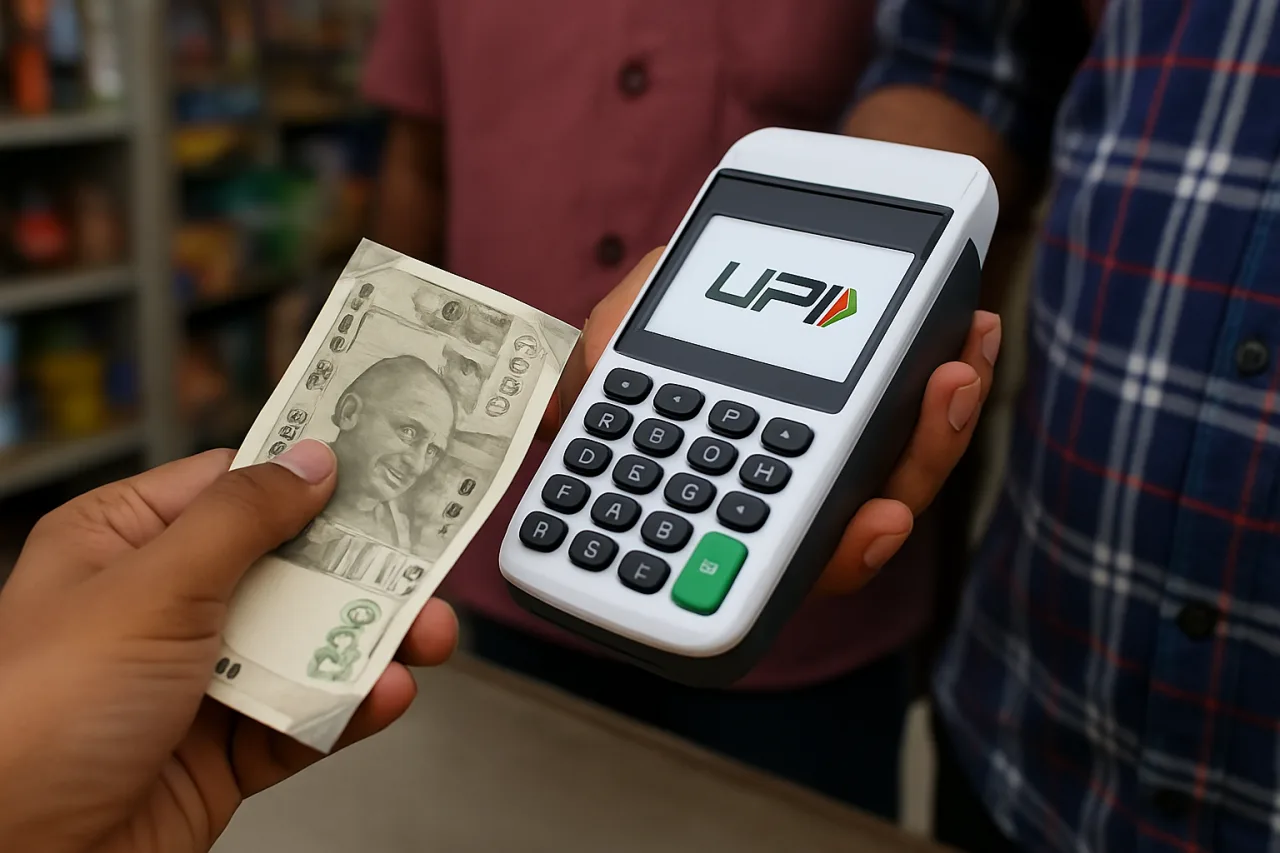
UPI merchant fee is now the phrase defining India’s biggest payments shift since UPI launched in 2016 — and understanding the UPI merchant fee rules now, before the notified date, is what separates prepared merchants from surprised ones. On September 15, 2026, the government introduced a 0.4% Merchant Discount Rate (MDR) on UPI person-to-merchant (P2M) transactions above ₹2,000 — the first fee ever placed on the network in a decade of free payments. The rollout was scheduled to begin on October 15, 2026. Then, on October 13, the National Payments Corporation of India (NPCI) blinked — and the UPI merchant fee rollout joined the list of global fee reforms that slipped a season: the fee now lands “immediately after Diwali,” which falls on Sunday, November 8, 2026, with a new date to be notified separately.
That one-week pause is not a cancellation. The fee structure is unchanged, the RBI has publicly backed the framework, and India’s payments infrastructure is quietly running the same playbook that remittance corridors — including the Philippines’ own QRPh system — watch closely. For anyone tracking payment costs across Asia, the UPI merchant fee debate is the cleanest case study of 2026. This article breaks down exactly who pays what, when, why the deferment happened, and what merchants, professionals, and cross-border users from Dubai to Singapore should do before the new date arrives.
UPI Merchant Fee Basics: the 0.4% Charge in Plain Math
The framework, introduced under the Payment and Settlement Systems Act, 2007, after deliberations by the UPI Steering Committee, works like this:
- 0.4% MDR applies only to P2M transactions above ₹2,000.
- ₹300 cap: for transactions of ₹75,000 and above, the fee stops at ₹300 per transaction. A ₹75,000 payment carries ₹300 (0.4%); a ₹5,00,000 payment also caps at ₹300 — 0.06% effective.
- Flat ₹5 for essential sectors: transactions above ₹2,000 in railways, telecommunications, insurance, fuel, and agricultural inputs pay a flat ₹5 per transaction instead of a percentage — cost certainty for infrastructure the government treats as public-interest.
- Who collects it: the government clarified that MDR is “neither a tax nor a charge collected by the Government or NPCI.” It is shared among banks, payment service providers, and UPI app providers to fund the ecosystem’s operation and expansion.
The math on real merchants (and the reason the Philippines digital payments story follows the same arc): a jewelry store running a ₹2,40,000 UPI settlement this festive season pays ₹300 — the cap — instead of ₹960 at raw 0.4%. A mid-size electronics dealer processing ₹40,000 in a single UPI transaction pays ₹160 (0.4%, below the cap). A fuel station charging ₹3,000 per UPI payment pays ₹5 — the flat essential-sector rate instead of ₹12.
Who Never Pays: the 96% Shield
The government’s own release (Press Information Bureau, Sep 15) is unambiguous about the exemptions, and they cover most of the network:
- All person-to-person payments stay completely free at any amount — no transaction fee, no platform fee, no charge may be imposed. P2P makes up about 70% of UPI’s total transaction value.
- Merchant payments up to ₹2,000 stay free — the volume backbone of street-level commerce.
- Small merchants and street vendors receiving up to ₹1 lakh per month through UPI QR codes (the P2PM category) keep zero MDR on every transaction, whatever the size.
- Combined, roughly 96% of all merchant transactions remain unaffected.
That last number is the political heart of the UPI merchant fee policy. India’s digital payments story is built on free adoption — 24.07 billion September transactions, a network larger than every card network it rivals. The government is not charging the fish-seller at the market or the auto-rickshaw driver. It is charging the structured, high-ticket side of the economy: large retail, travel, insurance premiums above ₹2,000, jewelry at festive-season peak.
Why the Rollout Slipped to After Diwali
The original October 15 start date collided with reality: India’s biggest shopping weeks. Festive-season sale events drove UPI to a record 873 million transactions on October 9 and 871 million the next day. Average October daily value hit ₹94,000 crore — up 13% from September. Traders’ bodies, notably CAIT, lobbied hard against charging merchants during the exact weeks they depend on maximum volume, arguing the fee would burden thin-margin businesses and discourage digital acceptance.
On October 13, days before implementation, the UPI and Services Steering Committee decided — “keeping in mind the festive season” — that MDR on select merchant transactions “shall be implemented immediately after Diwali,” with the new date to be notified separately and the fee structure unchanged. Press reports point to a possible January 1, 2027 rollout; NPCI has not confirmed a final date. Diwali lands on Sunday, November 8, 2026 — so realistically, the fee window opens mid-to-late November, or January if the government waits out the wedding season too.
The 11-Country Footprint: What It Means Abroad
UPI now operates in 11 countries: the UAE, France, Bhutan, Sri Lanka, Nepal, Singapore, Mauritius, Qatar, Cambodia, Greece, and the Maldives — with Greece and the Maldives the latest additions, according to the Press Information Bureau. Ministry sources confirmed the MDR framework extends to the countries where UPI is functional. Three practical consequences follow, each one relevant to anyone tracking ASEAN’s digital economy integration:
- The merchant pays, not the consumer. A shop in Dubai or Paris accepting UPI QR payments faces the same 0.4% economics an Indian large merchant faces — it is their cost of acceptance, to absorb or surcharge, exactly like card interchange anywhere in the world.
- Person-to-person transfers abroad stay free. Gulf News confirmed for UAE-based Indians that the fee taking effect “will not apply when individuals are sending money between themselves and their family” — UPI transfers remain fee-free regardless of amount.
- Watch the acceptance-side effect. UPI’s expansion pitch to foreign merchants has always included “zero merchant fees.” After the deferral expires, UPI internationally becomes a fee-based acceptance rail — a fact foreign acquirers and UPI’s competitors (Alipay+, Visa’s partnerships) will press hard. Watch whether NPCI International adjusts its overseas merchant acquisition offers.
Why India Did It: the Sustainability Logic
Six years of zero merchant fees made UPI indispensable and unprofitable. Banks were spending billions on processing and infrastructure with no revenue line on the merchant side; the government compensated banks directly, a subsidy that scales with volume. The RBI publicly backed the new framework on September 15 (Moneycontrol carries the RBI statement), saying MDR on large-value transactions “will support investment in technology and infrastructure while keeping UPI free for users” — per Moneycontrol. The Finance Ministry frames it as ecosystem sustainability: the fee is distributed to ecosystem participants (banks, PSPs, app providers) to fund operations and expansion.
Every real-time payment system in the region faces the same question at the same lifecycle moment. The Philippines’ QRPh and InstaPay/PESONet rails, Thailand’s PromptPay (2.53 billion transactions a month, per Paymentology’s October briefing), and Singapore’s PayNow were all launched cheap or free to drive adoption. India is the largest and the first to cross the monetization threshold — and its merchant fee decision tests whether adoption-first payment rails can mature without losing users — the others are watching, and their merchants should read it as a signal of where the region’s rails eventually drift.
The Merchant Playbook: 6 Moves Before the New Date
- 1. Confirm your category. If your UPI QR receives ≤₹1 lakh/month under the P2PM small-merchant definition, you stay exempt — verify your merchant category code and monthly volume with your acquiring bank rather than assuming.
- 2. Model your exposure. For large-ticket business (goods >₹2,000 per transaction), compute 0.4% against your average ticket and apply the ₹300 cap above ₹75,000. A store with ₹50 lakh monthly UPI volume split into ₹4,000 average tickets faces ₹20,000 in new monthly MDR — a real UPI merchant fee line item that changes checkout economics — decide now whether pricing, surcharges, or margin absorbs it.
- 3. Update invoicing systems. Payment apps may pass through or display MDR lines differently; ensure billing software, receipts, and reconciliation match the new fee lines from day one.
- 4. Renegotiate acquirer rates. NPCI’s framework sets the floor; banks and PSPs may add their own margins on top. Large merchants should benchmark offers across acquirers before the notified date.
- 5. For travelers and NRI/OFW families: sending money person-to-person via UPI remains free — no change at any amount, confirmed by the Finance Ministry and Gulf News for the UAE. Merchant QR payments abroad follow the fee rules of the country’s rollout; individuals are protected from consumer-side charges.
- 6. Mark the decision dates. NPCI will notify the new date separately after Diwali (Nov 8). If the reported January 1, 2027 target firms up, large merchants gain a six-week runway from mid-November to finish renegotiations.
The Filipino and Global-Corridor Read
For Filipinos, this is a preview, not a foreign story. The Philippines runs the same rail model: QRPh person-to-person transfers are free or near-free today, and BSP Governor Eli Remolona has pointed to regional standardization as the direction of travel. India’s fee decision shows the lifecycle: drive adoption free, reach national scale, then monetize the structured transactions while protecting the street-level base. When Philippine payment providers face their own revenue questions — a pressure point examined in our BSP stablecoin remittance rails analysis — as remittance fees compress and InstaPay waives approach review — the UPI 0.4% template (percentage fee with caps, essential-sector flat rates, small-merchant shields) is exactly the compromise architecture decision-makers will study.
The cross-border worker angle is direct too: in the UAE and Singapore — two of the largest Filipino OFW corridor endpoints, both also UPI-accepting countries — Indian merchants will now pay acceptance fees on large UPI tickets while Indonesian, Philippine, and Thai QR rails remain free — and the contest between free rails and priced rails echoes what we covered in AI agent payments, where machines actively route around percentage-based fees. The competitive gap between “free consumer, priced merchant” rails and entirely free ones is now a live experiment across Asia.
What to Watch Next
- The notified date. NPCI’s next announcement lands after Diwali. January 1, 2027 is the reported candidate; the final circular decides.
- UPI volume reactions. If large-ticket merchants shift volume to cards (where they already pay MDR-like interchange), UPI’s growth curve bends — watch NPCI’s monthly data releases.
- Merchant acceptance abroad. NPCI International’s foreign acquiring offers — whether “zero merchant fee” pitches survive — will shape UPI’s 11-country footprint expansion.
- The region’s copycats. Thailand, the Philippines, and Indonesia all run free-to-cheap real-time rails. India just moved first on monetization; the UPI merchant fee decision is the template document, and BSP and Bank of Thailand commentary through 2027 is the sequel to watch.
FAQ
What is the UPI merchant fee being introduced, and how is it calculated?
The UPI merchant fee is a 0.4% Merchant Discount Rate on UPI person-to-merchant transactions above ₹2,000, capped at ₹300 for transactions of ₹75,000 and above, plus a flat ₹5 rate for essential sectors (railways, telecom, insurance, fuel, agricultural inputs) above ₹2,000. Announced September 15, 2026.
When does the UPI merchant fee start after the deferral?
NPCI deferred the original October 15, 2026 start to “immediately after Diwali” (Diwali: Sunday, November 8, 2026). The new date will be notified separately; press reports suggest January 1, 2027 is possible, unconfirmed.
Will I pay the fee when sending money to family through UPI?
No. All person-to-person UPI transactions stay completely free at any amount — in India and abroad. The fee only touches merchant payments above ₹2,000.
Do small shops and street vendors pay the UPI MDR?
No. Small merchants receiving up to ₹1 lakh per month through UPI QR codes under the P2PM category keep zero fees on all their transactions. Payments up to ₹2,000 also stay free for everyone.
Does the UPI merchant fee apply abroad — UAE, Singapore, France?
Ministry sources say the framework applies in the 11 countries where UPI operates, and it is a merchant-side charge: shops accepting UPI absorb the 0.4% on large tickets, while individual users pay nothing on person-to-person transfers regardless of amount.
Why did India end the free UPI merchant payment era?
After six years of zero fees, the government and RBI argue the ecosystem needs a revenue line to fund infrastructure, security, and expansion sustainably — with roughly 96% of merchant transactions kept fee-free to protect adoption and small business.
Financial Disclaimer: This article is for general information and analysis, not financial or tax advice. Fee rules, dates, and figures reflect government and NPCI announcements and credible press reporting as of October 2026; the notified implementation date may change. Verify current rules with official NPCI or Finance Ministry circulars and your payment provider before making business decisions.