Table of Contents
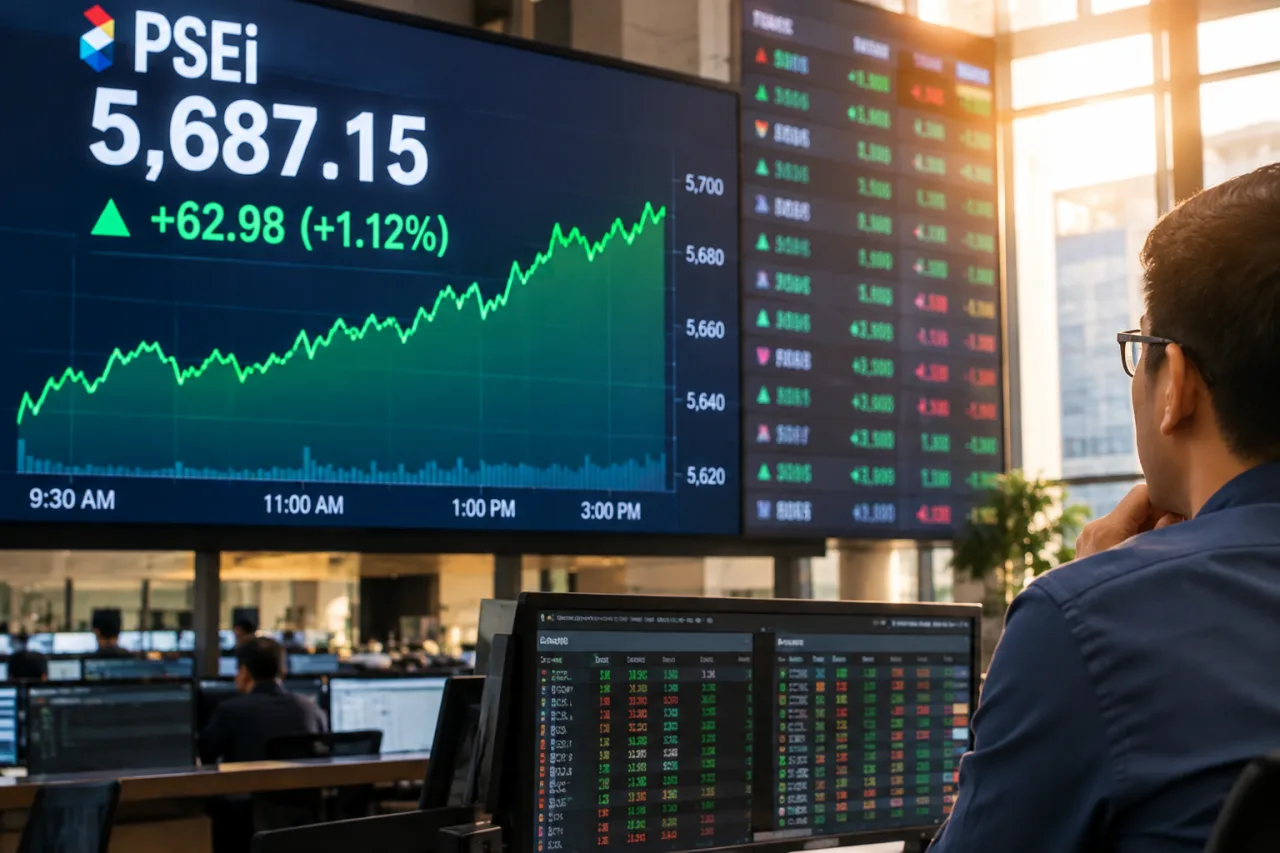
Editor’s Note — November 4, 2026: This article was updated after publication. The PSE’s official November 4 market summary reported the index at 5,694.92, up 70.75 points or 1.26% — an earlier draft used a provisional feed value (5,687.15, +1.12%). Participant-driver explanations were also reworded to attribute rather than assert, and an unsupported rebalancing claim was removed.
Key Takeaway
- 📈 The verified close: the PSEi rebounded on November 4, 2026 to 5,694.92, up 70.75 points or 1.26%, per the PSE’s official Nov 4 market summary — the arithmetic checks (5,624.17 + 70.75 = 5,694.92).
- 📉 PSEi rebound context: the close follows the Oct 30 session at 5,680.35 and the official Nov 3 close of 5,624.17 (−0.99%) — an October that ended in the red.
- 👥 The drivers are partly unknown: the exchange’s daily report can show net participation by investor class, but attributing the day specifically to retail bargain-hunting or short-covering remains a claim, not a measured fact, unless tied to identified data or named analysts.
- 💹 OFW investors feel two layers: the peso rate applied to a remittance, then the peso value it buys in stocks; check the provider’s published FX margin before assuming the quote is the market rate.
- ⚖️ One session is not a trend: a single positive day does not establish that the decline has ended; the checklist and position sizing decide what a rebound means for a specific investor.
What happened in the November 4 session
The Philippine Stock Exchange index recovered on November 4, 2026, closing at 5,694.92, up 1.26%, according to the PSE’s official market summary. The PSEi rebound followed an October that finished in the red: the Oct 30 session closed at 5,680.35, and the Nov 3 session gave back ground to 5,624.17, down 0.99%. November 4’s 70.75-point gain restored most of November 3’s loss and left the index just above the levels it has defended this quarter — a recovery inside a correction, not proof that one has ended, and no sentence here should be read as a prediction.
One sourcing note before the analysis: an earlier draft carried 5,687.15 (+1.12%), a provisional feed value that circulated ahead of the exchange’s summary. The official record supersedes feeds — the method is baked into this piece: check the exchange’s own report before repeating any number.
Who was buying: what the data can and cannot say
The PSE’s daily disclosures establish aggregates: net foreign flows, value turnover and market breadth, published in the exchange’s daily index and market reports. Motives are another matter. A claim that the PSEi rebound came specifically from retail bargain-hunters, institutional rotation or short-covering needs either a named analyst who measured it or the trading detail behind it — this report found no published breakdown attributing the November 4 session to any of those three specifically. The reporting line: the session’s aggregates are documented; the driver labels are interpretation until someone shows the data. Analysts quoted in coverage carry their views; a view is not a cause.
The week behind it: what the rebound followed
Three sessions frame the move. October 30: the index at 5,680.35, closing lower amid a global technology-selloff wave and a softer peso. November 3: the heavier session, down 0.99% to 5,624.17 — the week’s sharpest loss. November 4: the 1.26% PSEi rebound to 5,694.92. Read together: two red sessions, one green one, and a market still inside the range it has occupied all quarter. Breadth and follow-through in the daily reports will show whether the PSEi rebound broadened; until then the rebound remains one session’s story.
The exchange-rate layer: how OFW investors feel it
For overseas Filipinos the peso sits inside every transaction twice: the rate a remittance channel applies, then the peso value the converted money buys. A labeled hypothetical (our OFW FX playbook carries the fuller math): an OFW sends the peso equivalent of $200; at a P/USD rate of 58 the conversion yields ₱11,600; a provider margin of 1% keeps about ₱116 in the channel before any investing happens — and the next month’s rate decides what the following dollars buy. Both layers come from published rates and disclosed fees, so they are checked, not predicted. Our remittance-cost guides cover the fee side in depth.
For investors reading the index numbers, the same two-layer point applies in reverse: peso strength or weakness changes the entry price of peso-denominated assets, including the index funds tracking this benchmark. The rate is a disclosed figure on the provider’s own page, not a forecast to act on.
What our framework says to do now
Our evergreen guide to bargain hunting in a Philippine correction covers the durable method (liquidity, the balance-sheet pass, the five-year valuation corridor, the flow check and position sizing), so this report keeps only the session-specific layer for the PSEi rebound. The November 4 development at the close of this PSEi rebound: a level still below the year’s defended range, with driver claims unverified. For an investor running the checklist, one green day neither completes a screening decision nor cancels one. The habit stands: the exchange publishes each PSEi rebound figure in the daily report; the provider publishes its fees; the issuer publishes the filing; nothing substitutes for any of the three.
A reader’s session walkthrough: how to use a day like November 4
Make it operational with the actual session. Suppose an investor entered the week with the plan written: watchlist names with entry bands, a maximum of ₱40,000 committed in tranches, and one rule — no order until a name passes all five screens. On November 4 the index gaps up 1.26% on the official report. The first check is not the mood; it is the sequence: liquidity (whether the intended tranche size can execute without moving a thin name), the balance sheet from the latest annual filing, the valuation corridor, the session’s flow data from the exchange, and the sizing math. If a name fails at step two, the green day changes nothing for that name — which is precisely why the sequence runs in order and gets written before the session opens. The discipline is the part an investor owns; the session is the part they do not.
Common mistakes in bargain hunting, seen in one week of sessions
Three show up repeatedly in correction weeks. Anchoring: the belief that a stock that traded near 6,200 months ago must be cheap now is a memory, not evidence — the current multiple against current earnings is the only valuation that exists. Session extrapolation: reading one strong day as the start of a new trend and then abandoning the position ceilings that made the plan survivable — the daily report’s breadth, not one candle, is the indicator. Ignoring the currency and fee layers: a purchase executed at the session’s price still settles at the rate the remittance provider applies, and for OFW investors that published margin can move the cost more than the day’s index change did. Naming a mistake costs nothing; repeating one costs the portfolio.
Distinguishing a bargain from a value trap in this market
The distinction lives in the filing, not on the tape. A decline with stable margins, a dividend record funded by operating cash flow, and manageable debt describes a company whose price fell faster than its fundamentals — the condition where a lower price is genuinely a discount, and even then only if the reasons for the decline are cyclical rather than structural. A decline with rising interest costs, shrinking margins or a dividend cut mid-correction describes a multiple adjusting to lower expectations: cheap for a reason, and cheaper is not better. Between the poles sit the companies whose reports arrive late or whose disclosures raise questions; waiting solves that problem at no cost. Both kinds live in the issuer’s own published statements — the PSE’s disclosure system carries them, and the two-week check belongs there, not in a feed.
The primary records to keep open
Three destinations answer most of what this report raises. The PSE’s daily index reports: closes, value turnover, foreign-flow aggregates and market width, published by the exchange after each session — the record to check first. PSE Edge: company disclosures, quarterly reports and dividend announcements per issuer — the filings that separate bargains from traps (see also the bubble-stocks watchlist method for flow discipline). The provider’s published fee schedules: the conversion rate, the margin and the per-transaction costs that sit between any OFW investor’s dollars and the market. Feeds and headlines are provisional by design; these three are not.
How the market mechanics sit behind these numbers
Three mechanical facts stay true through any PSEi rebound narrative. Lots: PSE trades run in fixed board lots — a low-priced name moves more shares per lot, a high-priced one fewer — so the same ₱8,000 order buys different exposure depending on the price, and the liquidity screen has to account for it. Settlement: transactions settle on schedule under the exchange’s published trading rules (T+2 settlement), which determines when sold proceeds become cash again — relevant for any investor who plans to fund a second tranche from a first sale. Costs: the broker’s schedule, the VAT on commission and the exchange fees apply per transaction, which is why the position-sizing plan counts them before entry, not after. None of these moved on November 4; all of them shaped what any PSEi rebound order actually cost.
What to watch in the coming sessions
The indicators that matter, all publicly published: breadth in the daily index reports (whether advancing names widen beyond the day’s leaders), value turnover against the year’s average (participation or lack of it), the foreign-flow aggregates (net buying or net selling by class), and the peso’s disclosed rates in the FX market. A PSEi rebound followed by rising breadth and stronger turnover reads very differently from one followed by a fade to the prior close — the sequence says more than the single print does. Until those arrive, the November 4 close is the verified fact and everything beyond it is context.
Does an index rebound lift every listed stock equally?
No. Sector indices and individual names moved differently through the same sessions; the daily report shows the per-sector detail. A green PSEi day can arrive with the smaller names falling — another reason the checklist runs name by name.
Do OFW investors need different timing rules than local investors?
The investment checks are the same; the funding path differs. The remittance-to-peso conversion adds a timing decision (when to move funds) and a fee check (the channel’s margin) that a local investor never makes — both published, both worth the minutes they take.
Sourcing note: how this report was built
Transparency about the numbers, because this piece’s correction history is part of its usefulness. The verified spine: the exchange’s official November 4 summary (the close and its point change), the official November 3 close carried on the exchange’s own channels, and the October 30 close from exchange-linked records. The provisional layer, labeled as such in an earlier draft: a 5,687.15 / +1.12% reading from financial feeds, published here first and corrected now. The interpretation layer, kept honest by discipline: where the rebound’s drivers could not be established from published data, the report says so instead of narrating a cause. Readers wanting the method behind the screens can read the evergreen bargain-hunting guide; readers wanting the day’s verified record should read the exchange’s report; the two together are this piece’s purpose.
FAQ
What was the PSEi close on November 4, 2026?
5,694.92, up 70.75 points or 1.26%, per the PSE’s official November 4 market summary. An earlier version of this report cited 5,687.15 (+1.12%), a provisional feed value; the official figure governs.
Why did the PSEi bounce on November 4?
The driver labels are unproven. The rebound followed two falling sessions and a softer peso; the exchange’s aggregates show where net money moved, but attributing the day to retail buying or short-covering specifically requires data nobody has published.
Is the decline over because the PSEi rebounded?
One session does not establish a sustained recovery. Breadth and follow-through in the daily reports will show it or not; position sizing, not prediction, is the part an investor controls.
Is it safe for a PSE investor to buy on a rebound day?
Safety comes from the checklist and the position, not the day’s direction: a rebound changes neither. The screening method in our evergreen guide and the current filings matter more than one session.
How do OFW remittances connect to the PSE?
Overseas Filipinos convert remittances to pesos; the exchange rate affects what each remitted dollar buys and the peso value of the equities it can fund. Channel FX margins vary and are published — check them before conversions.
Where can I verify the PSEi’s close and the market’s data?
The PSE’s official daily index reports and market summaries are the primary record for closes, breadth and foreign flows. Feeds move faster and stay provisional; the exchange’s report is the one that concludes the session.
Financial Disclaimer
This article is general market information and commentary on publicly reported data; it is not financial advice and no outcome is promised. Figures cited are dated and sourced; provisional values are labeled. Product fees, exchange rates and market conditions change; verify with the provider’s disclosures and the exchange’s reports before decisions involving money. Investing involves risk, including loss of principal; decisions should reflect your own budget and tolerance for loss.
- pse.com.ph/stock-market-info — the exchange’s published trading rules
External sources linked in this article, in order of first mention. Spotted an error or a broken link? Tell us.
Cite this pagePublished Nov 4, 2026
Agron, E. (2026, November 4). PSEi Rebounds to 5,694.92: the Official Close, What It Shows. WorldNgayon. https://worldngayon.com/psei-snaps-back-5687-november-print/
Agron, Edmon. “PSEi Rebounds to 5,694.92: the Official Close, What It Shows.” WorldNgayon, 4 Nov. 2026, worldngayon.com/psei-snaps-back-5687-november-print/.
Agron, Edmon. “PSEi Rebounds to 5,694.92: the Official Close, What It Shows.” WorldNgayon, November 4, 2026. https://worldngayon.com/psei-snaps-back-5687-november-print/.
Agron, E. (2026) ‘PSEi Rebounds to 5,694.92: the Official Close, What It Shows’, WorldNgayon, 4 November. Available at: https://worldngayon.com/psei-snaps-back-5687-november-print/.
E. Agron, “PSEi Rebounds to 5,694.92: the Official Close, What It Shows,” WorldNgayon, Nov. 4, 2026. [Online]. Available: https://worldngayon.com/psei-snaps-back-5687-november-print/
@online{agron2026pseisnaps,
  author       = {Agron, Edmon},
  title        = {{PSEi Rebounds to 5,694.92: the Official Close, What It Shows}},
  year         = {2026},
  date         = {2026-11-04},
  organization = {WorldNgayon},
  url          = {https://worldngayon.com/psei-snaps-back-5687-november-print/},
  urldate      = {}
}TY - ELEC AU - Agron, Edmon TI - PSEi Rebounds to 5,694.92: the Official Close, What It Shows T2 - WorldNgayon PY - 2026 DA - 2026/11/04/ UR - https://worldngayon.com/psei-snaps-back-5687-november-print/ Y2 - ER -
Cite the version you read; the page may be updated. Zotero and Mendeley can also import this page directly.