Table of Contents
Philippines digital payments crossed the majority threshold without a super app or a CBDC. Forbes reports that the Philippines reached 52.8% digital payment volume in 2023, climbing to 57.4% volume and 59% value in 2024 — achieving what many countries are still debating. The secret? Interoperable public rails (InstaPay, PESONet, QR Ph) that let private wallets like GCash and Maya compete on top.
Key Takeaway
- 🎯 Philippines digital payments reached 57.4% of transaction volume and 59% of value in 2024 — without a super app or CBDC: Forbes reports the Philippines achieved majority digital payments through interoperable public infrastructure, not through a dominant platform or central bank digital currency.
- 📊 InstaPay and PESONet moved ₱24.745 trillion across 4.773 billion transactions in 2025 — up 42% year-over-year: InstaPay alone carried 4.656 billion transactions, a 231% jump. These rails are the engine of Philippines digital payments.
- 💼 BSP Governor Eli Remolona explicitly rejected a retail digital peso, citing bank-run risk: The central bank chose public rails over a sovereign token. Project Agila (wholesale CBDC) is the only digital currency work — and it’s for interbank settlement only.
- 🔧 GCash reached $5 billion valuation with 94 million registered users; Maya turned profitable in 2024: Two profitable, well-funded wallets competing on shared rails — a healthier structure than a single dominant super app.
- ⏱️ BSP targets 60-70% digital payment volume by 2028 and 70% of Filipino adults in transaction accounts: The Digital Payments Transformation Roadmap pairs payments growth with financial inclusion — each reinforcing the other.
The Philippines digital payments story is a global case study in how to digitize an economy without a super app or a central bank digital currency. While most of the policy world spent the past five years debating CBDCs and super apps, the Philippines quietly answered the question a different way — and crossed the majority threshold first.
Forbes, in a June 7, 2026 feature by fintech analyst Zennon Kapron, documented how the Philippines achieved majority digital payments through “interoperable public infrastructure rather than central bank digital currencies or super-apps.” The Philippines digital payments model offers a blueprint for other nations: build shared, open infrastructure and let private innovation flourish on top.
For OFW families, Filipino consumers, and the broader digital economy (₱2.74 trillion, 9.8% of GDP), understanding how Philippines digital payments achieved majority status reveals why the system works — and what comes next.
The Numbers: Philippines Digital Payments
| Metric | Figure | Source | Trend |
|---|---|---|---|
| Digital payment volume (2023) | 52.8% | BSP / Forbes | Crossed majority threshold |
| Digital payment volume (2024) | 57.4% | BusinessWorld | Up from 52.8% |
| Digital payment value (2024) | 59% | BusinessWorld | Value exceeds volume |
| InstaPay + PESONet volume (2025) | ₱24.745 trillion | BusinessWorld | +42% year-over-year |
| Total transactions (2025) | 4.773 billion | BusinessWorld | More than triple prior year |
| InstaPay transactions (2025) | 4.656 billion | BusinessWorld | +231% year-on-year |
| BSP 2028 target | 60-70% volume | BSP Roadmap | Next milestone |
| Financial inclusion target | 70% of adults | BSP Roadmap | Transaction account ownership |
The Three Pillars of Philippines Digital Payments
| Pillar | What It Is | Role in the System |
|---|---|---|
| InstaPay | Real-time, low-value account-to-account transfer rail | Handles everyday P2P and merchant payments; 4.656B transactions in 2025 |
| PESONet | Batch payment rail for larger transactions | Handles salary, government disbursements, B2B payments |
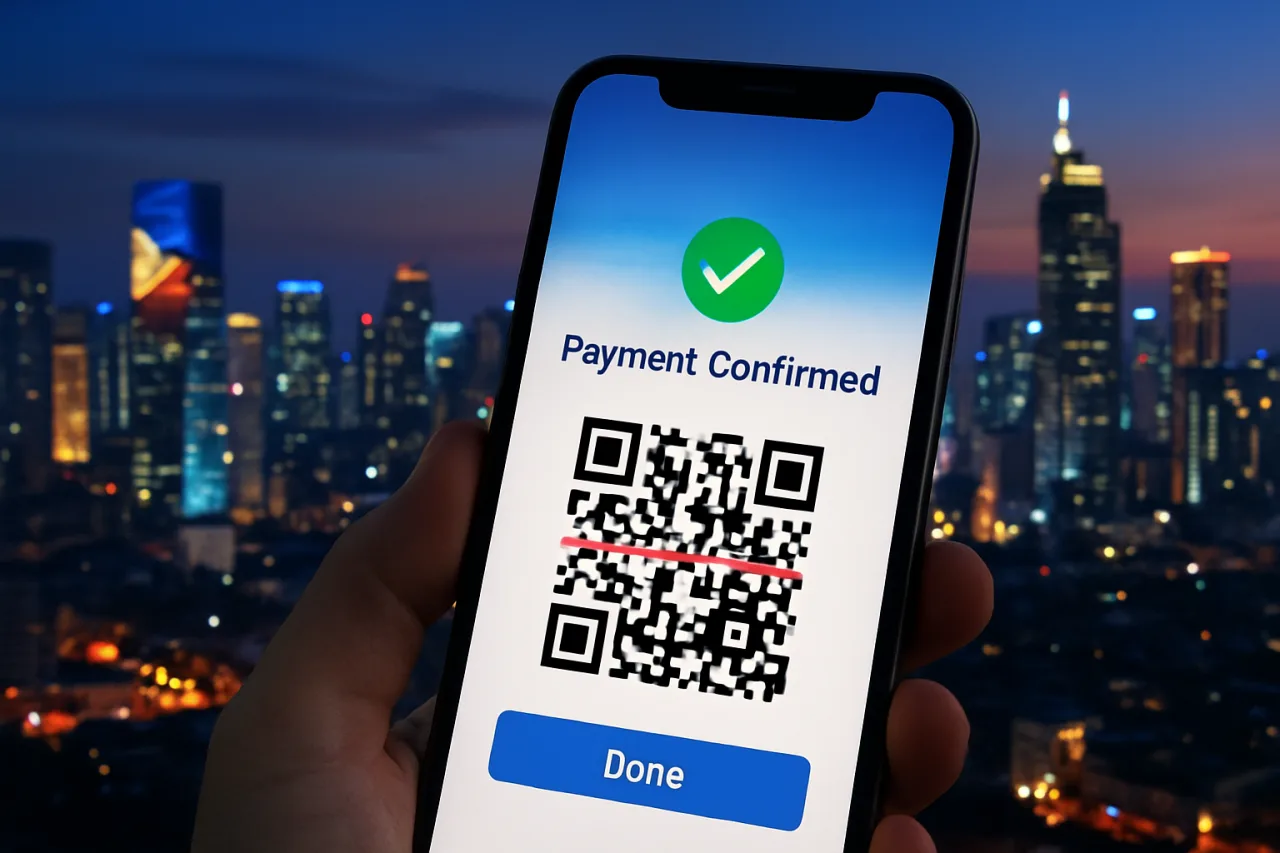
| QR Ph | National QR code standard | Enables any wallet or bank app to pay any merchant; interoperability at point of sale |
Together, these three pillars form the “plumbing” of Philippines digital payments. The key insight is that BSP built the rails and made them interoperable — then stepped back and let private wallets compete on top. A GCash user can pay a Maya merchant. A bank account holder can send money to a digital wallet. QR Ph gives every small merchant a single code that any app can scan.
Why the Philippines Rejected a CBDC
BSP Governor Eli Remolona has been explicit that the central bank will not build a retail digital peso. His reasoning: a retail CBDC carries bank-run risk and offers no compelling benefit that the existing rails do not already provide. The Philippines digital payments model proves his point — the country already has majority digital payments without a sovereign token.
| Approach | Philippines (Public Rails) | China (CBDC + Super App) |
|---|---|---|
| Model | Interoperable public rails + competing private wallets | State-backed e-CNY + Alipay/WeChat duopoly |
| Result | 57.4% digital volume; ₱24.7T moved in 2025 | e-CNY = 0.2% of card/wallet transactions (2024) |
| Wallet competition | GCash vs Maya — both profitable, both on shared rails | Alipay + WeChat Pay duopoly; limited competition |
| CBDC status | Rejected for retail; Project Agila is wholesale only | e-CNY redesigned into interest-bearing deposits (Jan 2026) |
| Interoperability | Mandated by BSP; QR Ph works with any app | Limited; wallets are largely closed-loop |
The contrast is stark. China’s e-CNY, after a decade of development, remains marginal — roughly 0.2% of card and wallet transactions. The cross-border CBDC project mBridge had processed only about 4,047 transactions for $55 billion total. Meanwhile, the Philippines digital payments rails move ₱24.7 trillion annually and growing at 42%.
The Private Layer: GCash and Maya Competition
The Philippines digital payments model works because the private layer is genuinely competitive. Two profitable, well-funded wallets fight for the same users — both settling over the same public rails:
| Wallet | Users | Valuation/Status | Key Metric |
|---|---|---|---|
| GCash (Mynt) | 94 million registered | $5B valuation (2024); preparing 2026 IPO potentially valuing at $8B | Largest digital wallet in PH |
| Maya (Voyager) | 8.2 million digital bank customers | Turned profitable group-level from late 2024; ₱50B+ in deposits | Bank + wallet hybrid; profitable |
Forbes notes that GCash is “reportedly preparing a 2026 Manila listing that could value it near $8 billion” — which would make it the largest IPO in Philippine history and “a rare example of a Southeast Asian digital-finance business reaching public-market scale on fundamentals rather than subsidy.”
The competition happens at the customer-experience layer. The interoperability lives in the infrastructure underneath, where BSP controls it. This is the opposite of a super-app monopoly — and it is why Philippines digital payments work for consumers, merchants, and the economy.
The Cross-Border Dimension: QR Ph Goes Regional
The Philippines digital payments model is now extending across borders. The Philippines has joined the regional push to link national QR and instant-payment systems, including work to connect QR Ph with Singapore’s PayNow and participation in the BIS-backed Project Nexus, which aims to plug domestic real-time rails into one another.
For OFWs, this cross-border integration matters enormously. Remittances are a structural share of Philippine household income — and linking QR Ph with regional payment systems could reduce remittance costs from 5-10% to near-instant, near-free transfers. The digital wallet infrastructure that OFWs already use domestically could extend to cross-border payments.
The Financial Inclusion Connection
The BSP’s Digital Payments Transformation Roadmap pairs the payments goal with a financial inclusion target: getting 70% of Filipino adults into a transaction account. The logic is that digital payments and bank-account ownership reinforce each other — a person with an account and a wallet has a reason to use the rails, and the rails give the account a reason to exist.
With 44% of Filipinos still unbanked, the Philippines digital payments infrastructure is the primary pathway to financial inclusion. GCash and Maya serve as the first financial account for millions of unbanked Filipinos — providing payments, lending, investment, and insurance without requiring a traditional bank account.
What Other Countries Can Learn
Forbes distills the lesson: “A country does not need a sovereign token or a national champion platform to digitize payments at scale. It needs interoperable public rails, a single QR standard, real-time account-to-account settlement, and a competitive private layer sitting on top.”
| Lesson | What the Philippines Did | What Others Should Do |
|---|---|---|
| Build rails first | InstaPay, PESONet, QR Ph before wallets | Create public infrastructure before privatizing |
| Mandate interoperability | QR Ph works with any app; BSP requires it | Don’t let platforms create closed loops |
| Let private sector compete | GCash vs Maya on shared rails | Competition drives innovation; monopoly doesn’t |
| Reject retail CBDC | BSP said no to retail digital peso | Existing rails may already solve the problem |
| Pair with inclusion | 70% adult account target alongside payments | Payments + inclusion = sustainable growth |
The Cybersecurity Challenge for Digital Payments
As Philippines digital payments volume grows, cybersecurity becomes an increasingly critical concern. The same interoperability that makes the Philippine model work — any wallet can pay any merchant, any bank can transfer to any account — also creates a larger attack surface for fraudsters and cybercriminals. The Philippine cyber threat landscape includes rising ransomware attacks, a 4,500% surge in AI deepfake scams, and sophisticated social engineering campaigns that target digital payment users.
BSP has responded with enhanced cybersecurity requirements for digital payment providers. All licensed payment system operators must implement multi-factor authentication, real-time fraud monitoring, and incident response protocols. The National Privacy Commission enforces data protection standards that apply to every entity processing payment data. Together, these regulatory frameworks create a layered defense — but the rapid evolution of cyber threats means that both regulators and industry must continuously adapt.
For Filipino consumers, the key cybersecurity practice is simple: never share OTPs (one-time passwords), enable two-factor authentication on all payment apps, and verify merchant QR codes before scanning. The Philippines digital payments infrastructure is technically secure — the vulnerability is often at the human layer, where social engineering exploits trust rather than technology. Consumer education, alongside the cybersecurity skills gap that limits the pool of qualified security professionals, remains the primary challenge.
The Road Ahead: BSP Targets and Timeline
The Philippines digital payments journey is far from complete. BSP’s Digital Payments Transformation Roadmap targets 60-70% digital payment volume by 2028 and 70% of Filipino adults in transaction accounts. Reaching these targets will require sustained investment in infrastructure, continued regulatory innovation, and expanded financial literacy programs. The progress from 52.8% in 2023 to 57.4% in 2024 shows momentum, but the next milestones will be harder — they require reaching the unbanked and underbanked populations that have been left behind by the first wave of digital adoption.
The digital banking sector will play a critical role in this next phase. With BSP allowing up to 10 licensed digital banks, the competitive landscape is intensifying. Digital banks that focus on the unbanked — rather than competing for already-banked customers — will be the ones that help close the financial inclusion gap. The DiBA PH fintech initiatives, with their emphasis on behavioral design and measurement, provide a framework for ensuring that digital banking growth translates into real financial inclusion rather than just user acquisition.
FAQ: Philippines Digital Payments
How did the Philippines achieve majority digital payments without a super app?
The Philippines built interoperable public rails — InstaPay (real-time transfers), PESONet (batch payments), and QR Ph (national QR standard) — then let private wallets like GCash and Maya compete on top. This shared infrastructure approach achieved 57.4% digital payment volume in 2024 without needing a single dominant platform.
What percentage of Philippine payments are digital?
Digital payments reached 57.4% of transaction volume and 59% of transaction value in 2024, up from 52.8% volume in 2023. BSP targets 60-70% volume by 2028.
How much money moves through InstaPay and PESONet?
InstaPay and PESONet together moved ₱24.745 trillion across 4.773 billion transactions in 2025 — up 42% from the prior year. InstaPay alone carried 4.656 billion transactions, a 231% jump year-on-year.
Why did the Philippines reject a retail CBDC?
BSP Governor Eli Remolona cited bank-run risk and the lack of compelling benefits that existing rails don’t already provide. The Philippines already has majority digital payments without a sovereign token. Project Agila, the only CBDC work, is wholesale-only for interbank settlement.
How does the Philippine model compare to China’s?
China’s e-CNY remains marginal at 0.2% of card/wallet transactions after a decade. The Philippines achieved 57.4% digital volume through public rails + private competition. China has a state token + private duopoly; the Philippines has shared rails + competitive wallets.
What is QR Ph?
QR Ph is the Philippine national QR code standard that enables any wallet or bank app to pay any merchant. It gives every small merchant a single code that any app can scan, creating interoperability at the point of sale — the difference between a closed-loop platform and an open network.
How does this connect to OFW remittances?
The Philippines is linking QR Ph with Singapore’s PayNow and participating in Project Nexus for cross-border instant payments. This could reduce remittance costs from 5-10% to near-instant, near-free transfers — transforming how OFWs send money home.
What is the BSP’s financial inclusion target?
BSP targets 70% of Filipino adults in a transaction account. With 44% currently unbanked, digital wallets like GCash and Maya serve as the primary financial account for millions — providing payments, lending, investment, and insurance without a traditional bank account.
Is GCash preparing an IPO?
Forbes reports GCash is preparing a 2026 Manila listing that could value it near $8 billion, making it the largest IPO in Philippine history. GCash has 94 million registered users and reached $5 billion valuation in 2024 when Ayala and MUFG invested.
What can other countries learn from Philippines digital payments?
Build interoperable public rails first, mandate a single QR standard, enable real-time account-to-account settlement, let the private sector compete on top, reject retail CBDC if existing rails work, and pair payments growth with financial inclusion targets.
This article is based on Forbes analysis by Zennon Kapron (June 7, 2026), BusinessWorld reporting on InstaPay/PESONet transaction data, BSP Digital Payments Transformation Roadmap, and FintechNews PH reporting. Transaction figures are as reported by BSP and BusinessWorld.