Table of Contents
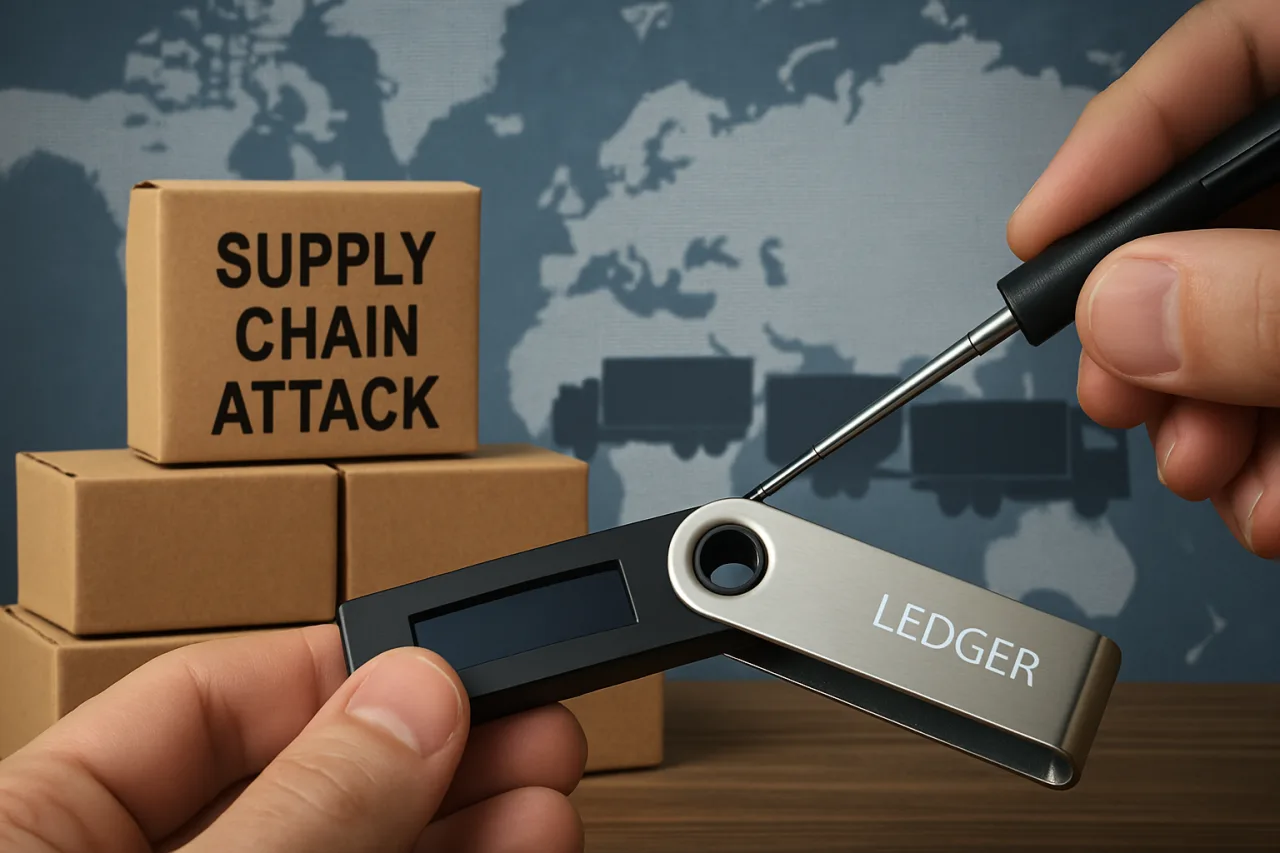
Supply chain attack is a term security teams used to reserve for code. In October 2026 it found a body. The Ledger supply chain attack, as the incident is now widely discussed, refers to hardware wallet devices modified between the factory and the buyer — inside the box, inside the seal, inside the case — so the wallet still looks genuine, still passes Ledger’s own cryptographic checks, and still hands every recovery phrase it displays to a stranger’s radio.
This article explains how the attack works, what Ledger has confirmed, what remains allegation, why the story widened to Europe’s largest consumer electronics chain, and what any buyer should do before trusting a sealed hardware wallet. It builds on our weekly coverage in Crypto Watch #015: the ledger implant, the AI bug hunt, and the governance rupture, and on the standing hardware wallet buyer shield guide.
Key Takeaway
- 🧩 The attack: A hidden board inside affected wallets reconstructs the recovery phrase shown on screen during setup and transmits it over an LTE radio with an eSIM. The secure element never fails — the leak happens after it, at the display.
- ✅ What Ledger confirmed: At least one victim device contained an unauthorized hardware implant; all confirmed fund-drain cases trace to devices sold through reseller CryptoBilis; Ledger’s own systems and direct sales channels show no compromise.
- 💸 The damage so far: On-chain tracking estimates the drain at roughly $86 million to $94 million across 311 wallets, with about $10 million frozen — preliminary figures, not Ledger-confirmed totals.
- 🇪🇺 The Europe twist: A growing number of reports now involve purchases from MediaMarkt stores, with store inventory records pointing to supplier Aqipa GmbH — reported by buyers and news agencies, not yet confirmed by Ledger.
- 🛡️ The takeaway: Where you buy matters as much as how you use it. Treat the purchase channel as the first defense against a supply chain attack, run the checks in this article before funding any hardware wallet, and never restore an old phrase onto new hardware.
The Ledger Supply Chain Attack Timeline: October 9 to October 12
The sequence moved fast, and each day added a layer worth separating. On October 9, Ledger’s support account opened an investigation into missing-funds reports from customers in Southeast Asia who had bought devices from CryptoBilis, an authorized reseller. Ledger asked the reseller to pause all sales and shipments, told anyone who bought within the previous 90 days not to initialize an unused device, and told active users to move assets to a new signer with a newly generated phrase. The full weekly context including the XRP Ledger governance rupture that same week is in our Crypto Watch #015 analysis.
On October 10, the story hardened. Ledger confirmed that one impacted user’s device contained an unauthorized hardware implant. That single confirmation turned rumors of sloppy operations into evidence of physical tampering — a modification performed on real devices, not a software trick or a phishing page.
On October 11, Ledger narrowed the blast radius. Every confirmed fund-draining case involved devices sold through CryptoBilis, the company said, and there was no indication that Ledger’s internal systems or direct sales channels were compromised. On-chain analyst Bitquery’s tracking, as reported by CoinDesk’s incident coverage, put the damage at roughly $92.9 million across 311 wallets spanning TRON, Bitcoin, Ethereum, BNB Chain and Polygon, with independent estimates clustering between $86 million and $94 million and about $10 million frozen. These are tracking figures, not an official loss count.
The wallet pattern Bitquery described reads like one operator working from a stack of pre-harvested phrases: 25 TRON wallets emptied within three seconds of each other, small test transfers weeks earlier, and a majority of victim wallets first funded from June 2026 onward. The supply chain attack did not strike when victims moved funds. It struck earlier — the moment each device showed its owner 24 words.
On October 12, the geography widened. Independent reporters relayed findings from a buyer identified as Johannes: two Ledger devices, purchased from two different MediaMarkt stores in Europe, allegedly containing spyware hardware — as relayed by Gate News following BlockBeats — additional wiring and an LTE module of the kind examined in the Asian cases. Store staff, according to the reports, confirmed the second device was not a returned item, and store inventory records pointed to supplier Aqipa GmbH. Johannes called for a product recall and said one device was submitted for analysis, with the second headed to Ledger.
What has Ledger said about the European claims? Nothing specific so far. The company has not confirmed that the MediaMarkt devices belong to the same supply chain attack, has not commented on Aqipa, and has not expanded its confirmed-cases list beyond the CryptoBilis channel. That gap between confirmed and reported is exactly where this story now stands — and it is the gap every buyer needs to respect.
How the Ledger Supply Chain Attack Steals a Seed Without Touching the Chip
The genius of the implant is that it never attacks what cryptographic checks protect. Published teardowns, including analysis from the researchers examining the Asian devices, describe extra circuitry wired to the internal lines that feed the device’s display. During setup, the genuine secure element generates the recovery phrase and sends each word to the screen. The implant reads that signal, reconstructs the words, stores them, and transmits them through a cellular module with an eSIM and an antenna small enough to hide inside the case.
Nobody cracks the chip. Nobody guesses a PIN. Nobody tricks the owner into signing anything. The attacker simply waits — sometimes for months — until the wallet is funded, then rebuilds it on their own hardware from the leaked words and drains it in seconds on-chain.
Teardown documentation describes several generations of the implant design: an earlier build with visible extra wires and a replaced battery, a middle generation on purpose-built flexible circuit boards, and a later version that keeps the original battery while hiding the circuitry beneath the screen. One examined device reportedly arrived in flawless shrink wrap and passed Ledger’s genuine check before the hidden board was found behind the display.
This is why the supply chain attack defeats the genuine check by design — the one blind spot every buyer should understand before trusting any sealed device. Ledger’s own documentation states the check verifies the secure element and its cryptographic attestation — and that it cannot detect unauthorized physical modifications, such as spying implants, when the original secure element remains intact. The company spells that limitation out in its hardware integrity support documentation, which is why the check should pair with purchase-channel verification rather than replace it. A cryptographic test can prove the chip is genuine. It cannot prove the board around the chip is honest.
The Europe Escalation: MediaMarkt, Aqipa GmbH, and Two Devices
The European claims deserve careful handling, because they are the part of this supply chain attack story where evidence is still forming. The first report, on October 11, concerned a single Ledger Nano X purchased in-store at MediaMarkt roughly two weeks earlier. The buyer posted teardown photographs showing internal wiring absent from a genuine device. Mark Karpelès — the former Mt. Gox chief executive who has spent the following week independently opening the tampered Asian devices — endorsed the find, describing it as a confirmed spy implant and, in his assessment, an earlier iteration of the design he has been studying. He noted the antenna suggests a regional variant, adapted to the mobile frequencies of a different market.
The second report, on October 12, is the one that changed the scale of the question: two devices from two different MediaMarkt stores, with staff stating the second was not a returned unit and store records pointing to Aqipa GmbH, an electronics distributor, as the supplier. If store inventory records are accurate, the question graduates from one anomalous unit to a distribution-chain inquiry.
Who is Aqipa? It is a real, established Austrian distributor — Aqipa GmbH is registered in Kundl, Austria, and operates internationally as a distributor and retail-services partner for consumer electronics brands, with distribution relationships reaching major European retailers including MediaMarkt channels, according to the company’s own materials. The circulating claim that Aqipa supplies more than 1,000 stores across 11 European countries comes from the reports circulating this week; we could not independently verify that figure, and neither Aqipa nor Ledger has confirmed it.
Here is the honesty ledger for the European segment, stated plainly:
- Confirmed by direct evidence: Aqipa GmbH is an operating electronics distributor in Europe. MediaMarkt is listed by Ledger as an authorized retail partner in Germany and Austria.
- Eyewitness teardown evidence: Photographs posted by the buyer showing hardware implants inside a MediaMarkt-purchased device, endorsed by an independent researcher as consistent with the implant family — but the endorsement covers the photographs, not the purchase record.
- Reported, not confirmed: The second-device findings, the Aqipa supplier link in store records, and any connection between European retail units and the confirmed CryptoBilis fund-drain cases.
- Not alleged by anyone credible so far: That Ledger’s factory, firmware or direct sales channels shipped the implants.
Until Ledger publishes findings on the European devices, the correct stance is neither panic nor dismissal. A distribution-chain inquiry with named parties is serious enough that buyers deserve the checklist below — and dishonest enough to deserve the scam-warning at the end.
What “Authorized Reseller” Actually Guarantees — and What It Does Not
The uncomfortable lesson of the supply chain attack is what the word “authorized” measures. Ledger’s reseller program verifies that a listed retailer or distributor has a commercial relationship with the company. It does not continuously audit every pallet, every warehouse handler, every cross-dock, and every employee between the factory floor and the sales shelf. Authorized status creates accountability and traceability. It does not create a physical chain of custody that is tamper-proof at every link.
The ownership angle adds a second layer. Former CryptoBilis co-founders stated publicly that new owners acquired the reseller earlier in 2026, that they surrendered backend and customer-record access at handover, and that agreement terms delayed public discussion until mid-October. Binance co-founder Changpeng Zhao alleged publicly that attackers effectively bought the reseller and had it sign a non-disclosure agreement — an allegation, not a finding. What is proven is the sequence: ownership changed hands, then devices sold through the channel began leaking. No party has established who ordered the implants, who installed them, or at exactly which logistics stage they entered.
For buyers, the practical meaning is simple. The reseller list is a procurement filter, not a security guarantee. It tells you whom to hold accountable if something goes wrong. It does not tell you that no adversary touched the device in transit. That distinction is why the verification steps below matter even for purchases from legitimate retail channels — and why the same logic generalizes beyond crypto hardware.
Your 7-Step Ledger Supply Chain Attack Verification Checklist
The checks below assume one thing: you already own, or are about to buy, a hardware wallet — any brand — and you want to decide whether the unit is safe to fund. They complement the permanent hardware wallet buyer shield guide, which covers the full buyer defense from purchase to daily use.
Step 1: Audit your purchase channel before anything else
Write down where the device was bought, when, and from whom. Then compare that source against the maker’s official, live reseller list — not a screenshot, not a marketplace badge, not the seller’s own claims. Devices bought directly from the manufacturer’s own store sit in the lowest-risk tier. Devices from a listed authorized reseller sit in the middle tier. Devices from unlisted sellers, marketplaces, gift givers, or second-hand trades sit in the highest-risk tier, regardless of condition.
Step 2: Do not initialize — inspect first
An unopened, un-initialized device is your best evidence. A supply chain attack harvests the seed at first setup, which means an untrusted device remains a loaded trap, not a neutral object. Before powering anything on, inspect the packaging: shrink-wrap seams that look re-sealed, label mismatches, box weight that seems off, accessories that look copied. The examined Asian device arrived in perfect shrink wrap, so a clean seal proves the packaging was not opened crudely — it is one signal among several, never a verdict.
Step 3: Reject any sign of pre-configuration
A genuine hardware wallet generates its recovery phrase on the device itself, at first setup, in front of you. If a device presents a printed recovery sheet, a pre-written phrase, a phone number to call, or a QR code that routes setup software outside the maker’s official app — stop. That is not a supply chain accident; that is the theft kit itself. Ledger never provides a recovery phrase in any form, and no legitimate support agent will ever ask for one.
Step 4: Run the maker’s genuine check — and read it correctly
Run the official genuine check in the maker’s app before funding. Then interpret it precisely: a pass confirms the secure element and firmware attestation. It does not scan for added hardware. In the documented cases, implanted devices passed their checks. Treat a pass as one necessary signal that is not sufficient on its own.
Step 5: Do the behavioral and physical spot-check
Before and during first setup, look for anomalies that cost nothing to observe: unexpected warmth when idle, a bulge or seam that sits wrong, visible cables through ventilation gaps, unusual weight, or the screen flickering in ways firmware updates cannot explain. Do not gut the device out of curiosity — opening the case can damage the hardware and void warranties, and a device you suspect should go unopened to the maker’s support channels, not your kitchen table.
Step 6: Decide the seed question before funding
If the device came from a channel you cannot vouch for after Steps 1 through 5, do not fund it. The remedy is not a reset — resetting does nothing once words have been transmitted. The remedy is a new phrase generated on trusted hardware, with the old phrase treated as permanently burned. Never restore an old phrase onto a new device to “test” it, because a leaked phrase re-creates the exposure the moment it is restored. The signer and the seed are one decision.
Step 7: Fund small, monitor, document
Devices that pass every step still deserve their first real test: send a small amount you can afford to lose, watch it settle, and only then fund the wallet for real purpose. Keep the box, the receipt, and the purchase history — provenance is documentation, and documentation is what turns a suspicion into a support case, an insurance claim, or a police report with evidence attached.
If You Bought From a Suspect Channel: the Remediation Order
Treat the two cases differently, because they are genuinely different states of exposure. If you own an unused device from a suspect channel, do not initialize it. An unopened unit has harvested nothing, cannot be retroactively trusted by inspection alone, and should either be returned to the seller or held unused while you contact the maker’s official support.
If you already initialized and funded a device from a suspect channel, the order is strict. Create a new recovery phrase on a device from an unambiguous channel — manufacturer-direct is the clean case. Move the assets to that new wallet. Abandon the old phrase entirely: never reuse it, never “test” it, and never let anyone convince you that a reset clears the leak. If funds were already drained, on-chain transfers are final, recovery offers that demand payment up front are follow-on scams, and the realistic path is reporting — to the maker, to the platform where the purchase occurred, and to local police with your evidence preserved.
One more rule deserves its own sentence, because the headlines guarantee its abuse: if someone contacts you claiming to fix the supply chain attack, restore your funds, or “verify” your device, and that someone asks for a recovery phrase, a PIN, a remote session, or a payment — it is a scam riding the incident. No real support process works that way.
Why This Supply Chain Attack Matters Beyond Crypto
It is tempting to file this as a crypto-only tragedy. The mechanics say otherwise. The implant pattern — a hidden board that watches a display path and phones home — is a general-purpose architecture that has now appeared, by different hands and different motives, in counterfeit devices across marketplaces for years. Earlier in 2026, a researcher in Brazil documented a counterfeit Ledger bought from a Chinese marketplace carrying hidden wireless silicon — that unit failed its genuine check and was caught. The difference between that counterfeit and this supply chain attack is instructive: cloning a fake device is detectable, while surgically modifying a genuine one is not — by the chip’s own attestation, at least.
For any professional or business that buys sealed electronics, the supply chain attack reframes the procurement habit itself. The router that guards your home office, the Android TV box streaming your entertainment, the dashcam recording your drives, the IoT sensors running a small operation — every one of them travels a similar chain: factory, contract manufacturer, distributor, warehouse, freight, reseller, marketplace, doorstep. Most links are honest. The incident proves adversaries only need one. The same month, a separate episode showed what access-as-a-service looks like when perimeter boxes are the merchandise — our FortiGate 14,700-firewall inventory analysis.
The durable discipline against a supply chain attack is channel hygiene plus verification at first use: buy from lists you can re-check, treat seals as signals not proof, run the first session on trusted infrastructure, and keep documentation from purchase to retirement. The npm ecosystem learned the same October lesson when the Shai-Hulud worm turned a package registry into an attack inventory, which we analyzed in the Shai-Hulud npm defense guide. The economics help here — a hardware wallet costs tens to hundreds of dollars, and channel discipline costs minutes. The stakes, as this October shows, can run to a nine-figure drain across wallets that all looked perfectly genuine.
The Filipino and OFW Relevance: Channels You Can Actually Check
The Philippines appears in this story through the reseller map, and the practical update is verifiable. In the days after the disclosure, our region-by-region check of Ledger’s official reseller page showed CryptoBilis still listed for Indonesia and Malaysia with the label “Sales temporarily paused,” and the current Philippines listing carrying three channels: the LazMall Ledger Authorized Reseller Store, the Shopee Mall Ledger Authorized Reseller Store, and local reseller CryptoKing. Filipino buyers can verify every current listing themselves on the official Ledger reseller page rather than trusting screenshots or vendor badges on marketplace listings.
The second exposure channel is the OFW corridor. Devices bought abroad — as gifts from family working overseas, from electronics stores during travel, or from unlisted online sellers “for cheaper” — arrive with their provenance spread across two countries. The verification checklist above is the equalizer because the supply chain attack audits no geography: it works identically in Manila, Riyadh, Dubai, or Hong Kong, wherever a sealed device changes hands.
The third note is the one our region knows best. Filipino self-custody adoption runs deep — our earlier reporting found Ledger devices dominate Filipino wallet setups at 76% — which means the practical reading of this incident lands locally even though the supply chain attack started across the sea. The safe version of the lesson: the official channels above are checkable today, and a device from an unlisted seller deserves the full seven-step audit before a single peso of crypto ever reaches it. The wider cold-storage picture, including the COLDCARD theft episode we examined in COLDCARD’s 2026 theft analysis, sits behind today’s incident. The broader crypto-security context, including how Filipino holders can guard their wallets day to day, lives in our crypto security analysis of the DCPay freeze and the Coldcard lesson.
Three Dates and Conditions to Circle
- Now through November 2026: Ledger’s next statements on the European devices. The first MediaMarkt unit is submitted for analysis and the second is headed to Ledger; their findings — or continued silence — will either join the confirmed-cases list or keep the European segment in the reported-only column.
- Any day: An Aqipa statement or investigation result. A named distributor records inquiry is the kind of development that quickly either clears the channel or hardens the case; the distributor’s commercial exposure alone makes that statement likely.
- October 15, 2026: The G20 finance ministers meeting, with the FSB’s stablecoin and AI reports tabled the same week — a reminder that hardware-trust incidents land in a broader regulatory debate about custody and control.
Frequently Asked Questions About the Ledger Supply Chain Attack
What exactly is the Ledger supply chain attack?
It is the October 2026 incident in which hardware wallets modified between the factory and the buyer were used to capture recovery phrases. A hidden implant circuit reads the display signal during setup and transmits the words over cellular radio, letting attackers rebuild and drain wallets later. Ledger has confirmed implants in victim devices sold through reseller CryptoBilis and is investigating separately reported European units.
Can Ledger’s genuine check detect an implant?
No. Per Ledger’s own documentation, the genuine check cryptographically verifies the secure element and firmware but cannot detect unauthorized physical modifications, such as spying implants, when the original secure element remains intact. A pass is one signal, not a full security verdict, which is why the purchase-channel audit matters as much as the electronic check.
I bought a Ledger from MediaMarkt. What should I do?
Follow the seven-step checklist: audit your receipt, do not initialize an unused device, inspect the packaging, reject any pre-configuration, run the genuine check while treating a pass as one signal, look for physical anomalies, and fund small only after every step holds. These European cases are reported, not Ledger-confirmed; the checklist protects you regardless of how the investigation ends. Keep your receipt and box — they are evidence if your device becomes part of the inquiry.
Is my Ledger still safe if I bought it directly from Ledger?
Ledger states that all confirmed implant cases involve CryptoBilis-sold devices and that its own systems and direct sales channels show no compromise. A device ordered direct and initialized clean carries the lowest documented risk. The general habit still applies: buy direct for the lowest-risk tier, and keep the purchase record.
What do I do if I bought a device from CryptoBilis?
Follow Ledger’s guidance: never initialize an unused device from that channel, and move funds to a new signer with a newly generated recovery phrase created on trusted hardware. Do not restore the old phrase anywhere — if it was transmitted during setup, restoring it re-creates the exposure. Contact Ledger support only through official channels and keep the device and packaging as evidence.
Does this mean every hardware wallet is untrustworthy?
No. The documented cases trace to a specific distribution channel, and the implant bypasses devices by physical modification rather than by breaking wallet cryptography. The correct conclusion is narrower and more useful: trust scales with chain-of-custody, not with brand logos. Buy through verified channels, run first setups on trusted systems, and treat any unexplained hardware anomaly as a reason to fund elsewhere first.
Sources and Methodology
This analysis draws on Ledger’s own posts of October 9 to 11, Ledger’s genuine-check documentation, Ledger’s public reseller directory as consulted directly on October 13, teardown analysis and technical commentary published by independent researchers including work attributed to Tibane Labs and Mark Karpelès, on-chain tracing reported by Bitquery and CoinDesk, and October 12 European retail reporting relayed by Gate News and BlockBeats. Loss totals are third-party tracking estimates and are labeled as such. The MediaMarkt and Aqipa findings are eyewitness and inventory-record reports pending confirmation by Ledger; Aqipa’s company profile comes from its own published materials. Allegations — including the claimed reseller purchase and non-disclosure agreement — are labeled as allegations.
Financial Disclaimer: This article is for educational and informational purposes only. It is not financial, investment, legal, or security-audit advice. Crypto assets carry market, custody, technology, fraud, and regulatory risks, and no checklist eliminates risk entirely. Verify current guidance through official manufacturer and regulator channels before buying, holding, or moving assets. Never risk emergency savings, essential household money, or borrowed funds.