Table of Contents
Key Takeaway
- 🏛️ Crypto Watch #001. The US House Financial Services Committee passed the American Reserve Modernization Act (H.R. 8957) 28-21 on September 16 — the closest a Strategic Bitcoin Reserve has come to law.
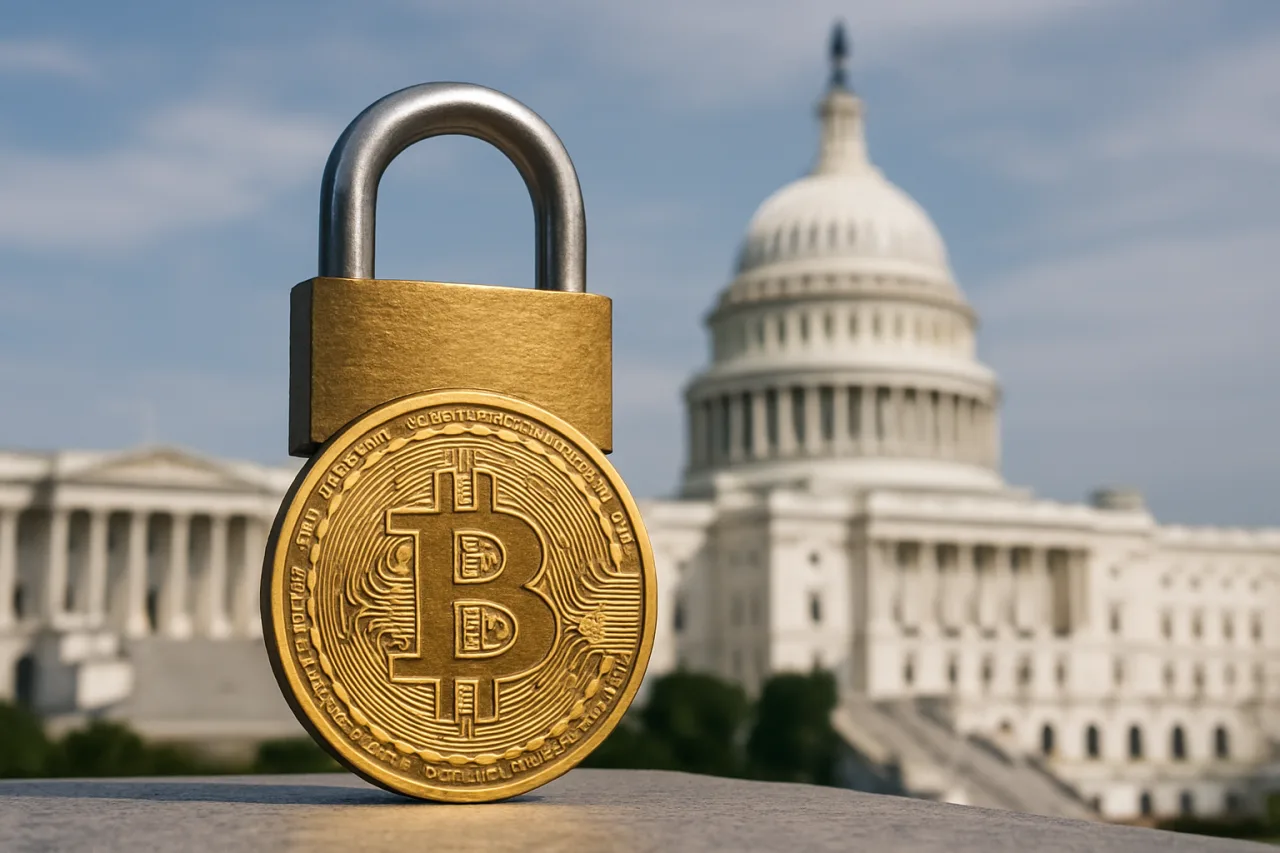
- 🔒 The famous number is the 20-year lock: once deposited, federal Bitcoin could not be “sold, swapped, auctioned, encumbered, or otherwise disposed of for any purpose” for two decades.
- 🧾 The fine print cools the hype: the bill authorizes NO new Bitcoin purchases — only custody of coins the government already holds, plus a 180-day study on whether buying more could happen “without cost to taxpayers.”
- 📉 BTC sits at $84,047 (Sep 26), up 7.1% for September — priced above the start of the month, with the sovereign-demand story already partly in the market.
- 🇵🇭 For Filipino wallets: crypto exposure stays a small satellite allocation — ₱5,000-₱10,000 tranches, only through BSP-licensed platforms, sized so a 50% drawdown hurts your pride, not your family.
Washington moved this week in a way that Bitcoin headlines will misread for months, and Filipino crypto holders deserve better than the misreading. The House Financial Services Committee voted 28-21 to advance H.R. 8957 — the American Reserve Modernization Act — the bill that would write President Trump’s Strategic Bitcoin Reserve into law, as Decrypt’s committee report detailed. Every vote in favor came from Republicans, every vote against from Democrats, and the market’s takeaway in most feeds was one word: squeeze. But the investor’s job is to read the bill, not the vibe. This piece does exactly that — clause by clause, then straight into what it changes, and doesn’t change, for an OFW deciding whether a slice of remittance money belongs in Bitcoin at $84,000.
Related: Standard Chartered Opens Bitcoin Trading in UAE: 3 Market Shifts
What the Strategic Bitcoin Reserve Bill Authorizes — and What It Doesn’t
Start with what passed. The committee reported H.R. 8957 favorably on September 16 after adopting a substitute amendment from Rep. Bryan Steil — and the substitute is the story. The bill gives the Treasury 180 days to stand up a Strategic Bitcoin Reserve alongside a separate Digital Asset Stockpile, and requires every federal agency to account for its crypto holdings within 60 days. Once deposited, the Bitcoin could not be sold, swapped, auctioned, or otherwise disposed of for 20 years. “Qualifying Bitcoin” widened from forfeiture-seized coins to all Bitcoin the federal government owns. Committee chairman French Hill framed it as bringing digital assets held across agencies “under Treasury custody and consistent oversight.”
Now the part the hype feeds skip. The bill authorizes no Bitcoin purchases. The original text floated buying coins with Federal Reserve surplus remittances, revaluing gold certificates, tariff revenue, and gifts — every one of those funding mechanisms was cut from the version that advanced, leaving only asset swaps, forfeitures, and cooperative programs with states. A 180-day Treasury-Commerce study will examine whether buying more “could be done without cost to taxpayers,” with an explicit prohibition on borrowing or pledging assets as collateral. Proof-of-reserve reporting dropped from quarterly to annual, and the requirement to post reserves on Treasury’s website disappeared. Read that like an investor: this is a custody and lock-up law, not a buying program. The government would promise to hold what it already seized or received — an estimated 200,000 BTC range from enforcement history — and the “sovereign demand” it creates is the demand of a vault door closing, not a new buyer entering the market.
Why the Fine Print Changes the Price Math
The supply-squeeze story that pumps Bitcoin on this headline runs: government locks coins → free-float supply shrinks → price rises. The investor checks the numbers before the narrative. The US federal government’s estimated holdings sit around 1% of Bitcoin’s 21-million cap — real, but not the annual demand engine that exchange-traded products have been. More important is what’s already priced: Bitcoin is up 7.1% this September (from $78,550 to the $84,000 area) — the reclaim we tracked in the $81,000 levels piece — and that move started before the committee vote. Markets front-run anticipated legislation; the 28-21 vote was the anticipated step, not a surprise. The genuinely informative parts for price are the parts nobody headlines: the 20-year lock applies only to coins already in federal hands, the bill authorizes no purchases, and the Senate path for a similar bill remains uncertain in a divided chamber.
The cycle read sharpens it further. Bitcoin at $84,000 is roughly flat-to-up against the year’s range, and September’s grind higher came on steady accumulation rather than a blow-off. The behavioral trap this headline creates is familiar from every policy pump: the fear of missing “the US buying Bitcoin” — when the bill, as written, prevents exactly that. If and when the House passes the full bill and it actually becomes law, the market event is clarity, not purchases. Clarity changes who can hold federal coins; it does not send a government check to exchanges.
That sentence is the entire allocation story.
Size allocations to the actual law, not the imagined one.
The Philippine Layer: Your Rails Are Licensed — Use Them
While Washington argues over custody, Manila has its own quiet regime running. As of July 15, 2026, the Bangko Sentral ng Pilipinas licenses nine Virtual Asset Service Providers authorized for crypto-to-peso transactions — the list includes the familiar retail rails (Coins.ph, PDAX, GCrypto among them), and trading through a licensed VASP is the difference between an audited on-ramp and a doorway with no one accountable behind it. The regulatory ground is also shifting: BSP’s Circular 1108 and the SEC’s CASP rules (Memorandum Circulars 04 and 05 of 2025) now form a dual-framework regime, and the SEC has its sharpest DeFi licensing push in draft — plus a draft BSP circular that would freeze new Operator-of-Payment-System licenses for 12 months while crypto firms get grouped with casinos for scrutiny. Translation for the wallet: the licensed channels are stable, the unlicensed ones are getting squeezed, and “my friend’s app” is not a rail.
For the OFW use case specifically, crypto’s honest value proposition remains what it always was: a remittance and savings rail with a price risk attached. The USD-to-BTC-to-PHP route through a licensed VASP can undercut bank corridors on some corridors and amounts — our remittance fees comparison shows where the fee layer lands — but holding Bitcoin as savings is a different act from sending it. The former is an investment decision; the latter is a transfer with two price-touchpoints. Confuse the two and you’ll size both wrong.
The Allocation Math: What This Week Should Change for You
Nothing in the bill changes the discipline. Crypto remains the highest-volatility asset a household can hold — drawdowns of 50% happen regularly, and the 20-year US lock doesn’t protect your coins from your next panic decision. The sizing framework stays:
- The 5% ceiling: crypto belongs in the satellite slice — at most 5% of investable assets for a household still building its income floor. Our OFW income floor plan comes first; crypto comes after the emergency fund, never instead of it.
- The tranche rule: any ₱10,000 crypto budget splits into three orders (now, in two weeks, in a month) — the same discipline the PSE wave is learning, because $84,000 can be a bargain or a local top and nobody gets to know in advance.
- The written thesis: before any order, write the reason and the exit. “The US is locking 200,000 coins” is a narrative; “I’m allocating ₱10,000 across three tranches because sovereign-supply dynamics plus halving scarcity support a 3-year hold, and I’ll reassess if the bill dies in the Senate” is a thesis.
- The licensed-rail rule: peso in and out through a BSP-licensed VASP, never through peer-to-peer strangers for anything beyond trivial amounts.
One more honest note: the bill still has a floor vote and a Senate to survive, and its predecessor’s fate shows nothing is sure. If it dies, the 20-year lock becomes a campaign promise again — and the price impact of that news would likely be larger than the committee vote was. Position-sizing exists precisely because the investor cannot legislate the future either.
The Stockpile Next Door: Why the “Digital Asset Stockpile” Line Matters
One clause in H.R. 8957 deserves its own paragraph, because it points at where the law is really aimed. The bill creates not just a Bitcoin reserve but a separate Digital Asset Stockpile — a Treasury home for every other crypto asset federal agencies currently hold, from ether seized in enforcement actions to tokens forfeited in fraud cases. The investor reads that as Washington formalizing a two-tier doctrine: Bitcoin gets the reserve treatment (single-asset custody, 20-year lock, strategic framing), while the rest of crypto gets a managed warehouse with looser rules — the forked and airdropped assets attached to those coins, for instance, would be held one year rather than five under the advanced text.
Why does that matter to a Filipino holder? Because it previews the taxonomy regulators worldwide are converging on: Bitcoin as the quasi-reserve asset that governments are comfortable warehousing, and everything else as risk assets subject to progressively tighter licensing — the same direction the SEC’s DeFi licensing push and BSP’s grouping of crypto firms with casinos are already moving. The world is not banning crypto; it is building filing cabinets for it, with Bitcoin in the heavy-gauge drawer. For allocation purposes, that argues for Bitcoin-heavy crypto exposure when a household’s satellite slice is small — the asset with the deepest custody story is the one sovereign frameworks are being written to accommodate first.
Your Watch List This Week
- The full House schedule: whether leadership brings H.R. 8957 to the floor — the committee vote is progress, not passage.
- The Senate counterpart: no companion bill has cleared committee this cycle; watch for one.
- Treasury’s 60-day agency audit (if the bill advances): the first official census of federal Bitcoin — the number that would define the locked-supply story.
- BTC’s $80,000 and $88,000 levels: the round numbers where September’s accumulation would either confirm or crack — and where tranche 2 or 3 of a disciplined plan gets its discount.
Frequently Asked Questions
Did the US government vote to buy Bitcoin?
No. The committee passed a bill to formally lock and manage Bitcoin the federal government already holds. Purchases are explicitly not authorized — the bill orders a study on whether buying more could happen without taxpayer cost. The “US buying Bitcoin” framing is ahead of the text.
What does the 20-year lock mean?
Once Bitcoin is deposited into the Strategic Bitcoin Reserve, the bill prohibits selling, swapping, auctioning, or encumbering it for 20 years. That’s the supply-squeeze element — but it applies only to government-held coins (roughly the 200,000 BTC range from forfeitures and seizures), not to anyone else’s.
Is Bitcoin at $84,000 a good entry after this vote?
Price is never the decision; allocation is. Bitcoin is up 7.1% this September, and policy clarity was part of that move. An investor sizes the position first (≤5% of investable assets), buys in tranches through a licensed rail, and holds a written thesis with a 3-year horizon — whether the entry is $80,000 or $88,000.
How can Filipinos legally buy Bitcoin?
Through any of the nine BSP-licensed Virtual Asset Service Providers — the July 2026 list includes Coins.ph, PDAX, and GCrypto. Licensed VASPs are supervised for consumer protection, custody, and AML; unlicensed peer-to-peer channels carry counterparty and legal risk that licensed rails don’t.
What happens if the bill fails in the Senate?
The reserve would remain an executive arrangement rather than law — holdings still exist, but the statutory 20-year lock and reporting framework wouldn’t be enacted. Markets would likely reprice the locked-supply narrative quickly, which is why the thesis needs an exit rule written before entry.
Should OFW money go into Bitcoin because of this news?
Only as the small, last-priority satellite it has always been — after the emergency fund, after MP2-style compounding, after the income floor. The bill is a reason to understand Bitcoin’s supply story, not a reason to exceed the 5% ceiling. Our GCash-first investing guides start with rails that don’t swing 30% in a quarter.
Financial Disclaimer: This article is for general information and education, not personalized investment advice. Crypto assets are volatile and may lose value. Do your own research or consult a licensed financial advisor before making investment decisions. WorldNgayon.com is not a broker, dealer, or investment adviser.